


The Talent Balance
La balance des talents fonctionne comme la balance commerciale d'un pays, sauf qu'à la place de biens, c'est le gain ou la perte de collaborateurs nécessaires à l'activité d'une entreprise qui est comptabilisée.
La balance des talents est donc la différence entre le nombre de collaborateurs provenant d'une entreprise concurrente et le nombre de talents qui ont démissionné pour rejoindre ce même concurrent. Les entreprises avec lesquelles il y a des échanges réguliers de collaborateurs sont appelées "Concurrents talents".
La balance des talents est un concept qui permet de mesurer l’équilibre entre l’attraction et la rétention de talents au sein d’une entreprise. Elle est analogue à la balance commerciale d’un pays, où l’on mesure la différence entre les exportations et les importations. Dans le cas de la balance des talents, il s’agit de la différence entre le nombre de talents qui rejoignent une entreprise en provenance d’une entreprise concurrente et le nombre de talents qui quittent cette entreprise pour rejoindre un concurrent. C’est la raison pour laquelle vous pouvez avoir une balance négative ou positive face à un concurrent talent.
La balance des talents est un outil de mesure précieux pour les responsables des ressources humaines, les dirigeants d’entreprise et les gestionnaires. Elle permet d’analyser et de suivre les flux de talents au sein d’une organisation et entre différentes entreprises.
Une balance des talents positive est le résultat d’une stratégie d’attraction et de rétention des talents bien pensée et mise en œuvre. Cela nécessite un investissement continu dans la culture de l’entreprise, l’environnement de travail, le développement des collaborateurs et la reconnaissance…Pour commencer !
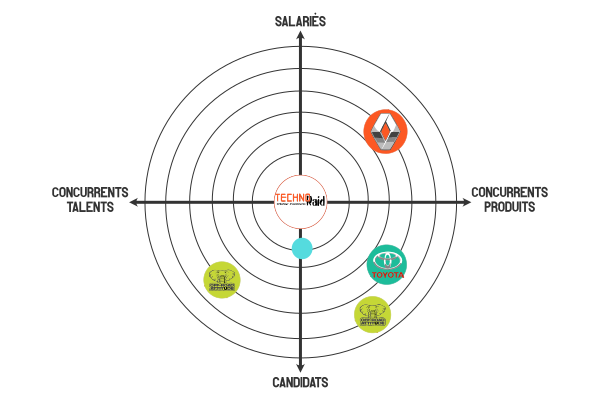
Talent competitors or business competitors?
In today’s economy, people have become one of an organisation’s most valuable assets. This gives the concept of the Talent Balance a whole new meaning. Traditionally, organisations competed for market share, revenue or product innovation. But what happens when two organisations that do not compete for customers find themselves competing fiercely for exactly the same highly skilled people?
In a skills-driven economy, can organisations really be considered non-competitors if they are fighting over the same talent pool? The Talent Balance explores this emerging reality, where competition is increasingly defined by the ability to attract, develop and retain exceptional people rather than simply outperform rivals in the marketplace.
A positive Talent Balance means attracting more talented people than you lose. Achieving this requires a deliberate strategy built around the following principles.
Track where your former employees go
Understanding where former employees build the next stage of their careers provides valuable insight into your organisation’s strengths and weaknesses. Analysing the career paths of your former employees can reveal important patterns. If many leave for the same organisation, it may indicate that employer offers something your organisation does not. These insights allow you to refine your employee value proposition and become a more attractive employer.
Build a compelling employer value proposition
A strong employer brand is essential for attracting and retaining top candidates. Salary and benefits matter, but they are only part of the picture. The most attractive organisations create cultures that align with people’s values, ambitions and expectations. A clear and authentic message about your purpose, mission and what makes your organisation unique can significantly influence how potential employees perceive you.
Understand your talent competitors’ advantages
To compete effectively for talent, you need to understand what other employers offer. This includes pay, benefits, workplace culture, career development opportunities, leadership quality and flexibility. Once you understand your competitors’ strengths, you can develop a strategy to match or outperform them in the areas that matter most to talented people.
Build relationships with your talent competitors
Developing constructive relationships with organisations that regularly exchange talent with yours can provide valuable insight into workforce expectations while creating opportunities for collaboration, shared learning and mutual benefit.
Using the Talent Balance
Measure your reputation as an employer
A positive Talent Balance indicates that your organisation attracts more talented people than it loses. This is often a strong indicator of an attractive employer brand and a positive reputation in the labour market.
Identify your talent competitors
By monitoring talent movements between organisations, you can identify the employers that consistently compete with you for the same people. These are your true talent competitors, regardless of whether they operate in the same industry.
Understand why people join and leave
Analysing the reasons employees join or leave your organisation provides valuable insights into the factors that influence attraction and retention. These findings help refine your recruitment, development and retention strategies.
Evaluate the effectiveness of HR initiatives
The Talent Balance provides a practical way to assess the effectiveness of HR initiatives such as learning and development, reward strategies, leadership programmes and employee retention efforts.
Discover opportunities for collaboration
Once you identify your talent competitors, you may also discover opportunities for mutually beneficial partnerships, including joint learning programmes, talent exchanges and broader strategic partnerships.