


HR Hacking Funnel
HR Hacking is an innovative approach to human resources that borrows ideas from agile methods, behavioural science and the hacker mindset to rethink how organisations attract, develop and engage people. In this context, hacking has nothing to do with cybersecurity. It is about challenging assumptions, finding smarter ways of working and solving complex people problems through experimentation, creativity and continuous improvement.
Rather than simply digitising traditional HR practices, HR Hacking redesigns them from the employee's perspective. It combines technology, data, behavioural economics, design thinking and rapid experimentation to create HR processes that are simpler, faster and more effective. The goal is not innovation for its own sake, but to build employee experiences that improve engagement, capability and organisational performance.
When I created the role of HR Hacker within my employee engagement consultancy in Australia, and began presenting the concept from 2013 during a series of conferences in the UK on the future of Human Resources, I never imagined it would grow into an international movement with conferences and communities across the United Kingdom and the United States.
The idea started with a simple question. If the Chief People Officer carried commercial responsibility, how would they make a direct and measurable contribution to business performance? How could HR move beyond being described as a business partner and become a genuine contributor to organisational results?
Over time, HR Hacking evolved into what is now widely recognised across English-speaking countries as HR Design. The philosophy is simple: employee-centred, customer-focused. Great HR does not choose between people and business performance. It improves both by designing better employee experiences that ultimately create better customer experiences.
To achieve this without losing HR’s core purpose of developing people and sustaining employee engagement, I built HR Hacking around principles borrowed from Lean Startup and Growth Hacking. These disciplines emphasise experimentation, rapid learning, evidence-based decision making and continuous improvement. Applied to HR, they create practical, measurable methods that focus equally on employees, customers and organisational outcomes.
You can find early examples of HR Hacking being applied in French organisations in this article and this case study, which illustrate how these principles were translated into measurable business results.
The HR Hacking Toolkit
HR Hacking remains a largely untapped discipline. It brings together four complementary capabilities that work best when used together.
Neuroscience and Behavioural Economics to accelerate change, learning and creativity
Neuroscience is transforming the way organisations understand people, and HR has a unique opportunity to lead this shift before it becomes dominated by marketing or sales. Beyond designing more effective learning experiences, behavioural economics gives HR professionals the ability to advise commercial teams on how people really make decisions. It also helps measure the true return on HR initiatives, from learning programmes and capability development to recruitment questions and their long-term impact on employee engagement.
Data and Analytics to transform HR from Business Partner to Value Creator
HR Hackers look for shortcuts that simplify processes without sacrificing outcomes. You cannot create intelligent shortcuts unless you fully understand the journey and know exactly where you want to go. That means mastering HR metrics, understanding the impact of every initiative and measuring its return. For example, I discovered that candidates who were asked what they hoped to do after leaving the organisation were significantly more engaged once they joined. The data challenged a long-held recruitment assumption and changed the interview process.
Trends and Innovation to create new opportunities
HR Hackers do more than solve today’s problems. They continuously scan the horizon for emerging trends and new ideas. One of their key responsibilities is to preserve an experimental mindset within HR. New technologies, management practices and social trends are identified, tested and refined before being shared across the organisation. This makes HR a driver of curiosity, adaptability and innovation rather than simply a support function.
Gamification to redesign HR experiences
The final ingredient of HR Hacking is making HR processes faster, simpler, more engaging and more valuable. This requires understanding game mechanics, behavioural design and motivational psychology to redesign recruitment, performance reviews, learning experiences and employee journeys that people genuinely want to participate in.
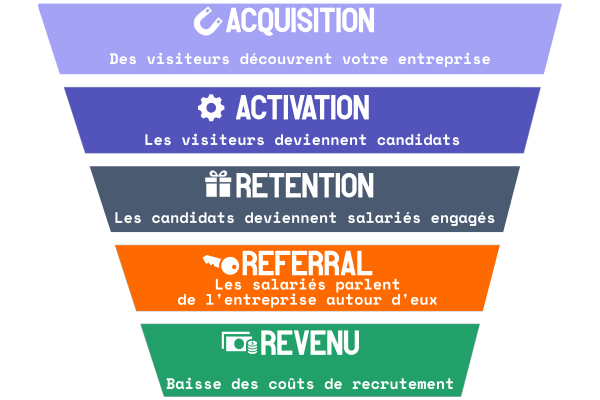
The HR Hacking Funnel
The AARRR framework has been adapted to HR to help organisations optimise every stage of the employee journey. From attracting talent to creating highly engaged employees, the model identifies the five stages that drive HR performance while highlighting the barriers that prevent progress. Its purpose is to help HR teams measure how employees respond to initiatives, programmes and workplace experiences throughout the employee journey.
Acquisition
The first objective is attracting new talent and building a strong candidate pipeline. Before candidates can apply, they need to discover your organisation. Employer branding, content, referrals, search visibility and social media all play a role. The goal is not simply to attract active job seekers but also talented people who were not looking for a new opportunity until they discovered yours.
Activation
Activation focuses on turning potential candidates into applicants and applicants into future employees. It is about creating enough interest, trust and alignment for people to choose your organisation. This stage measures how well your opportunities, culture and values match the aspirations of the people you want to attract.
Retention
Recruitment only creates value if people choose to stay. Once new employees have joined and settled into their teams, the focus shifts to keeping them engaged over time. Retention depends on meaningful work, effective leadership, growth opportunities and a positive employee experience.
Referral
The next stage transforms engaged employees into ambassadors for the organisation. Employee referrals have always been one of the most effective recruitment channels. Today, social media amplifies that influence, allowing every employee to shape your employer reputation through their experiences and recommendations.
Revenue
In HR, Revenue is not about generating sales. It represents the long-term value employees create for the organisation through their contribution, performance and engagement. The objective is to help every employee become fully productive while identifying and removing the obstacles that limit their success.
There is no universal formula because every organisation is different. However, adapting the AARRR model to HR provides a practical framework for improving talent management. Each stage of the Employee Lifecycle builds on the previous one, giving organisations a complete view of the employee experience and revealing opportunities to strengthen engagement and long-term performance.
How I use HR Hacking
Agile Recruitment
I apply agile principles to recruitment so organisations can respond more quickly to changing business needs while delivering a better candidate experience. Innovative sourcing techniques, specialist platforms and professional networks help clients reach talented people who would never respond to traditional recruitment campaigns.
Automation also plays an important role. AI tools and digital workflows can handle repetitive tasks such as CV screening and interview scheduling, allowing recruiters to spend more time assessing behavioural capabilities, cultural fit and long-term potential.
Continuous Feedback
Annual performance reviews are no longer enough. Continuous feedback creates regular conversations between managers and employees, allowing organisations to improve performance, resolve issues earlier and adapt more quickly. Digital platforms, pulse surveys and feedback tools make these conversations easier to sustain.
When feedback becomes part of everyday work, employee engagement increases. It also helps identify capability gaps, friction points and development needs before they become larger problems.
Agile Learning and Development
Continuous learning is essential for organisations that want to remain competitive. Agile learning gives employees access to online courses, virtual workshops and self-paced learning that adapts to changing business needs. These digital learning formats provide flexibility while allowing programmes to evolve based on participant feedback.
Collaborative learning platforms also encourage employees to share expertise, strengthen internal capability and support digital or cultural transformation across the organisation.
Employee Engagement and Wellbeing
HR Hacking uses regular pulse surveys, employee listening platforms and wellbeing initiatives to understand how employees feel in real time. This allows organisations to respond quickly, strengthen engagement and improve the overall employee experience.
Wellbeing programmes, recovery spaces, health initiatives and practical support all contribute to stronger engagement and a greater sense of belonging. Organisations that genuinely invest in employee wellbeing also strengthen their employer brand and improve talent retention.
Optimising HR Processes
Optimising HR processes sits at the heart of HR Hacking. Digital tools automate repetitive administrative work, simplify payroll and provide real-time HR analytics, allowing HR teams to spend more time creating value rather than managing paperwork.
Process optimisation also means questioning existing ways of working. Using agile thinking and employee feedback, HR teams redesign recruitment, learning and talent management around the employee experience instead of organisational bureaucracy.
Employer Branding and Communication
In today’s competition for talent, a strong employer brand is essential. HR Hacking helps organisations create authentic communication through employee stories, video, thought leadership and social media to attract people who share their values.
However, employer branding is built from the inside out. Organisations strengthen their reputation by creating outstanding employee experiences, celebrating success and encouraging open communication. HR Hacking provides the mindset, tools and metrics to design these experiences and measure their impact over time.