

Braintrust
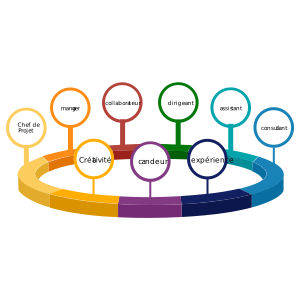
A Braintrust is a trusted group of talented people who come together to collaborate on creative projects. The concept was developed at Pixar to improve problem solving and unlock creativity. A Braintrust typically brings together directors, writers and other creative professionals with relevant experience and expertise.
The Braintrust is one of the Pixar tools and methods I introduce to organisations that want to build and sustain a culture of innovation, strengthen collaboration across teams and reduce internal competition.
As you’ll discover in my dedicated article on the Braintrust, I explain not only how to facilitate a Braintrust session, but also the practical steps required to implement it successfully.
How to organise a Braintrust
A Braintrust, whose origins date back to the nineteenth century and which was popularised more recently by Pixar, is built around five core principles.
1 – The group is heterarchical: A Braintrust is a peer-to-peer approach to problem solving and collaboration rather than a traditional hierarchical structure. In this method, participants act as trusted advisers. Final decisions always remain with the project leaders.
2 – Ideas belong to everyone: Participants contribute their perspectives without hidden agendas or personal motives. Their objective is not to promote themselves, push their own ideas or win someone’s approval. Their focus is on moving the project forward.
3 – Group members come from « the trenches »: Braintrust members have themselves led projects. They therefore understand first-hand the challenges faced by project leaders and bring two essential qualities to the discussion: practical experience and candour.
4 – Ideas are separate from the people who propose them: Project leaders must understand that their ideas are not an extension of themselves. A Braintrust does not judge people. It evaluates the projects and ideas presented.
5 – Candour and empathy come first: Empathy and candour are two fundamental values. Empathy enables participants to understand the perspective of project leaders and put themselves in their shoes. Candour requires honest and direct communication. Ideas are also shared freely, without expecting reciprocity or a quid pro quo.
This is where it becomes clear that the Braintrust sits at the intersection of creativity and organisational culture. An organisation built around rigid hierarchy and directive management will struggle to implement a Braintrust in a meaningful way. Popularised by Pixar (much like open-plan offices), this practice strengthens people’s ability to listen, accept feedback on projects and avoid taking criticism personally.
Using a Braintrust
If your organisation’s values align with what the Braintrust represents, adopting it can fundamentally change the way you approach innovation and creativity.
If your organisational culture values hierarchy over the best ideas, or believes that experience alone should determine who gets heard, then the Braintrust is probably not for you. A Braintrust gives everyone a voice and ensures that ideas are evaluated independently of the people who propose them. I use the Braintrust in the following contexts:
Solving complex problems
A Braintrust can be used to tackle complex business and project challenges. By bringing together experts from different disciplines, the group explores multiple perspectives and identifies innovative solutions that might otherwise be overlooked.
Developing products and services
A Braintrust can be applied to the design and development of new products or services. Participants contribute ideas, constructive criticism and practical suggestions to improve the offering, enhance the customer experience and increase customer value.
Refining business strategy
A Braintrust helps leadership teams refine and strengthen their business strategy. By involving specialists from a range of disciplines and drawing on their broader perspective, organisations can identify opportunities, risks and emerging trends that may be missed through a narrower viewpoint.
Building a culture of innovation
A Braintrust can help build a culture of innovation and continuous improvement. By valuing contribution, encouraging the open exchange of ideas and promoting cross-disciplinary collaboration, my clients who use Braintrusts strengthen innovation, increase engagement and accelerate sustainable growth.