


Criticity Index
The Criticity Index measures the importance and value an employee brings to an organisation because of the unique or hard-to-replace skills, knowledge, experience and relationships they possess. Employees with a high Criticity Index perform roles that are strategically important and difficult to replace. Their departure would have a significant impact on the organisation's performance, continuity and ability to achieve its objectives.
In my book Identify and Retain Your Top Talent, I explore the concept of employees, roles and capabilities that are considered critical to an organisation’s success. The term originates from NASA, where it was used to determine which systems required redundancy to ensure mission success. I adapted this concept to talent management to identify the people and capabilities an organisation simply cannot afford to lose.
Highly critical employees stand out because of their exceptional expertise, scarce capabilities or unique contribution to the organisation. They may possess specialised knowledge, years of experience, hard-earned professional relationships or technical skills that few, if any, of their colleagues can match. Their expertise is often rare within the organisation, making them strategically indispensable.
If one of these employees leaves, the consequences extend far beyond filling a vacancy. Their departure can disrupt operations, delay projects, weaken customer relationships and reduce organisational performance because replacing them is both difficult and time-consuming. Identifying these employees, developing successors and retaining their knowledge therefore become strategic priorities for any organisation that wants to remain resilient and competitive.
Criticity becomes even more important in the creator economy, where the success of an entire business can depend on a single individual. MrBeast is an obvious example. His personal brand, creativity and audience relationships are so central to the business that replacing him is virtually impossible.
In short, highly critical employees are those whose replacement would be exceptionally difficult and whose departure would have a significant impact on an organisation’s operations, performance and long-term success.
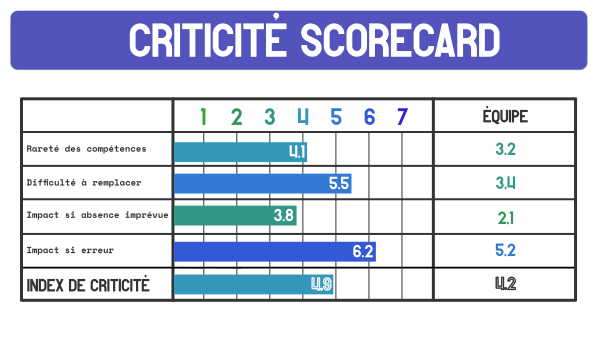
Measuring the Criticity Index of a Role, Employee or Capability
The Criticity Index of a role, an employee or a capability is a major strategic consideration in talent management.
Inspired by methodologies originally developed by NASA, this approach helps organisations identify the roles, people and capabilities that are essential to their performance and long-term success. It has become increasingly important as people have become the primary source of competitive advantage and operational performance.
Assessing criticity involves analysing several factors, including the role’s impact on critical business processes, its contribution to organisational value and the risks associated with losing that capability. An employee with a high Criticity Index typically possesses unique expertise, experience or responsibilities that are difficult to replace. Their presence and commitment directly influence the organisation’s ability to achieve its strategic and operational objectives.
When assessing the Criticity Index of a role or an employee, I generally look for the following characteristics.
Possesses unique skills, experience, expertise, qualifications and knowledge
Employees with a high Criticity Index often possess specialist skills, expertise, qualifications or knowledge that no one else in the organisation holds. These unique capabilities make them indispensable because they alone can perform certain tasks or provide knowledge that is critical to business success. They are frequently recognised as subject-matter experts whose contribution extends well beyond their formal role. This is why maintaining a healthy Talent Balance is so important.
These employees have often developed their expertise over many years. They possess deep knowledge of the organisation, its processes, customers and internal networks, making them extremely difficult to replace. They are regularly called upon to solve complex problems and support high-impact decisions.
Would be difficult to replace because of the scarcity of their profile in the labour market
Employees with high criticity are often extremely difficult to replace because their combination of skills, experience and knowledge is rare. Recruiting someone with equivalent capability usually requires considerable time, investment and onboarding before they reach the same level of performance.
The departure of a highly critical employee can also affect morale across the organisation. Colleagues frequently need to absorb additional responsibilities, increasing workloads and creating a greater risk of reduced productivity and lower quality of work.
Their absence would significantly disrupt business operations because of their specialist expertise and knowledge
The absence of an employee with a high Criticity Index can significantly affect organisational performance because they possess expertise that cannot easily be substituted. Certain activities may slow down or stop altogether, while colleagues are forced to assume unfamiliar responsibilities.
The consequences extend beyond productivity. Quality may decline, mistakes become more frequent and customer satisfaction may suffer because specialist knowledge is temporarily unavailable.
Occupies a role where mistakes would have significant operational or reputational consequences
Employees with a high Criticity Index often occupy positions where mistakes can have serious operational, financial, regulatory or reputational consequences. Their decisions influence business continuity, customer confidence and organisational performance.
Because these roles carry significant responsibility, errors may also affect team confidence, increase pressure on colleagues and reduce overall organisational effectiveness.
Occupies a role with a long time-to-productivity and a high cost of early turnover
Employees with a high Criticity Index often work in positions where it takes many months, or even years, before they reach full productivity. Organisations invest heavily in recruitment, onboarding, training and capability development before these employees generate their full value.
If they leave before that investment has been recovered, the organisation suffers a significant financial loss while simultaneously facing reduced operational capability.
Ultimately, employees with a high Criticity Index are fundamental to organisational resilience. Their expertise, experience and knowledge make them difficult to replace, making it essential to identify, develop and retain them as part of a long-term talent strategy.
How I use the Criticity Index
Identifying critical talent
The Criticity Index helps organisations identify employees whose expertise, knowledge and experience are essential to business performance. It reveals where organisational value is concentrated and where succession planning should begin.
Succession planning and strategic workforce planning
Once high-criticity roles have been identified, organisations can prepare successors, develop internal capability and reduce dependence on individual employees. This strengthens organisational resilience over the long term.
Managing organisational risk
The Criticity Index enables leaders to identify people-related risks and implement practical mitigation strategies, including knowledge transfer, cross-training, succession planning and business continuity measures.
Retaining critical employees
HR teams and managers can use the Criticity Index to prioritise retention efforts where they will have the greatest organisational impact. This may include career development opportunities, tailored reward strategies, recognition programmes and meaningful growth pathways.
Developing organisational capability
By identifying high-criticity roles, organisations can invest in mentoring, capability development and knowledge-sharing initiatives that reduce dependence on individual experts while building greater organisational resilience for the future.