

Human-Centred Design
Human-Centred Design (HCD) is a design approach that places people at the heart of the creative process. Rather than focusing primarily on business objectives or technical constraints, it seeks to develop solutions that address the genuine needs, expectations and aspirations of the people who will ultimately use them.
Widely applied in the design of products, services and experiences, Human-Centred Design is recognised as one of the most effective approaches for creating solutions that are both innovative and meaningful. It also laid the foundations for what later became known as Design Thinking.
**Human-Centred Design (HCD)** differs from User-Centred Design by taking a broader, more holistic approach to problem-solving. While User-Centred Design focuses primarily on the needs, behaviours and expectations of the end user, Human-Centred Design looks beyond the individual user to consider the entire ecosystem in which a product, service or experience will exist.
It takes into account social, cultural, environmental and organisational contexts, ensuring that solutions create value not only for users but also for the wider communities and systems they affect.
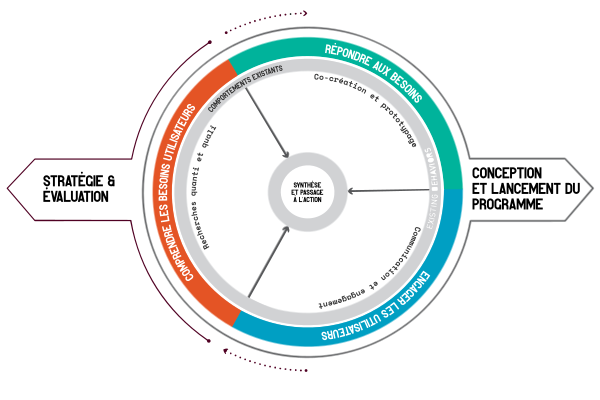
Human-Centred Design is not a linear process
Unlike a linear process, Human-Centred Design (HCD) is iterative and built around seven core mindsets.
These mindsets guide designers through the different stages of the design process, encouraging empathy, collaboration, experimentation and critical thinking. Each stage is revisited and refined based on feedback and learning, allowing for continuous adaptation and improvement. Ultimately, HCD provides a more comprehensive and responsible approach to solving design challenges by placing people and their environment at the centre of every decision.
Empathy
Empathy is the ability to understand and share the experiences and perspectives of others. In Human-Centred Design, empathy means immersing yourself in people’s lives to understand their needs, aspirations and challenges. In this respect, it shares common ground with Design Thinking. However, it differs from HR Design, which assumes that when people actively participate in designing solutions, there is far less need for extensive empathy.
Optimism
Optimism is the belief that better solutions are always possible and that designers have the ability to create them. This positive mindset encourages perseverance, creativity and resilience when tackling complex challenges.
Context awareness
Human-Centred Design places strong emphasis on understanding the context in which people live and work. Designers must consider the social, cultural, economic and environmental factors that influence behaviour and decision-making.
Embracing ambiguity
Complex problems rarely have obvious solutions. Human-Centred Design encourages designers to accept the uncertainty and ambiguity that naturally accompany these challenges. This means remaining open to new ideas and resisting the temptation to settle too quickly on premature solutions.
Learning through experimentation
Human-Centred Design encourages designers to test ideas rapidly through prototypes and experimentation. This generates valuable feedback, supports continuous iteration and refines concepts according to real user needs. It also requires organisations to foster curiosity and creativity, as demonstrated in this case study.
Cross-disciplinary collaboration
Human-Centred Design relies on collaboration between people from diverse disciplines and backgrounds. By combining different perspectives and capabilities, design teams generate more innovative ideas and develop more holistic solutions.
Inclusive design
Human-Centred Design aims to create solutions that are accessible and beneficial for everyone, including marginalised and under-represented groups. Designers should actively include diverse voices and perspectives throughout the design process.
How Human-Centred Design is used
Product development
Human-Centred Design is widely used when developing new products, whether consumer electronics, furniture, clothing or other physical goods. By focusing on user needs, designers create products that are not only functional but also enjoyable to use and own.
Service design
Many services, including healthcare, transport, hospitality and financial services, benefit from a Human-Centred Design approach. By focusing on the user experience, service providers can improve quality, satisfaction and long-term customer loyalty.
User interface (UI) and user experience (UX) design
Human-Centred Design is fundamental to designing websites, mobile applications and digital products. By understanding user expectations and behaviours, designers create interfaces that are intuitive, accessible and effective.
Improving the workplace
Human-Centred Design can also improve workplaces, from offices to factories and other working environments. By considering employees’ needs and preferences, organisations can create workspaces that are more comfortable, productive and enjoyable.
Social innovation and humanitarian development
Human-Centred Design is increasingly used to address social and humanitarian challenges such as poverty, healthcare and access to education. By understanding the needs and realities of the people affected, organisations can design interventions that are more effective, sustainable and impactful.