


Hype cycle
The Hype Cycle (sometimes referred to as the hype curve) describes the typical lifecycle of an emerging technology, from its initial introduction through to either widespread adoption or eventual decline. It is widely used to track and evaluate emerging trends in technology, information systems and digital innovation, helping organisations distinguish between short-lived hype and lasting business value
The Hype Cycle, a conceptual framework developed by research and advisory firm Gartner, is a valuable tool for leaders and decision-makers seeking to assess the maturity of an emerging technology. It describes the five stages that most innovations typically pass through: the Innovation Trigger, the Peak of Inflated Expectations, the Trough of Disillusionment, the Slope of Enlightenment, and finally the Plateau of Productivity. Each stage provides insight into a technology’s level of maturity, market adoption and potential business impact.
By using the Hype Cycle, organisations can better understand both the risks and the opportunities associated with adopting emerging technologies. It helps leaders make more informed decisions about when a technology is mature enough to justify investment—or when it may still be driven more by hype than by proven value. Beyond evaluating individual technologies, the Hype Cycle also serves as a practical framework for navigating the uncertainty that inevitably accompanies innovation, enabling organisations to distinguish lasting transformation from passing trends.
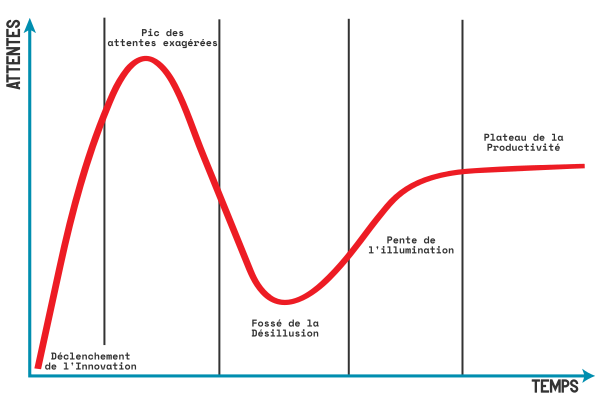
The five stages of the Hype Cycle
The Hype Cycle is a graphical model developed by Gartner to illustrate the maturity, adoption and business impact of emerging technologies. It explains the predictable pattern of inflated expectations, disappointment and eventual maturity that often accompanies new technologies and innovations.
The Hype Cycle consists of five distinct stages:
- Innovation Trigger: A new technology emerges and attracts significant media attention and high expectations. Early adopters begin experimenting with it, but it is not yet mature enough for widespread adoption.
- Peak of Inflated Expectations: Expectations reach their highest point, fuelled by intense publicity and media coverage. Early success stories receive disproportionate attention, often creating unrealistic assumptions about the technology’s capabilities and potential benefits.
- Trough of Disillusionment: Reality fails to match the initial excitement, and the technology does not immediately deliver on its promises. Early adopters become disappointed, pilot projects fail and the technology is frequently criticised or dismissed.
- Slope of Enlightenment: Organisations begin to understand both the strengths and limitations of the technology. Technical challenges are progressively addressed, successful use cases emerge, and practical applications become better understood.
- Plateau of Productivity: The technology reaches a level of maturity where it is widely adopted and delivers measurable business value. Expectations become aligned with reality, and the technology is integrated into mainstream business practices.
This pattern closely mirrors the 6Ds described by Ray Kurzweil and Peter Diamandis, particularly from the second D—Disappointment—onwards.
How I use the Hype Cycle
The Hype Cycle is a valuable framework for organisations, leaders and investors seeking to assess the maturity and long-term potential of emerging technologies. Here’s how I use it:
Understanding technology maturity
The Hype Cycle provides a visual representation of how enthusiasm for a technology evolves over time. By identifying where a technology currently sits on the curve, decision-makers can better assess its level of maturity.
For example, a technology at the Peak of Inflated Expectations may not yet have demonstrated commercial viability, whereas one reaching the Plateau of Productivity has typically overcome its major barriers and is ready for broader adoption. This helps investors distinguish speculative bubbles from genuine long-term opportunities and make better-informed investment decisions.
Managing stakeholder expectations
Organisations can use the Hype Cycle to communicate clearly with investors, customers and employees about both the current potential and the present limitations of an emerging technology.
Knowing where a technology sits within the cycle allows organisations to set realistic expectations and reduce the risk of disappointment or disillusionment. This helps maintain stakeholder confidence throughout the technology’s development and adoption.
Adapting commercialisation strategies
Understanding the Hype Cycle enables organisations to tailor their marketing and go-to-market strategies according to the maturity of the technology.
Technologies at the height of the hype often require an education-focused approach, while mature technologies benefit from messaging centred on proven value, business outcomes and practical benefits.
Evaluating and refining product development
Understanding the different phases of the Hype Cycle helps organisations anticipate the challenges associated with adopting new technologies, including the need to survive the Trough of Disillusionment before realising long-term benefits. It also provides a framework for evaluating emerging technologies and deciding whether they are ready to be incorporated into products or whether further development is required.
Guiding R&D investment
Because Gartner regularly updates the Hype Cycle, research and development teams can use it to identify emerging technologies that are likely to become strategically important, helping them prioritise research efforts towards the most promising areas.
Ultimately, the Hype Cycle provides organisations with a practical framework for navigating the fast-changing landscape of emerging technologies. It offers valuable guidance on timing, risk management and strategic decision-making, enabling organisations to maximise the benefits of innovation while avoiding costly mistakes and poorly timed investments.