


Employee lifecycle
The employee lifecycle (also known as the talent lifecycle) describes every stage an employee experiences throughout their relationship with an organisation, from the moment they are attracted and recruited through to their eventual departure.
This framework helps organisations understand and manage each phase of the employee journey, with the goal of creating greater value for employees while improving their overall experience. By taking a lifecycle approach, organisations can strengthen attraction, engagement, development, retention and advocacy, ultimately benefiting both their people and their long-term performance.
The employee lifecycle, sometimes referred to as the Talent Wheel, maps the journey people take within an organisation, from the moment they join to the day they
It is far more than a sequence of HR processes. It is a strategic framework for building engagement, unlocking potential and creating lasting value for both employees and the organisation.
At every critical moment: onboarding, development, recognition and career transitions, leaders make decisions that directly shape the employee experience and, ultimately, organisational performance.
Knowing how to activate the right levers at the right time transforms the employee lifecycle into a genuine competitive advantage: attracting the right people, helping them grow, and giving them compelling reasons to stay.
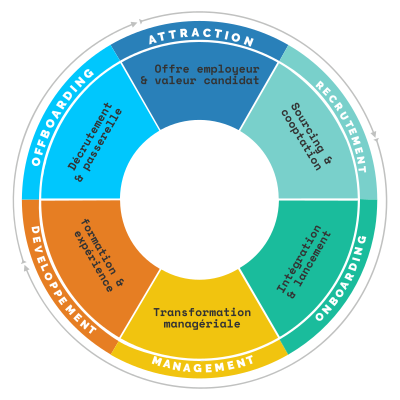
The stages of the employee lifecycle
Attraction
This stage focuses on attracting high-quality candidates by showcasing your organisational culture, values, employee benefits and career opportunities. This can be achieved through employer branding campaigns, careers events, employee referral programmes and authentic, compelling job advertisements. The objective is to build a positive employer reputation and encourage talented people to consider joining your organisation.
In other words, the same approach as everyone else. Or you can do it my way, using HR Design, which borrows the principles of business development and design thinking to create a compelling employee value proposition and not simply « another job in another company ».
Recruitment
Once candidates know your organisation and begin applying, recruitment is about selecting the people who best match both the role and your culture. Interviews, skills assessments, reference checks and other evaluation methods all play their part. But do you really understand your Talent Balance? Do you know why some of your most promising candidates decide not to join you?
Onboarding
After recruitment comes onboarding, where new employees are welcomed and introduced to the organisation. This includes orientation, training, meeting colleagues and learning how work gets done. A successful onboarding experience helps people feel comfortable, understand their role and become productive more quickly. But onboarding actually consists of two distinct phases. Do you know what they are?
The management experience
This stage focuses on the relationship between employees and their managers. A positive management experience is built on support, open communication, recognition and constructive feedback. It directly influences job satisfaction, motivation, performance and long-term engagement.
Professional development
Professional development enables employees to build new capabilities, progress in their careers and remain engaged over time. It may include training programmes, workshops, mentoring, coaching or internal mobility opportunities. Development benefits both the individual, who continues to grow, and the organisation, which strengthens its capability and adaptability.
Retention and engagement
Retention is about keeping talented people within the organisation. Competitive rewards, career opportunities, recognition and meaningful appreciation all contribute to retaining employees and maintaining organisational stability, continuity and performance.
Offboarding
Offboarding is the final stage of the employee lifecycle. It includes exit interviews, final employment documentation, returning company equipment and ensuring a professional departure. Effective offboarding provides valuable feedback on the employee experience while identifying opportunities for improvement. It also helps maintain positive relationships with former employees, who may later become employer brand ambassadors or even return as boomerang employees.
Alumni relationships
Maintaining relationships with former employees is increasingly valuable. Alumni can become ambassadors for your employer brand, recommend your organisation to prospective candidates or eventually return to work for you. You can nurture these relationships by inviting former employees to events, sharing company news or creating dedicated alumni networks. A strong alumni community becomes a valuable source of referrals, advocacy and future talent.
How I use the employee lifecycle in my work
I use this employee lifecycle framework throughout my work in management transformation, particularly in programmes focused on employee engagement through the employee experience and Regenerative Leadership. It also forms the foundation of the management academies I design and implement for organisations.
Building a compelling employer brand
By focusing on talent attraction, you can develop a distinctive employer brand that stands out in a competitive market. Through consulting and keynote presentations, I help organisations step back, learn from leading employers and design practical strategies that genuinely improve their attractiveness.
Optimising recruitment
By understanding candidate expectations and adapting your recruitment process accordingly, you attract stronger candidates and improve your offer acceptance rate. I run workshops inspired by commercial sales techniques to help organisations identify the factors influencing a candidate’s decision to join or reject an employer, and to design a stronger candidate value proposition.
Improving onboarding
Creating a positive and engaging onboarding experience increases the satisfaction, confidence and engagement of new employees. Having contributed to a book on onboarding and facilitated numerous workshops on the subject, I help organisations identify the key ingredients of successful onboarding and implement practical improvements.
Developing better managers
Providing managers with the skills to support employees at every stage of the employee lifecycle significantly improves engagement and retention. As I often remind audiences during my keynote presentations, this quadrant must come first. There is little value in attracting and recruiting outstanding people if poor management drives them away within a few weeks.
Improving retention and engagement
By understanding the factors that influence employee retention, organisations can develop strategies that reduce turnover and strengthen engagement. I help identify the drivers of both retention and disengagement before designing practical initiatives that improve the overall employee experience.
Offboarding and alumni engagement
Creating a positive departure experience and maintaining strong alumni relationships generates valuable referrals, future recruitment opportunities and a stronger employer reputation. Ask me how effective offboarding can strengthen your employer brand long after people have left your organisation.