

Design Thinking
Design Thinking is a problem-solving methodology that combines empathy, creativity and experimentation to generate innovative solutions. It is a human-centred approach that begins by understanding people's needs, aspirations and challenges before exploring possible solutions. Rather than starting with technology or business constraints, Design Thinking starts with people.
Today, it is used to solve complex challenges across a wide range of fields, including product and service design, business strategy, education, healthcare, public policy and social innovation.
This people-first philosophy is precisely why Design Thinking became one of the foundations of **HR Design**. By applying design principles to recruitment, leadership and the employee experience, HR professionals can move beyond managing processes to designing meaningful experiences that create value for both people and organisations.
Design Thinking is an exploratory problem-solving methodology popularised by the Hasso Plattner Institute of Design at Stanford University, often referred to as the d.school. Its origins can be traced back to Herbert A. Simon’s influential 1969 book, The Sciences of the Artificial, which first described design as a structured way of thinking about complex problems.
Design Thinking translates the mindset and working practices of professional designers into a practical framework that anyone can use. It codifies the design process into an iterative series of steps that help multidisciplinary teams explore challenges, generate ideas, build prototypes and learn through experimentation. Rather than assuming the problem is already well understood, it encourages teams to question assumptions and uncover the real challenge before searching for solutions.
The goal is not simply to produce bold or unconventional ideas. Instead, Design Thinking focuses on generating insights, testing possibilities and learning quickly until the most effective solution emerges. It has traditionally been used to design products, services and physical experiences, whether that means finding the most comfortable posture for a chair, creating a more ergonomic computer mouse or developing packaging that is both functional and intuitive. In each case, the design of the experience comes first, and the solution evolves through continuous testing and refinement.
Human-Centred Design or Design Thinking?
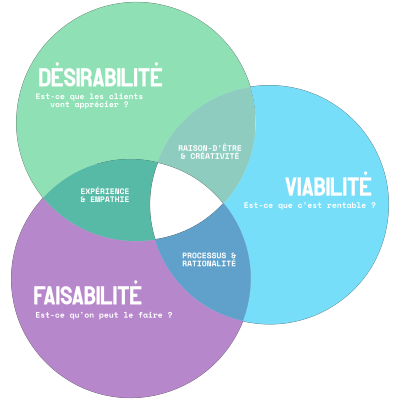
Human-Centred Design (HCD) and Design Thinking are two approaches that rely on empathy, collaboration and experimentation to solve complex problems. They share many of the same principles, but they differ in their scope, their process and the outcomes they are designed to achieve.
What they have in common
- People come first. Both approaches place people at the centre of the design process. They seek to understand users’ needs, aspirations and challenges so they can create solutions that deliver genuine value.
- Empathy drives the process. Designers spend time observing, listening to and engaging with people to understand their experiences, motivations and frustrations before proposing solutions.
- Rapid prototyping and iteration. Both approaches encourage teams to build ideas quickly, test them with real users and continuously improve them based on feedback. Learning happens through experimentation rather than assumptions.
- Cross-disciplinary collaboration. Human-Centred Design and Design Thinking bring together people with different backgrounds, expertise and perspectives. Diverse teams consistently generate more creative and more complete solutions.
How they differ
- Scope. Human-Centred Design focuses specifically on designing products, services and experiences that improve people’s lives. Design Thinking is a broader problem-solving methodology that can be applied to business strategy, education, public policy, organisational change and many other fields.
- Process. While both approaches follow similar stages of understanding, ideation, prototyping and testing, Human-Centred Design places greater emphasis on understanding context and involving users throughout the entire process. Design Thinking tends to focus more heavily on creative ideation and rapid experimentation.
- Purpose. Human-Centred Design seeks to create solutions that are accessible, inclusive and valuable for everyone, particularly people who are often overlooked or underserved. Design Thinking is primarily concerned with solving complex problems by generating innovative ideas and validating them quickly.
In practice, Human-Centred Design and Design Thinking complement each other exceptionally well. One ensures that people remain at the centre of the process, while the other provides a practical framework for turning ideas into tested solutions. Used together, they help organisations solve complex problems while creating experiences people genuinely value.
The five stages of Design Thinking
Although several versions exist, Design Thinking is most commonly described as a five-stage, iterative process.
Empathise
The first stage is developing a deep understanding of the needs, aspirations and challenges of the people you are designing for. This typically involves interviews, field observations and immersive research to build genuine empathy. This is where Design Thinking overlaps with Human-Centred Design, Emotional Design and HR Design.
Define the problem
Once you understand people’s experiences, the next step is to define the challenge clearly. Insights gathered during the empathy stage are synthesised into a clear, human-centred problem statement that guides the rest of the design process. A well-defined challenge is broad enough to encourage creativity while remaining focused enough to provide direction.
Ideate
The ideation stage is about generating as many potential solutions as possible. Teams are encouraged to think freely, challenge assumptions and explore a wide variety of ideas without worrying about feasibility too early. The goal is quantity first, then refinement.
Prototype
Promising ideas are transformed into tangible prototypes that people can interact with and evaluate. Prototypes can range from simple sketches and paper mock-ups to interactive digital models or working products. The objective is to learn quickly rather than build something perfect.
Test
The final stage involves testing prototypes with real users to gather feedback and validate assumptions. Testing identifies what works, what needs improvement and what should be discarded. Because Design Thinking is iterative, testing often leads back to earlier stages until the solution genuinely meets people’s needs.
How I use Design Thinking
Improving services
Design Thinking helps organisations redesign services by identifying pain points and unmet needs. By understanding how customers actually experience a service, businesses can create solutions that are simpler, more effective and more satisfying.
Designing better software and digital experiences
Software developers and UX designers use Design Thinking to create digital products that are intuitive, accessible and enjoyable to use. Understanding how people think and behave leads to interfaces that feel natural rather than frustrating.
Solving organisational challenges
Organisations use Design Thinking to address complex issues such as improving organisational culture, reducing employee turnover, strengthening leadership or increasing operational effectiveness. It provides a practical framework for tackling problems that have no simple solution.
Designing better public services
Governments, public agencies and not-for-profit organisations use Design Thinking to create policies and services that better reflect the real needs of citizens. By involving the people affected throughout the process, they develop solutions that are more practical, inclusive and effective.
Learning and development
Learning professionals use Design Thinking to create training programmes that are more engaging, relevant and impactful. By understanding participants’ goals, motivations and challenges, they design learning experiences that encourage active participation, creativity and long-term behaviour change.