


Curiosity matrix
The Curiosity Matrix is a model for understanding the different types of curiosity and the people who embody them. Inspired by a study run by psychologists at George Mason University, this matrix was developed to help understand the motivations and the desires of users, particularly in user experience design (UX).
Curiosity is a cognitive and behavioural trait that plays a crucial part in learning, in the drive to go further, in exploring your emotions, and in the appetite to experiment and live new experiences. Without curiosity, you put your career at risk. As a manager, encouraging curiosity in your teams has also become essential, because it is a key driver of innovation, creativity and growth.
In other words, your growth depends on your innovation efforts, which depend in turn on the creativity of your teams, which finally rests on their curiosity. The subject is in fashion, because recruiters no longer want candidates who are simply “dynamic”. They want curiosity.
A curious manager earns more respect from their team, which builds relationships based on trust and collaboration. That curiosity makes the team better able to adapt to uncertainty and outside pressure, and it softens the freeze response. A curious manager also stimulates the creativity of the team, helping people see opportunities where others see only obstacles.
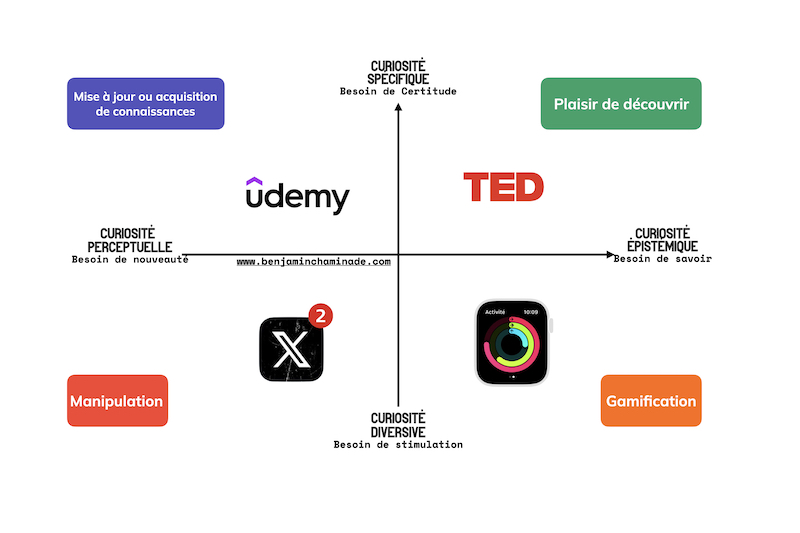
The curiosity matrix
The curiosity matrix is built around four dimensions. It sets out to determine whether curiosity is a passing state (I am looking for the answer to a specific question) or an intrinsic behaviour (I am naturally curious).Specific curiosity
This form of curiosity is driven by the desire to obtain a precise answer to a question or to solve a specific problem. It feeds on the need for certainty and clarity. If you wonder why the sky is blue, for example, you can look up scientific information to get a clear and precise answer.Epistemic curiosity
This is a broader curiosity that comes from the desire to fill the gaps in our knowledge. It is driven by the need to understand the world around us and to answer more abstract or philosophical questions. What is the meaning of life, for example? Why do people act the way they do? This form of curiosity pushes us to seek knowledge to satisfy our thirst for learning.Diversive curiosity
This form of curiosity is triggered when we are bored or looking for distraction. It pushes us to seek new experiences or new information to escape monotony or routine. You might start scrolling your Instagram or Facebook feed, for example, when you get bored in a queue or during a dull meeting. This form of curiosity is often short-lived and superficial.Perceptual curiosity
This form of curiosity is triggered by the search for novelty and for experiences we have never had. It is driven by the desire to see, hear, smell or taste something new and unusual. You might be intrigued, for example, by a new ice cream flavour or by an unusual artwork you see in a gallery. This form of curiosity pushes us to explore our surroundings and to look for new sensations. This curiosity matrix is the first step-
- A curious manager earns more respect and allows their employees to build relationships of trust and collaboration with their colleagues
-
- A curious manager helps their team adapt faster to uncertainty and outside pressure by reducing the freeze effect (the standstill that fear produces in the face of danger)
-
- A curious manager encourages their teams to use creativity to improve their results, helping them see opportunities where others see only obstacles.