


trendability
Trendability is the ability of a business to identify the trends that are useful to it or the disruptions that threaten it, and to adapt to them as quickly as possible. It complements the notion of agility, since the point is not only to adapt to unforeseen change but to spot it before your competitors do.
In the ceaseless whirlwind of the AI age, amid uncertainty and constant change, the real challenge is to discern the invisible, to anticipate what is not yet here but could shape our future. The capacity to meet that challenge has a name: trendability, a term formed from the crossing of “trend” and “capacity”.
And that challenge is far from simple. Caught up in the turmoil of daily activity, shifting customer consumption patterns and economic uncertainty, few employees have time in their day to identify “what is not yet here, but might arrive one day, perhaps”.
To measure a company’s level of trendability, I look at the two fundamental pillars that underpin it: the identification of trends, and the agility with which those trends are absorbed.
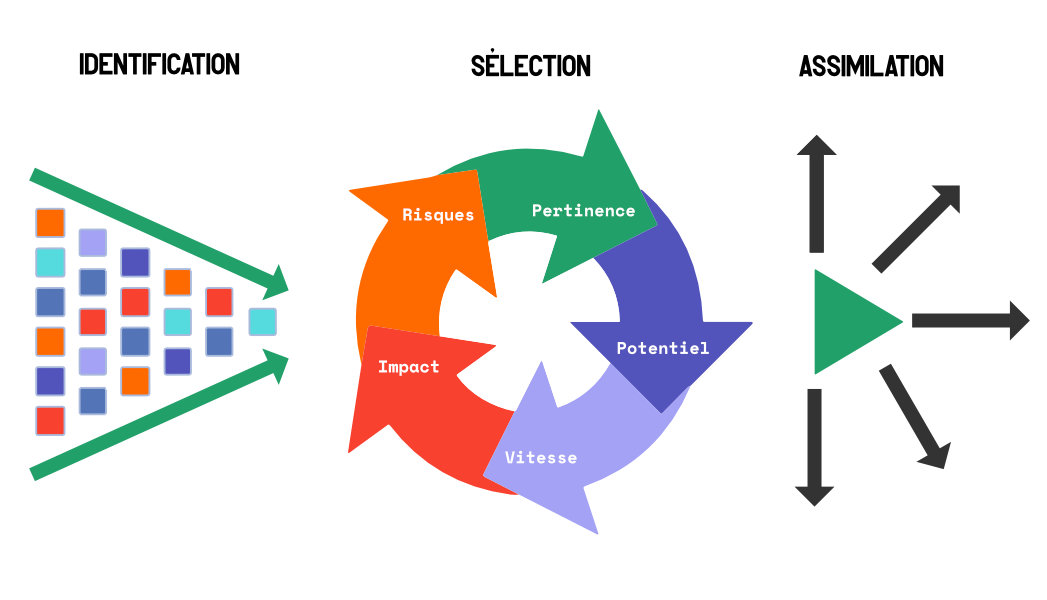
The 3 stages of trendability
Identifying trends
An integral part of the DNA of company culture, trendability is the ability to spot trends before they become dominant.
This goes well beyond simply watching current market movements. It is a capability that calls for constant scanning, thorough analysis and sharp intuition. And as you know, trends can emerge from anywhere: technological innovations, sociocultural shifts, economic changes or environmental concerns.
But who within the business is responsible for that scanning? Is it the role of a specific team, or a responsibility shared by everyone? And how do you tell a genuinely disruptive trend from a passing fad? Organisations need to be equipped not only with the right tools, but also with the right strategies for assessing the relevance, the speed of spread and the disruptive potential of these trends.
Selecting trends and weak signals
Selecting which trends to build into your strategy and your operations is a crucial stage in the trendability process. It calls for careful assessment and collaborative decision making when sorting the trends worth absorbing from those worth letting go.
That selection is generally made on the following criteria:
- Relevance of the trend: the first question to ask is whether the trend has a direct or indirect impact on the business. Is it relevant to your industry, your customers, your products or your services?
- Growth potential: assess the potential for the trend to become dominant in the future. A trend showing signs of rapid growth can be more valuable to take on board.
- Speed of spread: some trends travel faster than others. Assessing how quickly a trend is gaining ground helps you prioritise when to build it in.
- Disruptive impact: does this trend have the potential to disrupt the market or create new opportunities? A disruptive trend may call for faster action than another.
- Collateral risks and challenges: every trend comes with its own set of risks and challenges. Assessing those risks helps you decide whether the trend is worth pursuing.
Absorbing trends
Identifying a trend is one thing, building it into the strategy and operations of the business is another. This is where trendability comes into its own. Once a trend is recognised as relevant to the business, how does the business respond? How does it decide to adopt it, prioritise it and build it into its operations?
Absorption calls for collaborative decision making. That means involving different stakeholders, from leaders to employees, and through to partners and customers. It is a process that demands effective decision-making tools, transparent communication and leaders capable of guiding the business through the challenges of absorption.
Putting trendability to work
Trendability is more than a buzzword or a fashionable concept. It is an essential capability that combines curiosity, agility, vision and courage. It allows organisations to stay relevant, competitive and innovative in a constantly shifting landscape.
Businesses with strong trendability are the ones that not only survive, but thrive in the modern business world. They are able to question themselves constantly, to innovate and to adapt, while holding a clear direction and a long-term vision. They are reactive, responding quickly to change, and proactive, anticipating future trends.
Trendability, far more than a word, is a fusion of curiosity, agility and vision. It demands a culture that does not hesitate to reinvent its methods, while holding a clear direction to secure growth and harmony within the business. In a world where change is the only constant, trendability is your compass for quickly questioning a process, a product, a service or a strategy while preserving strategic, operational and human continuity.
To anticipate rather than react
In a fast-moving world, the ability to anticipate trends lets a business be proactive rather than reactive. It can position itself advantageously before a trend becomes dominant, and gain a competitive edge from doing so.
To stay relevant over time
Consumer needs and wants change. By detecting and responding to those changes, a business stays relevant, meets the shifting needs of its customer base and avoids obsolescence.
To innovate continuously
Trendability fuels innovation. By staying tuned to market shifts and consumer needs, a business can innovate continuously, offering forward-looking products, services or solutions.
To widen your horizon
Trendability encourages a culture of openness and curiosity. It pushes the business to explore new markets, new technologies and new ways of working.
To run permanent competitive intelligence
Trendability keeps businesses up to date on what their competitors are doing. That can help anticipate changes in the market and adjust strategies accordingly.