


RH Design
HR Design is an approach that redefines the role of Human Resources within an organisation. Its purpose is to create better experiences for employees at every stage of their journey. Instead of acting primarily as the department that develops policies and manages processes, HR becomes the architect of the employee experience and a catalyst for innovation.
This shift gives HR the opportunity to rethink every aspect of work, from the workplace itself and the organisational culture to the way people are attracted, selected, onboarded, developed, engaged, recognised and, eventually, supported as they leave the organisation. Every interaction becomes an opportunity to design a better human experience.
It's no coincidence that the logo of my company, **Reboot Inc.**, was inspired by the principles and methodology of HR Design. It reflects my belief that HR should not simply manage work. It should intentionally design work to create organisations where both people and businesses thrive.
Human Resources Design (HR Design) brings a human perspective to every challenge people teams face. It addresses issues such as attracting candidates who genuinely fit the organisation’s culture, creating a consistent leadership approach across the business, enabling successful organisational change and ensuring that company values, rather than individual personalities or moods, guide management decisions. At its core, HR Design combines collaborative and iterative ways of working with creative design methods to build employee-centred innovation.
The first dimension of HR Design is to reframe every challenge from the perspective of candidates and employees. The goal is to create an engaging employee experience (EX) that encourages collaboration, builds trust and supports innovation throughout the organisation.
The second dimension is to move beyond the individual and consider the organisation as a living system. This broader perspective recognises that organisational design, workplace relationships and the wider social environment all influence how people experience work. In this context, both organisational business models and the social experience (SX) become essential elements of effective HR Design.
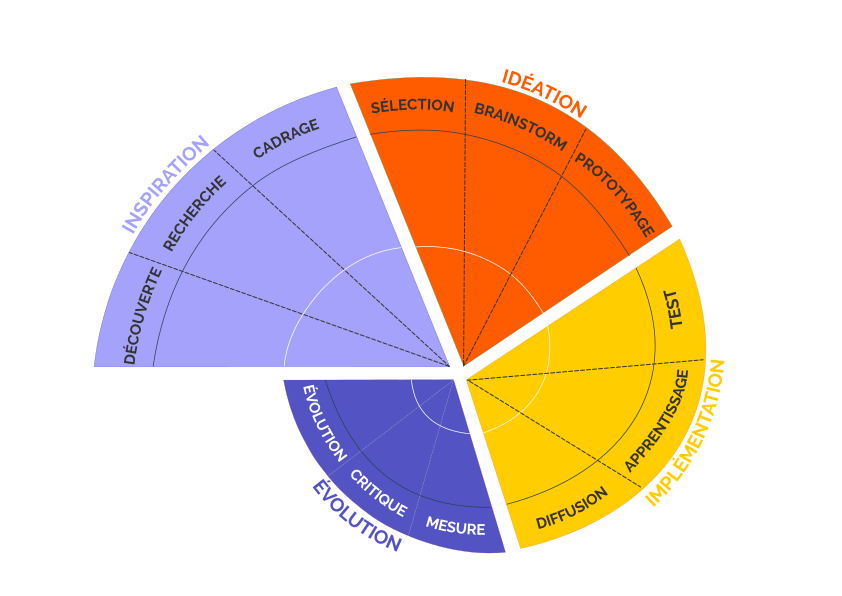
HR Design was almost inevitable. It was only a matter of time before human resources and design came together.
- Because HR must move beyond employer branding and embrace proactive talent attraction. Today’s candidates expect their next role to fit their life, not the other way around.
- Because HR must encourage collaboration and break down organisational silos in a world where the ability to work together often determines success or failure.
- Because many of the skills identified by the World Economic Forum’s Future of Jobs Report sit at the intersection of people, innovation and design.
HR Design is more than Design Thinking applied to HR
It would be easy to define HR Design as simply applying Design Thinking tools and methods, originally developed for innovation and marketing, to human resources. While there is some truth in that, it does not tell the whole story. HR Design borrows ideas from across the innovation landscape, not just from design.
Some practitioners argue that the word design has become overused. Terms such as service design, social design, strategic design and human-centred design have become so common that adding « design » to every discipline risks making the concept feel vague, much like words such as innovation or sustainability.
Others point out that HR Design is not new at all. Design as a way of thinking has existed since the pioneering work of Herbert A. Simon in the 1960s. Some prefer the title HR Strategist, arguing that design is simply one of many tools available to HR professionals alongside collaboration, HR technology and empathy. Others describe themselves as HR Hackers because applying design principles has never been considered a traditional HR responsibility.
Whatever label people choose, we all share the same belief. HR should never limit itself to a fixed set of responsibilities, so it should not limit itself to a fixed set of methods or tools either.
HR needs to reclaim its role in creating and sustaining an innovation culture. That means working closer to the business and drawing on perspectives, methods and tools from multiple disciplines. Design Thinking and Human-Centred Design are important parts of that toolbox, but they are only the beginning.
HR Design is an interdisciplinary approach inspired by Human-Centred Design methodologies and innovation strategy frameworks to solve the human and cultural challenges organisations face.
It brings together concepts from Design Thinking, Service Design, Lean, Growth Hacking and Gamification, alongside many other approaches that help organisations rethink the way people experience work.
The real value of HR Design lies in its ability to respond to the changing expectations of candidates and employees. At its core, HR Design is about creating meaningful connections with candidates, listening to employees and intentionally designing experiences that strengthen engagement.
The principles of HR Design
Like every design discipline, HR Design follows a number of guiding principles.
Human-centred
HR Design creates value for future, current and former employees. Throughout this book I refer to them as candidates, employees and alumni. The challenge is to design work experiences that recognise people as individuals rather than simply filling positions.
Iterative
HR Design is not a linear process. It is both a mindset and a way of working that involves testing, learning and refining ideas. Inspired by Design Thinking and startup methods, it focuses on practical solutions rather than perfect plans.
Collaborative
HR Design is not something HR does for employees. It is something employees help create. Rather than waiting for head office to deliver one-size-fits-all solutions, people become active participants in shaping their own work experience.
Driven by experimentation
HR Design is about making real changes, not developing theoretical concepts. Candidates, employees and alumni are treated as customers whose feedback helps organisations learn quickly through practical, incremental experiments.
Human-Centred Design brings a human perspective to every HR challenge, whether attracting candidates who genuinely fit the culture, creating a consistent leadership approach across the organisation, supporting organisational change or ensuring company values guide management decisions instead of individual personalities or moods.
How HR Design is used
HR Design certainly draws inspiration from Design Thinking, but it reaches much further than that.
Responding to the consumerisation of work
HR Design aims to create an end-to-end employee experience rather than simply filling vacant roles. By designing work around people’s needs and expectations, organisations create more engaging and rewarding careers instead of jobs defined only by tasks.
Moving beyond employer branding
Rather than imposing a corporate brand identity from the top down, HR Design encourages teams to define their own identity, values and ways of working. This builds ownership, meaning and a stronger sense of belonging because employees actively shape the culture they work in.
Encouraging ownership
HR Design empowers people to shape their own work experience. By encouraging initiative and recognising accountability, organisations move away from dependency and create workplaces where people enjoy greater autonomy and responsibility.
Supporting innovation
HR Design also focuses on attracting people who embrace change and challenge the status quo. By recruiting, supporting and retaining innovative employees, organisations become more adaptable and better prepared for future challenges.
Employee-centred, customer-focused
HR Design treats candidates, employees and alumni as customers. This perspective creates a more consistent employee experience while helping everyone understand how their work ultimately shapes the customer experience. Strong employee engagement and excellent customer experience reinforce one another.