


Organisational psychology
Organisational psychology studies the impact of psychological, social, cognitive and emotional factors on the behaviour of employees at work. It seeks to understand why capable teams disengage, why well-designed projects fail, and why the same management levers produce opposite results depending on the context.
Organisational psychology challenges the assumption that an employee is guided solely by the technical rationality of their role. That assumption holds that people carry out their work according to clear objectives, well-designed procedures and suitable rewards. In practice, behaviour at work is far more often shaped by fundamental psychological needs, emotions, group dynamics and social representations. These influences can pull employees away from the stated objectives of their organisation without their being aware of it.
Organisational psychology can be used to understand phenomena such as silent disengagement, burnout, resistance to change, recurring conflicts between departments and the loss of meaning felt by certain groups of employees. It is also used to design management approaches that encourage cooperative, creative and sustainable behaviour.
I use organisational psychology as a shared frame of reference with my clients. In a keynote, I use it to put subjects that look purely technical, such as digital transformation or the return to the office, back into their real human depth. I show leaders why a perfectly rational plan runs into resistance that is just as rational. That change of perspective changes the conversation. Participants stop looking for who is to blame for disengagement and start questioning the conditions they created themselves.
In a workshop, I move a committee or a team from complaint to diagnosis. Participants test their observations against frameworks such as psychological safety and self-determination theory. The realisations come quickly. One manager discovers that what they called a lack of motivation was a frustrated need for autonomy. A director realises that cooperation between departments follows logically from the indicators they set themselves, rather than from goodwill. The work then consists of adjusting what is within their immediate reach, without waiting for a hypothetical reorganisation.
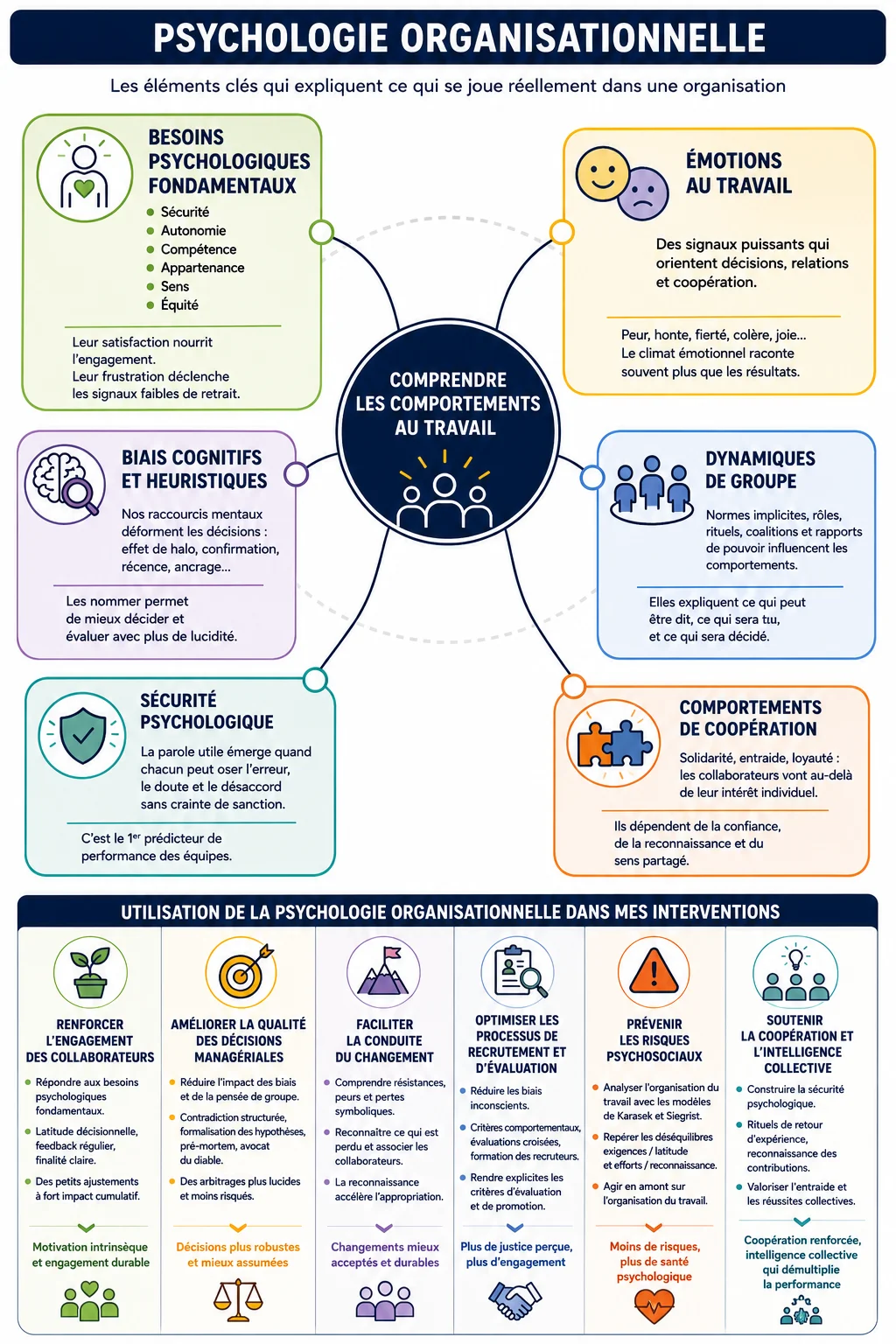
The elements of organisational psychology
Organisational psychology is a field of the human sciences applied to work. It is characterised by the way it brings the contributions of individual psychology, social psychology and cognitive science into the understanding of organisations, in order to explain observable behaviour and the decisions taken day to day. Thanks to organisational psychology, we have confirmation that the performance of a team depends more on the quality of interactions, on the sense of safety and on shared meaning than on the simple addition of individual skills.
Organisational psychology rests on several key elements that set it apart from a purely managerial approach. These elements include:
Fundamental psychological needs
These are the deep drivers that steer the engagement and the motivation of employees. Organisational psychology studies how their satisfaction or their frustration influences behaviour at work. For example, self-determination theory identifies three central needs: autonomy, competence and relatedness.
Researchers distinguish several categories of needs studied at work:
- Safety needs (stability and predictability)
- Autonomy needs (decision-making latitude and a sense of choice)
- Competence needs (a feeling of effectiveness and progression)
- Belonging needs (quality of relationships and social recognition)
- Meaning needs (perceived usefulness and ethical consistency)
- Fairness needs (distributive and procedural justice)
Emotions at work
These are signals that continuously steer professional behaviour, well beyond what organisations care to admit. They are often treated as background noise, and they shape the quality of decisions, of relationships and of cooperation. For example, the fear of error leads teams to hide incidents, which lastingly degrades the learning capacity of the organisation.
Cognitive biases and heuristics
They play an important role in managerial decisions and in the assessment of employees. Organisational psychology examines how mental shortcuts such as the halo effect, confirmation bias or recency bias influence recruitment, annual reviews, promotions and the strategic trade-offs made in the leadership committee. Organisational psychology helps to name them so that they can be neutralised, at least in part. For further reading centred on economic and managerial decisions, see behavioural economics.
Group dynamics
Individuals are deeply influenced by the norms, the roles and the rituals of their working collectives. Organisational psychology studies how social phenomena such as conformity pressure, groupthink, informal coalitions and power relationships affect cooperation, innovation and the quality of collective decisions.
Psychological safety
Contrary to the assumption that an employee is naturally inclined to voice their disagreements and their ideas, organisational psychology recognises that speaking up depends on the relational climate built within the team. Employees may give up on reporting an error, on suggesting an improvement or on expressing a doubt when the environment appears to penalise those behaviours, which reduces performance and collective learning.
Cooperative behaviour
Organisational psychology recognises that employees are driven by more than their individual interest or their employment contract. Individuals can show solidarity, helpfulness or loyalty towards a collective, sometimes at the expense of their own comfort, when the conditions of trust, recognition and meaning are in place.
Using organisational psychology in my sessions
Strengthening employee engagement
Organisational psychology can be used to design management practices that answer the fundamental psychological needs of employees and support their lasting engagement. By understanding the deep levers of motivation, managers can create working conditions that encourage the commitment and the satisfaction of their teams. For example, by widening decision-making latitude over the organisation of tasks, by recognising contributions regularly and by clarifying the purpose of the work, organisations can strengthen intrinsic motivation without relying solely on financial levers, whose effects on lasting engagement remain limited.
Improving the quality of managerial decisions
By understanding the cognitive biases and the group dynamics that influence decisions, leaders can put mechanisms in place to minimise these effects and make better informed decisions. For example, by organising structured challenge in leadership committees, by appointing a devil’s advocate or by formalising the assumptions behind each trade-off, organisations can reduce the risk of groupthink and of escalating commitment to a path that has become irrational. By using deliberative decision-making techniques such as the pre-mortem or decision reviews, directors can also assess their choices with more perspective.
Making change management easier
Organisational psychology helps you understand the emotional resistance and the symbolic losses that employees experience when facing transformation, and design support that takes these dimensions seriously. For example, by spelling out the deep reasons for the change, by recognising what is lost as much as what is gained and by involving employees in the design of new practices, organisations can reduce the anxiety and the mistrust that come with transformation. By offering spaces for dialogue where concerns can be voiced without risk, leaders also make it easier for people to take ownership of the change gradually, and they limit silent withdrawal.
Optimising recruitment and assessment processes
By using the contributions of organisational psychology, human resources leaders can design processes that reduce unconscious bias and support perceived fairness. For example, by structuring interviews around observable behavioural criteria, by cross-checking the assessments of several interviewers and by training recruiters in the mechanisms of the halo effect, organisations can limit decisions based on similarity or appearance. By making assessment and promotion criteria explicit, human resources directors also strengthen the sense of fairness, which is a major determinant of engagement.
Preventing psychosocial risk
Organisational psychology provides analytical frameworks for identifying work situations likely to damage the psychological health of employees. For example, the Karasek and Siegrist models connect job demands, decision-making latitude, social support and recognition to health indicators. By using these frameworks, organisations can spot the departments exposed to a lasting imbalance and design interventions on the organisation of work, instead of leaving prevention to the individual responsibility of employees alone.
Supporting cooperation and collective intelligence
Organisational psychology can be used to create the conditions for genuine cooperation between employees, teams and departments. For example, by working explicitly on psychological safety within teams, by clarifying roles and shared areas of responsibility, and by establishing regular debrief rituals, organisations strengthen the quality of interactions and the flow of information. By recognising cross-functional contributions and valuing helpful behaviour, directors encourage a culture where collective intelligence goes beyond the sum of individual intelligences.