


The 4 elements of collaboration
In a context marked by uncertainty, complexity and ambiguity, the word "agile" gets waved about as the miracle cure for every management problem. Agility is one aspect of a far broader and deeper answer, which is collaboration.
Collaboration in a management context can be defined as the art and the science of combining the skills, the talents and the resources of several people to reach a shared objective. It goes past simple cooperation or coordination. Collaboration calls for mutual commitment, open communication and a shared willingness to create value together. It works as a method and also as a culture, one that has to be built into the DNA of the organisation through its values.
The workplace has been organised for decades around a hierarchical separation between the people who design, meaning the leaders, and the people who build, meaning the workforce. That separation is now breaking apart under the management transformation a VUCA world makes unavoidable.
Collaboration is difficult, and plenty of obstacles stand in the way of anyone who wants to work, create and succeed together. For that reason I use a simple step-by-step approach that develops collaboration and makes it inseparable from your company culture.
-
- Trust: the starting point of any management relationship. Each person has to be sure they are dealing with reliable people who care about the success of the group rather than only their own. There is no collaboration without mutual trust.
- Knowledge: of yourself and of others. Each person has to know what they bring to the table in skills, expertise, personality, creative profile and the rest. There is no collaboration without empathy.
- Co-construction: collaboration is a stable structure in which ideas are shared to the point that their origin gets lost across the iterations. An idea has to become collective before it turns into something real.
- Co-responsibility: nobody hides behind their manager, and after a mistake the search is for a shared solution rather than for an individual to blame. Collaboration is also a question of individual and collective responsibility.
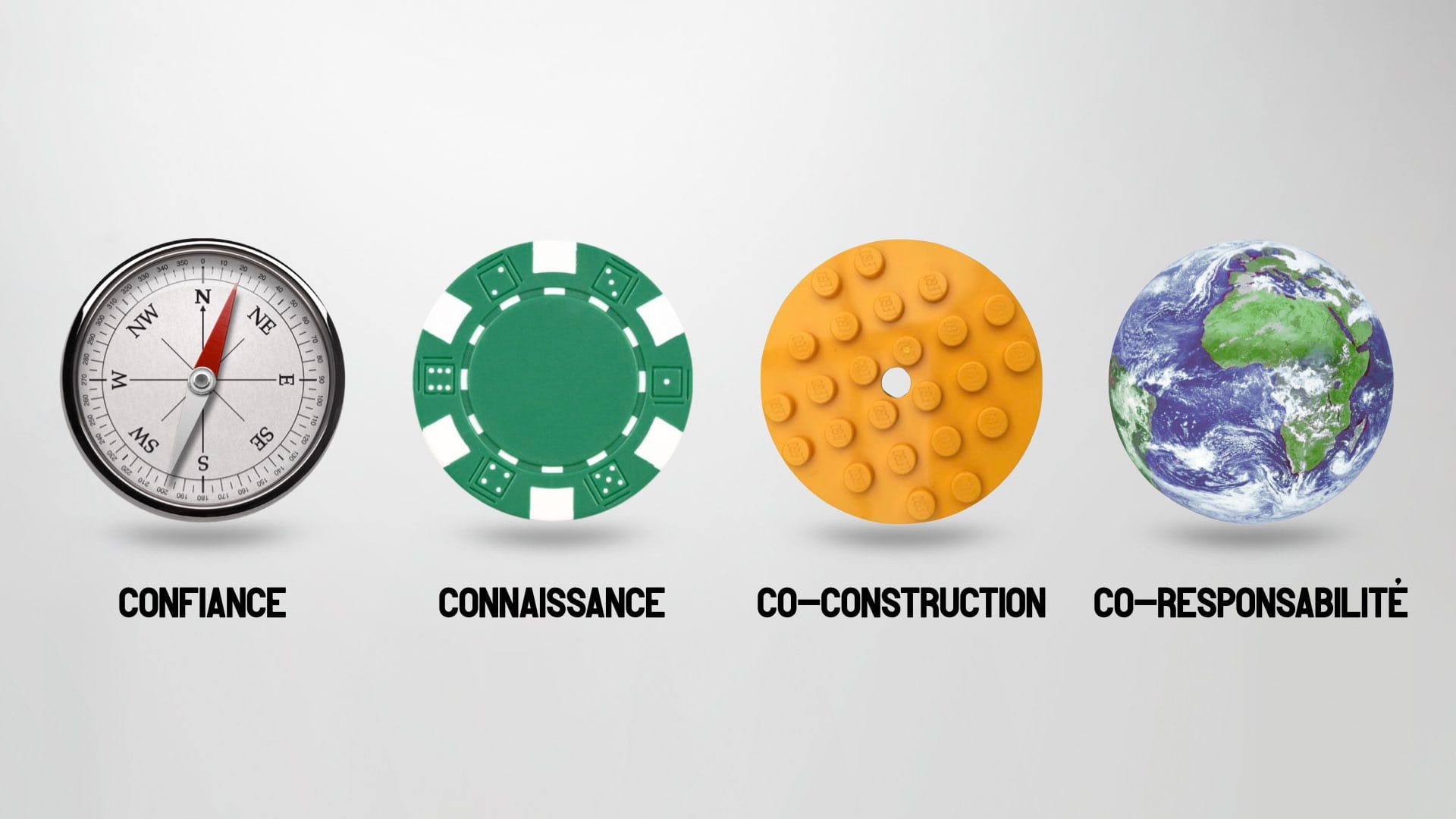
The elements of collaboration in detail
Trust: the base collaboration rests on
Trust is generally treated as the foundation of any successful collaboration. In a working environment, mutual trust between colleagues creates a safe space where each person can speak freely, share ideas and take calculated risks. That trust covers reliability and integrity, and it extends to the belief that every member of the team is invested in the success of the group rather than in personal gain. Mutual trust is the fuel that runs the collaborative machine, and it lets teams work more smoothly and more effectively.
Knowledge: the mirror of empathy
Knowledge of yourself and of others is another essential pillar of collaboration. Each person needs a clear understanding of their own skills, expertise and personality traits, along with those of their colleagues. That mutual knowledge makes it easier to allocate work according to each person’s strengths and it creates an environment where empathy can exist. Empathy in turn allows better communication and a better grasp of what each person needs and expects, which is what successful collaboration depends on.
Co-construction: the structure of collective ideas
Co-construction is the process by which an idea or a project is developed collectively, often to the point where the origin of the idea blurs as it evolves. In a collaborative environment, ideas work like building blocks that get stacked, modified and rearranged by every member of the team. That process enriches the original idea and turns it into a collective achievement. Co-construction reflects genuine synergy, where the final result is greater than the sum of its parts.
Co-responsibility: the collaborative safety net
Co-responsibility means that each member of the team is responsible for their own actions and for the collective result. In a culture of collaboration, mistakes become opportunities for the team as a whole to learn and grow rather than occasions for pointing fingers or assigning blame. Looking for shared solutions when problems arise strengthens the sense of shared responsibility and creates an environment where everyone is encouraged to contribute meaningfully.
Combining these four pillars lets organisations build a solid culture of collaboration that improves productivity and creativity while enriching the working life of every person involved.
Putting collaboration to work
To do well in an interconnected world
In a world where digitalisation reaches everywhere, the idea of the lone maverick innovator has become obsolete. The complex challenges we face call for a multidisciplinary approach, where varied skills and perspectives meet to create innovative solutions. Collaboration has therefore become an essential skill, both for solving problems and for doing well in an interconnected professional ecosystem. It breaks down silos, encourages diversity of ideas and creates an environment where collective innovation becomes the norm rather than the exception.
To reinvent the way we work
In French, the word “collaborateur” has replaced “salarié” in professional language, and that shift was no accident. The change in vocabulary reflects a deep transformation in how we understand work. Thanks to collaborative tools and platforms, work has become a collective undertaking where each individual contributes to a shared objective. This reinvention of how work happens encourages a culture where each person’s contribution is valued and where collaboration is woven into the fabric of the organisation.
To reach your objectives faster
Collaboration is more than a way of reaching an objective. It is the engine that drives a team towards higher productivity and creativity. Combining the talents and the skills of each person lets teams approach challenges from several angles, which speeds up problem solving. That synergy creates a virtuous circle where collaboration feeds creativity, which in turn feeds ideas such as Enableship, my term for an advanced form of collaborative leadership.
To build flexibility and autonomy
The era of nine to six is over. Collaborative technologies have created an unprecedented demand for flexibility and for the capacity to work autonomously, which lets people work where and when they choose. That flexibility has produced an interesting paradox, because people are more autonomous than ever and at the same time more interconnected. Online collaboration tools let individuals work independently while staying in step with the objectives and the information of the team, which was unthinkable in a model built on physical presence.
To strengthen resilience and adaptability
In a working environment that keeps changing, the ability to adapt and recover in the face of adversity has become decisive. Collaboration plays a key part in building that resilience. Working together lets people identify risks quickly, share solutions and make informed decisions. That collaborative dynamic creates a collective safety net, where mistakes and failures are treated as opportunities to learn rather than as individual faults. Collaboration is a way of reaching objectives, and it is also a defence against the uncertainty and volatility of working life.