


Gamification
Gamification is an approach that builds game elements and game mechanics into non-game contexts in order to hold attention, encourage effort and the will to go further, support learning, and strengthen the engagement of the people taking part.
Gamification is an approach that builds game elements and game mechanics into non-game contexts in order to hold attention, encourage effort and the will to go further, support learning, and strengthen the engagement of the people taking part.
Gamification uses game techniques to turn activities or tasks that could be seen as routine or boring into experiences that are more appealing and more motivating. By drawing on the competitive and playful side of people, gamification encourages them to put more of themselves into activities that would not engage them naturally.
The concept is used in many fields to encourage positive behaviour, improve learning, increase customer engagement, strengthen brand loyalty, promote health and wellbeing, and serve many other goals. Gamification works particularly well for encouraging behaviour that calls for persistence, effort or motivation.
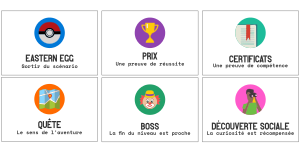
Game mechanics and player behaviours
Gamification has become a double-edged sword. On one side, it holds attention, builds strong and trusting relationships between people, and develops their potential. On the other, it lets you manipulate users into carrying out certain tasks, creates addiction, and drives impulse purchases.
The gaming industry was the first to understand and apply this kind of human-centred design, which is where the term gamification comes from. Games exist purely to give players pleasure, using motivation and engagement techniques. Those techniques have since been taken up by certain social media platforms, at times in roundabout ways.
I brought gamification into my own sessions to hold my audience’s attention, whether in a keynote or a workshop.
- To make my sessions more interactive and engaging, with video, images and the design work set out on the tools and concepts page of this site,
- And in the way I facilitate, using my own Gamestorming card deck, developed in-house alongside Trendstorming, Brand & logo storming and Value storming, in collaboration with the Neurosciences.
Gamestorming lets me present not only the various game mechanics, but also the player profiles likely to be sitting among the participants.
Disruptor
Disruptors are players who enjoy challenging the status quo and testing the limits of the system. They are often driven by a desire to create chaos, provoke reactions and see how other players and the system respond. Disruptors can be seen as troublemakers, yet they can also be agents of positive change, helping to identify the weaknesses of a system and encouraging innovation and improvement.
Achiever
Achievers are players driven by success and accomplishment. They enjoy taking on challenges, earning points, collecting rewards and reaching goals. Achievers are often competitive and want to be the best at what they do. They are motivated by the desire to succeed and to prove their worth, and they find satisfaction in meeting their goals and earning rewards.
Explorer
Explorers are players driven by discovery and exploration. They enjoy exploring new worlds, uncovering secrets and solving puzzles. Explorers are often curious and like learning new things. They are motivated by the desire to discover new information and to understand the world around them. They find satisfaction in discovering new things and acquiring new knowledge.
Free Spirit
Free spirits are players who like having control and the freedom to make their own choices. They are often driven by a desire for independence and autonomy. Free spirits enjoy making decisions and solving problems on their own. They are often creative and like finding their own answers to the challenges in front of them. They find satisfaction in reaching their own goals and making independent decisions.
Socialiser
Socialisers are players driven by social interaction. They enjoy talking with other players, making friends and taking part in group activities. Socialisers are often empathetic and like helping others. They are motivated by the desire to connect with people and build social bonds. They find satisfaction in social interaction and in creating meaningful relationships with others.
Killer
Killers are players driven by competition and power. They enjoy dominating other players, winning fights and being the strongest. Killers are often aggressive and like demonstrating their superiority. They are motivated by the desire to win and to prove they are better than others. They find satisfaction in victory and in dominating other players.
Putting gamification to work in my sessions
I’m not telling you anything new here. At a keynote, it is very easy to switch off unless you are at least somewhat involved in what the speaker is saying. Much like life, really. That is why I use a few simple gamification recipes, such as quizzes, open questions or riddles. Gamification has a far wider field of use across human resources and management.
Driving employee engagement
Gamification can be used to motivate employees by making work tasks more engaging and enjoyable. Using game elements such as points, badges and leaderboards, staff can be encouraged to reach targets and improve their performance. Achievers, for instance, can be motivated by rewards and recognition for what they deliver, while explorers can be encouraged to innovate and find new answers to problems. Free spirits can be motivated by giving them more control and freedom in their work, while socialisers can be encouraged to work as a team and collaborate with colleagues. Killers can be motivated by challenges and competitions, while disruptors can be encouraged to question the status quo and put forward new ideas.
Strengthening training and skills development
Gamification can be used to improve employee training and skills development. Using game elements such as quests, challenges and simulations, staff can be encouraged to learn new skills and deepen their knowledge. Explorers, for instance, can be motivated by quests and puzzles that push them to learn new things. Free spirits can be motivated by letting them choose their own learning path and make independent decisions. Socialisers can be encouraged to learn as a group and share their knowledge with colleagues. Killers can be motivated by challenges and competitions that push them to sharpen their skills and prove their superiority.
Encouraging innovation and creativity
Gamification can be used to encourage innovation and creativity among employees. Using game elements such as challenges, contests and rewards, staff can be encouraged to put forward new ideas and find creative answers to problems. Disruptors, for instance, can be motivated by challenges that push them to question the status quo and propose new ideas. Free spirits can be motivated by giving them more freedom and control in their work, which lets them explore new ideas and find creative solutions. Socialisers can be encouraged to collaborate with colleagues and share their ideas. Killers can be motivated by contests and competitions that push them to innovate and prove their superiority.
Increasing customer engagement
Gamification can be used to increase customer engagement by making interactions with the brand more enjoyable and engaging. Using game elements such as points, badges and rewards, customers can be encouraged to interact with the brand and stay loyal. Achievers, for instance, can be motivated by rewards and recognition for their loyalty and engagement. Free spirit customers can be motivated by giving them more control and choice in how they deal with the brand. Socialisers can be encouraged to share their experiences with other customers and take part in group activities. Killers can be motivated by challenges and competitions that push them to interact with the brand and prove their superiority.
Improving employee wellbeing
Gamification can be used to encourage employees to adopt healthy behaviours and improve their wellbeing. Using game elements such as points, badges and rewards, staff can be encouraged to exercise, eat well and look after their mental health. Achievers, for instance, can be motivated by rewards and recognition for the effort they put into their health and wellbeing. Free spirits can be motivated by letting them choose their own learning path and make independent decisions. Socialisers can be encouraged to share their experiences with colleagues and take part in group activities. Killers can be motivated by challenges and competitions that push them to sharpen their skills and prove their superiority.
Strengthening company culture
Gamification can be used to strengthen company culture by encouraging employees to adopt behaviours and attitudes that reflect the values and mission of the organisation. Using game elements such as points, badges and rewards, staff can be encouraged to work as a team, share their knowledge and contribute to the success of the business. Achievers, for instance, can be motivated by rewards and recognition for what they contribute. Free spirits can be motivated by letting them make independent decisions and contribute to the organisation’s innovation. Socialisers can be encouraged to work as a team and share their knowledge with colleagues. Killers can be motivated by challenges and competitions that push them to prove their superiority and contribute to the success of the business.