


VUCA
VUCA is an acronym that comes from American military terminology and describes the nature of the world we live in:
- V for Volatility: the nature and the dynamics of change, and the speed at which things move.
- U for Uncertainty: the lack of predictability, the difficulty of seeing ahead and the likelihood of surprise.
- C for Complexity: the many forces at play, and the confusion that follows, which characterise an issue.
- A for Ambiguity: the blurred reality and the potential to misread conditions.
VUCA is a set of mixed and complementary concepts used to introduce the current technological, economic and social transformations, and to make sense of this world of the “new normal”.
This acronym, a buzzword in the United States from 2005, is slowly making its way into our own language. I learned the hard way that failing to understand what VUCA means can put the future of your business at risk as you can read here.
VUCA is far more than a passing fashion. It has become particularly relevant in the current context, marked by events such as Brexit, the rise of China and global crises like the COVID-19 pandemic. Businesses have to adapt to this new reality, where well-established plans can be overturned by unforeseen crises.
VUCA in brief
VUCA does far more than string four letters together. It gives a real depth of understanding of the challenges businesses face in a world of constant change.VUCA was introduced to help cadets at the US war college understand the shifts taking place on the battlefield. Over time, the concept grew to cover the challenges businesses face in a world marked by rapid change, geopolitical uncertainty and technological transformation.
Paired with the acronym BANI, I also use VUCA to introduce what I call the age of fragility.
How I use VUCA in my sessions
Beyond the definition of this acronym and its effects on management, I use the VUCA theme in several ways to give the people in my sessions an inspiring perspective.
Strategic planning
In a VUCA environment, traditional strategic planning built on long-term forecasts and stable scenarios often falls short. Companies recognise that the future is unpredictable and that change can arrive quickly. They therefore adopt more flexible and adaptive approaches to planning. That often means setting short-term strategic plans, using simulations to consider a range of possible scenarios, and putting mechanisms in place to review and adjust the strategy regularly as the market moves.
Leadership development
Today’s leaders need to be equipped to navigate VUCA environments. That calls for a combination of skills, including agility, resilience, the capacity to innovate and strong emotional intelligence. Leadership training programmes put the emphasis on developing these skills, while teaching leaders how to make decisions in uncertain situations, how to manage change and how to inspire and motivate their teams in the face of adversity.
Leadership mental health
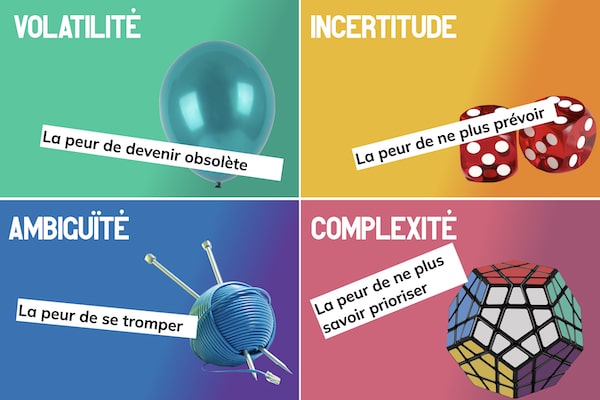
In practice, I mainly use VUCA to help leaders grasp the impact each element of VUCA has on the psychological health of managers and their teams. Volatility, for example, is a major source of concern for professionals who wonder whether they can keep pace as skills become obsolete faster and faster. Uncertainty generates anxiety because it makes medium-term forecasting difficult, sometimes impossible. Then there is complexity, which raises worries about how hard it is to understand the issues of the moment, and ambiguity, which can unsettle people by suggesting that ideal solutions have disappeared and only probable failures remain.
Risk management
Recognising the volatility and uncertainty of the VUCA environment means that companies have to rethink how they manage risk. Companies now take a proactive approach that reaches beyond the risks they have already identified, seeking to anticipate potential risks and to put measures in place to reduce them. That can include diversifying investments, setting up business continuity plans and training employees in crisis management.
Innovation
In a world shaped by VUCA, innovation has become a necessity for staying competitive. Companies are encouraged to push the boundaries, to experiment with new ideas and to adopt a mindset of continuous innovation. That can mean investing in research and development, encouraging a culture of experimentation where failure is seen as a chance to learn, and collaborating with outside partners to bring in fresh perspectives.
Organisational culture
A VUCA environment calls for an organisational culture that is agile, resilient and able to adapt quickly to change. Companies aim to build a culture that embraces change, values diversity of thought and encourages collaboration between teams. That often means promoting values such as transparency, open communication, continuous learning and initiative. Companies can also set up training and development programmes to strengthen these values and skills across their workforce.