

Reinventing the business model of recycling at Suez
Turning challenges into opportunities: collaborative innovation for recycling.
- client request
The request centres on a wish to establish a more integrated and cross functional innovation dynamic within the group, which indirectly leads to a rethink of business models. With its network of innovation correspondents already in place, and having started Design Thinking training, the company felt the need to take the approach further.
A need for an interactive session. The client asked for an interactive session that goes beyond straightforward theoretical training. She wanted a concrete and engaging experience, able to genuinely encourage collaboration between the different departments and profiles, and to produce concrete outcomes.
Promoting cross functional collaboration. The group wanted to use this moment to get employees from different departments working together smoothly and effectively, combining their skills and their different perspectives to reinvent the current business models.
Practical application. The client expected practical tools and proven methods from this session that participants could apply in their daily work. That allows teams to build innovation into every aspect of their work and contribute to the strategic objectives of the group.
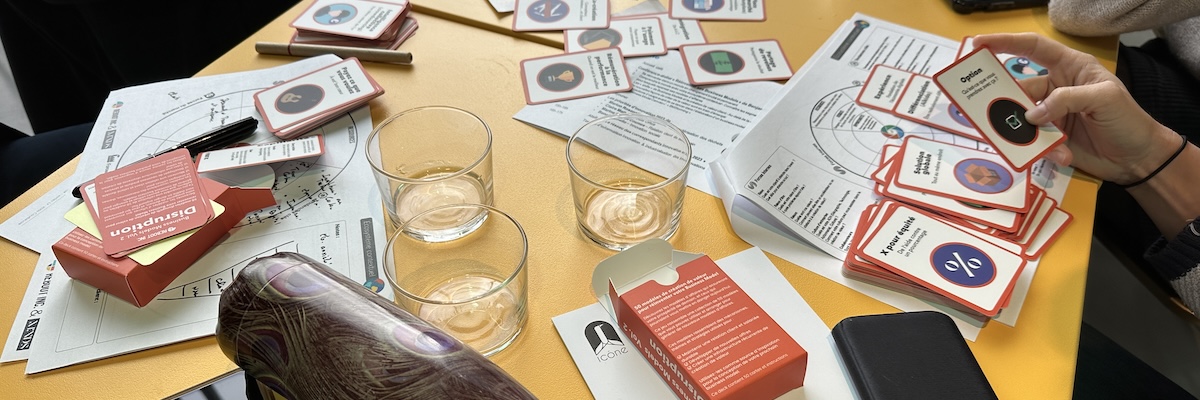
As the photo below shows, I used Volume 2 of my series of business model card decks, "the business models of disruption".
- challenges
Several challenges have to be met, both to strengthen the network of innovation correspondents and to establish a lasting culture of innovation that supports the growth and continued success of the company.
Making collaboration easier. In particular between the waste and water departments, and between sales staff and technicians. A diversity of profiles can often create communication barriers and misunderstandings, which makes collaboration difficult. It is therefore essential to put in place mechanisms and tools that support a smooth exchange of information and ideas between these different players.
Turning existing tools and resources into levers for innovation. The company already has a set of tools and resources, and the challenge is to adapt or reinvent them so that they work with the Design Thinking method. That calls for careful thought about how these resources can be used in an innovative way to generate added value.
Creating a space for exchange and co-creation. Another challenge is creating a space for exchange and co-creation where the innovation correspondents can work together to design new business models. This calls for an environment that encourages creativity, strategic thinking and experimentation, while staying flexible enough to adapt to the changing needs of the participants and of the market.
Breaking down organisational silos. These silos can block the flow of ideas and skills across the company, which limits its potential for innovation. It is essential to put in place initiatives that encourage the sharing of ideas and skills between departments, which supports an integrated and cross functional culture of innovation.
- stakes
Beyond the interest of the project itself and my idea of using my "Business Storming" card decks, which reference 150 different business models, the client request carries several important issues.
Encouraging a cross functional culture of innovation. According to a McKinsey study, 80 % of executives see innovation as a key growth factor. Establishing that kind of culture calls for effective collaboration between the different departments, a challenge the group has to meet in order to stay competitive and relevant in the market.
Reinventing the business model of recycling to meet current environmental challenges. According to a study by the Ellen MacArthur Foundation, the transition to a circular economy could generate 4.5 billion euros in value by 2030. This shows why Suez needs to rethink its approach to recycling, in order to maximise the environmental benefits and the economic ones.
Recognising and mobilising internal skills to generate innovative solutions. According to Gallup, companies that succeed in mobilising their employees see a 21 % increase in profitability. For Suez, that means creating an environment where every employee can make their own contribution to innovation and problem solving.
Recognising the role of the innovation correspondents as links to the field. These correspondents play a key part in passing information and innovative ideas across the company. According to Nielsen, companies that communicate effectively are 50% more likely to exceed their performance targets. By recognising the role of the innovation correspondents, Suez can improve internal communication and encourage innovation at every level of the company.
- solution
Immersion
Running collaborative working sessions so that participants can share their experiences, challenges and aspirations.
Collaborative brainstorming
Using the game on the business models of disruption to spark creativity and encourage collaboration between participants.
Rapid prototyping
Encouraging teams to design and test innovative ideas quickly, drawing on the tools and resources available.
Feedback and iteration
Sharing the ideas that came out of Business Storming, along with feedback, to refine them and align them with the overall vision of the company.
- results
The aim of this work was to bring about significant and lasting change within the company. The results were varied and touched several aspects of the organisation.
New ideas and solutions emerged for reinventing the business model of recycling. The brainstorming workshops and co-creation sessions brought the brightest minds in the company together and produced original ideas with the potential to transform the recycling industry.
Stronger collaboration and communication between the different departments. The work helped break down communication barriers, allowing smooth and effective interaction between the correspondents. This improvement in internal communication was a step towards a more unified and collaborative company culture.
Recognition of the skills and knowledge of the innovation correspondents. Their role as links to the field was strengthened, which lets them play a more active part in promoting and delivering innovation across the company. This recognition helps strengthen the innovation ecosystem at Suez and supports a steady flow of ideas and original solutions for the group.
TO ORGANISE A KEYNOTE, A WORKSHOP OR A MASTERCLASS