
Innovation killers are the people who close an idea down before it has been understood. Every organisation has them, most leaders can name theirs within about four seconds, and almost nobody has a strategy for them beyond hoping they miss the meeting.

Take any example at random. Social platforms arriving inside an organisation, for recruitment, for finding expertise, for internal communication, for customer relationships. I no longer know how to raise the subject without the ready-made anti-change phrases coming straight back at me.
The useful discovery is that innovation killers behave predictably, that converting them is a waste of your time, and that a different group entirely decides whether your idea survives.
| The inherited reflex | What it produces | The shift that transforms |
|---|---|---|
| Innovation killers, definedInnovation killers are people who reject new ideas on principle rather than on evidence, including ideas that do not affect them. They differ from change resisters, who object only to disruption of their own daily work. | Arguing with the loudest voiceAnswering an opponent in front of a group raises the status of their objection and consumes the attention the undecided majority needed. The debate ends up being held on the killer’s terms, in front of the people whose minds were still open. | Aim at the undecided, ignore the opposedGroup adoption tips at roughly a third of the population rather than at consensus. Converting a portion of the undecided reaches that threshold, and the rest of the organisation follows the visible movement without ever being persuaded directly. |
What an innovation killer actually is
An innovation killer rejects an idea before understanding it, using arguments that are personal and emotional while presenting them as prudence. The distinguishing feature is that they will oppose things that have no bearing on their own job, which separates them from ordinary resistance to change.
The reaction pattern, in two images
I used to close sessions on social platforms with a photograph, explaining that the immediate concern is not your own online visibility. For now, the task is to watch the subject closely, because things could get considerably stranger.

The reaction is always identical. It opens with incomprehension, then, after a short explanation from me, settles into a single shape. This is science fiction, it will never exist, if only for legal reasons, and besides, prying into our people’s private lives is not one of our values.
Fair enough, I am pushing it, and there is little chance that particular photograph becomes reality. Augmented reality plus facial recognition is already here though. Nobody is about to learn their neighbour’s name on the train tomorrow, and the technology has existed for a decade.
After several presentations where that slide swallowed everything that came before it, I stopped using it and switched to a more reassuring close. This one shows a recruitment centre built by Deloitte in Paris.
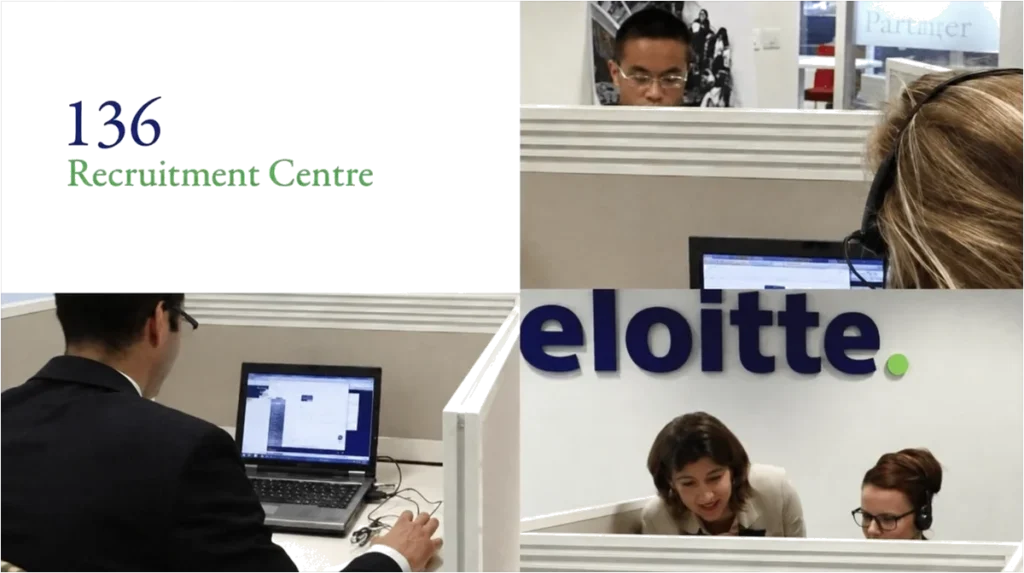
Whether or not the room grasps the point, that the future of social platforms is physical rather than virtual relationships, the protests arrive anyway. We cannot do that, we recruit engineers, forklift operators, people from regional areas, not accountants. And we recruit internationally. And besides.
In both cases, instead of identifying what might serve as the basis for a rethink, or asking what an adapted practice would look like, some participants concentrate on why it will never work here, because our sector is different and our organisation is unique with strong values.
Killers and change resisters are different people
Do not confuse people who resist change with innovation killers. Change resisters push back against anything that disturbs their daily life, which is a rational response to disruption. Innovation killers do not believe in innovation itself, which is why they will oppose things that have nothing to do with them.
The two overlap sometimes, and not always. That distinction decides your whole approach, because a change resister responds to explanation and reassurance while a killer responds to neither.
You already know most of yours. They put forward personal and emotional arguments that justify standing still, and you may have got used to working around them, or even indulging them out of loyalty. The organisation’s story gets told through those people, which is exactly why they are hard to challenge. My online course on leading change works through this in practice.
Why they matter more than they look
Some innovation killers are predictable and therefore harmless. Leave them out of the initial group and they will ask to join of their own accord, which solves the problem without a conversation.
The dangerous ones are active. They are not the people coasting quietly with no strategy beyond making no waves. They belong to the category Gallup calls actively disengaged: people uncomfortable in their work who spread their negative view and can work against their organisation’s interests.
The scale is worth knowing. Gallup’s most recent global measurement puts employee engagement at 20 per cent worldwide, with the cost of low engagement estimated at 10 trillion US dollars, or around 9 per cent of global GDP. Australia and New Zealand sit above that global figure, which still leaves most of any workforce outside engagement.
Financial tools do their own share of the damage, as Clayton Christensen, Stephen Kaufman and Willy Shih argued in their work on how discounted cash flow and earnings per share destroy the capacity to do new things. People are not the only killers in the building.
The 15/15/70 rule and the map of allies
Inside most organisations there are roughly 15 per cent allies, 15 per cent opponents, 35 per cent undecided and 35 per cent torn. The last two groups make up the 70, and they decide everything, which is the opposite of where most energy goes.
Sociodynamics, and its English-speaking cousin
Sociodynamics means movement through people. It was developed by the French consultant Jean-Christian Fauvet, and it is barely known outside France, which is a shame because it is more operationally useful than most of what replaced it.
Anyone who knows Everett Rogers on the diffusion of innovations will recognise the shape. Rogers sorts a population by how quickly it adopts, from innovators through to laggards. Fauvet sorts the same population by its posture towards a specific proposal, which makes his map more useful when you have one idea to carry rather than a product to launch.
The core claim is that mass adoption does not require convincing everybody. There is a tipping point sitting at roughly a third of the group, and reaching it flips the group one way or the other.
The four groups
The map of allies measures how much each person involved supports or resists. Four postures cover almost everybody, and each one behaves differently enough to need its own handling.
- Allies, or promoters. They like change and take pride in seeing their organisation take a risk ahead of its competitors. They are the ones who put a hand up first, and they are essential to any innovation strategy.
- The undecided. Neither for nor against, and comfortable with the status quo. Allies can win them over with proven usefulness and ease of implementation, and opponents can win them over through friendship, through scepticism, or by demonstrating which side of the argument is winning.
- Opponents, or detractors. Several sub-types exist: those who follow the strongest current, those who feel their job threatened, those who are frank and can explain their resistance, and those who prefer to hide behind a nominal agreement. You recognise them by their excuses per minute, which run high.
- The torn. Not for and not against. They find good arguments on both sides and wait for the wind to turn before joining the winning camp.
The opponents’ favourite arguments are stable across every organisation I have worked in. We tried that already and it did not work. Our culture is too different for that to work here. Good idea, but management, or HR, or sales, or marketing will never agree to it.
Since their aim is to outnumber you, they will look for allies of their own, which makes them the first people to explain their position to the undecided. They are working the same group you should be.
Where the tipping point sits
Start by bringing the undecided towards you. They already see both drawbacks and advantages in your project, which means there is something to work with. Reduce their objections and remove their fears and they will take a position in favour.
If your allies help you convince a little over half of the undecided, say 20 points out of the 35, you hold more than a third of the population. That is the threshold.
The torn then see a clear movement forming and tend to follow it, tipping the balance once you pass 50 per cent. You will have mobilised a large group by working only on the least reluctant part of it.
The rules that follow from the map
Two rules follow directly, and both feel wrong the first time you apply them. Do not try to convert the opponents, and do not spend time on the torn either. Everything you have is aimed at the undecided.
Do not go head on at the opponents
The theory says concentrate on converting the undecided into allies and avoid trying to convert opponents at all. Three reasons sit behind that, and each one costs you something different.
- You drift away from your own objective by letting their objections set the agenda. Their view is already formed and they have probably moved from the rational to the emotional.
- Answering them raises the status of their objections in everybody else’s eyes.
- You end up neglecting the other partners, who needed your attention and your explanations in order to join you.
Do not chase the torn either
Trying to convince the torn wastes your time as well, because this sub-group does not take clear positions by nature. They will follow the winning group once the dust settles, and no amount of persuasion accelerates that.
Treat them as a lagging indicator rather than an audience. When the torn start agreeing with you, you have already won, and the information is more useful than the conversion.
Field note
The objection I answered for forty minutes
I was running a session to launch an internal ideas programme, and one participant opened with a long, articulate objection about why the last attempt had failed. I answered it properly, because it deserved a proper answer and because I wanted the room to see that the question was welcome.
Forty minutes later we were still on it. I had won every individual exchange and lost the session. Reviewing the room afterwards, the pattern was obvious: the twenty or so people who had arrived undecided had spent forty minutes watching a debate framed entirely by the person least likely to change their mind, and they left with his objections and none of my material.
What I do now is different, and it takes about fifteen seconds. I acknowledge the objection, say it deserves a real answer, offer to give that answer one to one afterwards, and move on. The offer is genuine and it is almost never taken up.
Every minute spent answering an opponent in public is a minute taken from the undecided, who are the only group that can actually move. Take the argument offline and give the room back its attention.

Can you convince innovation killers?
Following the sociodynamic map, the answer is no, because you are dealing with people who have decided not to reverse and who will not give ground. I do not entirely believe that, and several methods exist for reducing their impact on an organisation without converting anybody.
Five ways to reduce their impact
Five interventions work, and none of them involves winning an argument. They change what is permitted in the room rather than what any individual believes, which is why they hold after you leave.
- Show them the damage. Bring the detractors together and work through cases in your own sector where refusing to act cost dearly. Polaroid, Kodak, Rover and Saab will do. Handle it carefully, because most innovation killers believe their caution is useful and that they should be rewarded for protecting the organisation.
- Ban complaining without a proposal. Explain that complaining becomes legitimate once you have shown that the method in place fails to deliver what was expected. Impose the rule that no negative comment is made without an alternative idea attached.
- Delay the criticism. A new idea, process or method can only be criticised, under the previous rule, once it has been fully presented or implemented and tested.
- Limit the criticism. Ask everyone to begin with a positive observation before making a negative one.
- Reward the constructive. Encourage and recognise the people who find ways around the problems that come up while an idea is being implemented.
Ban the ready-made answers
The sixth intervention is the most effective and the most fun. State plainly that the stock phrases are not permitted, and name them, because naming them is most of the work.
- We have always done it this way.
- That will never work.
- That is not my problem.
- We cannot do that.
- Our clients, our people or our managers will never want it or understand it.
- It is too expensive.
To make the ban playful, and to show how predictable these reactions are, use the innovation killer bingo card. Nothing proves a phrase is common, easy and hollow faster than watching a room fill in a grid with it.
I have sorted the stock answers into five categories, and almost every objection you will hear belongs to one of them.
- It will not work because of other people.
- It will not work because it unsettles us and we are not ready.
- It will not work because it needs more thought.
- It will not work because we are missing information.
- It will not work because you are annoying me.
Which approach to opposition fits your situation
Three approaches exist for handling opposition to a change, and they suit different levels of political tolerance. Choosing by comfort rather than by situation is how a project ends up negotiating with the one group that was never going to move.
Three approaches compared
The deciding question is whether you need the opponents’ agreement or merely their non-interference. Most projects need the second and spend their budget pursuing the first.
| Approach | What it targets | Its cost | Use it when |
|---|---|---|---|
| Consensus building | Everybody, including opponents | Slow, and it hands the agenda to the most resistant voice | The decision genuinely requires unanimity, such as a partnership vote |
| Map of allies | The undecided, using allies as the carrier | Feels unfair to those who are ignored | Most change projects, where a third of the population decides the rest |
| Executive mandate | Nobody, the decision is imposed | Compliance without commitment, and quiet sabotage later | Safety, legal or regulatory matters where debate is not available |
Signals that tell you which one you are in
Four signals settle the question inside one meeting, and each is observable rather than measurable.
- The same two people speak against every proposal regardless of topic, which identifies killers rather than resisters.
- Your allies have stopped speaking up, which usually means they lost the last public exchange and drew a conclusion.
- Objections arrive in the corridor rather than the room, which means the opposition is working the undecided and you are not.
- Everyone agrees in the meeting and nothing happens afterwards, which is the signature of a mandate applied where a map was needed.
Understand what happens to an idea before it reaches the room
Opposition in a meeting is the visible part. Read my analysis of why managers reject new ideas and find out what your people have already learned about bringing you one.
How I can help you handle innovation killers
I work with leadership teams and project owners on the political side of change, which is the part most methodologies leave out. The work runs from mapping your own population through to designing the rules that make an opponent’s stock phrases unusable.
Workshops and mapping sessions
A mapping session places your actual named stakeholders on the four postures, which takes about two hours and is uncomfortable in a useful way. Teams routinely discover they have been spending most of their effort on the 15 per cent that was never going to move.
Workshops then build the rules of engagement, including which objections get answered in the room and which get taken offline.
Keynotes and manager communities
A keynote works when a large management population needs to see the same map at once, and the bingo card usually does more work than any slide I could build.
Manager communities keep the practice alive afterwards, because the rules erode within a quarter unless somebody is holding them.
Conclusion: innovation killers are predictable, which makes them manageable
Innovation killers do not need converting, and they do need containing. Their objections are stable enough to print on a bingo card, which tells you they are reflexes rather than analysis.
Aim everything at the undecided, use your allies as the carrier, and let the torn arrive late. A third of the population decides the outcome, and it is never the third making the most noise.
Ban the stock phrases, require an alternative with every objection, and delay criticism until an idea has been properly presented. Do that and innovation killers become a manageable feature of your organisation rather than the reason nothing changes in it.
Frequently asked questions about innovation killers
What is the difference between an innovation killer and someone who resists change?
A change resister objects to disruption of their own daily work, which is rational and responds to explanation. An innovation killer rejects new ideas on principle, including ideas that do not affect them at all. The two overlap sometimes and need completely different handling.
Why should you avoid arguing with opponents in a meeting?
Answering an objection publicly raises its status for everybody watching, and it hands the agenda to the person least likely to change their mind. It also consumes the attention of the undecided majority, who are the only group capable of moving.
What is the 15/15/70 rule?
Roughly 15 per cent of a population are allies, 15 per cent are opponents, and 70 per cent split between the undecided and the torn. Group adoption tips at around a third, so converting part of the undecided reaches the threshold without persuading anyone else.
How do you stop the stock objections in a workshop?
Name the phrases and ban them explicitly, require an alternative idea with every negative comment, and delay criticism until an idea has been fully presented or tested. Printing the phrases on a bingo card makes the rule enforceable without anybody policing it.