Most organisations wait until they are ready to change. The Shift philosophy starts from the opposite idea: change never waits for you to be ready, and it has neither a beginning nor an end. It is a flow. For years I have supported executives who confused transformation with the adoption of a tool, exactly as a decade earlier organisations confused digitisation with change.
The Shift puts things back the right way up. The tipping happens first in the head, never in the software. This article gives you the complete definition of the Shift philosophy, its three stages, its documented examples and the concrete way to install it as a culture rather than endure it as an event.
| The inherited reflex | What it produces | The posture that transforms |
|---|---|---|
| Waiting to be readyThe Shift philosophy designates a posture that treats change as an uninterrupted flow rather than as a bounded stage with a beginning and an end. The inherited reflex consists of waiting for a trend to be validated by everyone before acting, at the precise moment when the advantage has already gone. | Organised unpreparednessOrganisations that discovered remote work at the start of the pandemic reaped the effects of an unpreparedness built over years. The same pattern is replaying with generative artificial intelligence, where adoption is running well ahead of any formal governance of its uses. | See, move and spread before the othersBenjamin Chaminade’s angle stays simple: the aim is to be among the first rather than to be the first. The Shift installs itself in three movements, focus, permanent (r)evolution and social expansion, so an organisation inhabits change as a culture instead of enduring it as an event. |
What the Shift philosophy is
Every transformation accompanies a Shift. This displacement refers to a significant modification in the way a company operates, approaches its objectives or manages its resources. Before entering the three stages, you need to understand what separates this posture from every change management method you already know.
The Shift, a flow rather than a bounded stage
The Shift philosophy is a strategic posture that treats change as an uninterrupted flow instead of a sequence with a starting point and an arrival point. This self-contained definition matters, because it stands squarely against the classic models of change management, which assume an initial state, a transition phase and then a stabilised target state.
The Shift refuses that target state. It holds that what you do today is already out of date, that continuous improvement makes you predictable, and that nothing should be treated as acquired or durable in this world of fragility.
This change of gaze can be provoked by various factors: new technologies, market trends, regulation, competition or consumer preferences. It touches strategy as much as organisational structure, production processes or marketing methods. The Shift philosophy suggests that the new wave of management, HR and innovation will rest on a culture of innovation and surprise, well beyond adaptation to your environment or a Darwinian approach where the fittest survives.
Why the Shift philosophy differs from change management
Classic change management steers a transition between two known states. The Shift philosophy organises a permanent setting in motion towards states nobody knows yet. The difference is anything but cosmetic. Many organisations confuse the adoption of a tool with a transformation, exactly as they had confused digital with change a decade earlier.
The final goal moves away from reaching a target and towards surprising your customers and creating a breakaway from the peloton of your competitors. For your customers or your candidates to choose you, you have to surprise them, and surprise resists planning as a project with a deadline.
The Shift is a disruption that demands a change of mentality. It also founds what I call futureproofing, the capacity to make an organisation resistant to the unforeseen by making it mobile rather than by making it rigid. Want to go further on the complete mechanics of this tipping? Discover the origin and the detailed definition in the article dedicated to the Shift explained, to grasp where the concept comes from before applying its stages.
Where the notion of the Shift comes from
The word shift describes in English a displacement, a tipping, the passage from one regime to another. I settled on it precisely because it avoids the trap of transformation vocabulary, too often associated with a bounded project that gets launched and closed.
The notion belongs to a wider family of ideas born of strategy and foresight. Disruptive innovation, theorised by Clayton Christensen, shows how peripheral players overturn established leaders. Blue ocean strategy, developed by W. Chan Kim and Renee Mauborgne, invites you to create virgin market space rather than fight in a saturated market.
The Shift borrows from these frames their refusal of head-on confrontation, and it adds a dimension those models leave aside: the uninterrupted character of the movement. Where the blue ocean describes a strategic move, the Shift describes a permanent posture. Nobody creates a blue ocean once and for all. You accept that the one you have just created will turn red, and that you will have to start again.
Why half measures no longer work
To understand the Shift philosophy, you first have to look at the terrain on which it deploys: a world of trends, disruptions and VUCA, meaning volatile, uncertain, complex and ambiguous. That context is what makes the half measure dangerous.
Trends as an uninterrupted flow
Trends form an uninterrupted flow of ideas and experiments. Business leaders absorbed by their daily work have no time to sort between the trends that pass, such as Second Life yesterday or some of the metaverse promises more recently, and those that stay, such as intergenerational management or hybrid work.
They are forced to wait until those trends become commonly used before getting to work, at the precise moment when the competitive value has already been extracted by others. The wait feels prudent from the inside and reads as lateness from the outside.
The Jeff Bezos lesson on the right moment to act
Jeff Bezos made the point while he led Amazon. Wait for a trend to confirm itself before investing massively in it. Earlier, it is a weak signal, which amounts to gambling. Later, it is too late, because everyone is already on it.
The point is to be among the first and never the first, even if that means giving up the competitive advantage of the first mover, an advantage that is relative and widely disputed by strategy research. The half measure consists precisely of entering too late to surprise, and too early to have validated. The Shift philosophy settles that dilemma through method rather than through a bet.
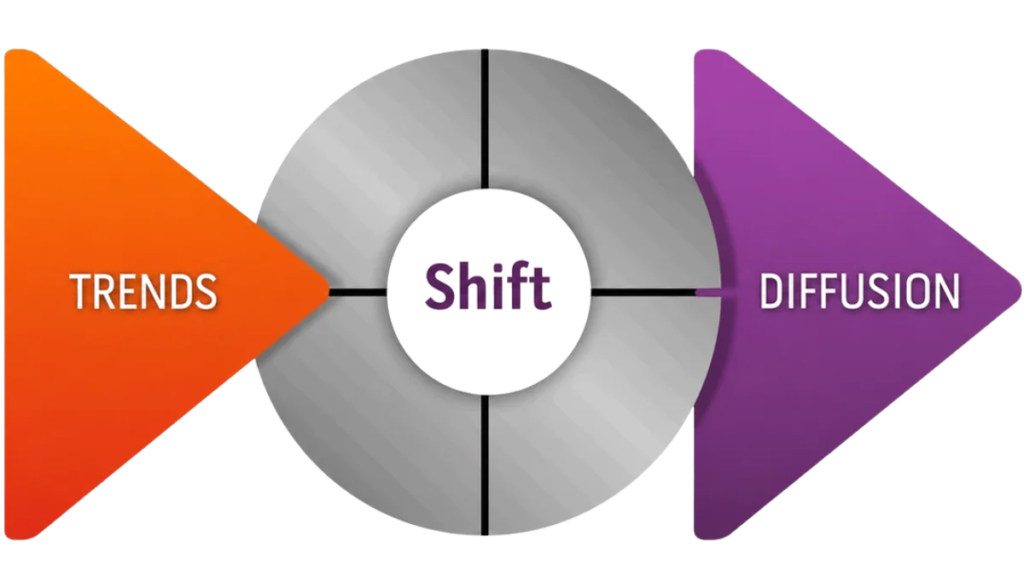
The Shift invents itself along a path in three movements: focus, permanent (r)evolution and social expansion. Separately, each one produces effects. Together, they create a lead that is hard to catch. Here is how each one works, illustrated by documented cases.
Stage one, focus: seeing what others cannot see yet
Any competitive advance depends on your capacity to perceive trends inside the current economic chaos and the noise of over-information. In a world saturated with data and constantly evolving ideas, accentuated by the flood of content generated by artificial intelligence, the ability to identify relevant signals has become a crucial skill.
Spotting the right trends still falls short of enough. You also have to distinguish those that pass from those that settle, and many organisations fail at it through a lack of collective method rather than a lack of intelligence. Focus is determined by your strategy and the collaborative work of your teams, to identify the trends that are most disruptive, credible, applicable and adaptable to your organisation.
The foresight heritage, from Igor Ansoff to weak signals
To understand why this stage counts so much, you have to go back to the discipline that invented it long before management: foresight. The concept of the weak signal, that early tremor announcing a major change, was theorised in the 1970s by the strategist Igor Ansoff, who observed that organisations always reacted too late because they waited for complete information before acting.
His proposal was radical for the time: learn to decide on partial, ambiguous and uncertain information, rather than wait for the certainty that arrives only when it is too late to draw any advantage from it. A weak signal is therefore defined as fragmentary information whose strategic reach exceeds its immediate visibility. That is exactly what focus seeks to capture.
Foresight has bequeathed an essential distinction between three levels that organisations routinely collapse into one:
- The weak signal is isolated and barely readable, and its strategic reach exceeds its visibility.
- The emerging trend confirms itself through several independent occurrences.
- The fad is already everywhere and brings no further advantage to whoever follows it.
The most instructive documented failure remains that of the large video rental chains, which held every weak signal of the tipping towards dematerialisation and chose to read them as a passing fad. Focus transposes this foresight heritage into the daily life of the company. The work is to organise the collective reading of signals so the three levels never get confused, rather than to predict. It is a team job, and never the stroke of genius of an isolated leader.
Veja, focusing on value where the market was looking elsewhere
When Veja launched its first pairs in 2005, the global sneaker market was dominated by logics of overproduction, massive marketing and low-cost offshore manufacturing. To measure the audacity of the choice, you have to recall how that market worked.
The big sports brands devoted a considerable share of the price of a shoe to its promotion rather than to its manufacture: sponsorship contracts, global campaigns and permanent presence in spectator sport. The product itself was often one of the cheapest raw materials in the value chain, with most of the margin coming from desirability manufactured by communication. It was a perfectly honed model, profitable, and it looked unsurpassable.
Veja did the exact opposite: no advertising budget, no marketing department, and total investment in the production chain, organic raw materials and fair trade. This choice was a deliberate focus on a trend the mass market had yet to validate, the growing demand for products whose manufacturing story survives examination.
At its birth, the bet looked like a weak signal. A few consumers were starting to question the origin of what they bought, without that yet constituting a market. Twenty years later, the bet is won. According to the most recent data available, Veja reached a turnover of 250 million euros in 2024 and employs more than 600 people across Europe and Latin America, while holding to its historic refusal of classic advertising in favour of investment in quality.
Hybrid work and AI, the signals many organisations missed
Remote work was not born with the pandemic. Studies on new forms of work had documented since the 2010s a growing aspiration among team members for more autonomy in organising their time. Companies that had focused their attention on this signal early were able, when the pandemic hit, to put solid protocols in place, preserve the cohesion of their teams and attract talent where others improvised in emergency mode.
Those that discovered the subject overnight reaped the effects of an unpreparedness built over years. The same phenomenon is replaying with generative artificial intelligence. Australian Bureau of Statistics data shows that around 12 per cent of Australian businesses reported using AI in their workplace in 2024-25, a sharp acceleration from the previous survey.
Adoption is running ahead of governance. The National AI Centre reports that trust is now the single biggest reason Australian small and medium businesses hold back, with around 65 per cent of non-adopters citing distrust of AI decision-making or a preference for keeping humans in control. Organisations that anticipated this signal already hold usage frameworks, charters and internal skills, while others are barely discovering the questions of governance and content reliability.
Focus predicts nothing about the future. It simply keeps you from being surprised by what you could have seen coming. By focusing your efforts on credible, applicable and durable trends, you waste neither time nor energy following short-lived fads.
Stage two, permanent (r)evolution: doing the opposite of what is expected
Once the promising trends are identified, you still have to integrate them proactively and keep making them evolve. This is where permanent (r)evolution comes in, the second stage of the Shift. The term is deliberate, since it contains both continuous evolution and rupture.
The Shift asks more than doing things differently. It often asks you to do the opposite, or to do what everyone does before everyone does it. Companies that have understood this logic have grasped a destabilising truth: innovation on its own falls short, creativity refuses to spring from a brainstorm, and inventiveness is anything but innate. It is cultivated, structured and decided.
Integrating trends does not mean following them
Permanent (r)evolution consists of asking what you will have to eliminate, reduce, strengthen or create. It works as an organisational reflex rather than an annual theoretical exercise, and it demands permanent revision of your processes, your offers and your founding assumptions.
The most frequent trap is to confuse continuous improvement with real transformation. Continuous improvement makes you better at what you already do, and it also makes you predictable. Permanent (r)evolution forces you to question what you do, well beyond how you do it.
Netflix remains the most documented example. The company changed its model radically three times without dying in between: first DVD rental by post, then a subscription streaming platform, then a producer of original content at global scale. Each transition preceded the collapse of the previous model rather than reacting to it.
In fashion, several large retailers integrated collection, resale and recycling programs well before circular consumption became a sector norm, anticipating a European framework that keeps tightening with the digital product passport and extended producer responsibility on textiles. The advantage went to those who moved while the subject was still optional.
Bayer and Dynamic Shared Ownership, an organisational Shift at 100,000 people
When the Shift touches the structure itself rather than only the strategy, it looks like what Bayer, 160 years old and more than 100,000 team members, launched under the name Dynamic Shared Ownership. Dynamic Shared Ownership is an operating model that replaces classic hierarchy with networks of autonomous teams steered in short cycles.
It rests on five structural and behavioural switches rather than values displayed on a wall:
- From scattered, inward-facing KPIs to a reduced number of high-impact objectives, tied directly to the value created for customers and patients.
- From ranked individuals to networked teams, where authority sits in the team rather than in the managerial layer above it.
- From large functions to customer-facing micro-enterprises, each turned towards a precise outcome rather than towards a discipline.
- From annual planning to rapid 90-day cycles, where each quarter teams define their outcomes, test, learn and run retrospectives.
- From reactive preservation to creative thinking about the possible, moving from defending the status quo to seeking what could be, and from demanding certainty before acting to experimenting.
The scale of the change is documented. Bayer reports that management layers have been cut by half and management roles by two thirds, with thousands of teams now working in a self-organised, cross-functional way. In pharmaceuticals, one cross-functional team solved a complex self-infusion problem for haemophilia patients in a single 90-day cycle instead of the usual two years.
This Shift deserves lucidity rather than blissful enthusiasm, and that is precisely what makes it interesting. The restructuring came with thousands of management positions eliminated and a company still wrestling with its wider difficulties a year after the rollout.
Several observers report faster decisions and stronger team engagement. Others openly question the sustainability of the model and ask whether fewer bosses really produces innovation. That is exactly what the Shift philosophy teaches. A permanent (r)evolution offers no guarantee of success. It is an owned bet on movement rather than on waiting, whose verdict gets written over time and never in the launch press release.
Field note
The executive team that wanted its AI charter before everyone else
During an engagement with a mid-sized services company, I was called in to run a workshop labelled internally as “our AI transformation”. The executive team wanted to produce a usage charter and an adoption plan in two days. The intention was sound and the reflex was the wrong one, because I was being asked to package a tool rather than to support a tipping.
Digging in, the picture appeared quickly. Nobody around the table could answer the simple question: what are we going to stop doing thanks to this tool? Teams were stacking a new use on top of unchanged processes. That was continuous improvement dressed up as transformation, exactly the trap the Shift philosophy describes. They were adding, and never tipping.
The operational lesson holds in one sentence I have repeated ever since: a transformation begins with what you agree to eliminate rather than with what you add. As long as no line of the old model has been crossed out, there is no Shift, there is one more layer.
Stage three, social expansion: turning an idea into a movement
An idea, however brilliant, has impact only if it is shared and adopted at scale. This is where social expansion comes in, the third stage of the Shift. Beautiful stories, astonishing facts, visions that make sense and original ideas travel faster than ever.
In this viral world, spreading your new thinking among your candidates, team members and customers becomes a strategic lever in its own right. The work sits far from conventional communication and further still from a media plan. It consists of building an authentic story, creating a community around strong values, and involving stakeholders in the transformation. Social expansion resists fabrication, and it has to be earned.
What Everett Rogers understood about diffusion
This stage rests on a solid theoretical heritage you need to know to avoid confusing it with viral marketing. In the 1960s, the sociologist Everett Rogers formalised the diffusion of innovations, the model describing how an idea spreads first among a handful of innovators, then among early adopters who act as opinion relays, before reaching a majority.
The decisive point of his work holds in one counter-intuitive observation. Budgets rarely tip an innovation into mass adoption. What tips it is the credibility of the first relays and the capacity of the idea to let itself be retold by those who adopt it.
Tesla is the clearest illustration. The brand built itself for a long time without an advertising budget in the classic sense, relying on the virality of its innovations and on a community of fans who spread the story before the company needed them to. This model resists identical reproduction, and it illustrates a universal principle. In a world saturated with messages, what circulates is what surprises and gives the person sharing it the feeling of belonging to something that counts.
Ben and Jerry’s, activating a community rather than an audience
Ben and Jerry’s offers a textbook case of what social expansion produces when it rests on real conviction rather than on a communication strategy. The ice cream brand looks past rallying consumers to its cause and works instead to amplify movements that already exist.
The method is unusual and simple to describe. The brand goes to see activists, asks them how it can help, then builds its campaign from there. Repetition over decades does the rest, since a brand that runs one activist campaign creates a press cycle, while a brand that runs dozens across forty years creates a category.
The commercial lesson matters as much as the ethical one. Positions taken have repeatedly triggered calls for boycott without breaking the brand, because a community that knows exactly why it chooses a product absorbs the shock that an audience would not. That resilience is the real return on social expansion.
Social expansion is not played only towards customers, since it starts inside. Organisations that succeed in their transformation are often those whose team members become ambassadors spontaneously, through understanding what the organisation is building and wanting to be part of it rather than through obligation or an internal campaign. This internal buy-in signals that the Shift has stopped being a strategic decision and become a culture.
Want to turn that buy-in into a durable engine? Discover how to structure a real managerial transformation that carries your teams instead of imposing itself on them.
The traps of the Shift philosophy
Adopting a posture of permanent movement carries risk, and I prefer to say so frankly rather than sell a miracle recipe. Two drifts lie in wait for organisations seduced by the Shift, and ignoring them condemns the posture to turn into agitation.
Mistaking movement for agitation
The first trap is to take instability for agility. An organisation that changes course every month, launches projects it never finishes and exhausts its teams in the name of permanent reinvention is practising something other than the Shift. It has confused the verb with the movement.
Permanent (r)evolution presupposes rigorous prior focus. You tip on what counts, after choosing it, rather than tipping on everything. The Bayer case is a useful reminder here, since the verdict on its Dynamic Shared Ownership remains unwritten and serious observers openly question the human sustainability of such a sustained rhythm. The Shift is a discipline of chosen movement rather than an invitation to permanent chaos.
Managing change fatigue
The second trap is human. Organisational psychology research has long documented a weariness in the face of repeated transformations, which erodes engagement and trust when changes follow one another without anyone seeing their sense or their end. A badly supported Shift posture produces exactly that effect.
This is why social expansion works as a structural component rather than a cosmetic supplement. Giving sense, telling the why, and carrying teams inside the decision is precisely what separates a transformation that is lived from one that is endured. Without that work on sense, permanent movement turns against the organisation that triggered it.
How to install the Shift philosophy in your organisation
Understanding the three stages falls short of living them. Here are the concrete conditions that separate an organisation that talks about transformation from one that practises it, as I observe them in the field.
Start with what you stop, not with what you add
The first reflex to invert is accumulation. A real transformation begins with a subtraction: which process, which ritual or which offer are you going to eliminate. As long as no line of the old model has been crossed out, you are stacking one more layer and calling it a change.
The Shift philosophy imposes the question of elimination before the question of addition, exactly as permanent (r)evolution demands with its grid of eliminate, reduce, strengthen and create. The exercise is uncomfortable for a reason: subtraction has an owner, and addition never does.
Shorten your decision cycles
The Bayer example shows it. Moving from annual planning to 90-day cycles changes the very nature of an organisation. A short cycle forces you to test, to be wrong quickly and to correct, rather than to bet a whole year on a frozen hypothesis.
You need nothing like the size of a multinational to apply this principle. A small or medium business can decide that each quarter one strategic hypothesis will be tested and settled, rather than deferred to the next annual offsite. It is one of the simplest levers for making a managerial transformation tangible rather than declarative.
Move from reading to practice
Want to install the Shift philosophy as a collective reflex in your organisation? Make your teams live the three stages with a keynote built on your culture and your real priorities.
How I can help you master the Shift philosophy
The Shift philosophy holds value only once it leaves the page to become a practice shared by your teams. That is precisely what I do on stage and in workshops, drawing on lived cases, recent sources and tools your managers can apply the next day.
My keynote on the Shift
My keynote on the Shift makes your teams live the three movements of this posture, focus, permanent (r)evolution and social expansion, through documented company stories and engagement anecdotes. The objective is to leave with a fresh reading of your own weak signals and a grid for deciding what to eliminate, strengthen or create, well beyond inspiration for the photo.
The format adapts to your challenges, from an opening keynote for a conference to a bespoke intervention built on your culture and your priorities. Want to program this session for your next event? Discover the available formats and request a date on my page devoted to the bespoke keynote, so we can build together a session that speaks directly to your teams.
Workshops and support for executive teams
Beyond the stage, I support executive teams who want to turn this posture into an organisational reflex. The workshops work on collective focus applied to your trends, the permanent (r)evolution grid applied to your real offers, and the social expansion mechanics adapted to your brand.
That team work is where the Shift philosophy stops being an idea and becomes a culture, durably. Each session starts from what your organisation actually does today rather than from a model imported from somewhere else.
Conclusion: inhabiting change rather than enduring it
The Shift is a fundamental change of posture in the face of a world that no longer waits for you to be ready. It asks for something other than transforming for the sake of transforming, or innovating to signal that you innovate. It asks you to see before the others, to move differently from the others, and to make that movement collective.
Focus, permanent (r)evolution and social expansion are the three movements of this posture. Separately, each produces effects. Together, they create something that resembles a lead that is hard to catch. That is the whole point of the Shift philosophy: stop enduring change as an event, and inhabit it as a culture.
Frequently asked questions about the Shift philosophy
What is the difference between the Shift philosophy and change management?
Change management steers a transition between two known states, with a starting point and an arrival point. The Shift philosophy refuses that target state and treats change as an uninterrupted flow. Where the first stabilises, the Shift keeps the organisation moving towards states nobody knows yet.
What are the three stages of the Shift philosophy?
The Shift philosophy articulates in three movements. Focus consists of spotting weak signals before they become fads. Permanent (r)evolution pushes you to do the opposite of what is expected rather than simply improve. Social expansion turns an idea into a collective movement carried by a community.
Why is continuous improvement not enough in the Shift philosophy?
Continuous improvement makes you better at what you already do, and it also makes you predictable. Permanent (r)evolution, at the heart of the Shift, forces you to question what you do rather than only the way you do it. That is the difference between optimising a model and daring to change one.
Do you need to be a large company to apply the Shift philosophy?
No. Bayer applies the Shift across more than 100,000 team members, and the principles hold at every scale. A small business can shorten its decision cycles, decide each quarter to test one strategic hypothesis, and start by eliminating an obsolete process instead of adding another. The Shift philosophy is a posture rather than a question of size.
Where do you start to install the Shift philosophy?
Start with subtraction rather than addition. A real transformation begins by identifying what you are going to stop doing, well before what you are going to stack on top. As long as no line of the old model has been crossed out, you have one more layer and no Shift. Ask the elimination question before the innovation question.