

The 6 circles of managerial transformation
The 6 circles of managerial transformation give managers a clear roadmap, letting them adjust their approach to the engagement and innovation roles the job now carries. It takes a manager from establishing trust through to putting shared responsibility in place across their team.
The product of several years of work and thinking, this step by step method guides leaders through the essential stages of their craft while avoiding passing management fashions.
The 6 circles of management innovation came out of the need for a logical, simplified path that a manager, experienced or not, can follow to keep their practice current. I also needed something to explain clearly the gaps between traditional management and current approaches.
The 6 circles of managerial transformation, also called the pillars of management innovation, illustrate the challenges managers face. They point the way to harmonising individual fulfilment with collective performance, and everyday work with innovative initiatives.
The 6 circles of managerial transformation
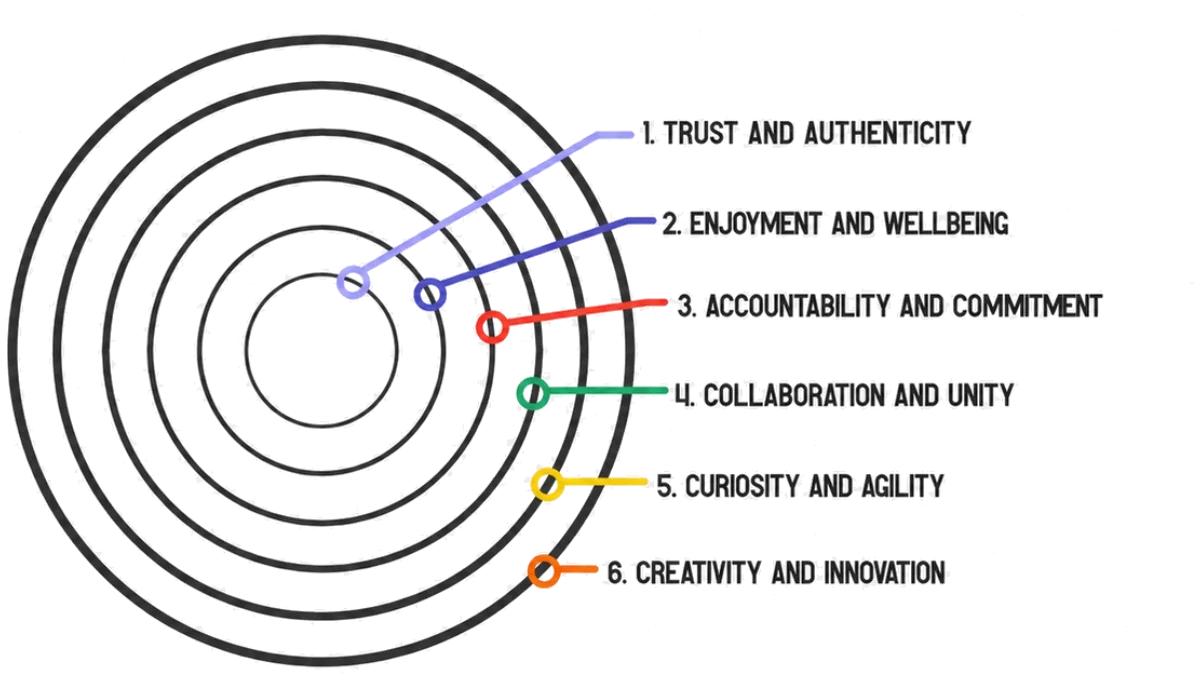
The six circles form a sequential path. Each circle has to be assessed and mastered before moving to the next, since there can be no wellbeing without trust, and no engagement without wellbeing. The six follow each other in this order.
- Trust: the foundation value of the path, fed by empathy and authenticity.
- Wellbeing: the balance between what a team member wants to do and what they are able to do, with working conditions, the right to be wrong and mutual help. It is one of the essentials of the innovation leader.
- Engagement: the voluntary decision to invest yourself over time, carried by enablement, transparency, reciprocity and fairness.
- Collaboration: mutual respect, complementary skills and the pooling of what each person brings, the ground where the most disruptive ideas germinate.
- Curiosity: openness to the outside and the will to understand complex or ambiguous situations.
- Creativity: the end of the path, running through inspiration, inception and ideation, and the point from which innovation is born.
What this tool is for
Assessing your managerial practice
Supporting the circles, the managerial transformation assessment measures your practices circle by circle and gives you a score out of ten for each one. After running it with several thousand managers and their teams, I found that a poor score on one circle almost always has its cause in the circle before it.
Getting out of the pile-up of management fashions
Every year brings its fashion: trust in 2010, freedom in 2013, collaboration in 2016, responsibility in 2017, curiosity in 2019, hybrid management in 2022 and regenerative leadership in 2023. I am not questioning any of these trends, they all count. Each concept piles up in a manager’s head though, and manufactures endless complexity. The circles connect these notions to each other and give them a context.
Answering the management crises
Managers today face seven simultaneous crises. The step by step approach of the circles gives them a path to follow, so they can answer those crises coherently rather than treating each one in isolation.
For the detail of the model, where it came from and how it works, read the full article on the 6 circles of managerial transformation.