

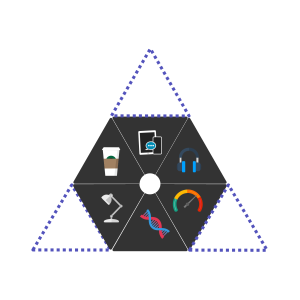
Hybrid management pyramid
Hybrid management is a management approach that combines elements of on site work, remote work and remote management. This way of managing allows employees to work both from a physical location such as the office and remotely, usually from home.
Hybrid management calls for leadership styles, communication tools and organisational practices to be adapted so that productivity, engagement and team cohesion are maintained in a flexible working environment. The model aims to take the best of both worlds, offering the flexibility and autonomy of remote work together with the benefits of collaboration and social interaction on site.
When I dealt with hybrid and remote management myself, while running an agency with offices in several Australian cities and in several countries across Asia, I developed a diagram to understand everything at stake and to make sure nothing was forgotten. The diagram is made up of three triangles representing the dangers of remote work. At their centre sits the hexagon of hybrid management solutions, which completes them.

With this in mind I developed the hybrid management pyramid, which rests on the three dangers of remote management: isolation, confusion and exhaustion. These dangers point to the six elements managers can act on within hybrid management.
The 3 dangers of remote work
Isolation
Isolation can be a major challenge for employees who are not prepared for remote work. The lack of social interaction and real-time support can create a feeling of isolation in the face of change and greater autonomy. This feeling can be made worse by very personal experiences, such as handling family or mental health problems without the usual support network of the office. Isolation can therefore affect an employee’s motivation, productivity and even mental wellbeing.
Confusion
Remote work can also create a great deal of confusion and worry, especially when employees are not well prepared. Faced with uncertainty, many of them fear that they will no longer measure up, or that they will lose power or responsibility. This need for clarification and new rules can create extra stress, which affects the quality of the work and job satisfaction. Managers therefore need to be proactive in communicating expectations and objectives so that this confusion never takes hold.
Exhaustion
Exhaustion is another potential danger of poorly managed remote work. Back-to-back virtual meetings, uncertainty about how to behave while working remotely, and looking after children around the table can all contribute to burnout. When emotional distress rises, an employee’s wellbeing can decline quickly, and that has consequences for their performance and their engagement. Putting measures in place to protect the wellbeing of remote employees is therefore essential.
The 6 response elements of hybrid management
Each section offers practical solutions for managers who want to minimise the dangers of remote work and hybrid management.
Culture
Isolation and the loss of cultural bearings are major dangers of hybrid work. Without a strong, shared culture, employees can lose their sense of belonging to the company.
✅ Solutions:
- Clarify and share the company values through rituals and set-piece moments such as meetings and internal events.
- Build an inclusive culture where every employee, wherever they are, feels involved and recognised.
- Encourage exemplary leadership, where managers embody the principles of the company and keep restating them.
Capabilities
Faced with confusion and exhaustion, managers need to know the skills of their employees along with their capabilities and soft skills. This makes it possible to allocate tasks more effectively, especially in a fast changing world.
✅ Solutions:
- Map the skills and the needs of employees so that assignments fit each person.
- Build personalised development paths, suited to the new demands of hybrid work.
- Give priority to continuous upskilling with training designed for both remote and on-site work.
Organisation
To avoid isolation and exhaustion, managers need to set up systems that make the move between remote work and office work seamless, which in turn maximises productivity.
✅ Solutions:
- Set clear rules on office attendance and remote work so that no ambiguity remains.
- Use digital project management tools to ensure the transparency and the coordination of tasks.
- Adapt the physical workspaces so that they support collaboration when a return to the office is needed.
Engagement
Emotional engagement is essential in the fight against isolation and exhaustion. Managers need to pay attention to the emotions of their employees and take steps to maintain a high level of engagement.
✅ Solutions:
- Put cohesion rituals in place (virtual coffees, weekly check-ins and team building sessions).
- Celebrate the wins, even from a distance, through regular feedback and moments of collective recognition.
- Listen actively to the needs of employees through surveys and frequent one-on-one conversations.
Communication
Clear and regular communication is essential to remove confusion and isolation. Managers need to make sure that every employee knows exactly what is expected of them and when.
✅ Solutions:
- Define the right communication channels for each type of information (Slack for instant messages, email for formal ones and meetings for strategic discussions).
- Standardise the communication rituals, such as weekly catch-ups or internal newsletters, so that information silos never form.
- Train managers in hybrid communication, and in particular in active listening and the handling of virtual interactions.
Collaboration
Finally, to fight isolation and confusion, managers need to encourage a working environment where trust and collaboration are valued. This lets employees gain autonomy while knowing that they can count on the support of their team.
✅ Solutions:
- Make asynchronous collaboration easier with digital tools that allow ideas to be shared effectively (Miro, Notion and Trello).
- Create hybrid workspaces that encourage co-creation (coworking and modular offices).
- Encourage cross-functional projects to stimulate exchanges between teams.
Using the hybrid work pyramid
Strengthen your company culture, even from a distance
A solid, shared company culture can serve as the foundation for performance and wellbeing. It creates a sense of belonging and direction, which can lift motivation and job satisfaction.
✅ Good practices:
- Define and share common values, in particular through internal events and regular communications.
- Encourage an inclusive culture where every employee feels involved, whatever their place of work.
- Maintain team rituals (virtual coffees, weekly meetings and shared wins) to strengthen cohesion.
Develop your knowledge of the capabilities of your team members
By knowing the real capabilities of your employees, you can assign them to tasks that draw on their current skills and prepare them for future challenges. This can lift their engagement and their sense of achievement.
✅ Good practices:
- Map the skills and aspirations of the teams through regular conversations and self-assessment tools.
- Put individual development plans in place to support the growth of your talent.
- Encourage continuous learning by offering training and mentoring.
Keep the organisation effective, even from home
A smooth transition between remote work and on-site work can minimise wasted time and lift productivity. It lets employees concentrate on their work instead of on logistical problems.
✅ Good practices:
- Set clear work rhythms (days in the office, flexible hours and fixed meetings).
- Use project management tools (Trello, Asana and Notion) to guarantee transparency and task tracking.
- Encourage good personal organisation habits, such as time management and the prioritisation of tasks.
Strengthen emotional engagement
A manager who pays attention to the emotional wellbeing of the team reduces stress and encourages greater job satisfaction. Over the long term, this improves productivity and talent retention.
✅ Good practices:
- Encourage regular feedback and open exchanges about how employees feel and what they expect.
- Put concrete wellbeing measures in place at work (psychological support, flexibility and team events).
- Adapt your management to the emotional needs of the teams, by establishing a culture of trust and listening.
Ensure clear and smooth communication
Effective communication is crucial to avoid misunderstandings and inefficiency. Knowing who does what and when helps maintain a high level of productivity while reducing the stress that comes with uncertainty.
✅ Good practices:
- Define the right communication channels (Slack for instant messages, emails for structured information and meetings for important decisions).
- Clarify the expectations and responsibilities of each member of the team.
- Encourage regular moments of exchange, and in particular team retrospectives and project reviews.
Adopting an effective hybrid work model takes more than technology or flexibility. Structuring the organisation around the six pillars of the hybrid work pyramid is essential:
✔️ A strong company culture, which unites employees around shared values.
✔️ Better knowledge of talent and capabilities, so that assignments are allocated well.
✔️ A fluid organisation, which simplifies the move between on-site work and remote work.
✔️ Stronger emotional engagement, which guarantees wellbeing and motivation.
✔️ Clear communication, which is essential for transparency and efficiency.
✔️ Real collaboration, which you must never confuse with cooperation or participation.