


ICE Matrix
The IFC matrix is an effective, fast and intuitive tool for prioritising projects according to their impact, reliability and feasibility. Although it rests on subjective assessments, it brings greater clarity and efficiency to project management and innovation.
In an environment where ideas, projects and features keep multiplying, prioritising them effectively becomes essential so that resources go to whatever will deliver the most value.
The IFC matrix is a simple and powerful tool used mainly in product management, marketing and innovation to help identify high-impact initiatives while keeping risk and the investment of resources to a minimum.
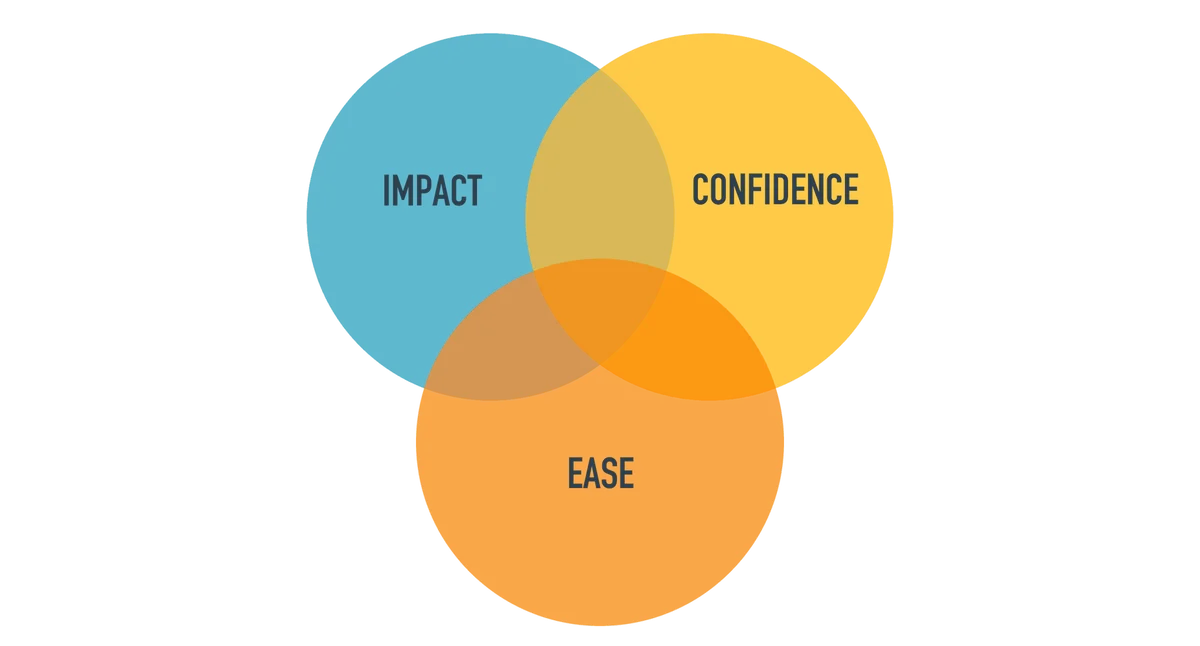
The acronym ICE stands for Impact, Confidence and Ease. These three criteria, which complement the premortem, let you assess quickly and objectively whether a project is worth running before you put it in place. Unlike other, more complex models, the ICE matrix offers a fast and effective decision process that suits companies looking for agility.
How does the ICE matrix work?
The assessment works by giving a score from 1 to 10 to each of the three criteria:
- Impact (Impact): What effect will the project have on the target objective (growth, conversion, customer satisfaction or internal performance…)?
- Ease (Ease): How simple is it to put in place? Does the project demand a lot of resources, or can it be delivered quickly with little effort?
- Confidence (confidence): How certain are we about the estimated impact? Do we hold solid data, or are we still working from a fragile hypothesis?
The final score comes from multiplying these three values:
ICE score = Impact × Ease x Confidence
The ideas and projects with the highest scores get priority, because they represent the best opportunities, with a good return on investment and a measured risk.
A detailed explanation of the three criteria
1. Impact: the effect of the project on strategic objectives
Why does this matter? Impact measures the potential added value of the project. It answers the question: “If we put this project in place, what concrete benefits will we see?“
Examples of impact in a company:
✔️ A change to the user interface can lift the conversion rate on an e-commerce site.
✔️ Adding a loyalty programme can improve customer retention and satisfaction.
✔️ Automating an internal task can reduce costs and optimise productivity.
Scoring the impact:
🔸 A project with minor impact gets a low score (1-4).
🔸 A project with strong potential impact gets a high score (8-10).
3. Ease: the simplicity and the resources needed
Why does this matter? Even when a project looks impactful and reliable, you still need to make sure that it can be delivered quickly and without too much complexity.
Criteria for assessing ease:
✔️ The time needed to put it in place.
✔️ The people and the equipment required.
✔️ The technical or organisational complexity.
Scoring the ease:
🔸 A long and costly project gets a low score (1-4).
🔸 A simple, quick and inexpensive project gets a high score (8-10).
📌 Example: Creating a new logo → this is very easy and earns a high score (9 or 10). Rebuilding an e-commerce site from scratch → this is more complex and earns a low score (2 or 3).
2. Confidence: the robustness of the hypotheses and the data
Why does this matter? You can predict a strong impact, and when that forecast rests on intuition alone you run the risk of a poor decision. Confidence lets you assess the reliability of the hypothesis by drawing on:
- Existing data (tests, studies and user feedback).
- Past experiences (for example, a similar project that worked well).
- The expertise of the teams on the subject.
Scoring the confidence:
🔸 When the project rests on assumptions or intuitions, it gets a low score (1-4).
🔸 When the data is reliable, tested and validated, the score will be high (8-10).
📌 Example : When a company wants to launch a new feature based on a user test with 10 customers, the confidence will be moderate. When the test has been run with 500 customers and solid data, it will be high.
An example of the ICE matrix in use
Imagine a company that wants to improve its user experience and is weighing up three projects:
| Project | Impact (1-10) | Confidence (1-10) | Ease (1-10) | ICE score |
|---|---|---|---|---|
| Rebuild of the user interface | 9 | 8 | 4 | 288 |
| Addition of a customer service chatbot | 7 | 6 | 7 | 294 |
| Improvement of the conversion funnel | 8 | 7 | 6 | 336 |
📌 Prioritisation: The project with the highest score (336), the improvement of the conversion funnel, is the one to tackle first.
Advantages and limits of the ICE matrix
| ✅ The advantages | ❌ The limits |
| ✔️ Simplicity and speed: Complex analysis becomes unnecessary and decision-making speeds up. ✔️ Help with prioritisation: It lets you arbitrate effectively between several ideas. ✔️ Easy to use as a team: It can be built into collaborative workshops. | ⚠️ It depends on subjective assessments : The scores are influenced by the experience and the biases of the assessors. ⚠️ It leaves financial ROI out of the picture : Unlike other tools such as the RICE matrix (which adds the “Reach” criterion, meaning the audience affected). ⚠️ It has to be paired with other methods for a finer analysis. |