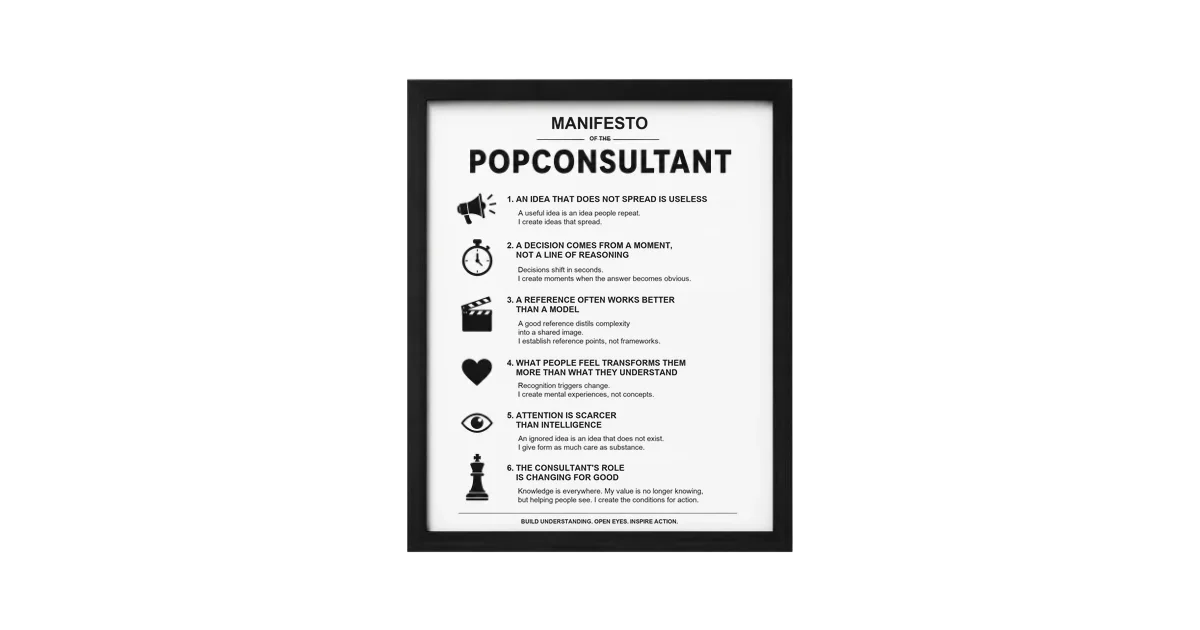
The pop consultant manifesto: six principles for producing decisions rather than reports
If you have read my articles on popconsulting and on the pop consultant, you will have understood that the profession is shifting. Consulting can no longer settle for explaining, because everyone has access to the same explanations. What still creates value is the ability to produce a lightbulb moment, which means turning an analysis into a concrete decision for the people who have to decide.
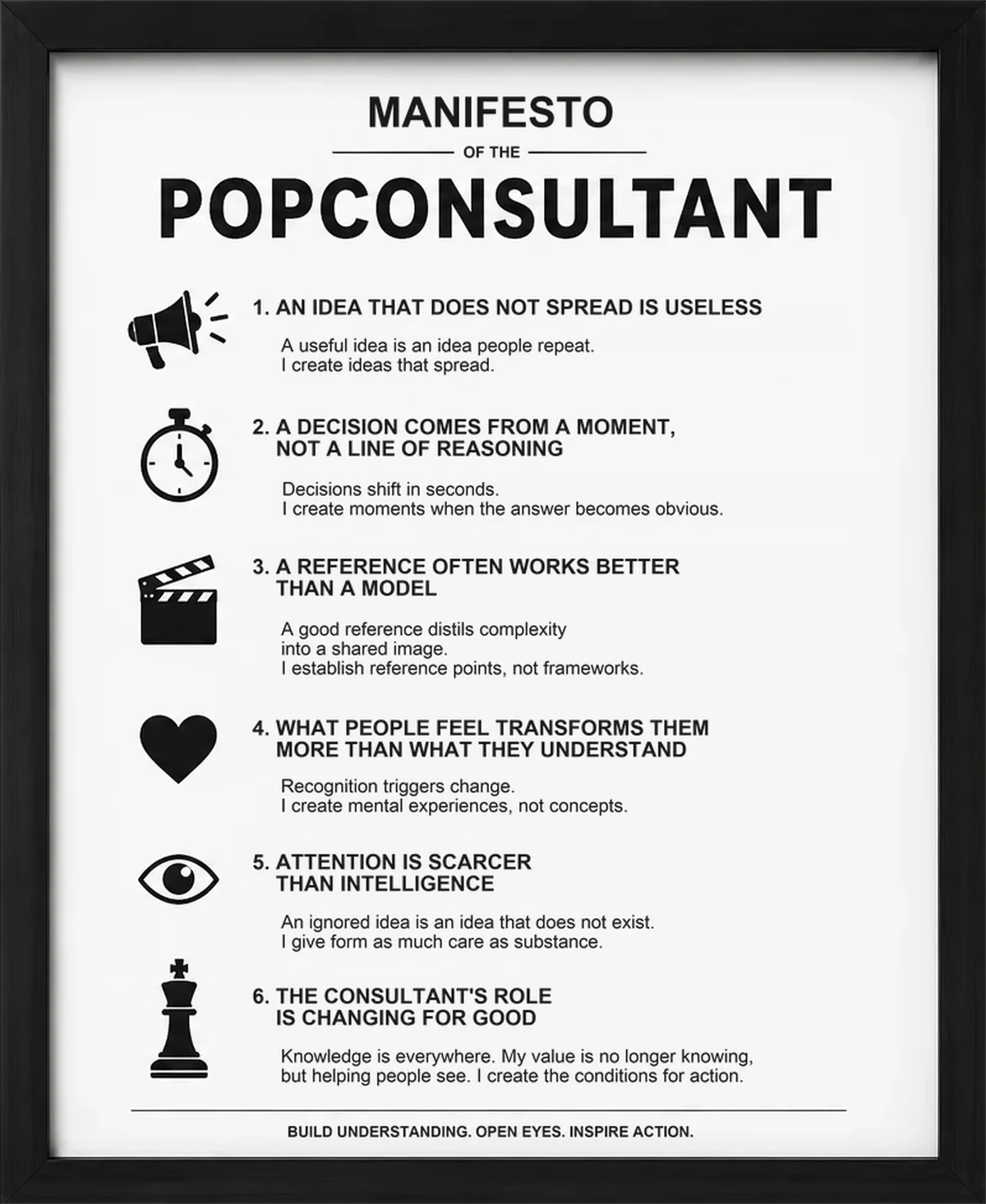
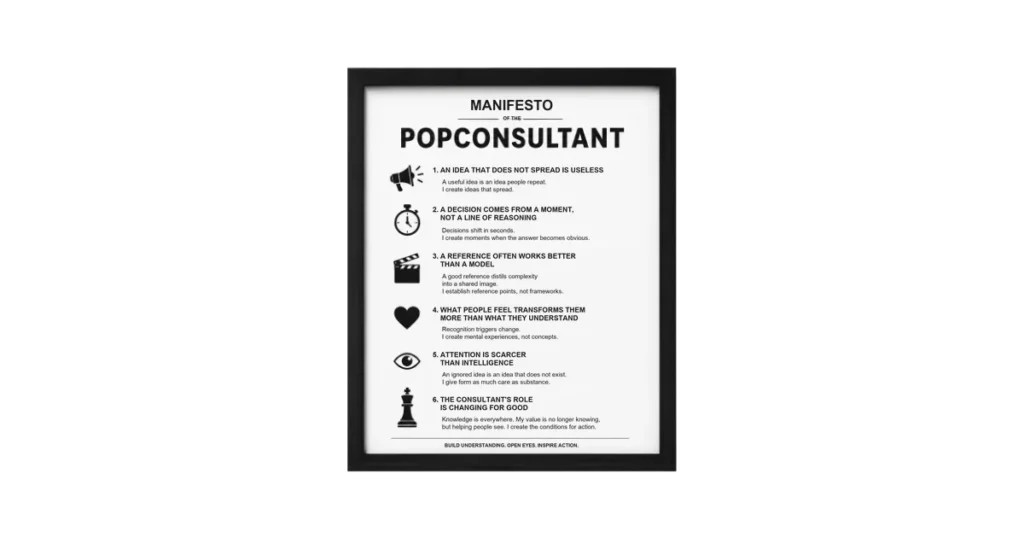
This practice still needs a clear frame. Without one, popconsulting risks sliding towards hollow storytelling or dressed-up entertainment, which discredits it. That is precisely what this manifesto sets out to avoid. It lays down the six principles that structure a rigorous pop consultant, and each one is embodied in a reference or an example. An idea without embodiment stays theoretical, and a manifesto that fails to respect its own rules does not deserve to be read.
| The observation | The shift | The philosophy |
|---|---|---|
| Traditional consulting produces brilliant analyses that trigger nothing. Knowledge has become abundant, attention has become scarce, and executive committees understand without acting. This manifesto sets out a different logic. | Six principles that structure the practice of the pop consultant, each one embodied in a concrete example. An idea has to travel, a decision is born from a moment, a reference is worth more than a model, what is felt transforms, and attention counts for more than intelligence. | Taking on the role of a consultant who produces decisions rather than reports, and who measures impact by what the organisation keeps alive after they leave. The pop consultant triggers decisions instead of transmitting knowledge. |
Why a manifesto, and why now
Before we get to the principles themselves, it helps to understand why this frame becomes necessary at this particular moment. Three transformations make the manifesto useful, and they all converge on the same conclusion.
The profession is changing faster than its landmarks
Traditional consulting had clear codes: a structured report, well-made slides and costed recommendations. The pop consultant breaks those codes without having stabilised any others yet. Without a manifesto, it becomes difficult to tell a demanding practice apart from simple seminar entertainment. This text exists precisely to draw that line.
Authenticity is often confused with improvisation
Many consultants now confuse authenticity with improvisation, as if telling your own story were enough to create a lightbulb moment. That is not the case. A lightbulb moment is built, it is prepared and it rests on solid research. The manifesto is a reminder of that demand.
The risk of empty storytelling is real
As storytelling tools become available to everyone, the risk grows of seeing consultants pile up pop culture references with no real substance. This manifesto also works as a safeguard: if you remove the pop reference from a session and nothing remains, then it is not popconsulting.
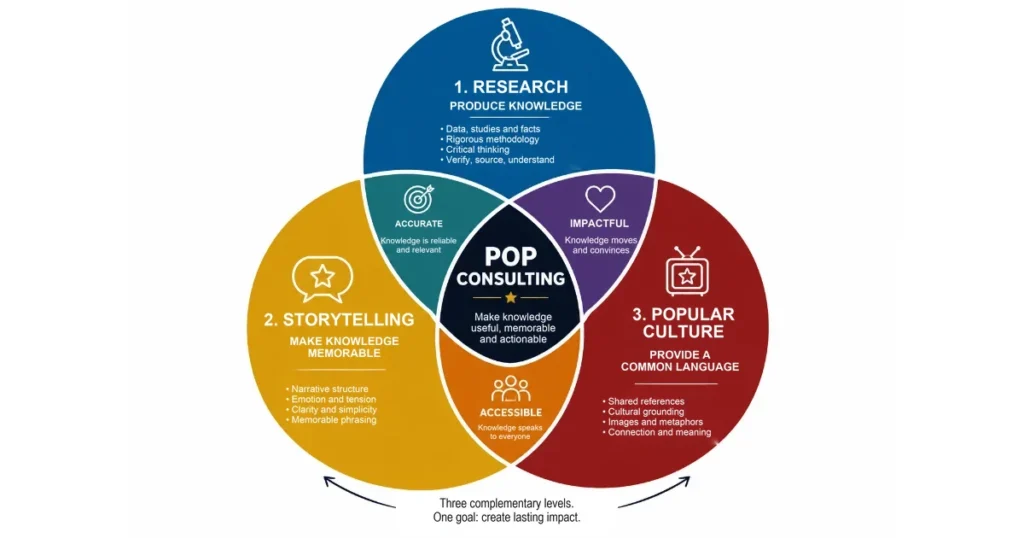
The principles of the pop consultant
Here are the six principles that structure the practice. They are not ranked, they reinforce one another, and none of them is sufficient on its own. Their combination is what produces the intended effect.
Principle 1: an idea that does not circulate serves no purpose
The book Start with Why by Simon Sinek, published in 2009 by Portfolio, invented nothing in substance. Many authors had written similar things before him about meaning and motivation at work. Sinek created a simple, memorable and repeatable form that has travelled on its own for fifteen years. His 2009 TEDx talk, How Great Leaders Inspire Action, has passed 60 million views on ted.com and still circulates in executive committees all over the world.
The pop consultant looks for ideas that travel rather than ideas that impress. The difference is essential. An idea that impresses stays where it was first stated. An idea that travels keeps producing effects long after you have left the room. This capacity for spreading connects directly to the championing dimension identified in the measurement of a team’s innovative behaviour.
Principle 2: a decision is born from a moment rather than from a line of reasoning
Watch any Steve Jobs keynote presenting a product. At the iPhone launch on 9 January 2007 at the Macworld Conference, Jobs staged the product instead of demonstrating it. He began by announcing three products in one, a phone, an iPod and an internet communicator, before revealing that they were the same device. He created an instant where the audience felt the obviousness of it before they had even grasped the technical logic.
The pop consultant works on those tipping points rather than on linear demonstrations. In practice, that means designing sessions as narrative arcs, with a point of tension and a moment of resolution, rather than as a succession of argued slides. The same intuition sits at the heart of creative leadership: human decisions tip at precise moments rather than at the end of a calculation.
Principle 3: a reference is often worth more than a model
When a team starts talking about Succession to describe its own dynamics, it is talking about power, loyalty, family strategy and manipulation, with no slides at all. The series created by Jesse Armstrong and broadcast on HBO between 2018 and 2023 works as an immediate shortcut because everyone has watched the Roys tear each other apart for control of the family empire. Quoting a specific Waystar Royco board scene saves twenty minutes of theoretical explanation about succession issues in family businesses.
The pop consultant installs shared references rather than frameworks to be memorised. Benoît Aubert and Benoît Meyronin argue for exactly this practice in their book De MacGyver à Mad Men, quand les séries TV nous enseignent le management, published by Dunod. The title translates roughly as From MacGyver to Mad Men, when TV series teach us management. They draw on House, Borgen, The Walking Dead and Mad Men to address leadership and strategy. A shared reference creates common cultural capital that lasts well beyond the engagement.
Principle 4: what is felt transforms more than what is understood
Chip and Dan Heath popularised this work in Made to Stick, published by Random House in 2007. They showed long ago that an idea which is lived leaves a more lasting mark than an idea which is only stated. Their acronym SUCCES (Simple, Unexpected, Concrete, Credible, Emotional, Story) sums up the six characteristics of an idea that sticks, and emotion is the fifth of those six characteristics.
Neuroscience confirms that intuition. Research by the neuroeconomist Paul Zak, published in the Harvard Business Review in 2014, shows that a well-built story triggers the release of oxytocin in the listener’s brain. That release correlates directly with the willingness to take action. The pop consultant creates mental experiences, and that is precisely what separates this work from good training. Training transmits knowledge. A mental experience produces a decision.
Principle 5: attention is rarer than intelligence
Platforms such as Netflix worked this out before everyone else. What decides success is the moment content captures attention, more than the sheer availability of that content. When Netflix produces Stranger Things or Squid Game, everything is settled by the ability of the first episode to hold attention within the first ten minutes. The raw quality of the script decides far less.
The pop consultant treats attention as a raw material rather than as a by-product of quality. In practice, that means thinking first about what will capture, then about what will hold, and only then about what will convince. Traditional consulting does the exact opposite, thinking first about what will convince and assuming the rest will follow. In committees saturated with notifications, that inversion is strategic. It is also what helps a team become creative, because creativity starts with the ability to perceive, and therefore with attention.
Principle 6: the role of the consultant is changing for good
Knowledge is available everywhere, in every form and at every price. A senior leader can now learn on YouTube, read the same Gallup studies you read and follow the same authors on LinkedIn. Value moves mechanically towards the ability to make people act, to prompt the decision and to generate movement. Everything else becomes secondary.
This is exactly the movement described in the end of management innovation and the rise of creative leadership. A consultant who settles for transmitting knowledge becomes replaceable by a well-executed Google search or by a generative AI. The pop consultant does something no search engine knows how to do, which is to create the precise moment when an idea becomes obvious to a human being who has to decide. That pressure on the whole trade is the subject of my article on whether consulting is about to face its own disruption.
How to live this manifesto day to day
Six principles make a frame without yet making a practice. Here are three concrete habits that bring this manifesto to life day to day, without falling into the trap of posturing.
Always start from solid research
None of these six principles works without a rigorous factual base. If you draw on Succession to talk about governance, you need to have read the recent studies on family dynamics in business. If you quote Sinek, you need to know the academic criticisms of his model. Pop culture is the language of the pop consultant rather than its content.
Test before you present
A good reference is not discovered in the meeting itself. It is tested, ideally on three or four different people, to check that it produces the intended effect. If the reference fails in testing, it will fail in committee. The pop consultant prepares tipping points the way an actor prepares lines, through iteration.
Measure impact by what survives
The real indicator of success is what survives three weeks later in corridor conversations rather than the applause at the end of the presentation. If a team keeps using your reference, reformulating your metaphor and drawing on your frame, then you have done your job. If none of that happens, you have provided entertainment. Your approach then needs a rethink.
What this manifesto implies for what comes next
Adopting these six principles has consequences. It requires giving up certain reflexes of traditional consulting and building others that are more demanding in some respects.
Giving up the authority of the expert who knows
The pop consultant no longer arrives as the person who holds the truth. The job is to create the conditions for the organisation to see its own truth. That position calls for humility. It also unsettles a number of practitioners who are used to a different relationship with the client.
Accepting the extra rigour these principles demand
Building a shared reference, creating a tipping point and capturing attention all demand far more preparation than a classic report. The pop consultant works twice as hard upstream to deliver a session that is half as long. That is what makes the skill rare.
Taking on a new professional identity
Adopting this manifesto means accepting that you will no longer look like the traditional consultant. It means taking on a new professional identity that can surprise people. It also means positioning yourself in the only space where consulting still produces value that nothing else produces.
If you want to go further, you can revisit the pillar article on popconsulting which sets out the method in full, or explore the article on the pop consultant which describes the professional figure who embodies this manifesto.