Simon Sinek is probably the best known business speaker on the planet, and the clearest popconsultant example available to anyone who wants to study the trade. His 2009 TED talk, How great leaders inspire action, sits among the most watched talks ever published on TED.com, and the Golden Circle it introduced has become common property in boardrooms across Australia and well beyond. His register borrows freely from research vocabulary, which gives him the bearing of a scientist rather than a speaker.

His background explains a good deal. Before he turned to leadership, Sinek began his career in New York advertising, at Euro RSCG and then at Ogilvy and Mather. That lineage matters, because the strategies he uses to move ideas through books, keynotes and consulting engagements come from a craft whose entire object is making an idea memorable.
His case is instructive for understanding the pop consultant trade and the mechanics of popconsulting. Sinek shows what narrative craft produces when it is pushed to its best level, and by contrast he throws light on what still sits with whoever practises this job.
| The case observed | What it teaches | What still has to be earned |
|---|---|---|
| The most visible popconsultantSimon Sinek offers the most studied popconsultant example in the world, with a TED talk among the most watched ever published and a formula that has entered the common vocabulary of management. A career in advertising preceded the work on leadership, and it explains the command of idea transmission. | Narrative mechanics can be learnedCondensing a complex idea into a formula that travels on its own, building tension and staging a moment of tipping all belong to an identifiable craft. That craft is teachable, legitimate and worth borrowing. | Research as the load-bearing floorPopconsulting stands on three combined floors: research that produces the knowledge, narrative that makes it memorable and popular culture that gives it a shared language. Remove the first floor and the other two lose their footing. That is the position taken here. |
Scientific vocabulary works as an attention accelerator
Borrowed science gives a simple idea relief. Naming the neocortex, the limbic system or dopamine lifts a management statement over the listening threshold of a leadership team that has already heard a thousand of them. The technique is old, it works and it carries one specific risk that deserves naming out loud.
What brain words do inside a boardroom
Sinek attributes durable corporate success to the human neocortex, the weight of passion in business to the limbic system, and the pull of social media on your team members to dopamine. Whether those shortcuts are accurate belongs to neuroscientists. What belongs to my trade is their effect on a room.
I do not rule on the science in their place. I watch what happens once the word lands. The audience leans in, the note taking starts and the idea acquires a density it did not have thirty seconds earlier.
Halitosis, the advertising ancestor of the neuroscience name drop
The technique sits inside a long advertising tradition. In the 1920s the word halitosis was close to unknown outside medical journals. An American manufacturer, Gerard Lambert, put it at the centre of a campaign for a product called Listerine, and turned an ordinary fact of life into a legitimate medical condition.
Bad breath existed long before the campaign. What the campaign added was a clinical label, and the label did the selling. Lambert found the term in a press clipping, recognised immediately that it gave him something to build on and never looked back.
The test to run before borrowing a scientific term
My rule fits in one sentence. Strip the scientific vocabulary out of a statement, and if an original, evidenced analysis survives, the register was the right one. If only an obvious truth survives, the vocabulary was carrying the whole demonstration on its own.
The procedure works, and a pop consultant gains by recognising it in order to handle it with judgement. I use the same test on my own material before a keynote goes anywhere near a stage.
Direct assertion works as a decision tool
Another strength of Sinek sits in the way he asserts. His tone stays measured and generous, and his formulations still establish without ambiguity that he is offering a direction rather than a hypothesis. A leadership team under decision pressure treats that difference as a gift.
Why an imperative travels further than a hypothesis
Take his most famous formula, Start with Why. It arrives in the imperative, it names a point of departure and it settles the question on the reader’s behalf. A brain under decision stress welcomes a clear instruction, and that is precisely what the formula supplies.
Compare it with a qualified version of the same claim. Organisations whose stated purpose is clear tend to communicate more consistently. The second sentence is more defensible and nobody repeats it in the lift on the way out.
Research on how managers receive new proposals points in the same direction. Asking why an idea is innovative puts a manager in a frame that gives a genuinely creative proposal a fair hearing, which is one of the mechanisms behind why managers reject new ideas that deserved better.
The price of deciding on the reader’s behalf
The technique produces excellent effects when it pulls a leadership team out of analysis paralysis with a readable heading. It asks one thing in return: the direction given has to rest on something other than the authority of whoever is speaking.
That is exactly the limit set out in the pop consultant manifesto. Popular culture serves the analysis, and it never replaces it. An imperative with nothing underneath is a slogan with better posture.
Assumed conviction works as an adoption accelerator
One Sinek video on younger generations at work travelled a very long way. He explained their difficulty adapting inside companies by their upbringing, by the participation medals handed out in childhood and by the mechanics of instant gratification. The construction of that video repays close study, whatever you make of its conclusion.
How the generations video was built
Its success comes from its assembly. Sinek chains a complete inventory of psychological, sociological and neurological reasons, then delivers the lot inside one continuous account the viewer follows without effort. Millions of views and enthusiastic comments turned it into a reference for part of the YouTube ecosystem.
Nothing in that assembly is accidental. Each reason arrives at the moment the previous one has created an itch, which is the oldest structure in persuasion and still the most reliable one.
Where I part company, the category of analysis
My disagreement bears on the object rather than the method. Explaining professional behaviour by an entire generation treats as homogeneous a group that is nothing of the sort. A person raised in Broken Hill and a person raised in Mosman share neither the same environment, nor the same schooling, nor the same relationship to work.
Every preceding generation has received the same reproach from its elders, from the hippies of the 1960s to the slackers who followed them. That is why I now work on intersocialisation, the principle that differences observed at work come from the successive environments that shaped a person rather than from a year of birth. The narrative mechanics of that video remain remarkable, and its category of analysis remains debatable.
What his own team publishes about doubt
One clarification is owed here, because the easy criticism would be to accuse Sinek of never doubting in public. The material published by his team shows the opposite, and a fair reading has to account for it before any verdict is passed.
A column signed Team Simon recommends learning to say I do not know as an executive skill. Another builds its case on the value of an eight minute phone call by linking out to studies published in JAMA Psychiatry, the psychiatry journal of the American Medical Association, and in the Proceedings of the National Academy of Sciences. The charge of systematic absence of nuance does not hold as a general rule.
What the Sinek case teaches about the trade
The case forces two findings to be held together, and they look opposed until you sit with them. Sinek is an outstanding technician of idea transmission. His success also exposes a permanent temptation in this job, which is letting the story run ahead of the research that is supposed to feed it.
What this popconsultant example gets right about transmission
Turning an abstract concept into a memorable formula, producing a Golden Circle that has travelled on its own since the day it was published and structuring a narration that lodges in millions of heads all belong to genuine craft. On the pure mechanics of popconsulting, Sinek serves as the reference in most conferences on the subject.
The Golden Circle itself deserves a plain definition, since it gets quoted far more often than it gets described. It is a three ring model, why at the centre, how around it and what on the outside, arguing that people respond first to the purpose behind an offer.
The permanent temptation of letting the story outrun the research
A formula circulates faster than the study that grounds it. It quotes more easily, it survives a bad recording and it fits on a slide. A pop consultant therefore works continuously against that slope, which concerns nobody in particular and threatens everybody in this trade.
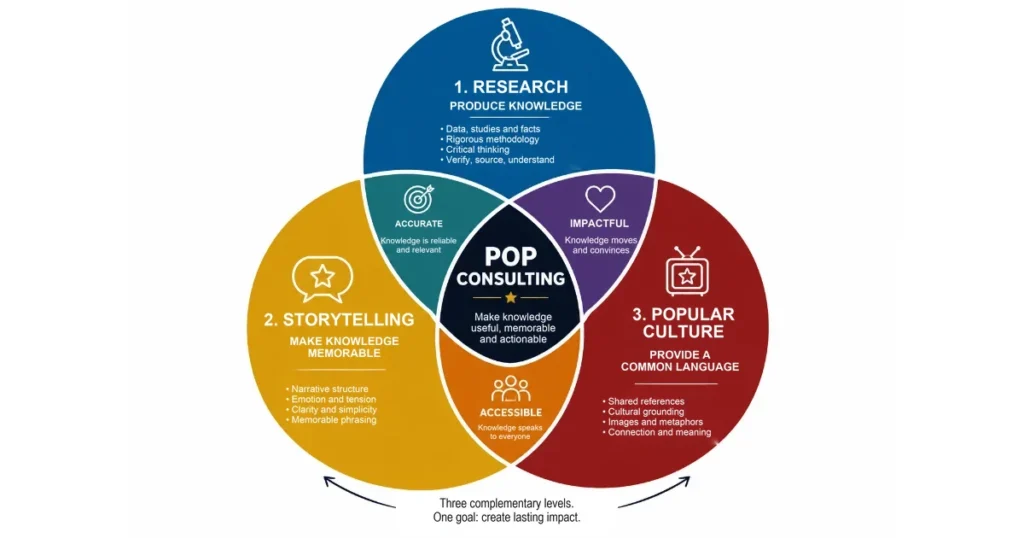
This tension defines the rigorous pop consultant precisely. The trade rests on three combined floors: research that produces the knowledge, storytelling that makes it memorable and popular culture that gives it a shared language. Sinek delivers a masterclass on the last two, and the first stays with each of us.
Field note
The leadership team that had its why and nothing else
A services business I worked with had run a purpose workshop eighteen months before I arrived. The output was framed and hanging in reception, and every member of the leadership team could recite it without hesitation. I was called in because nothing downstream had changed: the same three client segments, the same pricing, the same hiring profile and the same two managers doing most of the leaving.
I asked one question in the opening session. Which decision did you take differently because of that sentence? The room went through eighteen months of minutes and found one, a sponsorship renewal. The formula had been adopted as a piece of language, never as a filter applied to choices. Nobody had lied to them and nobody had tested the idea against their own numbers either, because the keynote that introduced it had been booked as a morale item rather than as a working session.
An idea that changes no decision inside six months has been consumed rather than adopted. Book the speaker, then schedule the working session that turns the formula into a filter, with a named owner and a list of choices it is supposed to change.
What a pop consultant can borrow from Sinek
Unqualified admiration and blanket rejection are both lazy responses. The useful reflex isolates what deserves to be borrowed outright and what needs a personal dose. Two items sit firmly in the first category and two in the second.
Borrow outright, the formula that travels on its own
Borrow without hesitation his capacity to condense a complex idea into a formula that moves by itself. Start with Why remains a textbook case of a business formula that outlives its author, and that is exactly the sort of output a pop consultant sets out to create for clients.
His command of narrative tempo is worth the study too. When Sinek presents an idea, he builds the tension, he stages the tipping moment and he releases the obvious. Most consultants deliver the obvious first and wonder why nobody remembers it.
Dose to taste, the scientific register and the certainty level
Dose personally the use of scientific vocabulary. A rigorous pop consultant calls on neuroscience when it genuinely explains the mechanism, and drops it when the idea stands up on its own. The test in the first chapter settles the question in about ten seconds.
Dose the displayed level of certainty as well. Making visible what the studies establish, what experience suggests and what stays open strengthens an argument over time rather than weakening it. Audiences forgive an unresolved question, and they remember a confident claim that fell apart in the field.
Want the method behind the formula?
Ready to build ideas that survive the drive home instead of dying with the applause? Read the full popconsulting method for turning ideas into decisions and apply it to your next leadership session.
How to weigh a pop consultant against your own criteria
Choosing who speaks to your leadership team is an investment decision, and it deserves explicit criteria. The Productivity Commission has found management capability critical to innovation and Australian businesses performing poorly on it, which raises the stakes on what a leadership team imports from a stage.
Three questions to ask on the way out of the room
These three questions give a quick, applicable test the moment the session ends. They cost nothing, they take a minute in the corridor and they sort serious work from stagecraft faster than any reference check.
- Did the speaker cite verifiable studies you can find and examine for yourself?
- Did the speaker qualify his, or her, claims, or present a view that cuts against the central argument?
- If you strip out the popular culture references and the scientific vocabulary, does an original, evidenced analysis remain?
Three positive answers point to substantive work. Three negative answers point to a performance, which stays honourable in a theatre and falls short in a leadership meeting.
The same discipline applies before the booking rather than after it. Commissioning work on curiosity in leadership comes with its own list of questions to put to a provider, and the answers show whether you are buying a change in capability or an event.
Performer, subject expert or pop consultant, compared on explicit criteria
The three profiles answer different needs, and confusing them produces most of the disappointment I hear about after conferences. This comparison sets out what each one sells, when to book them and how to test the result afterwards, so the brief matches the intention.
| Criterion | Stage performer | Subject expert | Pop consultant |
|---|---|---|---|
| What you are buying | Energy and a shared moment | Depth on one narrow question | A decision made easier to reach |
| Best moment to book | Conference opening, end of a long day | Technical seminar, expert committee | Strategy offsite, the day before a call is made |
| What to ask for beforehand | Running order and audience fit | Publication list and prior clients | Sources behind the two or three central claims |
| Main risk | Applause without action | A room that loses the thread | A formula that travels further than its evidence |
| Test three months later | People remember the day | People can restate one finding | People can name one decision that changed |
How I can help you put this reading to work
Reading a speaker well is a skill, and building your own ideas to that standard is another. I work with leadership teams on both, through keynotes that carry their sources and through working sessions that turn a formula into a filter applied to real choices.
Keynotes built to survive the drive home
My keynotes on regenerative leadership, enableship and the age of fragility are built on the same discipline described here. Every central claim carries a source your team can open on the way back to the office, and every model comes with the boundary where it stops working.
Regenerative leadership describes a way of leading that restores the capacity of the people and systems it uses rather than drawing them down. Enableship names the leadership of innovation, the practice of creating the conditions in which other people produce the new thing. The age of fragility describes an operating context where exposure, rather than uncertainty alone, sets the agenda for leadership teams.
Workshops and diagnostics that test an idea against your own numbers
The session that matters usually happens after the applause. I run workshops and leadership diagnostics that take an adopted idea, your own purpose statement included, and test it against the decisions your team actually made over the last two quarters.
The output is a short list of choices the idea should have changed and did not, with an owner against each one. Manager communities and internal leadership programs use the same format on a recurring rhythm, which is how an idea stops being a poster and starts being a practice.
Simon Sinek, a popconsultant example to study without dogma
Sinek offers the most visible popconsultant example in the world and the best demonstration of what the mechanics of popconsulting produce in the hands of someone who has mastered them. His capacity to condense a complex idea into a formula that has travelled on its own for years, his sense of tempo and his command of the tipping moment make him a reference for anyone interested in this trade.
His case also carries a reminder that the power of a technique never guarantees the solidity of what it carries. A well built formula circulates just as fast when it holds a rigorous analysis as when it holds an attractive hunch, and the difference shows neither on stage nor in the view count.
The pop consultant trade is built at that intersection: borrow the narrative rigour, dose the vocabulary taken from the sciences and keep research as the floor you never negotiate. Sinek teaches the first part superbly and leaves the third to each of us, which is why this popconsultant example is more useful than either a takedown or a tribute.
Frequently asked questions about the popconsultant example
What is a pop consultant?
A pop consultant works at the meeting point of research, storytelling and popular culture, turning verified knowledge into ideas that leadership teams can actually use. The popular culture supplies a shared language and the research supplies the substance. Remove the research and what remains is entertainment with a lectern.
Is the Golden Circle backed by neuroscience?
Sinek presents the Golden Circle as a pattern he codified and connects it to the structure of the brain. Treat those brain references as an illustration of the model rather than as evidence for it. The model earns its keep through clarity, and the neuroscience framing is a transmission device.
How do I choose between a keynote speaker and a consultant?
Decide what you want to be different three months later. Book a speaker when you need a shared moment and shared language, and book a consultant when a specific decision has to move. A pop consultant covers both, on condition that the brief names the decision in advance.
Is generational analysis reliable for managing a team?
Generational categories group together people whose environments have almost nothing in common, which makes them weak predictors of behaviour at work. Successive environments of socialisation explain far more than a year of birth. Ask what shaped a person’s expectations rather than which label their birth year attracts.