


The 6 levels of autonomy
Autonomy is about an employee's ability to organise their own schedule, their assignments and their obligations without a manager watching over them continuously. It calls for a high level of trust, solid skills and effective communication, so that the employee makes sound decisions and acts proactively.
The 6 levels of autonomy became a live subject during the COVID-19 pandemic, which acted as a catalyst for remote work and forced companies and employees to reconsider their traditional ways of working.
As remote work becomes a new norm for many workers and a firm expectation from candidates, it is essential to understand the different levels of autonomy at play.
As you can read in my article on the 6 levels of autonomy in remote work published on my site dedicated to new ways of organising work, there are six distinct levels of autonomy.
These levels vary in autonomy, in equipment, in management posture and in working conditions.
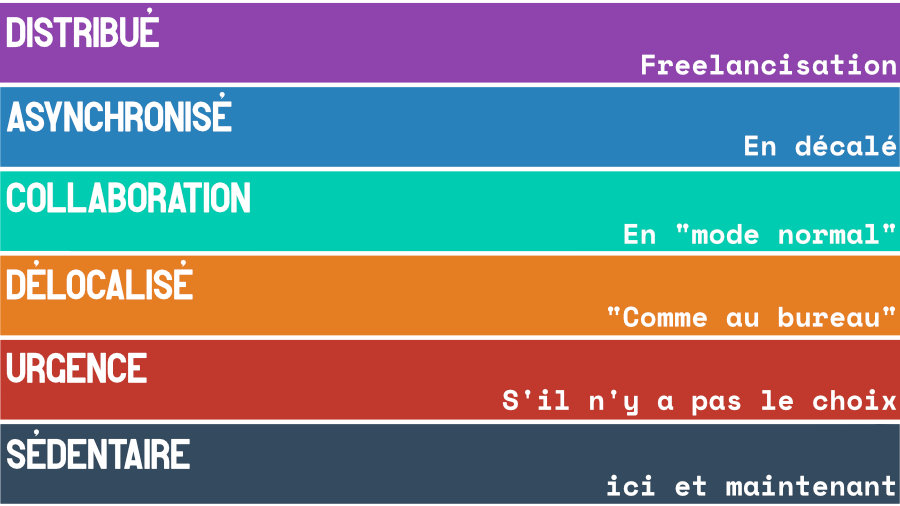
The levels of autonomy
Level 0 – Anchoring
This level covers jobs that require a physical presence, such as building workers or bar staff. Remote work is out of reach for these roles. The point here is that the nature of the work itself keeps some jobs firmly on site.
Level 1 – Improvisation
This level is marked by an ad hoc approach to remote work, often with no preparation or planning. Companies at this level generally have no intention of allowing remote work on a regular basis. Employees can handle basic tasks such as sending emails, while collaborative work and access to sensitive documents usually stay in the office.
Level 2 – Acclimatisation
Here the aim is to recreate office conditions at home. Companies provide more sophisticated tools such as Zoom or Teams to make communication easier. Remote work at this level remains rare and tightly framed, often limited to a few days a month or a year.
Level 3 – Connection
This level represents a fuller adaptation to the new normal of remote work. Companies provide the necessary tools along with the training and the managerial support that make effective collaboration at a distance possible. Remote work becomes more regular and more institutionalised, and employees are granted greater autonomy.
Level 4 – Shift
At this stage we start to move into the future of work because work adapts to the daily rhythms of employees and leaves the traditional office timetable behind. The focus sits on productivity and creativity, and hours spent in front of a screen lose their importance. Management also centres on results and support, with surveillance and punishment falling away.
Level 5 – Distribution
This level represents the final stage of autonomy in remote work. The company has no fixed office; everyone works remotely. The focus sits on meritocracy, complete autonomy and collective responsibility. Teams are often global, and the workplace can be anywhere, from home to a local cafe or even another country.
In short, these six levels of remote work autonomy offer a useful framework for understanding where a company sits in its adoption of remote work and which steps it can take to improve the effectiveness and the wellbeing of employees in a way of working that keeps spreading.
Using the 6 levels of autonomy
Each level brings its own challenges and advantages in terms of management and performance. The move from one level to the next needs careful planning and execution so that the benefits are maximised and the drawbacks are kept small.
Level 1: Occasional remote work
Remote management: At this stage the manager needs to be flexible and watchful. In-person meetings are still frequent.
Company performance: Little impact on overall performance, since remote work happens only sporadically.
Level 2: Regular remote work
Remote management: The manager needs to start using project tracking and online communication tools.
Company performance: A slight improvement in productivity is often observed thanks to shorter commuting time.
Level 3: Mostly remote work
Remote management: Trust and autonomy become essential. Managers need training in managing teams at a distance.
Company performance: Operating costs such as office space can be reduced, which lifts profit margins.
Level 4: Fully remote work with flexibility
Remote management: The manager needs to be a transformational leader, able to motivate a team that works entirely remotely.
Company performance: Productivity can rise considerably, though company culture then has to be maintained online.
Level 5: Distributed teams
Remote management: Management becomes decentralised. Remote leadership skills are crucial.
Company performance: Access to a global talent pool , which can improve innovation and competitiveness.
Level 6: Fully distributed organisation
Remote management: The manager’s role evolves into that of a facilitator and a coordinator.
Company performance: Productivity, efficiency and agility are maximised, and the organisational structure needs a complete redesign.