

Rethinking the business model of construction
Spotting and getting ahead of the disruptions in individual house building.
- client request
In a familiar context of fast moving markets and the emergence of disruptive business models, the client asked me to run two participative and playful workshops, each bringing together 50 people. The main objective of these workshops is to challenge the traditional business models of the profession and to build in a thorough look at the new disruptive approaches that are redefining the commercial environment.
The client wants the workshops designed so that participants question the usual working methods and business models of the profession. Participants need to step out of their comfort zone and explore new perspectives, which allows genuine innovation in the design of business models.
Attention also goes to the disruptive business models that are transforming the industry. The client wants the workshops to build a deep understanding of these new models, along with thinking about how they can be adapted and adopted in the specific context of the profession.
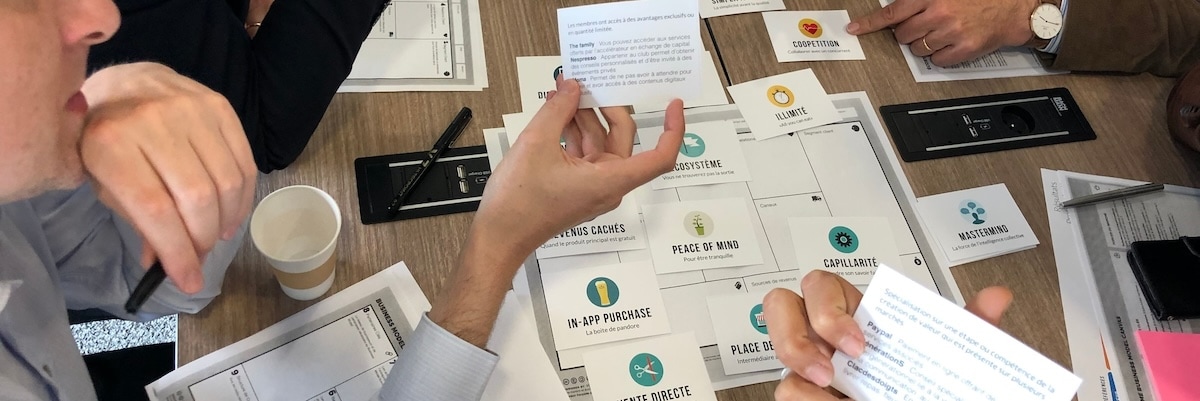
As the photo below shows, I used Volume 1 of my series of card games on business models: "Les business models incontournables".
- challenges
Running participative and playful workshops brings several challenges, because the workshops are meant to question the usual business models and to take account of disruptive business models.
Identifying and anticipating disruptions. The first challenge is to prompt proposals that get ahead of them. Staying on top of trends and innovations in the sector is essential in order to anticipate change and adapt accordingly, which secures the durability and the competitiveness of the business.
Creating a shared imagination. Another challenge is to think about new tools that invite the prospect into a shared imagination with the salesperson, who becomes the co-creator of a shared story. That calls for a deep understanding of what prospects need and want, along with effective and empathetic communication from the sales team.
Combining technological and traditional tools. Keeping in mind that tools built on imagery age badly is another challenge. How, in those conditions, do you combine Virtual Reality and Augmented Reality tools with long standing craft? The task is to find a balance between adopting new technologies and preserving proven traditional methods.
Making it easier to challenge the status quo. Creating an environment where participants are ready to question traditional business models is another major challenge. Building an open and inclusive atmosphere where every voice is heard and every idea is considered matters a great deal.
Synthesis and putting the ideas to work. Finally, the challenge of bringing together the ideas and solutions that emerge from the workshop is a serious one. The ideas generated need to be innovative, and also practical and achievable, and they need to be presented in a way that allows them to be put to work after the workshop.
- stakes
In the context of a session aimed at rethinking traditional business models, there are several issues to address in order to carry out this assignment.
Anticipating disruptions. The main issue is the ability to anticipate the disruptions that threaten builders of individual houses. According to a McKinsey study, companies that manage to anticipate disruptions and adapt to them are 20 % more likely to survive and prosper in the current competitive market.
Establishing effective communication. Establishing effective and empathetic communication between the sales team and prospects is another key issue. A Harvard Business Review study points out that companies which encourage open and honest communication are 50 % more likely to retain their employees and to grow customer satisfaction.
Balance between technology and tradition. The balance between adopting modern technologies, such as virtual and augmented reality, and preserving traditional methods is also essential. Harmonious integration can raise productivity by 30 %, according to a Deloitte study.
Building an environment that supports innovation. Creating an environment where participants are encouraged to question traditional business models is a significant issue. Companies that encourage an innovative environment are 60% more likely to respond effectively to market changes, according to the BCG.
Putting the ideas to work. The final issue is putting the ideas and solutions generated during the workshops to work. According to a Gartner study, 75 % of innovation initiatives fail because there is no practical and structured implementation. Bringing the ideas together and applying them effectively is therefore essential to the success of the assignment.
- solution
Today
Step outside the usual Business Model Canvas to question the most widespread business models.
Dangers
Identify the business models that could put us at risk if they became widespread.
Impact
What effects do these disruptions have on our trades, processes and organisations?
Tomorrow
What strategy do we adopt to surf, outpace or absorb the disruption that is coming?
- results
Here are some of the results from these workshops that were reported back to me.
Stronger legitimacy for the profession. The workshops brought out the importance of building the legitimacy of the profession against crowdfunding and peer-to-peer models. Participants developed effective communication strategies to put forward their expertise, their technical craft, and their commitment to safety and the environment. That work strengthened the image of the profession and set it clearly apart from non specialist third parties.
Reconnecting with customers. The workshops were also an opportunity to rethink pre sales and sales methods so they answer the expectations of new customers, particularly younger ones. Participants recognised the need to go beyond the traditional approach and to put forward independent feedback from other customers. That strategy strengthened trust and built a stronger link with prospects.
Adapting to falling prices. Faced with customers having less to spend, the workshops prompted deep thinking about the need to rethink the business model for selling individual houses. Participants explored various options for reducing sale prices while maintaining quality, and identified potential new sources of revenue. Among the ideas put forward, renting interchangeable houses and monetising the energy produced by positive energy buildings were particularly well received.
Building new strategies. Finally, the workshops made it possible to build new strategies to anticipate and counter the risks tied to disruptive business models. Participants left with concrete action plans to put these strategies to work in their own businesses, which secures the durability and the growth of those businesses in a constantly changing environment.
These workshops raised awareness of the current challenges and issues, and they also provided practical tools and innovative solutions for dealing with them effectively.
TO ORGANISE A KEYNOTE, A WORKSHOP OR A MASTERCLASS