

Why is it that, when an Australian board talks about leadership, purpose or culture, the names in the room belong to Simon Sinek, Brene Brown or Adam Grant, and almost never to one of the Australian management speakers who could do the same job here?
Simon Sinek’s TED talk on starting with why has passed sixty million views on the TED platform, and his interventions have reached well over a hundred million people worldwide. Cal Newport has sold his books in the millions, translated into dozens of languages.
So where are the Australian management speakers with that kind of reach?
Let me say it plainly. There are very few. Australia does not manufacture management superstars, in the sense of globally identifiable public figures who get quoted in meetings, translated, and invited everywhere rather than only at home. That absence has nothing to do with a shortage of talent. The country is full of first-rate experts, some sharper than their overseas counterparts.
The whole subject sits in one distinction. An expert is defined by competence and can stay invisible. A superstar is defined by recognition, and therefore by visibility. The real question is why Australia fails to turn its experts into superstars, given that it has no shortage of experts. The missing link is the transformation step, well beyond raw brainpower.
To understand that missing link, I will look first at how the United States manufactures its superstars, because that is where the whole thing is decided. Only then, held up as a mirror, do the Australian blockages become legible. The American machine is the source. Australia’s singularity is the target.
| The mis-framed question | What the pattern shows | The shift proposed here |
|---|---|---|
| No absence, a missing linkAsking where the Australian management speakers are invites a blunt answer: there are almost no Australian management superstars, in the sense of global public figures. Yet the country produces first-rate experts. What is missing is the step that turns an expert into a visible figure. | An asymmetry of circulationThe gap is one of diffusion rather than depth. American ideas travel through a complete machine of books, talks and platforms, while Australian ideas of equal or greater quality rarely reach the same circulation, held back by culture and market structure. | Experts, not yet superstarsThe shortfall is one of transformation rather than ideas. Australia knows how to train experts, it is less practised at turning them into superstars, and it tends to cut down the ones who start to become so. |
How the Americans manufacture management superstars
Before asking why Australia struggles, it helps to understand how the other camp succeeds. The United States does not win on better ideas. It wins because it built a complete chain that turns an idea into a shareable cultural object. That chain is the real subject, and it is largely copyable.
1982, the year the guru industry was born
The management superstar phenomenon has a fairly precise birth date. In 1982, two McKinsey consultants, Tom Peters and Robert Waterman, published In Search of Excellence, a study of forty-three American companies reputed to be the best run. The book sold more than five million copies.
In its wake, the management book market exploded into an industry worth many millions. Tom Peters was reinvented as the first of a new species, the management guru. He has since given more than two and a half thousand talks in dozens of countries, in front of millions of people, and sold around ten million books in total.
That founding moment is instructive. The context of 1982 was an anxious America, watching Japan as the rising economic power and studying its methods. Peters and Waterman took the opposite tack by telling the story of what made American companies succeed. They produced more than a study, they produced a reassuring, mobilising narrative, at the right moment and in an appropriable form.
The pioneers laid down a shared grammar
Tom Peters did not come from nowhere. He sits in a lineage that structured mainstream management thinking after the war. Peter Drucker had established the idea of management as a discipline in its own right. Authors like Jim Collins, Stephen Covey, Peter Senge and Charles Handy extended that tradition, each with a signature concept.
What strikes me is the consistency of the method more than the consistency of the ideas. Each author isolated a central concept, gave it a memorable name, and carried it for decades across books, talks and spin-offs. The thinking passed on by accumulation, each generation citing and extending the last, which created a dense and recognisable graph of authority.
This continuity has a powerful effect. It turns a run of isolated authors into a visible school, one a leader can draw on with confidence. The reference stops being a person and becomes a living tradition that cites itself and reassures by its density.
An idea treated as an editorial product
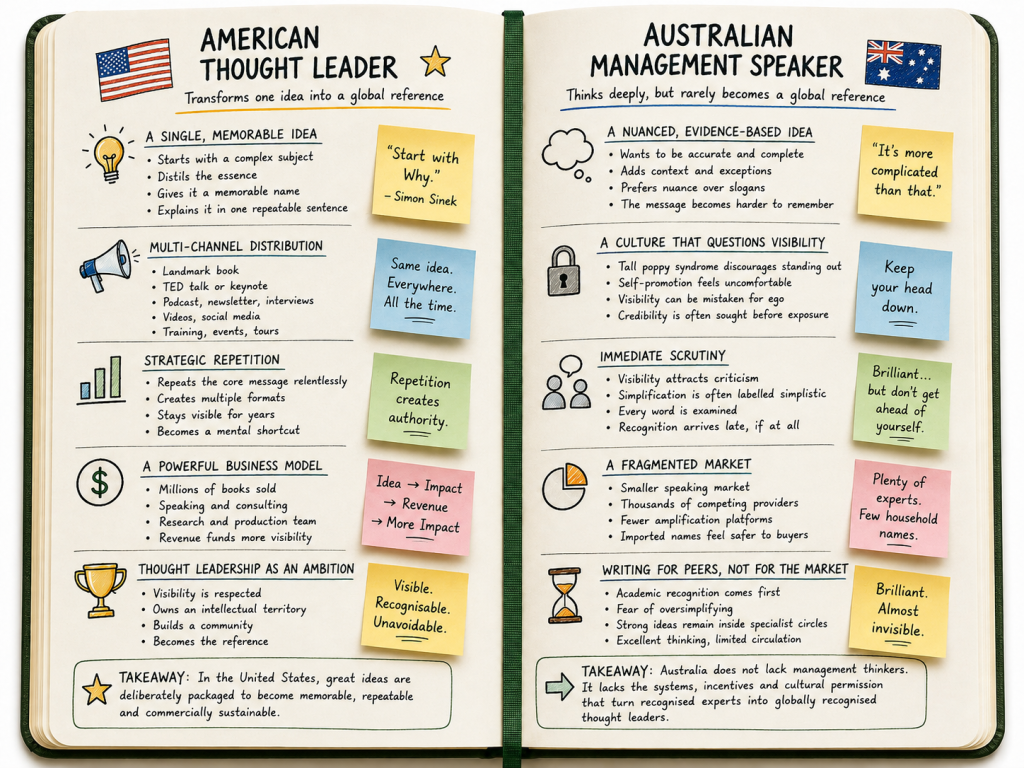
The American mechanism always follows the same logic. You take a complex subject, lift it out of its fog, name it, condense it and repeat it. Then you spin it across every possible format.
- A book that states the thesis and serves as the reference anchor.
- A filmed talk that gives the idea a face and a voice.
- A podcast, a newsletter and video clips that sustain presence over time.
- Training, tours and in-company work that monetise and amplify.
The genius of this system is editorial rather than intellectual. Simon Sinek turned the golden circle into a memorable shortcut any leader can repeat in a meeting. Cal Newport gave a name to a modern pain and the shape of a method to a vague need.
Newport is a particularly instructive case. A computer science professor at Georgetown, he sold close to three million copies of Deep Work alone with no social media presence, by recommendation and word of mouth. The power of a concept comes as much from its circulation as from its content.
Becoming a thought leader, an owned ambition
In the United States, becoming a visible reference is a claimed career path. An expert is not only asked to be competent. They are asked to be visible, to rally, to formulate, to inspire and to embody. The figure of the thought leader, the thinker who occupies public space on a territory of ideas, is a desirable status there, not a suspect one.
This owned ambition changes everything in the making of a management superstar. The American author takes the space early, plants an idea, builds an audience, then reinforces their authority through production and research. They do not chase perfection before speaking. They speak to claim ground, and improve as they go.
The result is an ecosystem where the idea and the figure reinforce each other. The idea makes the person credible. The person gives the idea a body. And repetition does the rest, because a reference is born from years of coherent hammering more than from one good media appearance.
The flaw in the model, when the story beats the proof
This model has a weakness. The same mechanics that make an idea shareable can make it fragile on the evidence. The most documented example is the founding book itself. In Search of Excellence was criticised for weak methodology.
The researcher Phil Rosenzweig showed, in his book The Halo Effect, that the work rested largely on the halo effect, the bias of crediting a successful company with every quality and then presenting those qualities as the cause of the success. Several of the companies held up as models ran into serious trouble in the years that followed.
Tom Peters himself ended up defending the book as a narrative meant to provoke action rather than as rigorous science. That is exactly where the ambivalence of the American model sits. Its diffusion power can serve a sound idea or a shaky one equally well. Simplification is a tool, not a guarantee of truth, and that is precisely what Australian culture eyes with suspicion.
A market that turns an idea into a business
The last cog in the American model is economic, and it is decisive. Over there, a management idea that meets its audience does not stay an idea. It becomes a business, with revenue from talks, books, training and licensing that in turn funds content production and long-term presence.
This virtuous circle changes the nature of the game. An author who sells millions of books and charges high fees can build a team, invest in research, produce a weekly podcast and tour relentlessly. The figure becomes a small organisation dedicated to sustaining and spreading a body of thought, well past a lone individual.
Newport is a clean example again. A full-time professor, he publishes a weekly essay to more than a hundred thousand subscribers, runs a podcast, writes for major magazines and puts out a book every two to three years. That cadence holds only because the ecosystem makes it pay. Profitability funds repetition, and repetition manufactures the reference.
The field even keeps an official scoreboard. Thinkers50, the London-based ranking sometimes called the Oscars of management thinking, codifies who counts, and its lists lean heavily American, with dozens of United States names to a handful from anywhere else. A benchmark built on visibility rewards the machine that produces visibility, which is exactly the machine Australia has not built.
Why Australia does not manufacture management superstars
Now that the American machinery is laid out, the Australian mirror becomes legible. Australia has the raw material, sometimes better, and yet each step of the diffusion chain runs into a cultural, economic or psychological brake here. These brakes are not fixed fate, and they are rarely named.
We think better than we sell ourselves
The average Australian expert has a very noble flaw. They want to be right. They want to qualify, to add context, to note the limits, the conditions and the special cases. On the substance, that is admirable. In practice, it is a disaster for diffusion, because a qualified idea travels poorly.
It cites poorly, transmits poorly and sticks poorly. It does not fit in a sentence or in the mind of a leader between two meetings. Where an American says start with why, an Australian expert risks explaining for twelve minutes that purpose depends on the sector, the managerial maturity and the ownership structure. They may well be right. They will already have lost the room.
The tragedy is that many brilliant people confuse accessibility with vulgarity. They fear simplifying, because they read it as an intellectual betrayal. Their ideas then stay inside circles that already understand each other, a private club of the clever, elegant and strategically useless. The Australian expert is often a fine thinker and a reluctant speaker, and the market rewards only the second half of that pair.
I say this as someone who has fought the same instinct. The urge to caveat is conscientiousness turned against its owner rather than laziness. The expert protects the truth so carefully that they never hand anyone a usable version of it, and usable is the only version that travels.
Tall poppy syndrome, the Australian brake
There is also a cultural brake with a name here. The moment a person becomes a little too visible in Australia, the suspicion arrives with the flat white. Tall poppy syndrome, the impulse to cut down anyone who stands too tall, is documented and widespread. It reads visibility itself as a kind of showing off.
The numbers are not trivial. SEEK’s research finds that one in three Australian workers say they have experienced tall poppy syndrome, and almost a quarter say it is a problem in their current workplace. When standing out carries a social cost, credible people learn to keep their heads at hedge height.
This modesty has an invisible cost. While the Australian expert polishes chapter four to be beyond reproach, someone else overseas has already named the idea, published the book, launched the podcast and booked the collective memory. The beyond-reproach rarely arrives on time.
A smaller, more fragmented market
Economic reality weighs in too. The American market for talks, management books and executive speaking is vast. It lets an idea become a business and funds the ecosystem that manufactures durable figures.
Australia’s market is not small in absolute terms, but it is spread thin. The training and development landscape runs across about 4,000 registered training organisations, alongside countless unregistered coaches, consultancies and in-house learning teams. A market split that finely produces many small voices and few diffusion machines powerful enough to install a figure as a national, then international, given.
That fragmentation is precisely the problem. Australia can produce excellent wine. It has more trouble building the global distribution chain that carries it. The same holds for ideas. The result is a run of respected niche voices and no owned national platform to lift one of them into a household name.
Buyers who prefer the reassuring import
Look at the demand side and the picture sharpens. Conference organisers, learning directors and schools constantly weigh a safe bet against a gamble. Booking an already-installed overseas name is the prudent choice, low risk for the person deciding.
Choosing an Australian voice still on the way up is, by contrast, a reputational gamble. If the session disappoints, the person who programmed it wears it. This asymmetry of risk pushes mechanically towards the reassuring international brand, at the expense of local talent that needed exactly those stages to grow. Cultural cringe, the old Australian habit of trusting the imported over the homegrown, does the rest.
The circle is vicious. Without being programmed, Australian experts never build the exposure that would make them safe bets. Without being safe bets, they are not programmed. Cautious demand and fragmented supply reinforce each other, and the market ends up producing exactly the shortage of figures it complains about.
Writing for peers rather than for the market
Another bias, one I work to undo in myself, is writing for validation by people who already own the subject. Many Australian experts chase horizontal recognition, the approval of specialists. The market rewards something else, namely the ability to speak to intelligent non-specialists, with clarity, teaching and memorability.
You can dislike that logic. It exists anyway. As long as an expert aims first for the esteem of their peers, they condemn themselves to remain a niche reference, cited in three universities and two symposiums, and absent from the conversations that actually shape companies.
A brake that is not only cultural, it is internal
Let me be honest, the system is not the only culprit. There is an internal brake too, one I meet constantly in the experts I coach. Many will not own what visibility demands, because it grates against a certain idea of good taste.
Becoming a figure involves several gestures that feel uncomfortable to a well-raised Australian temperament.
- Repeating the same idea until it anchors, at the risk of boring yourself.
- Simplifying without saying everything, and accepting that some dear nuances get left aside.
- Openly claiming an intellectual territory as your own.
- Stepping forward and owning a presence strategy that looks like marketing.
For many, all of that feels like a sin of taste. So they stay in an honourable zone, neither private enough to be unknown nor sharp enough to be unmissable. The result is a soft presence, which in influence terms is about as useful as a chocolate teapot.
The experts exist in Australia, they just do not become superstars
All of the above could suggest a desert. That would be false, and it needs saying plainly so as not to insult a rich reality. Australia has produced and still produces first-rate management experts. The problem is the visibility ceiling they hit, and the treatment they meet the moment they approach it, rather than any non-existence. The expert is there, the superstar does not take off.
A real Australian tradition the country barely claims
Australia sits closer to the origin of modern management thinking than it admits. Elton Mayo, an Australian psychologist, led the Hawthorne studies that produced the Hawthorne effect and launched the human relations school, the idea that social and psychological factors drive performance more than physical conditions. One of the founding figures of people-centred management was Australian, and almost no one here claims him.
The pattern repeats in the present. Australia has a strong tradition in organisational psychology and leadership research, often written for peers and rarely translated into formats a leader can pick up. It has nourished generations of managers and consultants in depth, without producing the single memorable public figure who could embody it on a world scale. The material was there, the packaging was missing.
The organisational psychology and leadership research produced in Australian universities is genuinely strong, and most of it lives in journals read by other academics. It shapes the consultants and managers who pass through business schools, then stops at the edge of the specialist world. The distance between that work and a book a chief executive reads on a flight is the whole distance between an expert and a superstar.
This is the clearest illustration of my point. A body of thought can outclass the one holding the world stage and stay confidential, simply because it was never designed to travel. Intellectual quality is only one condition among several, and it is never enough on its own. That points to a distinction the debate tends to blur, between the thinker who has the idea and the speaker who can carry it into a room.
Speaker or thinker
A speaker and a thinker are not the same job
A thinker produces the original idea, the framework or the research that did not exist before. A speaker makes an idea land in a room, with the timing, clarity and presence that hold an audience. The first is a work of creation, the second a work of transmission, and each takes years to master on its own terms.
One does not guarantee the other. A brilliant thinker can freeze on a stage, and a magnetic speaker can carry no original idea of their own, packaging the thinking of others with real skill. The rare superstar happens to be both at once, which is exactly why the combination is so valuable and so hard to find.
Australia is full of thinkers who never learned to speak, and hears plenty of speakers who never had an original thought of their own. The gap between the two is where its missing superstars live.
When an Australian figure breaks through, the reflex kicks in
There are exceptions that show the climb to superstar status is possible. Dr Kirstin Ferguson has been named among the world’s leading management thinkers by Thinkers50, frequently the only Australian on the list, and Amantha Imber won the same body’s Innovation Award. Australians do reach the global stage.
Watch what tends to happen next. The moment a homegrown idea starts to install itself, part of the ecosystem sets about deflating it. The critical reflex arrives faster than the support. That is healthy when it lifts the debate. It turns sterilising when the reflex is automatic, and when it discourages the people who were already hesitating to make themselves visible.
The pattern is structural rather than malicious. No single actor decides to keep Australian experts small. The audience reaches for the safe overseas name, the media moves on after one interview, the schools teach the imported model, and each reasonable choice adds up to a ceiling no one built on purpose. That is what makes it hard to see and harder to fix.
The mechanism deserves a close look, because it is the most powerful brake of all. A country that produces few figures and then struggles to tolerate the ones who approach reference status will keep importing its icons. This is where the Australian paradox lives, and it has a name worth examining on its own.
Field note
The board that quoted Sinek and skipped the Australian in the room
At a leadership offsite for an Australian mid-size company, I asked each executive to name a management author or speaker who had shaped them. Seven of nine names were American or British. Sinek, Collins, Brene Brown, the usual reflex.
Digging in, I found that two of the concepts they admired lined up almost word for word with the work of an Australian organisational researcher, published years earlier, that no one in the room had read. The material existed, in plain English, within reach. It had simply never been packaged to travel, so it lived in a journal instead of in their heads.
The lesson is simple. Australia’s deficit is a packaging deficit far more than a thinking one. A sound idea that has not been shaped to circulate does not exist in a decision-maker’s mind, even when it is better than the one holding the seat.
Tall poppy syndrome and the reflex to cut down our own figures
There is a last wall, more uncomfortable than the others. Australia does not only produce few figures. It tends to struggle with the ones who approach reference status. The moment a figure emerges, they become a target, and a severe checking mechanism switches on. On principle this demand for truth is healthy, in practice it sometimes acts as an early guillotine.
Where the tall poppy reflex comes from*
The tall poppy image runs deep in Australian culture, popularised as a national shorthand by Susan Mitchell’s 1984 book of that name and rooted in a genuine value, egalitarianism. Cutting the tallest poppy keeps the field level. Applied to ideas, it means a visible expert is read as someone getting above themselves.
The value underneath is worth respecting. A culture that distrusts hierarchy and self-importance has real strengths, including a healthy allergy to pomposity. The cost appears only at the edges, when the same reflex that punctures a windbag also punctures a serious expert the moment they raise their head to share something useful.
The effect on aspiring figures is chilling in the literal sense. People who could carry an idea into the national conversation choose instead to stay just below the line, where no one can accuse them of thinking too highly of themselves. The field stays level, and empty at the top.
* As understood by a French guy
Cultural cringe, the other half of the problem
The twin of tall poppy syndrome is cultural cringe, a term the critic A.A. Phillips coined in 1950 for the Australian habit of assuming local work is second-rate until an overseas stamp says otherwise. Where tall poppy cuts the local achiever down, cultural cringe waves the imported one through.
Together the two form a pincer. A local expert who dares to be visible risks the tall poppy treatment at home, while the same audience grants instant authority to an overseas name with a bestseller and an accent. The homegrown expert has to prove themselves twice, the import arrives pre-approved.
This is not a fixed law of the Australian character. Cultural cringe has faded in food, film and sport, where local confidence grew once the wins piled up and the audience learned to back its own. Management thinking simply has not had its moment yet, because the pipeline that would produce the wins keeps getting cut at the stem.
The yeah-but reflex that stops a clear idea forming
These reflexes surface in a single phrase that haunts every half-educated Australian conversation, yeah but it is more complicated than that. Of course it is more complicated, reality always is. The phrase has become an elegant way to prevent any clear formulation from ever being born.
A visible figure does not win by saying everything. They win by formulating something simple enough to become useful. The reference, in media terms, is the one that hands others a line to take home, more than the one that holds the whole truth. In Australia that act of simplification gets reread very quickly as simplistic, and that is where the debate goes sterile.
Australian media and platforms illuminate more than they install
A figure is not built alone. It needs stages that repeat it. This is one of the big structural differences between the two countries, and it explains a great deal. The cultural and economic brakes are compounded by a shortage of platforms able to install a figure over time.
The amplification-infrastructure gap
The United States has a dense set of platforms that build public intellectual characters. TED, the big business podcasts, paid speaking circuits, globally minded publishers and influential newsletters form a continuous mesh that carries a name from a room to the world.
Simon Sinek’s TED talk illustrates the amplification effect. Given in 2009 to a modest room, it became one of the most watched talks in the world. The platform, more than the quality alone, turned a good talk into a global phenomenon. Australia has bright stages, and fewer of them wired together into that kind of amplifier.
Australia has genuine assets here, including strong national broadcasters, a lively festival and speaking circuit, and some of the most engaged professional audiences anywhere. What it lacks is the connective tissue that carries a name from one of those stages to all the others, and then overseas. A great talk in Melbourne stays a great talk in Melbourne, where the same talk on the right platform elsewhere becomes a career.
Exposure in Australia exists but stays episodic. An interview, a column, an invitation, then something else. The system exposes, and installs less. It comments, and builds less continuity. An unmissable figure is born from repeated, coherent presence over several years, more than from one good appearance.
The absence of repetition circuits
Repetition is the fuel of memory. An idea heard once is forgotten. An idea heard ten times, across ten different formats, becomes a mental reflex. The American system is built for that repetition, the Australian system much less so.
Australia lacks enough long-running formats that keep an idea alive month after month. Business podcasts are growing, some newsletters are taking hold, and the ecosystem stays scattered and loosely coordinated. An Australian idea rarely meets the frequency of exposure it needs to anchor durably in the collective memory of decision-makers.
This infrastructure weakness combines with the cultural brakes to produce a cumulative effect. Even an Australian expert willing to be visible and to simplify runs into a shortage of stages able to relay the message over time. Individual will is not enough when the shared playing field is missing.
Schools and companies import more than they anoint
Prescribers play an underrated role. Australian business schools teach largely Anglo-American frameworks, given their place in the international academic literature and in rankings that reward publishing in the dominant journals. A student leaves with a management vocabulary that is largely imported.
Companies extend the move. When they want intellectual cover for a transformation, they reach for models already legitimised overseas, easier to sell internally. The foreign concept arrives haloed with a global reputation, where the Australian concept still has to prove itself to the same decision-makers.
This preference is rational for each individual buyer. Aggregated, it starves Australian thinking of the institutional relay it needs to install itself. An idea needs schools that teach it and companies that adopt it to become a reference. Without those relays, even the best idea stays orphaned.
There is a real irony here. Australian business schools rank among the best in the region and export education across Asia, and the frameworks they teach are mostly written elsewhere. A country confident enough to sell its degrees abroad still imports the ideas inside them, which tells you the brake is cultural before it is intellectual.
How to tell a genuine thought leader from a reassuring import
If you book speakers, choose experts or commission thinking for your organisation, the useful question is not which name is most famous. It is which choice will actually change how your people think and act. Weighing an imported guru against a homegrown Australian expert on explicit criteria protects you from paying for a brand and getting nothing that sticks.
What to weigh before you book an Australian management speaker
Comparing the two options against the same criteria settles the choice faster than reputation alone. The overseas name buys brand safety, the local expert buys context and freshness. The table below is decision support rather than a verdict, so read it against your own goals and pick the column that serves them.
| Criterion | The reassuring overseas name | The homegrown Australian expert |
|---|---|---|
| Brand safety for the buyer | High, few people question it | Lower, the choice carries some reputational risk |
| Contextual fit | Generic global frames and US examples | Built for Australian conditions and cases |
| Freshness of the idea | Often a decade-old concept on tour | Current work, still developing |
| Cost | Premium global fee | More accessible, better value |
| What the room remembers | A famous name | An idea they can actually apply |
Signals that an idea will actually travel
Whether you back a homegrown voice or build your own, a few signals tell you an idea is ready to circulate rather than sit in a drawer. They separate a genuine thought leader from a competent expert who will stay invisible.
- The idea has a name a leader can repeat without notes.
- It fits in one clear sentence before it unfolds into nuance.
- It shows up in more than one format, so it can be met again and again.
- It is owned openly, with a person willing to stand behind it in public.
Want to understand how a management idea turns into a concept your teams can actually own and repeat? Discover my four innovation strategies grid to place your own idea and make it memorable, in the dedicated article on the four innovation strategies method.
Make your idea travel, not just survive
Ready to turn your best thinking into a concept people repeat? Explore my four innovation strategies method to place your idea and shape it so it circulates instead of sitting in a drawer.
How I can help you turn expertise into recognised authority
I work with organisations and experts who want their thinking to carry, not only to be correct. As an independent consultant, author and speaker who has spent two decades on managerial culture, attraction, engagement and reinvention, my role is to turn genuine expertise into clear, named, repeatable ideas rather than one more imported concept.
Keynotes and interventions
My keynotes help your teams and leaders see the machinery behind ideas, why some travel and most do not, and what that means for their own work. They draw on recent Australian and international data and on my engagement observations, built to spark a real conversation rather than polite applause.
These interventions suit a leadership offsite, a management convention or a strategy day, and adapt to your context. They pair well with a broader program when you want the ideas to outlast the event and land in daily practice.
Turning your own experts into recognised voices
Beyond the stage, I help organisations do to their own expertise what the American machine does as a matter of course. We extract the thinking of your leaders and specialists, name it, condense it into memorable concepts, and shape it for formats that repeat over time.
This work runs over time, because authority is built by repetition rather than declared in a workshop. My job is to supply the method and the outside eye that turn a strong but invisible expert into a recognised voice. Want to make your best Australian management speakers visible at last? Let us talk about how to build that authority with them.
Conclusion
Australia’s problem is one of transformation rather than brainpower. It trains solid experts and blocks the step that would make them superstars. It admires competence and eyes the staging sideways. It laments the absence of Australian figures and cuts down the ones who approach it.
Meanwhile, simpler Anglo-American concepts, sometimes less sharp, hold the space. They occupy it because they were built to travel, more than because they are better. As long as Australia confuses visibility with showing off, teaching with dumbing down, and embodiment with ego, it will keep producing excellent experts without letting them become superstars, then act surprised that the superstars are always imported.
The encouraging part is that none of this is fixed. Australian confidence has already overturned cultural cringe in food, film and sport within a generation. The management ideas market is waiting for the same turn, and it will arrive faster the moment buyers, schools and media decide to back a homegrown expert before the rest of the world does it first.
So the real question is not where the Australian management speakers are, because they are already here. The real question is whether Australia is ready to let them become superstars.
Frequently asked questions about Australian management speakers
Are there really any Australian management speakers of global standing?
Yes, though they stay less visible than their reach deserves. Australia has researchers, authors and practitioners of genuine standing, and figures like Kirstin Ferguson have reached global rankings. The shortfall is the step that turns solid expertise into a memorable, exportable public figure, rather than a shortfall of talent.
Why do Australian boards mostly quote American management authors?
Because the American ecosystem turns an idea into a complete product: book, talk, podcast, training. That diffusion chain, plus a huge speaking market, manufactures durable figures. Australia’s market, though sizeable, is more fragmented and, through cultural cringe, tends to trust the imported name over the local one.
Does Australia lack management ideas?
No. Australia produces management thinking that is often more nuanced and better grounded than many imported slogans, and even gave the world Elton Mayo and the Hawthorne studies. Its problem is turning those ideas into appropriable formulas, because an idea never shaped to circulate does not exist in a decision-maker’s head.
How does tall poppy syndrome affect Australian management speakers?
Tall poppy syndrome cuts down visible achievers, so experts who could carry an idea nationally often keep their heads down to avoid looking self-important. Paired with cultural cringe, which favours imported names, it forms a pincer that punishes local visibility and waves the overseas brand straight through.
How can an organisation grow its own recognised thought leaders?
By applying the diffusion method to its own expertise: extract the leaders’ thinking, name it, condense it into memorable concepts, then repeat it across varied formats over time. It is editorial and strategic work, not a one-off communications push, and it is how invisible experts become recognised voices.


