How to build an innovation culture is a different question from what an innovation culture is. The second has a tidy answer and the first has an order, which is where most attempts come apart.
Building and holding one matters most during a downturn. Without an active innovation culture, the day job catches up with you and your teams slide into creative stagnation, where whatever creativity remains gets aimed at defending territory rather than expanding it.
That leaves the ground open for competitors who are more innovative than you, who have more to lose than you do, and considerably more to gain.
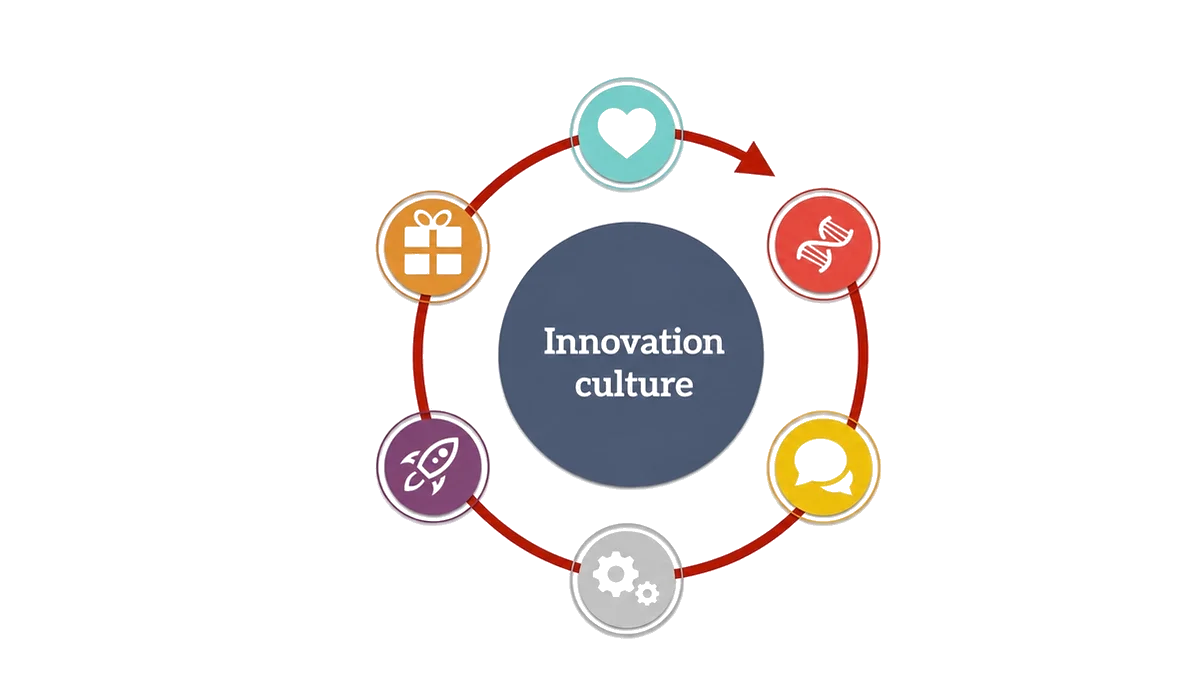
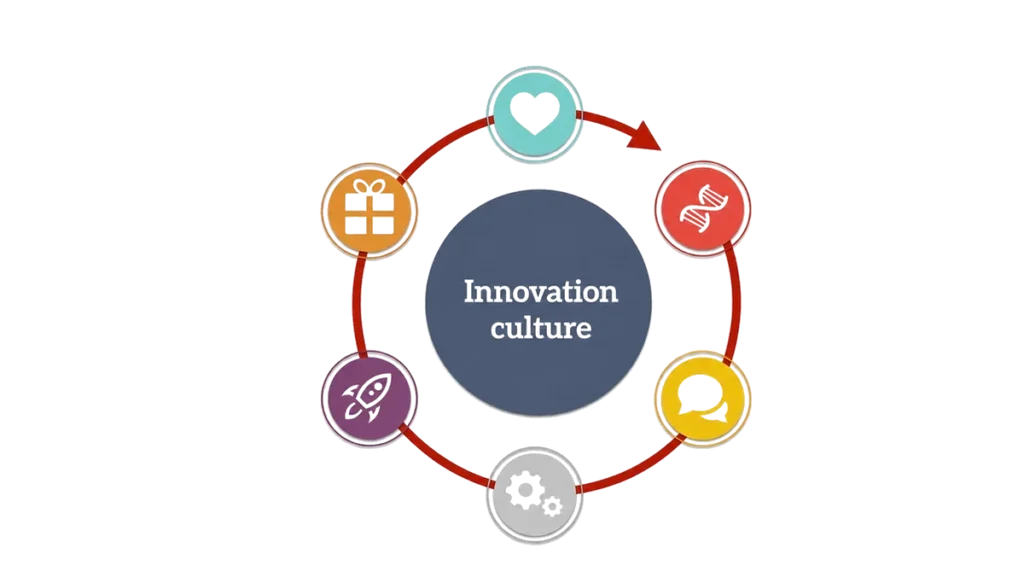
Six components make up an innovation culture. They follow each other in a specific sequence, and this article works through what each one requires.
| The problem | The reason | The solution |
|---|---|---|
| How to build an innovation cultureOrganisations run workshops, buy platforms and appoint innovation managers, then find the output no different a year later. The components were assembled in whichever order was easiest to fund. | Innovation is a by-product, not a programmeAn innovation culture treats creativity as a virtue rather than a nuisance, and treats innovation as the side effect of a suitable management environment. Programmes cannot manufacture a side effect. | Six components, taken in sequenceCulture and purpose, talent and leadership, process and design, ecosystem, offer, and impact on customers and people. Each one makes the next possible, which means starting at the fourth wastes the budget. |

What has to be true before you start
An innovation culture comes down to seeing creativity as a virtue rather than a nuisance, and seeing innovation as the by-product of a suitable management environment rather than as a programme. Those two beliefs decide whether anything you build afterwards holds.
Candour, and ideas detached from rank
An innovation culture supports candour, in the sense Netflix made famous, along with the freedom to voice an idea and to experiment on your own initiative even when the risk of failure is high. It rests on ideas and collaboration being disconnected from hierarchical position.
The person at the top of the pyramid stops being the person with the best ideas. That is why an innovation culture frequently comes down to the democratisation of innovation, which sounds pleasant and costs somebody their monopoly on being right.
My work on cultural toxins and accelerators covers what erodes this, and measuring team creativity covers how to see where you currently sit.
The management model that prevents it
Innovation culture is nowhere near as widespread as performance culture. I still meet managers who hold their team’s motivation together artificially, using fear of job loss and limiting the visible horizon to the end of the month.
The purpose is keeping people in a routine where their place in the organisation never comes up for discussion. Professional exhaustion, loss of interest in your own development and passivity about the future are the symptoms of that model.
The result is people abandoning their own long term while they drown in their organisation’s short one. That would be unobjectionable if it were temporary, and in practice it runs for years in specific functions and departments, with people who will say exactly what they think at the next engagement survey.
Worth noting that these are usually models attached to particular managers rather than to a whole organisation, which is what makes them survivable and also what makes them invisible in an all-staff report.
Where Australian businesses actually sit
National data gives you a baseline before you diagnose your own organisation. The Australian Bureau of Statistics found that 46 per cent of Australian businesses were innovation-active in 2024-25, with 35 per cent of all businesses reporting barriers to innovation.
Two findings from the same release matter for anybody building a culture. Business management was the most commonly used specialist skill for innovation, reported by 46 per cent of innovation-active businesses. And insufficient time was the leading barrier to collaborating for innovation, ahead of insufficient funds.
Read those together and the picture is clear enough. Innovation in this country runs through managers, and what those managers lack is time rather than money.
The six components, in order
Innovation is a continuous effort rather than a one-off project, and it does not necessarily need facilitation methods and sticky notes. What I call event innovation, or innovation team building, is the version that produces a good day and no change. Six components make up the alternative.
Component 1: culture, values, vision and purpose
Know yourself, and build a shared environment so the whole organisation holds one meaning and one understanding of what innovation is for it. These ingredients are so bound into your innovation DNA that this first component is strictly uncopiable.
Even if a competitor adopted every one of your values, the culture that emerged would be different. Copying it would be like eating cereal at midnight because a famous founder does, and concluding that this is what makes his companies inventive.
Competitive differentiation no longer comes from product superiority, exceptional customer relationships or operational excellence alone. Your culture, the values you look for in candidates, the DNA your history produced and your purpose all shape your innovation culture through who you let in, how you allow them to fail and which behaviours you reward or punish.
This component also covers the physical and mental spaces you offer. Standardised desks under harsh lighting with a view of a loading dock, or open spaces that make encounters likely? Look at co-working spaces and at organisations that have done this well. They have more than bean bags and quotes on the wall, and what they have is contact.
Component 2: talent and leadership
Without the talent and the right leadership, your culture and your values are worth very little, which is why this component comes immediately second. An innovation culture depends directly on the management style, or the enableship, you offer your people.
It breaks into three levels. Attractiveness, because talent attracts talent and creative people attract creative people, which means using your networks to show your culture, holding an employer brand that is strong and realistic, and valuing referrals.
Appetites, meaning the natural talents we enjoy using because they mobilise easily and produce results that startle anybody without them. Before anything else you have to know your own appetites, know your people’s, and put them to work.
Leadership is the keystone. What are you doing to make ideas and collaboration emerge, to reduce the fear of failing, and to help your people own the implementation of their own ideas?
Component 3: process and design
Starting on innovation without prior experience is hard. Innovation means change, and leaders fear that change will be negative, so the right processes matter: ways to collect suggestions from customers and staff, and working groups with the authority to act on them.
Your managers need training in creativity tools exactly as they need training in leadership, and your people need to know the phases an innovation passes through. This is why I push leaders towards design thinking or service design, which are simplified design methods running from a customer problem to a tested solution.
You also need a process for evaluating, prioritising and funding ideas, and the more defined and agile it is, the better. Doing something new by following the old method is impossible, so reform your project management approach from the start.
Instead of planning the whole project at once, start small, form light teams combining internal and external talent, work in short sprints, and establish the working process before extending it across the organisation. Beyond funding, resources mean the technology and the people who turn ideas into something real, and having innovation champions matters most of all.
Component 4: ecosystem
An innovation ecosystem is the set of actors inside and outside your organisation who matter to your innovation performance. It is a network of colleagues, entrepreneurs, experts, consultants, researchers, media and, in open innovation, customers with an idea.
Ecosystems create an active flow of information and resources that lets ideas become reality and lets you follow trends while they are still weak signals. You end up with a process where more innovators can develop and launch solutions, exchange ideas and solve problems faster.
That process builds expertise in new fields, diversifies where value comes from, and lets organisations meet customers where those customers already are. It also creates economic stability and shared resources over the long term.
Following weak signals is what I call trendability, a term I coined for an organisation’s capacity to identify and track the trends useful to it, so it can adapt its strategy, products and processes fast enough to anticipate customer needs, create new markets and differentiate itself.
Component 5: products, services and solutions
Innovation investment has to balance across research and development, open innovation and experimenting with ideas from your own people. This component also demands thinking about your business models, following the movement from product to service and from service to solution, which I cover in my piece on the SAVE model.
The larger the organisation, the more problems it has to solve, which means many possible places to aim and makes prioritisation one of the hardest steps in the whole exercise.
The best way to handle it is writing an innovation thesis and sharing it with every senior manager, so your initiatives line up with the long-term strategy. Stakeholders need to see how the new way of doing things produces better results for them, or they will treat it as somebody else’s project.
Component 6: impact on customers and people
The customer half is called leapfrogging. It means creating commercial separation by surprising customers rather than by anticipating them, which is the territory of breakthrough innovation. That requires involving your customers, not to ask for their ideas but to test your hypotheses.
The people half is about rewarding and recognising your own team’s ideas and creativity. The aim is that the best ideas surface wherever they come from, and that you never stop shifting attitudes and holding off resistance to other people’s ideas.
This matters most when your ecosystem is performing well, because your people can start fearing their own ideas will no longer be wanted. Increase the ideas coming from outside and you can expect an equivalent drop in demand for internal ones.
With genuinely ambitious growth targets there should be no ceiling on how many ideas you need. Count how many of the six components sit with human resources and the answer is almost all of them, because surfacing values, managing to permit boldness and recruiting iconoclasts are all HR work.
Field note
The ecosystem that arrived before the leadership
A client had built component four beautifully. Partnerships with two universities, a startup hosting arrangement, an external advisory group and a genuine flow of ideas arriving from outside the organisation. They asked me in because none of it was converting into anything they shipped.
The problem sat two components upstream. Their managers had no discretion over their teams’ time, so an idea arriving from the ecosystem had nowhere to land. Worse, their own people had noticed the pattern: external ideas got meetings and internal ones got a form. Someone in the workshop said out loud that it was easier to get heard by starting a company and coming back as a partner, and nobody in the room laughed.
An ecosystem amplifies whatever culture you already have. Build component four before components one and two and you will import a flow of ideas into an organisation with no capacity to act on them, and teach your own people that their ideas are worth less than a stranger’s.

Six rules for keeping an innovation culture going
Once the components are covered and the tools chosen, one question remains: how do you keep innovating consistently over time? Six rules answer it, and each one is a decision somebody has to defend during a bad quarter.
Set the boundaries, then let go
Treat your innovation culture like a child learning to walk. Set firm limits and let them play however they want inside those limits. Innovation should rest on your organisational objectives, your core capabilities, your customer-facing services and your commitments to stakeholders.
People need to understand what is expected of them, which is practical solutions that can be repeated and scaled affordably. To get there you have to let them follow their own approaches, make their own mistakes and build their own experience. Easier to write than to do, I know.
Set ambitious goals and stay out of the how. When a project is ambitious and nobody is prescribing the method, people stop optimising existing routines and start suggesting complete reconfigurations, which frequently produces more efficiency than you asked for.
Flatten the path and cap the load
Big ideas need to reach leadership immediately, with no intermediary, or they die on the way. If you want a genuinely innovative organisation, arranging a meeting with an executive to discuss an idea should take no more effort than booking lunch with a colleague.
Do not underestimate the internal resource required. Any connect and develop initiative needs a senior person on it full time, and part-time sponsorship is how these programmes quietly stop.
An organisation can starve without new ideas, and it can die just as easily from having too many and never choosing. Nobody should carry more than two projects at once, at different stages of maturity, because beyond that they cannot concentrate properly on either.
Network outward and hire fast
Your managers and your people should be actively building their own knowledge-exchange networks, through professional platforms or by turning up to conferences. Sharing ideas without fear of having them stolen produces better and more workable ideas than hoarding does.
Never assume that ready-made ideas found outside are actually ready. There is always development work left.
Creative people do not grow on trees. They appear when they send you a CV, when you visit startup incubators, or when you run events that let your own people show you a side of themselves you had not seen. Good relationships with universities put you in front of the strongest graduates, and hosting early-stage companies gives you instant access to a talent pool.
Where to start given your own constraints
Three starting points get chosen in practice, and they differ in cost, in speed and in whether they survive a leadership change. The right one depends on which component is currently weakest rather than on which is easiest to fund.
Three starting points compared
The deciding question is whether your constraint is belief, capability or permission. Each one responds to a different intervention, and buying the wrong one is how organisations end up with a well-attended programme and an unchanged output.
| Starting point | Component it works on | Its blind spot | Fits you when |
|---|---|---|---|
| Idea collection platform | Three, process and design | Collects ideas an organisation has no capacity to answer | Managers already have discretion and response capacity is resourced |
| Creativity training for managers | Two and three, talent and process | Builds capability inside conditions that have not changed | Your people have permission and lack the methods |
| Values and leadership work | One and two, culture and talent | Slow, and it exposes decisions the executive would rather not revisit | Good ideas exist and never survive contact with the hierarchy |
Signals that tell you which component is failing
Four signals locate the weak component without a diagnostic exercise. Each one is visible in things your organisation already does.
- Ideas arrive and nobody replies, which points to component three and to response capacity rather than to collection.
- Every idea resembles your existing product, which points to component four and to a closed ecosystem.
- External ideas get meetings and internal ones get forms, which points to component six and to how you recognise your own people.
- Your best people describe innovation as something the innovation team does, which points to component one and to what innovation means in your organisation.
Find out which component your organisation is actually made of
Building starts from a diagnosis rather than from a preference. Read the four bases of your innovation DNA before you decide which of the six components to fund first.
How I can help you build an innovation culture
I work with executive teams on the components in sequence rather than on whichever one has budget attached, which usually means starting further upstream than the brief anticipated. The work runs from a keynote through to designing the response capacity that makes an idea scheme worth running.
Keynotes and diagnostic sessions
A keynote suits an organisation that has already run an innovation programme and seen no change in output. The six components give a leadership group a shared map within forty-five minutes, and the diagnostic that follows locates their weakest one.
Full details sit on my page about building an innovation culture.
Programmes and manager training
Programmes work component by component, starting from the cases your teams are stuck on rather than from a model. Manager training covers the creativity methods, the design thinking sequence and the response obligations that stop an idea scheme collapsing.
Where value creation is the constraint, the work connects to plural value creation rather than to creativity techniques.
Conclusion: how to build an innovation culture is a question of order
Six components make an innovation culture: culture and purpose, talent and leadership, process and design, ecosystem, offer, and impact on customers and people. Every organisation I meet can name all six and very few have built them in that sequence.
Innovation arrives as the by-product of a suitable management environment. It cannot be commissioned, and it cannot be produced by an afternoon of brainstorming, which is a relief once you accept it.
Find your weakest component, work on the one before it, and stop funding the one that was easiest to approve. That is how to build an innovation culture that survives a change of leadership.
Frequently asked questions about building an innovation culture
What are the six components of an innovation culture?
Culture, values, vision and purpose; talent and leadership; process and design; ecosystem; products, services and solutions; and impact on customers and people. They follow each other in that order, because each one makes the next possible.
Where should an organisation start when building an innovation culture?
Start at the earliest weak component rather than at the one with budget attached. Most organisations begin at component three with an idea platform, which collects suggestions an organisation with weak components one and two has no capacity to answer.
Can you copy another company’s innovation culture?
No. The first component is bound into your own history, values and DNA, so even a competitor adopting every one of your stated values would produce a different culture. What you can observe in another organisation is the result rather than the conditions.
Is innovation culture an HR responsibility?
Almost all six components involve human resources, since surfacing values, managing in a way that permits boldness and recruiting people who think differently are HR work. That said, the sequence is an executive decision, because it commits time and reporting lines.