
A disruption, in the context of business and business models, is a radical and sudden change that upends established markets and traditional industries. It usually comes from the arrival of new technologies, new economic models or new approaches that leave existing products, services or practices obsolete.

Innovation

The 4 states of disruption
Welcome to the fascinating world of disruption, where the state of any organisation can be mapped on a spectrum running from viability through to velocity. Each state holds a lesson for the incumbents, those industry giants who look unshakeable in their viability. The same lessons apply to organisations in a state of vulnerability, which find themselves under constant pressure to innovate and to become more efficient despite their established position.
Each state brings its own challenges and its own opportunities, and knowing where your organisation sits on that spectrum can be the key to working your way successfully through the rough water of disruption. Whether you make tyres, drive a taxi or run a hotel, this guide is built to help you understand the forces at work in your sector and to build strategies for surviving and going on to do well.
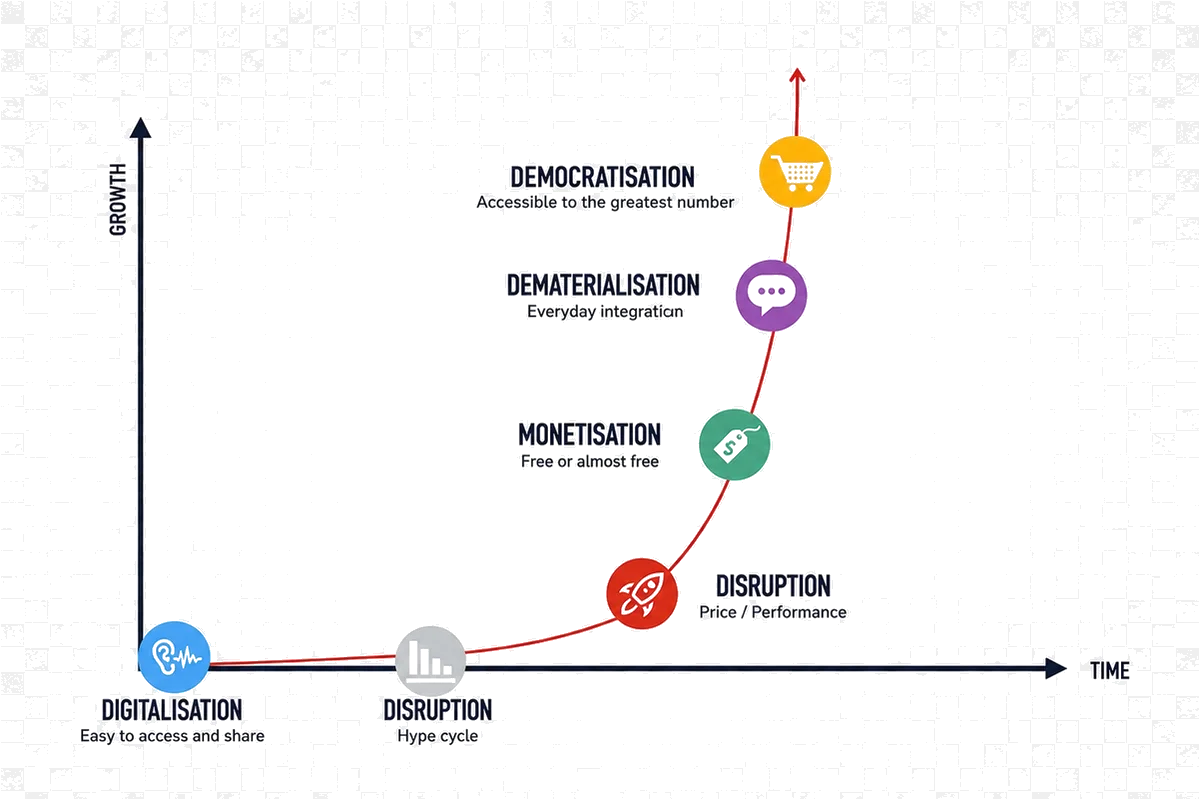
Before we look at the states of disruption, let us identify the characteristics every disruption shares.
The characteristics of a disruption
Here are the key characteristics of a disruption.
- Radical: disruption usually comes out of a radical innovation that brings significant added value to customers. That innovation can take the form of new technologies, new processes or new approaches that improve the efficiency, the convenience or the quality of products and services considerably. The arrival of smartphones, for instance, changed how people communicate and reach information, with a level of convenience and connectivity nobody had before.
- Replacement of existing products or services: disruptive products and services tend to replace what is already on the market. They usually offer significant advantages over the traditional alternatives, whether lower costs, better quality or greater convenience. Music streaming services, for instance, replaced CDs and music downloads by giving users instant access to millions of songs for a fixed monthly cost.
- Upheaval in established markets: disruption can upend established markets by changing how customers buy and use products and services. Organisations that fail to adapt quickly can lose market share and slide into irrelevance. The rise of e-commerce platforms, for instance, upended traditional retail and forced many retailers to rethink their strategy and take on online sales models.
- Change in business models: disruption can also bring changes to the business models organisations run on. Disruptive companies can introduce new models that call the traditional ones into question and create new sources of revenue. Software as a service companies, for instance, introduced a subscription model that lets customers pay for access on a monthly or annual basis rather than buying expensive perpetual licences.
- Impact on traditional industries: disruption can hit traditional industries hard and force them to adapt quickly or risk losing their relevance and their competitiveness. Established organisations often have to rethink their strategies, their operations and their business models to stay competitive in the face of disruption. The hotel industry, for instance, had to respond to the rise of peer-to-peer accommodation platforms such as Airbnb by offering more personalised experiences and adopting digital technologies to improve the customer experience.
Beyond these characteristics, organisations going through a disruption pass through four phases, which I call the “4 Vs“.
Viability (or durability)
This state applies to the most mature and enduring industries. The organisations in it, which Clayton Christensen called incumbents in The Innovator’s Dilemma, are solidly established brands that own their technology and control their distribution channels. They remain permanently exposed to shifts in technology or in consumer habits, and they are able to spot new threats and remove them by acquiring them or adapting to them. Alcoholic drinks manufacturers, tyre manufacturers and large-scale retail are examples of organisations in this state.
Vulnerability (or fragility)
In this state, established organisations benefit from protective barriers, such as market access shielded by legislation or an entry cost too high for newcomers. They face growing pressure to optimise costs and improve their efficiency in order to stay in step with their customers, and that pressure is what attracts disruptors. Taxis, the music industry, publishing, notaries, recruitment and rally raid (where I can tell you about my own direct experience of disruption) are examples of sectors in this state.
Volatility (or unpredictability)
This state is marked by a high level of disruption. Remember VUCA. The organisations in this situation may have felt invulnerable, protected by a barrier to competition that has since been lifted, or their vertical approach to their industry turns against them and starts to block the agility the new environment demands. The automotive industry and the hotel sector are examples of industries going through this state.
Velocity (or speed)
In this state, organisations are reborn after living through a disruption or accompanying one. The competitive landscape brings new opportunities and new forms of structural efficiency, though innovations no longer deliver a lasting competitive advantage unless the innovation is radical. Disruption becomes constant and can even become predictable.
Putting the 4 states of disruption to work
The four states of disruption help you understand and anticipate the challenges ahead and rethink your strategy, your business model and your operations. That makes a good starting point for exploring new ideas, for working with other players in your market to stay competitive, and for taking the new opportunities as they appear.
Viability
For organisations in the viability state, leadership can build on a solid position to become pioneers of innovation. These organisations usually have the financial resources to invest in research and development, which helps them read market trends early and stay ahead of the competition. Leadership can also consider strategic partnerships or the acquisition of innovative start-ups to round out their portfolio of products or services, which strengthens their resilience against future upheaval.
Vulnerability
In the vulnerability state, leadership has to take a proactive stance to identify both threats and opportunities. That means constant strategic watch and regular SWOT analysis to assess strengths, weaknesses, opportunities and threats. Vulnerable organisations can also look to diversify their activities or enter new markets to reduce their dependence on any one sector. Adopting emerging technologies can be an effective strategy for reducing vulnerability, and even for becoming “invincible“.
Volatility
For organisations