


Behavioural Economics
Behavioural economics studies the impact of psychological, social, cognitive and emotional factors on the economic decisions of individuals and institutions. It looks at how people make consumption decisions and how those decisions can depart from the predictions of traditional economic models based on rationality and self-interest.
Behavioural economics questions the assumption of homo economicus, which holds that individuals make rational decisions by weighing up the costs and benefits of each option and choosing the one that maximises their utility. Instead, it recognises that people are often influenced by cognitive biases, emotions and social factors that can lead them to make decisions that are not necessarily in their best economic interest.
I use behavioural economics as a shared frame of reference with my clients, company directors, executive committees and HR managers. In my talks, I use it to dismantle the illusion that their employees will react the way the strategic plan predicts. I tell the story of the founding experiments of Kahneman and Tversky, the nudges and the paradoxes that everyone has lived through without knowing what to call them. I show why a promised bonus does not always motivate, why internal rules sometimes produce the opposite of the intended effect, and why a sound rational argument is not enough to move a team.
In workshops, I get participants working on their own biases. I run scenarios in which each person discovers, in themselves, the judgement traps they criticise in others. A director realises that he has recruited the same profile three times in a row without meaning to. An HR team finds that its pay policy produces perverse effects that nobody had anticipated. Once those realisations are in place, I guide the group towards designing concrete measures, including revised assessment grids, modified decision-making rituals and redesigned onboarding paths. A workshop is only worth what it changes the following Monday.
In my consulting work, I draw on behavioural economics to help management committees review their own systems. Many HR and management arrangements were designed on the assumption of a rational employee who does not exist. The results disappoint and everyone looks outside for the cause. I offer a different diagnosis, which is to examine the choice architectures that the organisation imposes on its teams and the involuntary signals it sends through its bonuses, its forms and its procedures. That is often where the explanation lies for the behaviour that company directors complain about. When you change the architecture, you change behaviour, without having to ask people to be different from what they are.
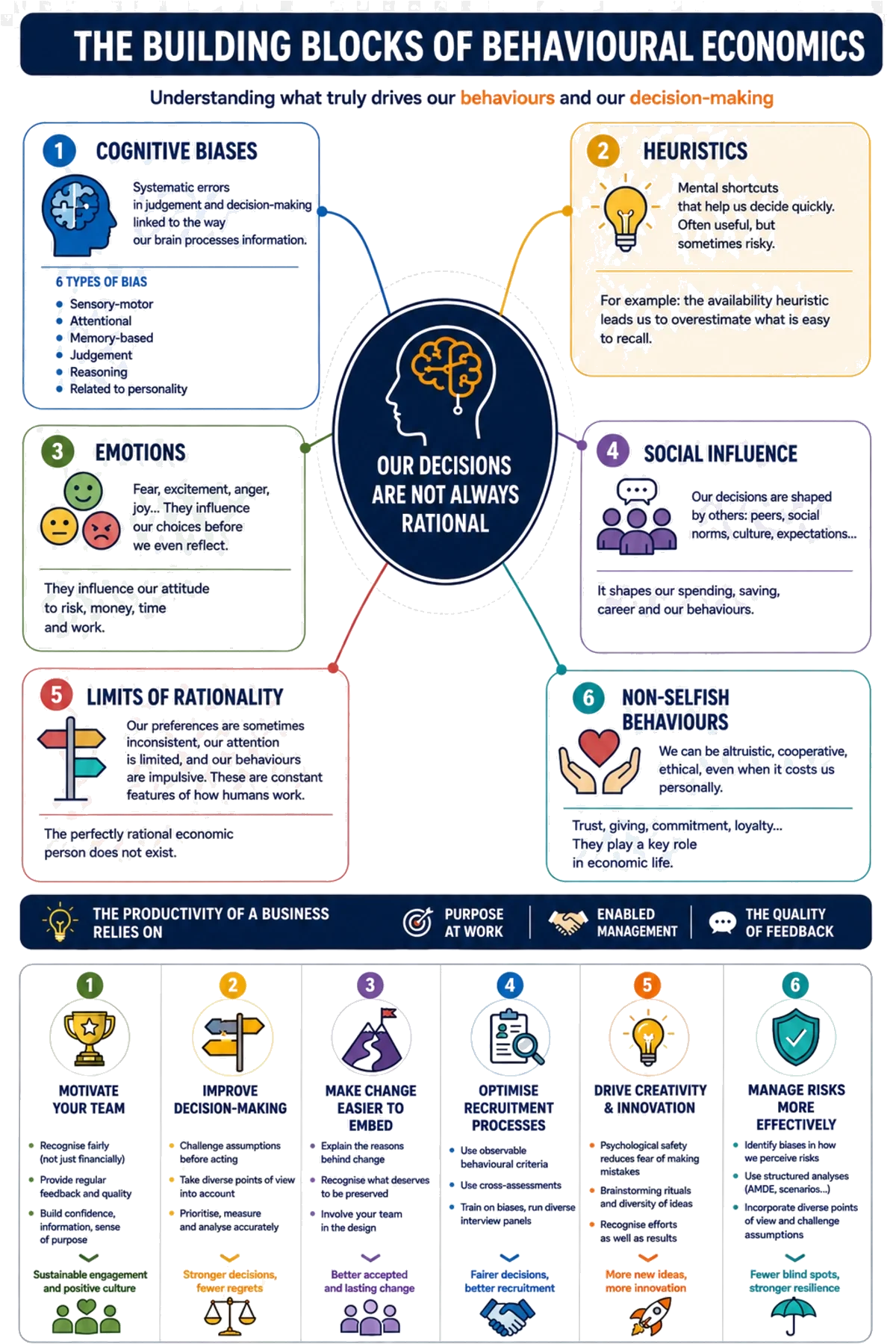
The foundations of behavioural economics
Behavioural economics is a branch of economics that combines insights from psychology and sociology to explain how people actually make decisions. Rather than assuming individuals are perfectly rational, it recognises that our choices are shaped by emotions, habits, social influences and mental shortcuts. Research in behavioural economics has shown that organisational performance depends on far more than financial incentives. Purpose at work, trustworthy leadership and meaningful feedback remain among the strongest drivers of motivation and productivity. Organisations rediscover these principles during every major crisis.
Behavioural economics differs from traditional economics through several key concepts.
Cognitive biases
Cognitive biases are systematic errors in judgement caused by the way our brains process information. Behavioural economics examines how these biases influence economic and organisational decisions. Confirmation bias, for example, leads us to seek information that supports what we already believe while ignoring evidence that challenges our views. It explains why two people can look at the same facts and reach completely different conclusions.
Researchers have identified around 250 cognitive biases, which are generally grouped into six broad categories:
- Sensorimotor biases
- Attentional biases
- Memory biases
- Judgement biases
- Reasoning biases
- Personality and social influence biases, including culture, social influence and ego
Heuristics
Heuristics are the mental shortcuts we use to make decisions quickly. They are often useful, but they can also lead us to poor decisions. The availability heuristic, for example, causes us to judge an event as more likely simply because we can easily remember similar examples. This helps explain why many people fear flying more than driving, despite the statistics showing the opposite.
Emotions
Emotions influence our economic decisions far more than most of us realise. Fear, excitement and anger often shape our choices before rational thinking even begins. Behavioural economics examines how emotional states affect our relationship with risk, money and time. A manager announcing a major organisational change on Monday morning will often receive a different response from making the same announcement late on Friday afternoon. The message is identical. The emotional climate is not. Understanding these collective emotional dynamics is one of the strengths of organisational psychology.
Social influence
Human beings are inherently social. Our decisions are constantly influenced by the opinions, behaviours and expectations of others, often without our awareness. Peer pressure, social norms and cultural expectations shape our purchasing decisions, career choices and workplace behaviour. This explains how organisations can establish new norms surprisingly quickly, or why entire teams often adopt the working habits of their manager without being explicitly instructed to do so.
The limits of rationality
Traditional economics assumes that people behave as perfectly rational decision-makers who carefully weigh costs and benefits before acting. Behavioural economics has shown this assumption to be unrealistic. Human preferences are inconsistent, expectations are often irrational and decisions are frequently impulsive. These are not exceptions. They are fundamental characteristics of human behaviour.
Prosocial behaviour
People are not motivated solely by self-interest. We often cooperate, help others and make ethical decisions even when doing so comes at a personal cost. These behaviours are central to economic life, whether through teamwork, volunteering, charitable giving or rejecting profitable opportunities that conflict with personal values. Behavioural economics places these behaviours back where they belong, at the heart of understanding how people really make decisions.
How I use behavioural economics
Improving employee motivation
I use behavioural economics to design recognition and incentive systems that target the drivers of human behaviour instead of relying on outdated assumptions. Once organisations understand what genuinely motivates people, they realise that annual bonuses alone are rarely enough. Non-financial recognition, public appreciation, career development opportunities and simply keeping people informed about decisions that affect them often have a far greater impact on motivation and engagement. These invisible mechanisms can transform the culture of an organisation.
Improving decision-making
Cognitive biases do not disappear inside executive meetings. In fact, they often become stronger when the stakes are higher. I help leadership teams introduce practical safeguards such as structured debate, independent perspectives and explicit assumptions before major decisions are made. Techniques such as the pre-mortem, where participants imagine that a decision has already failed and explain why, are remarkably effective. Decision matrices and multi-criteria analysis can also improve judgement when used thoughtfully rather than as bureaucratic exercises.
Leading organisational change
Behavioural economics explains why employees often resist change, even when the proposed changes appear logical. Resistance usually reflects an unrecognised emotional loss, uncertainty or misunderstood signal rather than irrational behaviour. I help leaders communicate the deeper purpose of change, acknowledge what deserves to be preserved from the existing organisation and involve employees in designing new ways of working. Training and technical support should follow this work, not replace it.
Improving recruitment decisions
Unconscious biases influence recruitment decisions far more than many organisations realise. Halo effects, similarity bias and first impression bias regularly distort hiring outcomes. I work with HR teams to structure interviews around observable behaviours, compare evaluations across multiple interviewers and train recruiters to recognise the biases that influence their judgement. More diverse hiring panels generally lead to fairer and more effective recruitment decisions while strengthening the employer brand.
Encouraging creativity and innovation
Creativity cannot simply be demanded. It depends on the cognitive and emotional conditions an organisation creates. Behavioural economics helps explain those conditions. Teams that fear failure rarely innovate. Teams that never encounter different perspectives often recycle the same ideas. I help organisations design collaborative environments, creative rituals and workspaces that encourage new thinking. Recognising creative effort is just as important as celebrating successful outcomes.
Managing risk more effectively
Our perception of risk is heavily distorted by cognitive biases. We overestimate dramatic events while underestimating slow-moving threats. Recent experiences often outweigh long-term evidence. I help leaders use structured risk assessment techniques, including Failure Mode and Effects Analysis (FMEA), to make more balanced decisions. Ultimately, however, no framework replaces diversity of thought. Inviting external perspectives, encouraging constructive disagreement and avoiding groupthink remain the most effective ways to improve decision quality.