

The 5 dimensions of curiosity
Curiosity is a behavioural and cognitive tendency that pushes us to search, to explore, to take risks and to engage in situations likely to give us new information, new sensations or new experiences.
Over the long term, it expands our knowledge, develops our intellectual and creative capacities, and strengthens our social bonds.
In psychology, curiosity is a multidimensional concept that cuts across several fields of study, including openness to new experience, novelty seeking, empathy, need for cognition, tolerance of ambiguity, tolerance of uncertainty, tolerance of frustration, and sensation seeking.
In short, curiosity, and above all in a professional environment, is a strategy for a world of fragility.
The 5 dimensions of curiosity
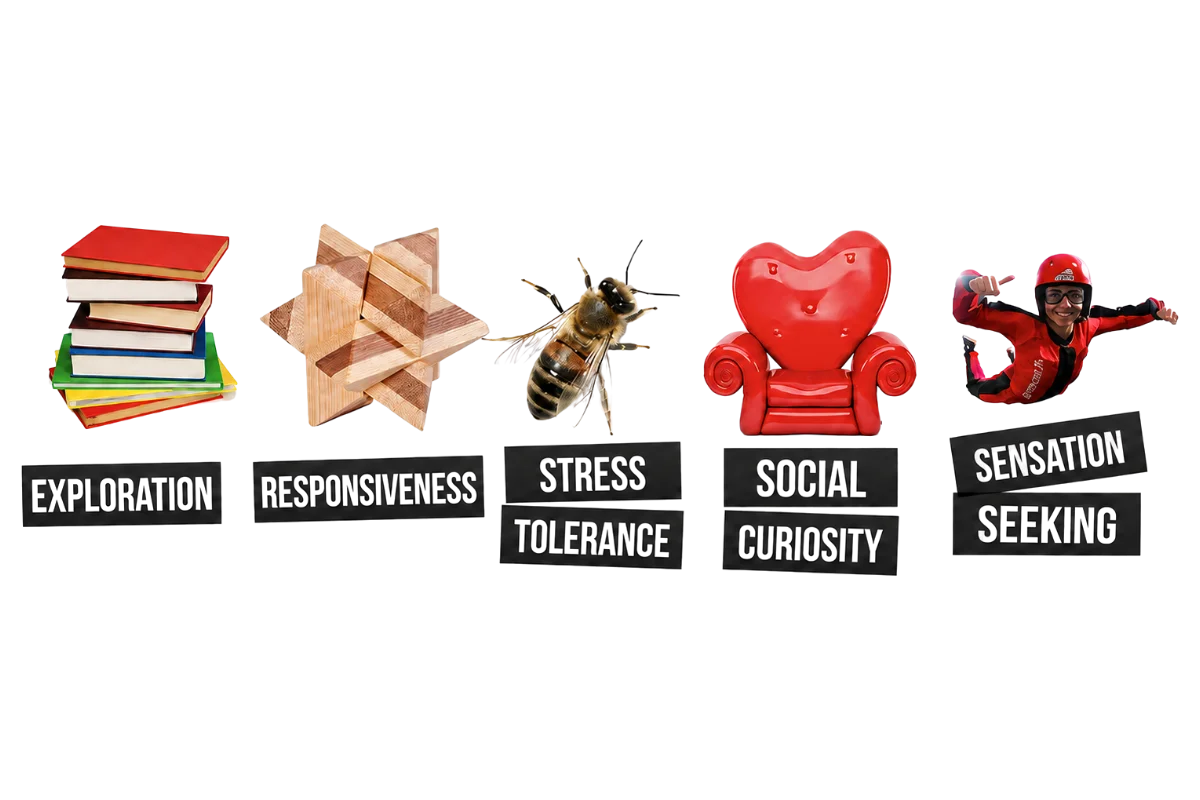
The five-factor model of curiosity was built and validated on the basis of several studies carried out between 2004 and 2009, in particular by Kashdan et al. and Peterson & Seligman. I regard this model as the most relevant one available today for analysing the nature of curiosity in the workplace.
1. Exploration
Called “Passionate Curiosity”, this dimension expresses the pleasure of discovering and learning. It rests on the desire to broaden your knowledge and your understanding. Explorers enjoy asking questions, searching for answers and immersing themselves in new information. Their intrinsic motivation to learn makes them open, enterprising and tenacious in their quest for knowledge.
This dimension is useful for encouraging the search for new ideas, new knowledge and new perspectives. It can be used to stimulate innovation and creativity, and to support a more open and more diverse working environment.
2. Reactivity
Also called “Deprivation Sensitivity”, this dimension appears when frustration or a lack of knowledge pushes someone to look for solutions. These “Solvers” identify an information gap, run an investigation and close that gap. The motivation here is one of avoidance, where acquiring knowledge serves to remove a discomfort rather than to gain personal wellbeing.
This dimension is essential for solving complex problems and for reacting quickly to change. It is particularly useful for employees who work in fields that evolve constantly, such as technology or scientific research.
3. Stress Tolerance
The third of the 5 dimensions of curiosity refers to the ability to accept and manage the uncertainty and the fear of the unknown that come with new experiences. People who tolerate stress well are able to appreciate novelty and complexity, and their capacity to cope with discomfort makes them more resilient and more open to exploration.
This dimension matters for employees who have to handle difficult or stressful situations. It is particularly useful for leaders and managers who have to make decisions under pressure.
4. Social Curiosity
This is the desire to understand other people by listening to them and socialising with them. It is a strategy for gathering information and understanding the experiences of others. Socially curious people show empathy, ask questions and take an interest in the ideas of others, whatever their background. That sets them apart from gossips and supports more effective communication and stronger relationships.
This dimension is essential for building better communication and better understanding between employees. It can be used to improve interpersonal relationships, to increase empathy and to promote a more inclusive company culture.
5. Thrill Seeking
This dimension covers the desire to live intense, varied and new experiences, even when that means taking physical, social or financial risks. Thrill seekers like being at the centre of attention and living adventurous experiences. This pursuit can lead to risky behaviour, and it can also build effective leadership skills in volatile and complex environments.
This dimension is useful for encouraging employees to take calculated risks and to step out of their comfort zone. It can be used to stimulate entrepreneurship and to encourage innovation in areas that call for a bold and inventive approach.
Using the 5 dimensions of curiosity
Identifying your curiosity profile
These 5 dimensions allowed me to create a curiosity profile indicator that helps the people who use it understand their preferred type of curiosity.
Better problem solving
In general, curious people tend to ask questions, to look for answers and to explore new approaches. That makes them more effective at solving problems, because they are more likely to consider different perspectives and to find creative solutions.
Adaptability to change
In a world that changes constantly, the ability to adapt quickly to new technologies, to market trends and to shifts in the environment is essential. Curious people are generally more open to learning and to experimenting with new things, which makes them better able to adapt to change.
Personal and professional development
Your curiosity is a key factor in personal and professional development. Curious people are more likely to look for learning opportunities, to take courses, to read books and to explore new skills. That can help them improve their skills, progress in their career and contribute more meaningfully to their company.
Better interpersonal relationships
Curiosity can also improve interpersonal relationships inside the company. Curious people are generally more empathetic, better listeners and more open to a diversity of opinions. That can lead to better communication, better collaboration and a more inclusive working environment.