


Level 6 Leadership
The concept of Enableship goes beyond traditional leadership. It is distinguished not only by its focus on innovation, but also by its commitment to shielding team members from unnecessary hierarchical pressure while creating a working environment where people feel safe to experiment, challenge assumptions and even make mistakes. In short, Enableship is the leadership of innovation.
Enableship is inspired by Jim Collins’ concept of Level 5 Leadership, which describes leaders who combine personal humility with fierce professional ambition. These leaders inspire others, sustain their team’s commitment over time and never allow their ego to become an obstacle. They measure their own success by the success of the people around them.
However, I believe this model no longer goes far enough. The challenges facing organisations today are very different from those of the early 2000s. In a world defined by uncertainty, complexity and constant disruption, leadership is no longer just about driving efficiency and performance. It is about helping people develop the human capabilities that technology cannot replace, such as curiosity, empathy, critical thinking and adaptability. It also means creating the conditions for people to become more autonomous, take greater ownership and actively contribute to innovation. That is the ambition behind Enableship.
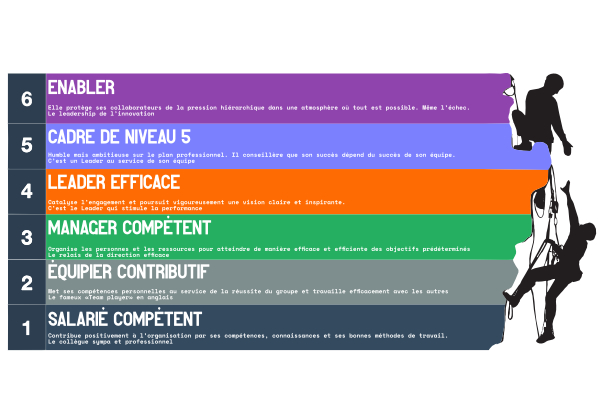
The Role of Level 6 Leadership
The primary objective of Level 6 Leadership, or “Enableship“, is to create and sustain a culture of innovation that keeps the flow of practical, implemented ideas open. To achieve this, the leader must adopt several complementary postures that combine behaviours and actions.
Exploration Facilitator
In the context of Design Thinking, the enabler acts as an exploration facilitator. They help teams navigate the iterative and exploratory process, often using specific methods and tools to stimulate creativity and innovation. The enabler encourages the team to ask profound questions and challenge existing assumptions, drawing on the Stanford d.school approach to defining complex problems.
Solution Catalyst
The enabler also acts as a catalyst in the search for solutions. They use Design Thinking techniques to help the team move from a vague understanding of the problem to practical, achievable solutions. By structuring the design process into a series of prescriptive steps, the enabler ensures that even non-designers can make a meaningful contribution to problem-solving.
Advocate for Interdisciplinary Collaboration
The enabler encourages collaboration between a range of disciplines within the team. They understand that the best solutions often emerge from the convergence of different perspectives, in keeping with the Design Thinking approach, which values interdisciplinary teams when addressing complex problems.
Guide to Experimentation
The enabler places an emphasis on experimentation as a way to test and refine ideas. They guide the team through rapid cycles of prototyping and testing, enabling faster adaptation and continuous learning while maintaining a focus on solving real problems.
Amplifier of Empathy
Finally, the enabler helps amplify empathy within the team. They encourage a deep understanding of users’ needs and expectations, which is essential to Design Thinking. By adding a deeper level of empathy, the enabler helps the team understand users more effectively, leading to more human-centred solutions.
In summary, the enabler must ensure that:
- Every team member feels sufficiently safe and autonomous, and understands that failure is first and foremost an opportunity to grow.
- Every member of the team has appropriate responsibilities and develops their soft skills through work aligned with their interests and natural strengths.
- There are no human or organisational barriers preventing the first two conditions from being met.
- Team members are protected from unnecessary pressure.
Enableship therefore moves away from traditional hierarchical models in which decisions are centralised. It promotes a culture where team members have greater autonomy and responsibility, which can lead to greater innovation and responsiveness across the organisation.
How Enableship Is Used
To Promote Innovation
Giving teams greater responsibility empowers them to make relevant decisions at their own level. This could mean, for example, giving a team the budget and authority required to deliver a project without constantly seeking approval. This approach creates greater responsiveness because teams can adapt to change without waiting for instructions from above. Teams also feel more valued because they have greater control over their work.
To Strengthen Team Autonomy
By empowering team members to experiment with and implement new ideas, organisations can encourage a culture of innovation. This could take the form of innovation workshops, hackathons or dedicated experimentation budgets. Such an approach helps organisations identify and act on new opportunities more quickly. It also motivates team members because they can see that their ideas are taken seriously and may be implemented.
To Improve Team Engagement
Allowing team members to make decisions, lead projects or experiment with new ideas shows them that they are an essential part of the organisation. Engaged team members are often more invested in the organisation’s success. This can also improve job satisfaction, reduce staff turnover and support a positive organisational culture.
To Develop Managers’ Leadership Capabilities
Giving team members opportunities to take initiative and accept responsibility prepares them for future leadership roles. By developing Enableship, organisations ensure they have a pipeline of future leaders ready to take the reins. Team members who see genuine opportunities for professional growth are also more likely to remain with the organisation over the long term.