


BREAK methodology
The BREAK methodology is an acronym standing for five key principles: Bricolage, Resilience, Experimentation, Adaptability and Kaizen.
Choosing BREAK means choosing agile and resilient management, where every action aims to anticipate change rather than endure it. The approach minimises risk, and it also creates opportunities you would not otherwise see, by drawing on collective intelligence and continuous experimentation.
Now that uncertainty has become the norm, traditional models of leadership and innovation are showing their limits. Crises follow one after another, markets move at dizzying speed, and what employees expect is changing. In that context, how can a company stay productive, innovative and resilient without tipping into instability?
The answer comes down to one word: BREAK. It is a pragmatic and adaptable methodology, designed to help companies and teams deal with the unexpected, use their resources creatively, and establish continuous improvement. The five interconnected principles allow organisations to turn every challenge into an opportunity and to build a lasting competitive advantage.
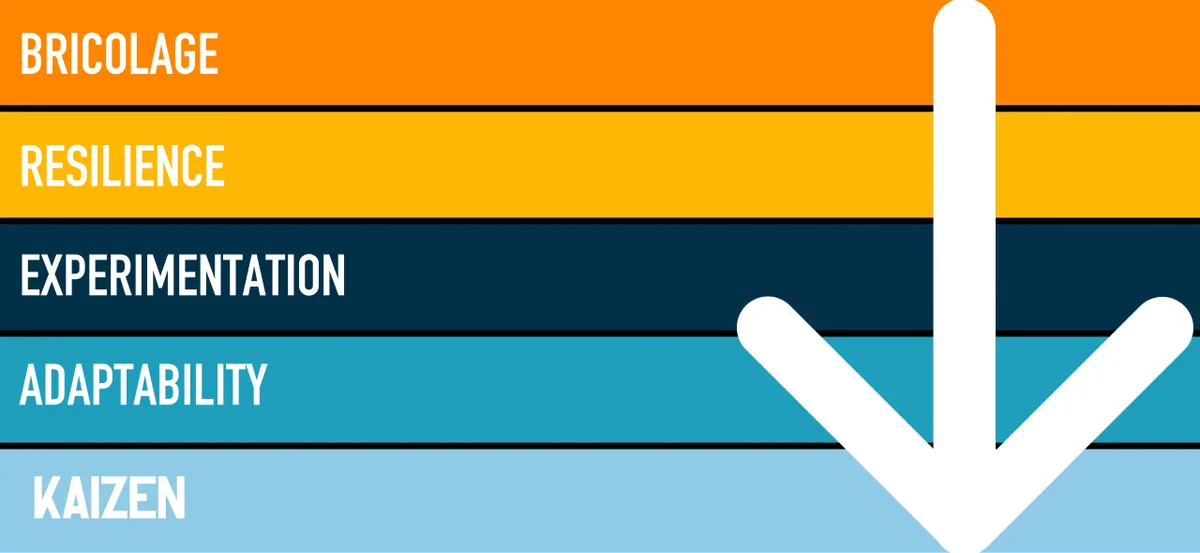
The BREAK methodology in action
The methodology BREAK is an in-house approach that rests on five pillars, and those pillars help teams and employees adapt to uncertainty and to challenges through creativity, agility and continuous improvement.
Bricolage, Resilience, Experimentation, Adaptability and Kaizen
Bricolage: making do with what is at hand
Bricolage: This concept comes from entrepreneurial research, and it means making the most of existing resources, in effectuation mode, by combining what is available in creative ways to solve new problems or seize opportunities. Bricolage lets companies overcome resource limitations through a flexible and inventive approach. It is a pragmatic method where you maximise what you already have at hand instead of waiting for ideal resources.
🔹 Example of use: A fast growing start-up with a limited marketing budget
- The company cannot yet afford a massive advertising campaign.
- Instead of waiting for funding, it uses the free (and no code) tools at its disposal: social media, content marketing and collaborations with influencers in exchange for visibility.
- The team adopts a low-cost and agile approach by testing different campaigns on a small scale before it invests more.
- Result : Thanks to marketing bricolage, the company builds real awareness without a large initial budget.
Resilience: getting back up after a failure
Resilience is the ability to adapt and bounce back when facing a difficulty or a failure, while learning from the experience. A resilient organisation draws lessons from its crises and uses them to grow stronger.
🔹 Example of use: A restaurant chain facing the COVID-19 crisis
- With dining rooms closed, the company watched its revenue collapse.
- Instead of accepting the situation, it developed new business models:
- It set up an express delivery service with dishes suited to travel.
- It created a range of “cook at home kits” to keep the link with its customers.
- It digitised orders and trained its teams in new roles such as logistics and online order management.
- Result : The company survives the crisis and builds new and sustainable revenue streams.
Experimentation: test, learn, adjust
Experimentation rests on a test and learn approach. Teams try several approaches quickly and analyse the results before they decide, and they do so long before any perfect solution exists.
🔹 Example of use: A company that wants to launch a new technology product
- Instead of investing heavily in the development of a product with no market validation, it adopts a Lean Startup approach.
- It first releases a minimum viable prototype (MVP) and tests it with a small group of customers.
- Thanks to the feedback, it adjusts the features and refines the product before the official launch.
- Result : The company avoids investing too early in a product that does not fit, and it increases its chances of success in the market.
Adaptability: adjusting to the unexpected
Adaptability is the ability to adjust your strategy and your working methods quickly in line with changes in the context, new technologies or market expectations.
🔹 Example of use: A training company facing the new demands of digital
- For years it offered face-to-face training only.
- With the rise of remote work and the demand for online training, it understood that it had to go digital.
- Within a few months it turned its offer into blended learning:
- It set up interactive online courses.
- It used virtual reality for role-play scenarios.
- It ran remote coaching sessions to support learners.
- Result : The company meets the new expectations of the market and widens its audience.
Kaizen: continuous improvement every day
The Kaizen, a Japanese concept, means “change for the better”. It rests on gradual and continuous improvements, and it leaves brutal revolutions aside. The idea is to make small regular adjustments that, over the long term, generate considerable impact.
🔹 Example of use: A company that optimises the productivity of its teams
- Instead of imposing a massive restructure, it applies Kaizen by involving its employees directly.
- Every employee can suggest small improvements to the work processes.
- Each week, adjustments are tested:
- Fewer pointless meetings.
- Automation of some time-consuming tasks.
- Better distribution of workloads.
- Result : Productivity rises gradually and lastingly, employee wellbeing improves and a culture of continuous innovation takes hold.
An operational framework that turns uncertainty into a lever for growth
The BREAK methodology rests on a simple observation: agility works only when it becomes a reflex. Where some people see obstacles, BREAK identifies concrete and actionable solutions. It stays well away from grand unworkable theories and encourages an approach anchored in the reality of the field, suited to organisations of every size.
Each part of the model answers a key question of modern management :
- Bricolage: How do you maximise existing resources without waiting for ideal conditions?
- Resilience: How do you bounce back quickly after a crisis or a failure?
- Experimentation: How do you test innovative approaches before investing heavily?
- Adaptability: How do you respond effectively to market transformations?
- Kaizen: How do you ensure continuous and lasting improvement?
By applying these principles, companies gain flexibility, innovation and robustness in the face of change in their environment. BREAK offers a thinking framework and it radically transforms the way teams work, innovate and evolve from day to day.