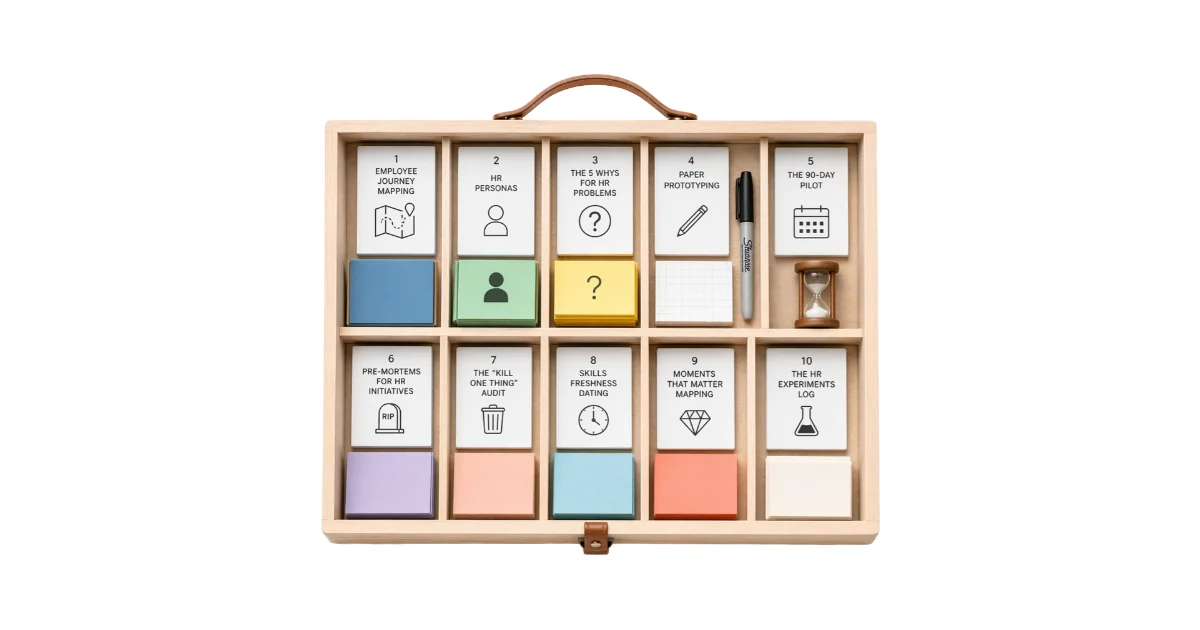
HR designer toolkit You have the challenges. You have the mindset. Now comes the part where most HR teams stall: turning intention into method. A new posture without new methods is a good conference talk, not a transformation.
This article is the third piece of the triptych, after the 17 HR challenges for 2026 and the 10 mindset shifts. It gives you 10 concrete methods HR leaders can use on Monday morning. Each one is tested, documented, and small enough to start without a budget or a committee. Each one has a clear output. Each one answers the same question: what do I actually do now?
The case for method over method-talk is statistical. Atlassian’s 2025 AI Collaboration Report found that 96% of executives say AI has not delivered meaningful ROI, not because the technology fails, but because organizations lack a clear measurement process. Translation: good intentions, missing method. McKinsey’s 2024 State of Organizations research adds that pilots increase adoption rates by 73%. The teams that ship beat the teams that plan. This toolkit is built on that principle.
What is the HR designer’s toolkit? The HR designer’s toolkit is a set of 10 repeatable methods HR leaders can use to turn the new HR mindset into action: employee journey mapping, HR personas, the 5 Whys for HR problems, paper prototyping, the 90-day pilot, pre-mortems, the “kill one thing” audit, skills freshness dating, moments that matter mapping, and the HR experiments log. Each method is low-cost, high-output, and designed to generate evidence instead of opinions.
Employee Journey Mapping
Employee journey mapping visualizes every touchpoint a collaborator has with the organization, from the first job ad they see to their exit interview. It is borrowed from customer experience teams, and it works because it forces HR to see its own processes through the eyes of the people going through them.
The data backs the method hard. According to WTW research cited by Reworked, 90% of businesses with a strong and clear employee experience report lower annual undesired turnover than peers. The same study shows companies with highly engaged and high-performance EX achieve up to three times higher revenue growth and 11 times the profit margin. Separately, G2’s 2025 journey mapping analysis cites Gallup data showing that 42% of collaborators who voluntarily left their organization in the past year believe their manager or company could have prevented it. Journey mapping is the method that catches those preventable exits before they happen.
What it means as a mindset change: HR stops optimizing isolated processes and starts designing a coherent journey, the way product teams design a coherent experience.
Three things HR can start with:
- Pick one journey (onboarding, promotion, exit) and map every touchpoint, emotion, and pain point on a single page with collaborators in the room.
- Identify the three touchpoints where the gap between intent and experience is largest, and fix one in the next 30 days.
- Review the map every 6 to 12 months, or after any major organizational shift, so it stays a living document rather than a poster.
HR Personas
Marketing teams spend real budget building client personas. HR teams, for the most part, still design for a generic “employee” who does not exist. An HR persona is a realistic, research-based profile of a type of collaborator (a remote software engineer, a first-time manager, a new hire over 50, a returning parent) with their motivations, pain points, moments that matter, and deal breakers.
Personas work because they force specificity. People Managing People’s 2025 journey mapping guide makes the point directly: “Create personas. Develop representative personas of typical employees based on roles, career stages, demographics. Understand their motivations, challenges, needs, and goals.” Hiver’s 2025 design thinking analysis adds that a one-size-fits-all approach to employee experience does not work, because a remote engineer, a live-chat support agent, and a senior executive have fundamentally different needs. Designing for “everyone” means designing for no one.
What it means as a mindset change: HR stops addressing “employees” as a homogeneous group and starts designing for distinct personas with distinct needs.
Three things HR can start with:
- Identify the five most strategic personas in your organization (not the easiest, the most strategic) and write a one-page profile for each.
- For each persona, document what a great experience looks like in their specific context, not in the abstract.
- Review every new HR initiative against the personas: who wins, who loses, who is forgotten.
The 5 Whys for HR Problems
The 5 Whys is borrowed from Toyota’s production system. You take a visible HR problem, and you ask “why” five times in a row, each time on the answer you just got. By the fifth why, you are usually standing in front of the root cause, which is rarely what you started with.
Example. Problem: “Our new hires quit after 3 months.” Why? “They feel disconnected.” Why? “They do not know their manager well.” Why? “Their manager does not run 1:1s in the first 30 days.” Why? “Managers are not trained on structured onboarding.” Why? “HR assumes managers know how to onboard.” Root cause: a missing enablement program for managers, not a “new hire retention problem.” You were about to rebuild your onboarding process. You actually need to train managers. Different problem, different budget, different solution.
The broader case for root-cause thinking sits in the data. Deloitte’s 2025 Global Human Capital Trends, based on 9,000 business and HR leaders in 89 countries, describes this moment as “tensions becoming tipping points.” Tipping points do not get solved by treating symptoms. They get solved by naming the actual cause.
What it means as a mindset change: HR stops solving the visible problem and starts solving the real one.
Three things HR can start with:
- Pick one recurring HR complaint (low engagement, slow hiring, training no-shows) and run the 5 Whys on it with the team.
- Document the root cause in writing before designing any solution, so future debates stay on evidence rather than opinion.
- Review every big HR initiative’s brief and ask: are we solving the visible problem or the root cause? If unsure, run a 5 Whys before starting.
Paper Prototyping
A paper prototype is a low-fidelity, low-cost version of an HR idea, tested with real collaborators before you build the real thing. A new performance review form becomes a handwritten sheet. A new onboarding path becomes a series of index cards. A new career page becomes sticky notes on a whiteboard. The point is not to be pretty. The point is to learn fast and cheap before investing.
HRKatha’s 2025 design thinking in HR analysis describes prototyping this way: “An organisation could trial team-based metrics with a single department to evaluate how the shift impacts collaboration and productivity. Feedback from the pilot informs adjustments before broader adoption.” The logic is the same whether the prototype is paper, PowerPoint, or a scrappy Google Form. AIHR’s 2026 HR trends report adds that top performers report an ROI of 55% or more on HR AI investments, while others get 5%. The difference is not the tool. The difference is how many prototypes were run before the tool was bought.
What it means as a mindset change: HR stops launching finished products and starts shipping rough drafts, because rough drafts produce better data than polished assumptions.
Three things HR can start with:
- Before any new HR process launch, build a paper or slide version and walk five collaborators through it while they think out loud.
- Capture what they stumbled on, where they pushed back, and what they ignored, and rewrite the prototype before writing any code or policy.
- Keep the prototype visible for one week and invite walk-by feedback, so the method becomes cultural rather than a one-off exercise.
The 90-Day Pilot
The 90-day pilot is the scientific version of “let’s try it and see.” You pick one HR change, you run it with a small team for 90 days, you measure against a clear baseline, and you decide: scale, adjust, or kill. No committee, no multi-year plan, no 40-slide business case.
The timeframe is not arbitrary. ValueX2’s 2025 Agile HR research recommends 90 days as the ideal length: long enough to generate real data, short enough to maintain executive attention. Maybe’s 2025 AI ROI analysis puts a sharper edge on it: “Leadership patience for AI experiments typically lasts 3-4 months. Show ROI in 90 days, and you earn license to continue. Miss that window, and budgets get cut.” And the payoff is real. Agile Alliance case data cited by Applaud HRshows one European company cut its hiring process time by 30% by redesigning steps iteratively with direct collaborator input. Separately, McKinsey’s research finds that pilots increase adoption rates by 73%. Small bets, big learning.
What it means as a mindset change: HR stops asking “how do we roll this out” and starts asking “how do we test this first.”
Three things HR can start with:
- For your next HR initiative, write a one-page pilot plan: hypothesis, scope, success metric, timeline, decision gate at day 90.
- Pick a high-volume or high-pain area for the pilot (onboarding, internal mobility, performance reviews), not a peripheral one.
- At day 90, make an explicit scale, adjust, or kill decision in writing, and share it. No silent extensions.
Pre-Mortems for HR Initiatives
A pre-mortem is the opposite of a post-mortem. Before you launch an HR project, you gather the team and imagine it is 12 months later and the project has failed spectacularly. Everyone writes down why. You surface assumptions, risks, and blind spots before they become real. It is one of the cheapest risk management tools in HR and one of the most underused.
The logic is simple: most HR projects fail not because the idea was bad, but because nobody named the obvious risk out loud. Pre-mortems force that conversation while it is still free to have. This matches what Deloitte’s 2026 Global Human Capital Trends calls the shift “from tensions to tipping points”: hesitation has become the biggest cost. Teams that name the risk early move faster than teams that discover it at launch.
What it means as a mindset change: HR stops protecting its projects from criticism and starts inviting criticism while the project is still cheap to change.
Three things HR can start with:
- Before every HR project kickoff, run a 30-minute pre-mortem: “it’s 12 months later, this project failed, why?”
- Document every failure cause in writing, grouped by theme (execution, adoption, politics, external).
- Assign one owner per top risk, with a simple mitigation action and a check-in date.
The “Kill One Thing” Audit
HR teams are famously good at adding and famously bad at removing. Every new trend, every new tool, every new CEO priority stacks a new layer on top of the existing pile. After a few years, collaborators face 12 different HR systems, 40 internal policies, and three overlapping training catalogs. The “kill one thing” audit is a quarterly ritual: identify one HR program, policy, tool, or meeting that creates more friction than value, and kill it.
The business case for subtraction is real. Deel’s 2025 HR automation research shows HR staff still spend up to 57% of their time on administrative tasks. A large portion of that time is spent on processes that were added years ago and never removed. HiBob’s 2026 HR tech analysis reports that more than half of HR professionals have used two to three different HR tech solutions throughout their careers, and ease of use is now the second highest priority (27%) when choosing a new system. Adding is easy. Removing is what creates space for design.
What it means as a mindset change: HR stops measuring itself on what it launches and starts measuring itself on what it removes.
Three things HR can start with:
- At the start of every quarter, run a 1-hour audit with the team: list everything HR does and star one thing that should die.
- Communicate the kill to collaborators clearly: what is going away, why, and what replaces it (sometimes nothing).
- Track “things killed per quarter” as a proud HR KPI, visible on the team dashboard.
Skills Freshness Dating
Skills used to live for 10 years. Now, in many tech-adjacent roles, they live for 2. Skills freshness dating is the method of attaching an expiration date to every critical skill in your organization, the way a pharmacy dates medicine. Once you know when a skill is going stale, you can plan the refresh before the crisis.
The numbers demand this method. Second Talent’s 2025 HR industry statistics report that skills have a 2.5-year half-life in tech roles and 88% of organizations plan L&D budget increases. The World Economic Forum’s Future of Jobs Report 2025 projects that 39% of core skills will change by 2030, and that 59 out of every 100 workers will need training. McKinsey’s 2025 European skills research adds that 63% of leaders identify skills gaps as the biggest barrier to business transformation between now and 2030. These are not training problems. They are inventory problems. Dated inventory needs a method.
What it means as a mindset change: HR stops treating skills as permanent and starts treating them as perishable assets with a shelf life.
A freshness map is only as good as the records behind it, and people keep those records accurate when they can see a recorded skill opening a real opportunity. That condition is the argument in skills are a currency only when people trust them.
Three things HR can start with:
- For your top 20 roles, list the 5 critical skills and assign each one a freshness date (for example, “relevant until Q3 2026”).
- Refresh the map every 6 months with business leaders, adding new skills that emerged and retiring ones that did not.
- Tie L&D investment to the freshness map, so training budget flows to expiring skills first, not to the loudest internal demand.
Moments That Matter Mapping
Not every touchpoint is equal. A moment that matters is one that disproportionately shapes how a collaborator feels about the company: first day, first 1:1, first promotion, first conflict, first child, last day. Get them right and you earn years of trust. Get them wrong and you lose collaborators who had no other reason to leave.
Reworked’s February 2026 journey mapping analysis cites research from MIT by Dery and Sebastien showing that businesses with strong employee experience enjoy up to double the level of customer satisfaction and 25% greater profitability compared to organizations with poor experience. HeartCount’s 2025 journey mapping guide defines moments that matter as “critical touchpoints that have a disproportionate impact on engagement and perception.” The insight is simple: you cannot improve 100 touchpoints. You can improve 5 moments, and collaborators will talk about them for years.
What it means as a mindset change: HR stops spreading its effort evenly across all touchpoints and concentrates on the moments where the emotional return is highest.
Three things HR can start with:
- List the top 10 moments that matter in your company, ranked by emotional intensity, not process frequency.
- For each moment, run a quick audit: what does the company currently do, and what would excellence look like?
- Pick three moments where the gap is largest and redesign them this year, with collaborators in the room.
The HR Experiments Log
The last tool ties all the others together. An HR experiments log is a simple visible document that tracks every test the HR team runs, with three columns: what we tried, what we learned, what we kept. It is the quiet ritual that turns scattered initiatives into a learning organization.
Without a log, HR teams repeat the same mistakes because they forget the last attempt. With a log, every experiment compounds. AIHR’s 2026 HR trends report notes that 89% of HR functions have restructured or plan to restructure in the next two years, shifting away from siloed centers of excellence toward cross-functional capability networks. That kind of restructuring demands institutional memory: what worked for us, what did not, what is worth trying again. The experiments log is that memory, in its simplest form. Mosaic’s 2025 agile project management analysis adds that 93% of organizations employing agile methods experience higher satisfaction, and 73% report project success rates over 75%. The difference between those numbers and HR’s typical hit rate is method. A log is the method.
What it means as a mindset change: HR stops relying on individual memory and starts building institutional knowledge, one experiment at a time.
Three things HR can start with:
- Open a shared doc, spreadsheet, or board titled “HR experiments log” and add the three columns today. Do not overthink the format.
- Make it a ritual: every monthly HR team meeting ends with “what did we try, what did we learn, what are we keeping.”
- Publish one experiment per quarter internally, especially the failed ones, to signal that learning is the norm and launches are not the only success.
Conclusion
Methods beat intentions. Every HR team in the world has heard of design thinking, agile, and experimentation. Very few actually use them. The difference between the teams that talk about transformation and the teams that actually transform is the shelf full of methods they can pull off in a Tuesday afternoon without asking anyone’s permission.
This toolkit is not exhaustive. It is enough. Ten methods, each small enough to start tomorrow, each powerful enough to change how HR operates within 90 days. You do not need all ten. You need to start with one, run it, document what you learned, and pick the next one. That is how the new HR mindset turns into the new HR function.
The triptych is now complete. The 17 challenges map the problems. The 10 mindset shifts name the posture. The 10 methods above are how you make it real. The rest is a Monday morning decision.
How Can I Help You With These Methods?
Conference
I speak at conferences, executive off-sites, and HR events about how HR leaders can stop talking about transformation and start practicing it. My talks show the methods in action, with real cases from companies that used them and real traps for teams that stopped at the theory.
Typical topics include: designing employee experiences, running 90-day HR pilots, the power of paper prototyping, moments that matter as a retention strategy, and building a learning HR function through experiments. Each keynote is tailored to the audience (HR teams, executive committees, full company events) and built to spark real conversation rather than polite applause.
If you want a speaker who hands the room usable methods rather than inspirational quotes, let us talk.
Workshop
For HR teams and leadership groups ready to practice, I run half-day and full-day workshops that put the toolkit in their hands.
Formats include: employee journey mapping sprint (mapping one journey with collaborators in the room and leaving with a prototype), 90-day pilot design workshop (writing the full pilot plan for one HR initiative, ready to launch), paper prototyping lab (building three lo-fi prototypes of real HR processes in half a day), and moments that matter audit (identifying the 10 moments, ranking them, and redesigning the top three).
Every workshop ends with a written output your team can use on Monday morning. No fluff, no slideware, no “we should think about this.” Just prototypes, decisions, and next steps.