
Skills are often described as the new currency of talent, and the comparison holds up well. A currency works when people trust that it will be honoured, and a skills-based organisation works on the same condition: people keep their skills record accurate when they can see it opening real opportunities.

That makes the move from roles to skills as much a question of trust as of technology. The taxonomy, the platform and the data all matter, and they deliver value once the organisation shows, consistently, that a recorded skill leads somewhere.
Key takeaway
How to build a skills-based organisation at scale
Move from roles to skills by making every recorded skill lead somewhere. Start with internal mobility, where the people and the data already exist and results show within weeks, then attach development to real assignments, and change hiring last, once the vocabulary has proved itself inside the business.
- Describe the ten most common assignments of one business unit in skills terms before rewriting any job description.
- Publish internal openings against skills, and share the outcome of every application.
- Recognise the managers who release people into new roles, so that developing talent counts as a contribution.
- Record, for each skill, whether the person wants more of this work, the same amount or less.
How to know it is working: track the honoured claim rate, the share of recorded skills that led to a visible opportunity within twelve months, reported by manager.
This article covers what a skills-based organisation is made of, the order in which to build it across mobility, development and hiring, how to choose a skills model, and the one dimension every inventory needs to add to keep people committed.
| THE PROMISE | WHAT MAKES IT CREDIBLE | WHAT KEEPS PEOPLE COMMITTED |
|---|---|---|
| Skills as the working currencyA skills-based organisation uses the skill instead of the job title as the unit for hiring, developing and deploying people, which widens access to opportunity and speeds up redeployment. | Records that lead somewhereThe model earns trust when recorded skills visibly change decisions such as assignments, projects and development, starting with internal mobility where results appear within weeks. | Capability plus appetenceThe approach set out here adds appetences, meaning the work people want to do more of, to every skills record, and measures the share of recorded skills that produced a visible opportunity within a year. |
What a skills-based organisation is made of
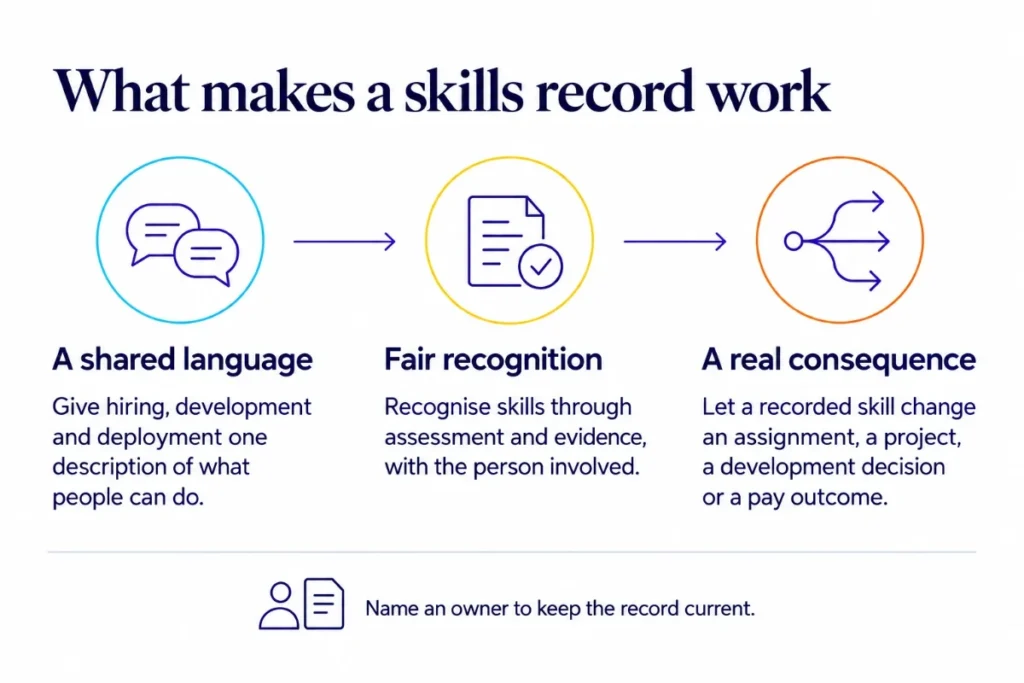
A skills-based organisation uses the skill as its operating unit, so that hiring, development and deployment draw on one shared description of what people can do. Three layers make that work: a shared language, a reliable way of recognising skills and a visible consequence when a skill is recorded.
The starting question is practical. When the content of a job changes faster than its job description, the description stops describing anything useful, so the unit an organisation manages has to become smaller and more durable than the job itself.
Skills give that unit, and capabilities give it scale. A capability groups the skills, tools and decisions a business needs to do something well, and it survives a reorganisation that renames every role. Managing at that level keeps the conversation on what the business can do, rather than on who sits where on the chart.
A shared language, a fair recognition and a real consequence
The first layer is a shared language, and Australia is building one at national level. Jobs and Skills Australia, the Commonwealth body that analyses the labour market, is developing the National Skills Taxonomy, an evidence-based framework designed to give education and employment a common way of describing skills. It builds on the Australian Skills Classification, which profiled occupations through core competencies, specialist tasks and technology tools.
The second layer is recognition: deciding what a person actually holds, through self-assessment, manager validation, assessment or evidence from work history. Fairness matters most here, because this layer decides who gets seen, and people commit to a system they experience as fair.
Recognition also brings clarity to judgements that already exist. Australian employers estimate that, on average, 13 per cent of their people are not yet fully proficient in their current role, down from 19 per cent two years earlier. Writing those assessments down, transparently and with the person involved, turns an informal opinion into a development conversation.
The third layer is consequence. A recorded skill has to lead somewhere for the person who holds it: an assignment, a project, a development decision or a pay outcome. This is the layer that builds trust, because it shows people that the record works for them.
Someone also has to look after the record, and in smaller businesses that role is often unassigned. Drawing on a hundred enterprise case studies, the OECD found that lack of time is the biggest impediment to training, including the time the HR function itself needs to organise it, and that firms with a dedicated training specialist deliver more of it.
Its work on smaller firms traces the same pattern to the absence of a professional HR function able to assess needs and build the tools, and notes that learning on the job, the main way capability grows in a small business, is rarely recognised formally. In the businesses I work with, naming an owner for the record is one of the simplest steps with the largest effect.
Why a skills-based organisation needs practice as much as announcement
The strongest programs change mechanics as well as messages. Research by the Burning Glass Institute and the Harvard Business School Project on Managing the Future of Work, covering 11,300 roles in the United States, found that removing a degree requirement lifted the share of hires without a degree by 3.5 percentage points, which works out at fewer than one in 700 hires.
The same study also shows what works. Around 37 per cent of employers changed their hiring mechanics and increased non-degree hiring substantially, while about 45 per cent changed the wording of their job ads only. The difference between the two groups lay in process, and process can be redesigned.
That evidence is American, and the Australian equivalent shows up in planning. The Australian HR Institute reports that one organisation in five has its training plan and its workforce plan integrated to a large extent, which leaves plenty of room for organisations that connect the two.
Where to start, and in what order
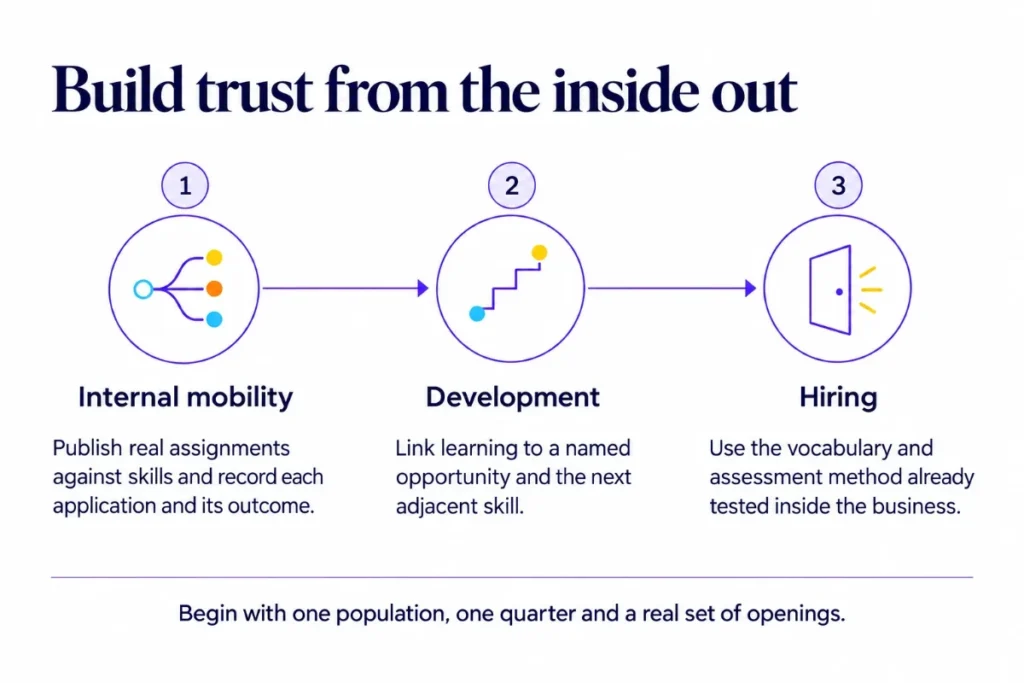
Sequence decides how quickly people start to trust the model. Start with internal mobility, because the people and the data already exist and results appear within weeks. Development comes next and hiring comes third, once the vocabulary has proved itself inside the business.
Mobility first, because careers now grow mostly inside
Australians are staying with their employers longer. The Australian Bureau of Statistics recorded a job mobility rate of 7.2 per cent in the year to February 2026, with just over a million people changing employer, and describes the fall as part of a long-term trend since the 1970s.
When people stay, the internal market becomes the main place a career can grow. That gives employers a real opportunity to show commitment, since every internal move made on the basis of skills tells the whole workforce that the model is working.
Managers need support to make this work. Releasing a strong performer costs a team capacity in the short term, so the organisation has to recognise managers who develop and release talent, and make that contribution visible.
The HR function has to look at its own settings here as well, since the processes governing recruitment, mobility and capability development can hold back the movement the business is asking for. I take up that tension in the role of HR in innovation, where opening bridges between departments and backing temporary secondments sit among the levers that matter most.
Begin with one population, one quarter and a real set of openings. Publish internal assignments against skills rather than titles, and share what happened to each application. That log becomes your first measure of trust.
Development second, attached to real opportunities
Australian employers invested around $1,122 per employee in training in 2025 and reached 38 per cent of the workforce with it, according to the Australian HR Institute survey of 612 senior decision makers. The commitment is real, and it pays off most when learning connects to a place to use it.
The same survey names two obstacles: four employers in ten point to a lack of time, and about a quarter worry that trained people might leave. Attaching development to a named internal assignment answers both concerns, because the time is spent on real work and the new skill has a place to grow inside the business.
Build this layer around adjacency, meaning the skills one step away from what somebody already holds. It is the organisational version of becoming a T-shaped expert generalist, deep in one area and useful across several, and it gives people a clear and motivating next step.
Hiring third, with a vocabulary that has proved itself
Skills-based hiring is the most visible part of the shift and benefits most from preparation. Its filters live in applicant tracking systems, agency briefs and the habits of hiring managers, so it changes faster once the vocabulary is already in daily use inside the organisation.
Once mobility and development are running, hiring inherits a tested language and a working assessment method. Here is the sequence I recommend:
- Choose one business unit and one quarter, and describe the skills for its ten most common assignments.
- Publish those assignments internally against skills, and record every application and its outcome.
- Link development to applications that fell short on one adjacent skill, so each person has a clear next step.
- Recognise managers who release people into new roles, so that developing talent is a visible contribution.
- Rewrite external job ads using the vocabulary that worked internally, and assess candidates on the same grid.
- Report the share of recorded skills that led to an opportunity each quarter, and follow up on those that did not.
Field note
The strongest column that told only half the story
During a talent workshop with a group of managers, we mapped each participant across their aptitude zones rather than their job description. One participant filled her strongest column with client reporting. She was the best in her team at it, she had received every complex account because of that, and her name sat beside that skill in every capability review.
When we reached the appetence question, she placed reporting in the zone I call the mastered chore: high capability, little desire to keep doing it. Her manager had been reading the first half of that picture for three years. Once the second half was on the table, the conversation changed within minutes, and the two of them agreed on a new mix of work that kept her expertise available to the team while opening the client strategy work she wanted.
Record capability and appetence together, and a skills conversation becomes a commitment conversation. People stay engaged when the organisation shows it knows what they want to do next, as well as what they already do well.
How to choose a skills model against your own criteria
Organisations have three ways to bring a skills language in, and each one suits a different situation. The choice belongs with the executive team, because the vocabulary it sets will shape every career conversation in the business for years.
Buy, align or derive, and what each route offers
| Route | What you gain quickly | What to plan for | Best fit |
|---|---|---|---|
| Buy a vendor taxonomy and platform | A complete library, inference tools and a working marketplace within months | Vocabulary owned by the vendor, renewal terms and time for managers to adopt the language | Large organisations with many roles and an urgent redeployment need |
| Align to the national taxonomy | A public, free and interoperable language linked to Australian occupations and training | Adaptation for specialist work, and separate tooling for inference | Organisations with compliance needs, government work or a priority on portability |
| Derive from live work | A vocabulary managers recognise, because it comes from real assignments | Sustained internal effort and a named owner to keep it current | Mid-sized organisations with distinctive work and strong operational managers |
Many of the organisations I work with combine the second and third routes, then add tooling once the vocabulary has settled. That order keeps the language close to the people who use it, which is where trust in the model starts.
Four questions to test any skills model before you commit
Put every proposal, internal or external, through the same four questions:
- Can a line manager describe a real assignment in this vocabulary without a translation guide?
- Does the model record what people want to do more of, as well as what they can do?
- Who owns the data if the contract ends, and in what format can it be exported?
- Which decision will visibly change in the first ninety days, and who is accountable for it?
A model that answers all four well is ready to scale. The second question deserves particular attention, because it decides whether people experience the system as something done to them or something built with them.
The dimension that keeps people committed
Most skills inventories record capability: what a person does well. Commitment depends as much on what that person wants to do more of. Adding that second dimension is the single change with the largest effect on engagement at scale.
In a team of fifteen, a manager carries that knowledge in conversation. Across five thousand records and an automated matching engine, the system needs to hold it explicitly, or it will keep matching people to work they have outgrown.
Appetences, and the five aptitude zones
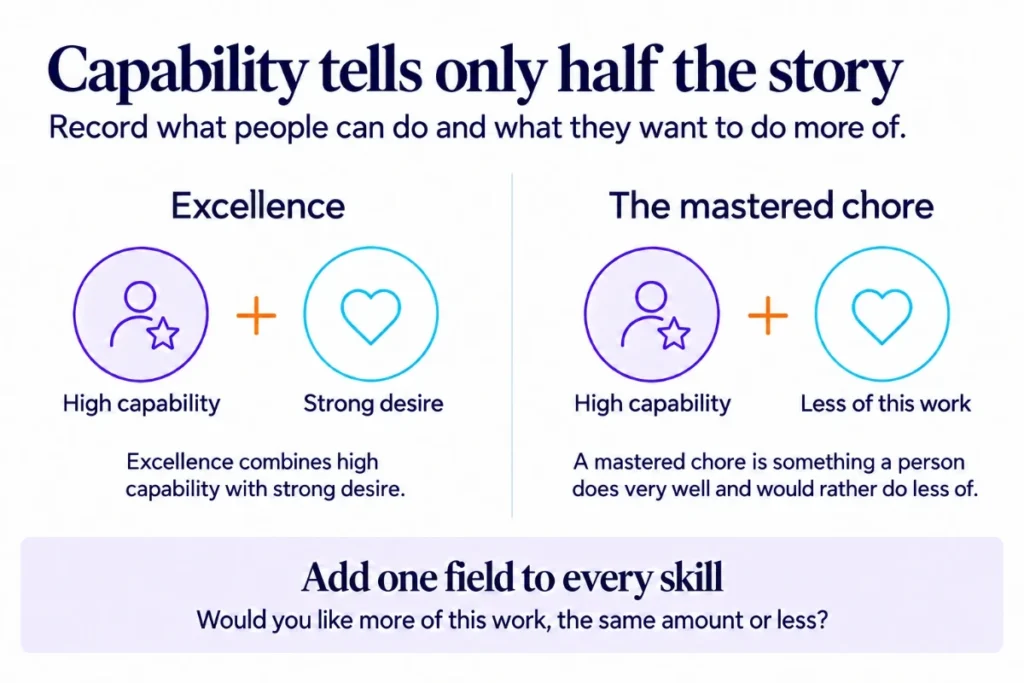
Appetences are the activities a person is drawn towards and wants to do more of, which is a different question from competence. I map them across five aptitude zones in my Talentstorming workshops: excellence, natural drive, built drive, strength and the mastered chore.
Excellence combines high capability with strong desire. Natural drive is desire that has not yet been developed, built drive is desire that grew through practice, and strength is solid capability with moderate pull. The mastered chore is the zone that needs the most care.
The difference between a strength and a mastered chore
A mastered chore is something a person does very well and would rather do less of. On a capability scale it looks identical to excellence, so an inventory that records proficiency alone will keep routing that person back into it.
The fix is one extra field: for each recorded skill, whether the person wants more of this work, the same amount or less. That field turns a static profile into a conversation about the future, and people value being asked.
It also turns a profile into a set of options, which is the logic behind my article on replacing the career plan with option capital.
The honoured claim rate, a measure of kept promises
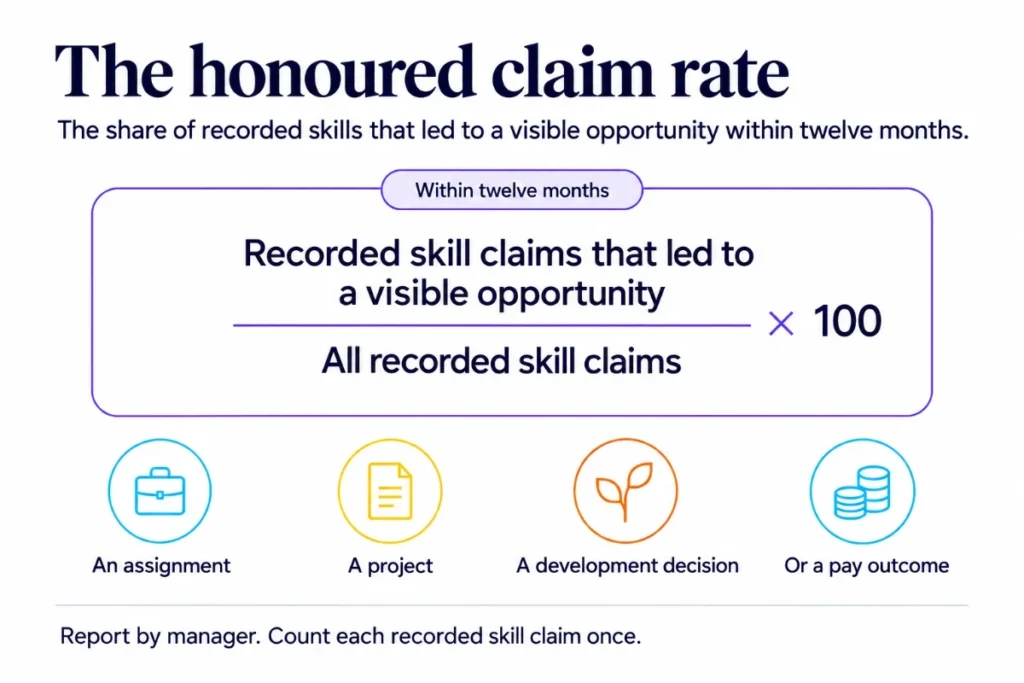
Every skill recorded against a person is a claim the organisation has accepted about them. The honoured claim rate is the share of those claims that led to a visible opportunity within twelve months: an assignment, a project, a development decision or a pay outcome.
Treating the record as a commitment puts it in the same category as any other public promise an organisation makes. That is the standard I apply in how to write a company manifesto, where a statement earns its place by being provable today rather than aspirational.
Profile completion shows whether people filled in a form. The honoured claim rate shows whether the organisation kept its side of the arrangement, which is what trust is built on. I use it as a working measure drawn from practice.
Reporting it by manager helps most, because mobility decisions are made locally and managers respond well to seeing their contribution recognised.
What AI readiness asks of an organisation
Training is where most AI programs start, and it is the easiest part to buy. Readiness shows up later, in whether people change how they actually work, and it depends on conditions that a training budget never touches.
Training builds skills, conditions build readiness
Australian employers already make the connection. They rate adaptability and learning agility as exactly as critical as technical and AI skills for the next two to three years, according to the Australian HR Institute survey of 612 senior decision makers.
That pairing carries the whole point. Tools keep changing, so the capacity to absorb the next one decides the return on the last one. A workforce trained on a specific assistant holds a skill, while a workforce that has learned how to adopt something new holds a capability.
Skills records help here too. Once appetences sit beside capability in the record, you can see which people want to work on new tools and which teams have the room to try, which turns an adoption plan into something you can staff.
Five conditions that decide whether the tools get used
Readiness comes down to a short list of conditions, and each one is a management decision rather than a purchase:
- permission to experiment during working hours, with a named place where results are shared
- managers who use the tools themselves, because teams copy behaviour faster than they follow instructions
- work practices rewritten wherever the tool changes the task, rather than added on top of the old ones
- clear rules on which data and which decisions stay with people, so the workforce trusts the system enough to use it openly
- a feedback loop short enough to turn one person’s discovery into shared practice within weeks
Organisations that put these in place get real value from ordinary training. Organisations that skip them buy licences that sit unused, then conclude that the technology was oversold.
Want careers that grow with your skills strategy?
Give your people a frame that outlasts any taxonomy. Explore my permacareer method for building a career that regenerates over time and use it as the individual counterpart to your skills model.
How I can help you build this at scale
I work with executive teams, HR functions and manager communities on the human side of skills strategies, which is the side that decides whether the technical investment pays off. The work runs in two main formats.
Talentstorming workshops for managers and HR teams
Talentstorming is my workshop method for mapping appetences alongside competence, across the five aptitude zones. Managers leave with a richer understanding of their own team, and HR leaves with the missing field for the inventory.
The session runs as a manager community format or as a train-the-facilitator program for internal HR teams.
Keynotes and executive sessions on skills and commitment
My keynotes give a leadership population one vocabulary for skills, appetences and internal mobility in ninety minutes, with the Australian evidence base built in. A shared vocabulary helps executives align their investments around one coherent program.
For organisations already mid-program, a shorter executive session reviews the current design against the four questions above and sets a baseline for the honoured claim rate.
Conclusion: trust is what makes the currency circulate
The technical foundations for this shift are now within reach. National work is under way, the tooling is mature and the evidence on what works is clear. The decisive ingredient is an organisation that lets a recorded skill change a real decision, and that asks people what they want to do next as well as what they can do.
Build a skills-based organisation on consequence and appetence, and people will keep the record alive because it works for them. That is how skills become a currency your whole workforce trusts.
Frequently asked questions about building a skills-based organisation
How do you move from roles to skills without rewriting every job description?
Start with assignments rather than jobs. Describe the ten most common pieces of work in one business unit in skills terms, publish them internally and keep the existing job architecture for the first year. Job descriptions can follow once the vocabulary has proved itself in daily use.
Where should a skills-based organisation prioritise first, hiring or mobility?
Mobility, because the people and the data already exist inside the business and results appear within weeks. Hiring benefits from the vocabulary and assessment methods tested internally, so it changes faster once mobility and development are running.
Do we need to buy a skills taxonomy?
Not at the start. Jobs and Skills Australia is developing a National Skills Taxonomy as a common public language, and vocabulary drawn from your own assignments reads naturally to managers. Tooling adds most value once the language has settled.
How do we know a skills program is building trust?
Track the share of recorded skills that led to a visible opportunity within twelve months, reported by manager. When that share rises, people see the model working for them, and they keep their records accurate without being chased.