Building a career on the same skills in the same sector, year after year, has become the professional equivalent of planting one crop across an entire paddock. It works beautifully until the season it does not.
That thought is what pushed me from the idea of the monocareer towards what I call the permacareer, a career designed the way a permaculture system is designed. A sustainable career, on this reading, is one that keeps producing without exhausting the person growing it.

There is a detail that makes this analogy work far better in Australia than anywhere else. Permaculture was invented here, in Tasmania, by two people whose names are on the record and whose design principles are published. This is home ground rather than a borrowed image.
So I want to do this properly. First the discipline itself, including the parts that get skipped and the criticisms it has attracted. Then the transposition to a career, and one mechanism inside permaculture that almost every career metaphor misses, which changes what you should actually be doing about your skills.
| The inherited reflex | What it produces | The design shift |
|---|---|---|
| One crop, one paddockThe monocareer builds on the same skills in the same sector for decades, which delivers efficiency until the sector moves. A sustainable career applies ecological design thinking to a professional trajectory instead of relying on a single specialisation. | Advice that only says add moreMost career guidance responds to that fragility by recommending more skills, more certifications and more side projects. Adding elements without a maintenance plan produces a collection of half-tended capabilities rather than a working system. | Yield per unit of attentionPermaculture organises elements by how often they need attention rather than by how many there are. Applied to a career, the design question becomes how far each capability sits from daily attention, which is the mechanism most career metaphors leave out. |
Permaculture, an Australian design discipline before it was a metaphor
Permaculture is a whole systems design method for productive landscapes, built on three ethics and a set of published design principles. It was created in Tasmania in the nineteen seventies and formalised in a book in 1978. Understanding what it actually contains is the precondition for transposing any of it to a career.
Most career articles that reach for permaculture take the word and leave the discipline. That produces a pleasant metaphor and no method.
Two Tasmanians and a backyard experiment
Bill Mollison was a senior lecturer at the University of Tasmania. David Holmgren was a student at the Tasmanian College of Advanced Education. From 1974 they ran what amounted to a three year design experiment in a shared house and garden on Strickland Avenue in Hobart, testing perennial polycultures and observing what survived a Tasmanian winter.
Holmgren wrote the manuscript as part of his environmental design studies and handed it to Mollison to edit and expand. The result was published in 1978 as Permaculture One: A Perennial Agriculture for Human Settlements.
The word itself changed meaning during the work. It started as a contraction of permanent agriculture and shifted towards permanent culture, once the pair concluded that the social and economic structures around food needed redesigning as much as the planting did. Mollison resigned his university post in 1979 to teach the method full time and received the Right Livelihood Award in 1981.
Three ethics and twelve design principles
Permaculture rests on three ethics: earth care, people care, and fair share, which sets limits on consumption and redistributes surplus. Holmgren later published twelve design principles that turn those ethics into decisions. The principles are the operational layer, and they are what a career transposition has to work with.
Several of the twelve read like career advice already, which is exactly why the analogy is tempting and why it is so often taken no further. The first four in particular could be lifted straight into a development plan without anyone noticing they came from a garden.
- Observe and interact, which puts watching before intervening.
- Catch and store energy, which treats surplus as something to be banked rather than spent.
- Obtain a yield, which insists that a system must produce something usable now and not only later.
- Apply self-regulation and accept feedback, which builds correction into the design instead of bolting it on.
Four others are less quotable and considerably more useful, because they describe how to make decisions rather than how to feel about them. These are the ones that survive translation into a professional context with their meaning intact.
- Design from patterns to details, which maps the large structures before placing anything specific.
- Integrate rather than segregate, which is the reasoning behind companion planting and agroforestry.
- Use small and slow solutions, which favours systems at human scale that develop gradually.
- Use edges and value the marginal, which exploits the productive boundaries where two systems meet.
The ethics matter for a different reason. A design method that includes people care and fair share is making a claim about limits, and limits are precisely what the career advice industry refuses to discuss.
Zones and guilds, the two mechanisms that do the real work
Zoning organises a site by how frequently each element needs human attention. Zone one sits at the back door and holds the herbs picked daily. Zone five is barely entered at all. Guilds group elements that support each other, so a single plant provides shade, nitrogen and food rather than one function.
Zoning exists because a gardener has a finite number of hours. Every design decision is really a decision about where scarce attention will be spent, and the diversity that everyone admires in a permaculture garden is a consequence of that constraint rather than the goal.
Guilds carry the same logic. An element earns its place by doing several jobs at once, which is how a small site produces a large yield without a proportional increase in labour.
Hold on to both mechanisms. They are the two that survive the journey from a Tasmanian garden into a professional trajectory, and they are the two that almost nobody transposes.
Succession and edges, or planting for a gardener you have not met
Succession is the practice of planting for stages that arrive after the current one, so that fast species shelter slow species which will outlast them. Edge effect is the observation that the boundary between two systems is more productive than either system alone. Both principles ask a designer to accept a delay between the decision and the result.
Succession is the least fashionable idea in the whole method, and the one with the most to say about a working life. It requires planting something whose value will appear years after the effort, possibly under someone else’s care.
Edges do the opposite work. The most productive part of a site sits where the orchard meets the pasture, or where the pond meets the bank, because two sets of conditions overlap and species from both can use the ground.
Keep those two alongside zoning and guilds. Four mechanisms, all published, all testable, and all considerably more demanding than the version of permaculture that reaches most metaphors.
What permaculture gets criticised for
Permaculture has a documented evidence problem. A peer-reviewed review in Agronomy for Sustainable Development found that substantive assessment of permaculture as an approach to agriculture appears to be absent from the peer-reviewed literature, with the field dominated by popular publications containing almost no experimental design or statistical analysis.
A second criticism comes from inside the movement itself. Practitioners complain that permaculture is repeatedly reduced to a handful of attractive techniques, herb spirals and swales and companion planting, while the design discipline underneath them is skipped.
I raise both because they matter for what follows. Borrowing the vocabulary of a method whose own evidence base is contested obliges me to be careful about what I claim, and the technique-over-design criticism is precisely the failure mode a career version would repeat.
Why the monocareer fails
A monocareer builds on one set of skills, exercised in one sector, refined over years until the person and the role are difficult to separate. It produces genuine efficiency and real expertise. It also concentrates every risk the person carries into a single market, which is the same structural weakness that makes an agricultural monoculture fragile.
The failure mode is rarely dramatic. The sector shifts, the role dissolves, and the expertise turns out to be difficult to move.
Efficiency bought with transferability
Deep specialisation trades transferability for output. The longer a capability is exercised inside one organisational context, the more of its value comes from that context, which is invisible while things go well. When the role disappears, the person discovers how much of their competence was local.
This is why I treat professional risk as a design problem rather than a motivation problem. Nobody chose the trade, and most people never saw it being made.
The corrective is to specialise in a capability rather than in an employer, so the expertise can travel when the position cannot.
How Australian careers actually move
Jobs and Skills Australia has mapped how workers move between occupations, and the finding is more specific than the usual advice to stay flexible. Movement is clustered. Some occupations act as gateways connecting to a wide range of others, and mobility is more common within clusters than between them.
Read that against the standard recommendation to diversify. Adding a capability that sits outside your cluster buys very little mobility, because the pathway between clusters is thin. Adding one inside your cluster, or moving towards a gateway occupation, buys a great deal. Climate is one of the forces now reshaping those clusters, and climate anxiety is now the manager’s job description looks at what that asks of managers and their teams.
This is the empirical version of a guild. Elements that support each other produce more than elements that merely coexist, and the same holds for capabilities inside a working life.
The Australian ground most careers are planted in
A design method only works if it acknowledges the soil. In Australia a substantial share of the workforce holds arrangements that make long horizon planning difficult, which changes what a realistic career design looks like. Any advice that assumes a stable full-time base is describing a minority of working conditions rather than the general case.
The ABS counts 2.4 million casual employees, 19 per cent of all employees, alongside 1.1 million independent contractors. Seventeen per cent of employees hold no minimum guaranteed hours at all.
Those numbers change the design brief rather than invalidating it. Someone whose hours move week to week has less predictable attention to allocate, which makes zoning more important rather than less, since the cost of maintaining an element they cannot reach is higher.
It also puts a limit on how much of this is an individual responsibility. A person can design their zones. Only an employer can decide whether the work leaves any attention to design with, which is why I treat this as a management question as much as a personal one.
The employer side of that question has an ecology of its own. I map it in your workplace is an ecosystem, not a machine, where the physical setting, the social layer, the culture, the psychological climate and the economic conditions are read as layers of one living system.
Yield per unit of attention, the mechanism career advice misses
Permaculture is organised around a constraint rather than around variety. A gardener has a finite number of hours, so every element is placed according to how often it must be visited. Transposed to a career, your capabilities are not a portfolio to be expanded. They are elements sitting at different distances from your daily attention.
This reframes almost every piece of career advice you have been given. The question stops being how many skills you hold and becomes which zone each one lives in.
Zone one is whatever you touch every day
Your professional zone one holds the capabilities you exercise daily without scheduling them. They stay sharp because the work itself maintains them. Zone two holds what you use weekly, zone three what you touch monthly, and beyond that sit capabilities you claim on a CV and have not exercised in a year.
Most people can name their zone one immediately. Almost nobody can name their zone four honestly.
The useful exercise is to place every capability you claim on a distance scale from your actual working week, then look at how much of your professional identity sits in zones you never visit.
An unmaintained skill is a weed bed
A capability that receives no recurring attention degrades rather than holding steady. It stops being an asset and starts consuming credibility, because you keep listing it and can no longer perform it at the level the listing implies. In garden terms it is a bed you planted, stopped weeding, and still describe as productive.
The damage runs further than the individual skill. Every unmaintained element occupies a slot in how you present yourself, which crowds out the elements you could actually defend.
Removing an element is a design decision of the same weight as adding one. Career advice almost never mentions subtraction, which tells you something about who writes it.
Why a sustainable career is designed rather than accumulated
A sustainable career is one whose elements are placed deliberately according to the attention available to maintain them. Accumulation produces a long list and a thin system. Design produces fewer elements, positioned so that each supports the others and none decays without you noticing.
The test is uncomfortable and quick. For every capability you would put on a professional profile, state when you last used it in real conditions.
Anything you cannot date within the last twelve months belongs in an outer zone, and it should be described that way or removed.
A designed career answers the question of what you can maintain, and I take up the question of whether that work still feels worth doing in meaning at work and what a manager can actually fix.

The five steps of a permacareer
The five steps below are my transposition of ecological design thinking to a professional trajectory. They move from what you want, through the ground you are standing on, to the layout, the combinations and the maintenance. The sequence matters, because each step constrains the one after it.
None of this requires a career change. Most of it can be done inside the role you already hold.
Steps one and two, your needs and your ground
Step one is assessing what you want the system to produce, which means naming the work you like doing before naming the skills you should acquire. Step two is reading your ground: the dynamics of your sector, the culture of your organisation, and the growth openings actually available to you rather than the ones described in the strategy deck.
The order is deliberate. Choosing capabilities before understanding what you enjoy produces a competent professional who dreads Monday.
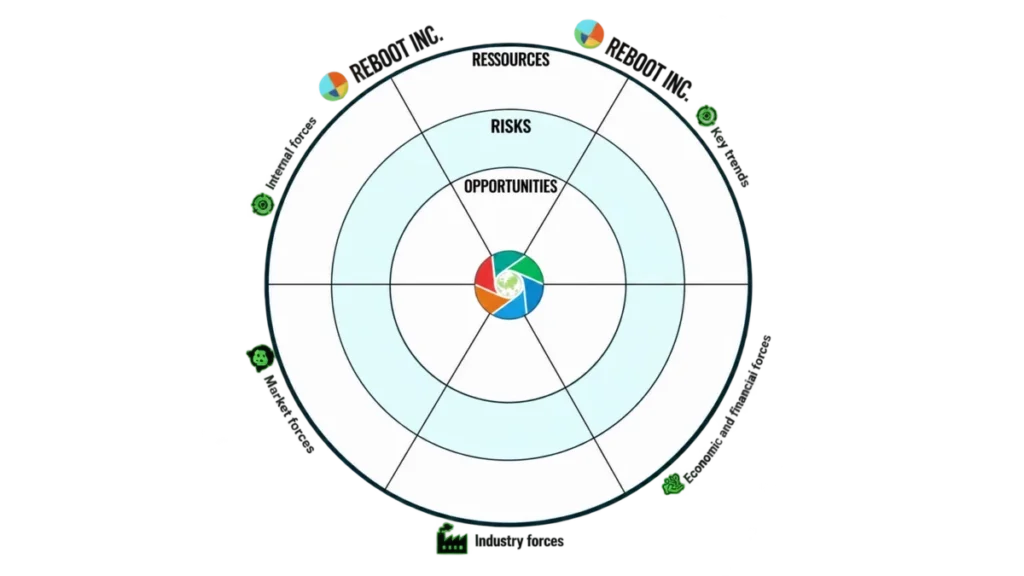
Reading your ground also means being honest about time. If your organisation leaves no room at all for your own development, that is information about the organisation rather than about your discipline. I use a contextual ecosystem map for this with clients, and it works just as well on an individual trajectory as on a business model.
Steps three and four, your paths and your guilds
Step three is laying out the paths, which means deciding what you will attempt over a defined horizon and how you will get there. Step four is choosing combinations rather than isolated skills, so that each capability strengthens another. A technical skill paired with the ability to explain it produces more than either alone.
The Jobs and Skills Australia mobility clusters give this step a factual basis. Combinations inside your cluster compound, and combinations across distant clusters mostly sit idle.
Combined roles have a name in the careers literature. Marci Alboher described the slash career, the composer slash performer or the consultant slash lecturer, in her 2007 book on holding multiple working identities at once.
| Technical capability | Companion capability | What the pairing produces |
|---|---|---|
| Data analysis | Written explanation | Findings that reach decision makers instead of stopping at the dashboard |
| Project delivery | Negotiation | Scope that holds when the budget moves |
| Technical specialisation | Teaching | Expertise that travels beyond the current employer |
| Client work | Writing in public | Proof of capability that exists outside a reference check |
| Operational management | Financial literacy | Decisions defensible at board level rather than at team level |
Step five, observe and adapt
Step five is the maintenance layer, and it is the one people skip. It means reviewing what has grown, what has failed and what has stopped receiving attention, then adjusting the layout rather than adding to it. A permaculture garden is never finished, and neither is a working life.
Keeping a record helps more than it sounds. A short log of what you attempted, what worked and what you abandoned turns a vague sense of progress into something you can actually read.
Experimentation belongs here too. Taking an unusual project, moving sideways or testing a capability at low cost is how you find out what your ground will actually support.
Field note
The year I discovered I had planted three zone ones
I run this site on innovation and managerial transformation, a second business on engagement and workplace culture, and a consulting and speaking practice that feeds both. On paper that is textbook diversification, and I have recommended the same structure to clients. Three streams, related capabilities, shared audience.
Then I applied the zoning question to myself rather than to a client. Each of the three needed daily attention to stay alive. Writing, client delivery and audience building all sit at the back door, and none of them tolerates being visited monthly.
I had designed three zone ones and had one gardener. The symptom had been visible for a while and I had read it as a workload problem: weeks where everything received something and nothing received enough, and a growing list of capabilities I still described as current while no longer exercising them. What fixed it was not working longer. It was accepting that one of the three had to move outward, run on a slower cycle, and stop being measured weekly.
The operational lesson is that the constraint is attention rather than ambition. Before adding anything to your professional system, count how many elements already demand daily contact, because a second or third zone one does not add capacity, it starves the first.
Budgeting attention instead of counting skills
The measurable unit in a career design is recurring attention, expressed in hours per week, allocated across zones. Counting capabilities produces a list that flatters you. Counting the hours that actually maintain them produces a map you can act on, and it usually reveals that several claimed strengths receive no time at all.
This shifts what is being measured. The question moves from what you can do to what you are currently keeping alive.
A protocol you can run this weekend
The exercise takes about ninety minutes and needs your calendar from the last three months rather than your memory. Memory reports intentions and the calendar reports behaviour. Work from the second one.
- List every capability you would put on a professional profile, including the ones you are slightly embarrassed to still be claiming.
- Against each one, write the date you last used it in real working conditions, taken from your calendar rather than from recollection.
- Assign each capability to a zone: daily, weekly, monthly, yearly, or dormant.
- Total the recurring hours per week that each zone genuinely consumes, and compare that total to the hours you actually have.
- Decide what moves outward, what gets removed, and what single element deserves the attention freed up by those two decisions.
Repeat it once a year. The pattern of movement between zones tells you more about your trajectory than any annual review will.
What the map usually shows
Three findings recur when people run this exercise honestly. They hold more claimed capabilities than they can maintain, they have more than one element demanding daily attention, and the capability they most want to develop sits in the zone furthest from their actual week. The third one explains most stalled career plans.
The fix is rarely more discipline. Moving a capability inward requires displacing something already occupying that zone, which is a subtraction decision that no amount of motivation will make for you.
People who make that trade explicitly tend to move. People who add without subtracting tend to describe themselves as busy for several years.
Choosing a career development approach against your own criteria
Several approaches to career development compete for your time, and each suits a different situation rather than a different personality. The traditional plan, the option portfolio, the ecological design approach described here, and pure specialisation all work under specific conditions. Choosing well means matching the approach to your attention budget and your sector’s rate of change.
This section is decision support rather than a recommendation. My own preference is visible enough in the rest of the article.
Four approaches compared
The table sets each approach against the situation it suits, the attention it demands, and the way it typically fails. Read the failure column first, since most people choose an approach without ever asking how it breaks.
| Approach | Suits | Attention demanded | How it fails |
|---|---|---|---|
| Traditional career plan | Stable sectors with visible ladders | Low, reviewed annually | The ladder is removed and the plan has no second route |
| Option portfolio | Sectors under visible disruption | Medium, several trajectories kept warm | Options are collected and never exercised |
| Ecological design, the permacareer | Anyone whose attention is the binding constraint | Medium, concentrated on maintenance | Zoning is done once and never revisited |
| Deep specialisation | Fields where mastery takes a decade | High, all in one zone | The market for that mastery contracts |
Signals you have chosen the wrong approach
Three signals show up within a year. You are learning constantly and can name nothing you now do differently. Your professional profile lists capabilities you would hesitate to demonstrate on request. Opportunities arrive that fit the person you were three years ago and nobody offers you the ones you have been preparing for.
The third signal is the sharpest. What the market offers you is a reasonably accurate reading of what you have actually been maintaining.
If the approach fits, the opposite happens. People start approaching you about work adjacent to what you have been building without announcing it, usually before you have finished building it.
Turn your zones into activatable options
Want the portfolio version of this thinking? Read my full method for building career option capital and learn how to hold several trajectories ready without maintaining all of them at once.
How I can help you design a sustainable career
I work with organisations on career design as a regenerative management question rather than an individual development question, because attention budgets are set by workload long before anyone attends a course. The work runs as keynotes, workshops, leadership programs or a short diagnostic, depending on whether the constraint sits with the individual or with the system around them.
The starting question is always the same. What are your people currently maintaining, and what did the organisation ask them to plant and then never resource?
Keynotes and workshops
A keynote suits a conference or an internal event where a large group needs the zoning idea quickly and a reason to act on it. A workshop suits a smaller group ready to run the mapping exercise on their own capabilities and leave with decisions. Both work with Australian data and Australian examples.
The workshop version produces a completed zone map per participant, along with the subtraction decisions most people avoid making alone.
Where the audience is a leadership group rather than individual contributors, the session connects career design to the wider question of regenerative management, since an organisation that extracts attention faster than it restores it cannot host sustainable careers whatever its development budget says.
Programs and diagnostics
A leadership program suits organisations where managers are expected to develop their teams and have never been given a method for it. A diagnostic suits organisations that suspect their development spend is producing activity without capability, and want the gap made visible before the next budget cycle.
Programs cover the practical layer: mapping zones, designing capability pairings, and running the annual review that keeps the design alive.
The diagnostic connects naturally to work on the three temporalities of regenerative management, because a system that only measures the current quarter will always underfund the elements that mature slowly.
Conclusion
I started writing about the permacareer more to amuse myself than to be serious. The parallel turned out to hold better than expected, and the reason is that permaculture was never really about diversity. It was about designing a productive system around a finite amount of attention, which is exactly the constraint every working person is under.
So the practical instruction is smaller than most career advice and harder to follow. Stop counting what you can do. Map what you are actually maintaining, decide what moves outward, and accept that adding anything means displacing something.
A sustainable career is built that way, one zoning decision at a time, the same way two men in a Hobart backyard built a design discipline by observing what survived the winter. From monocareer to permacareer, what do you think?
Frequently asked questions about building a sustainable career
What is a permacareer?
A permacareer is a professional trajectory designed with ecological design thinking, where capabilities are placed according to the attention available to maintain them. It is my transposition of permaculture design to a working life, and it treats subtraction as seriously as addition.
How many skills should I be developing at once?
Fewer than most advice suggests, and the number depends on your recurring attention rather than your ambition. If more than one capability requires daily contact to stay current, the others will degrade. Count maintenance hours before counting skills.
Is diversifying my skills always a good idea?
Diversification helps when the new capability sits inside a cluster you can already reach. Jobs and Skills Australia data shows movement between occupations is clustered, so a skill added far from your existing cluster buys much less mobility than one added close to it.
Who invented permaculture?
Bill Mollison and David Holmgren created permaculture in Tasmania, publishing Permaculture One in 1978 after several years of experimentation in Hobart. Mollison received the Right Livelihood Award in 1981 and Holmgren later published the twelve design principles most practitioners use.
Can I design a sustainable career without changing jobs?
Most of it happens inside your current role. Mapping zones, retiring capabilities you no longer maintain, and pairing an existing strength with a companion capability all require decisions rather than a resignation. A move becomes useful only once the design shows your ground cannot support what you want to grow.