I have watched organisations spend a fortune on wellbeing apps, foosball tables and quarterly surveys, and watch their engagement scores keep falling anyway. The engagement crisis is the widespread loss of motivation, commitment and discretionary effort at work, and it is the seventh and last of the management crises for a reason. It is the boss final, the point where all the others land at once.
This is the final article in my series on the seven management crises, and it follows the social connection crisis. Broken connection drains belonging, and this crisis drains the will to try. I want to make an argument that most engagement programs get exactly backwards. You cannot fix the engagement crisis by managing engagement, because engagement is a symptom, not a cause.

| The perks fix | What it really is | The shift that transforms |
|---|---|---|
| A perks problemThe engagement crisis is usually treated as a perks-and-surveys problem, met with wellbeing apps, foosball tables and another pulse survey. Treated that way, the numbers keep sliding no matter what is spent. | The boss finalEngagement is the compound symptom where the other six crises land, from lost meaning to broken connection. It is a lagging indicator of how work is going, not a lever a manager can pull on its own. | Fix the causes, back the managerBenjamin Chaminade’s frame treats engagement as the boss final of the seven crises. Since around seventy per cent of team engagement depends on the manager, a manager who fixes the upstream causes earns the engagement that perks can never buy. |
What the engagement crisis really is
The engagement crisis is the erosion of the motivation, commitment and discretionary effort that people bring to their work. It shows up as people doing the minimum, watching the clock, and quietly withdrawing the extra that used to come for free. Understanding it as the sum of the other six crises, rather than a problem in its own right, is the key that unlocks it.
Defining the engagement crisis
Engagement is the mix of involvement and commitment that together make up a person’s attachment to their work. A person can be present and busy while giving none of their real energy, which is why attendance and engagement are not the same thing at all.
The global picture is stark. Gallup found that worldwide engagement fell to around 20 per cent in 2025, a second straight year of decline and the lowest level since 2020, while in Australia and New Zealand roughly one in four workers are engaged. Most people, in other words, are turning up without really being there.
It helps to separate engagement from satisfaction. A person can be satisfied and coasting, content enough to stay and giving nothing extra, while engagement is the willing effort that goes beyond the job description. Satisfaction keeps someone in the seat, and engagement makes the seat worth having.
The two components are worth naming. Involvement is how much of themselves a person puts into the work, and commitment is how attached they are to staying and contributing, and together they form the professional attachment that the crisis is eroding. Lose either, and the attachment weakens.
The distinction is practical. A drop in involvement points to the work itself, and a drop in commitment points to trust, growth or belonging, so naming which one has fallen tells a manager where to start.
That is the practical value of treating attachment as two parts rather than one number.
Why the manager crisis is now the workforce crisis
The sharpest recent finding is that disengagement now begins at the top of the team. Managers are more burnt out and less engaged than the people they lead, reversing the old pattern, and because engagement cascades downward, a checked-out manager layer has become the single biggest driver of the whole crisis.
This is why the manager crisis is now the workforce crisis. When the person responsible for a team’s climate is themselves exhausted, squeezed between demanding teams and pressing leadership, and rarely trained for the job, their disengagement flows straight into the group. The upside is that it points to the highest-leverage fix available, since lifting and supporting managers moves the factor that shapes team engagement most.
The boss final: where the other six converge
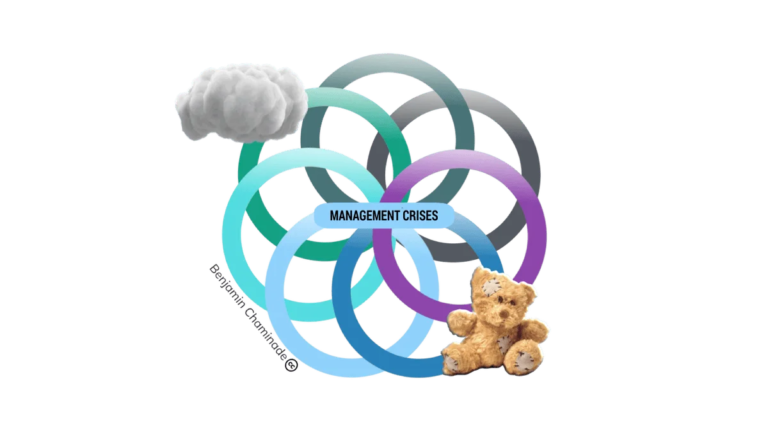
My frame for this crisis is the boss final. In a video game the final boss is where every earlier challenge you failed to master comes back at once, and the engagement crisis works the same way, gathering the unresolved climate anxiety, broken trust, lost meaning, poor health, stalled growth and thin connection into one overwhelming problem.
This reframes the whole fight. Engagement is the readout, the number on the dial that tells you how the other six are going, so a low score is information about the causes rather than a problem to attack directly. Treat it as the final boss it is, and you stop swinging at the symptom and start beating the crises feeding it.
There is a strange comfort in this framing. A single, mysterious engagement problem feels unfixable, and six named crises with known responses feel like a plan. Naming the final boss as the sum of its parts turns despair into a to-do list.
It also explains why isolated fixes disappoint. A perk aimed at engagement is aimed at the boss while ignoring the six attacks draining it, so the score barely moves. You have to clear the ones behind it before the last one falls.

How the engagement crisis shows up at work now
At work the crisis shows up in three ways a manager will recognise: in the hard numbers on disengagement, in the quiet withdrawal of effort that people now call quiet quitting, and in a manager layer that is itself checked out and squeezed. Each points to a different part of the response.
The three are one story. The numbers show the scale, quiet quitting shows the mechanism, and the state of managers shows the cause, and a response that reads all three does far better than one that reaches for another perk.
Disengagement by the numbers
The scale of disengagement is easy to underestimate until you cost it. Most of the workforce is not actively hostile, they have simply stopped giving the extra, and that gap between showing up and truly contributing is enormous in aggregate.
The price is measurable. Gallup estimates that low engagement costs the world economy the equivalent of around 9 per cent of global GDP in lost productivity, an almost unimaginable sum built from millions of small daily withdrawals of effort. What looks like a soft, cultural issue turns out to be one of the largest economic losses there is.
Behind the percentage are people. Each single point of global engagement stands for roughly twenty million workers, so the recent slide is tens of millions who have quietly stopped bringing their best. The number is abstract, and the disengaged colleague at the next desk is not.
The comparison that lands hardest is to lost output. Disengagement is capable people doing a fraction of what they could, which is a loss that never appears as a line item and dwarfs most of the ones that do.
This is why the crisis is easy to tolerate for too long. It hurts slowly and everywhere at once, rather than in a single visible failure, so it rarely triggers the alarm a sharper problem would.
Quiet quitting and the withdrawal of effort
Quiet quitting is disengagement with a new name. It describes people who stay in the job and withdraw the discretionary effort, doing what the role strictly requires and no more, which is a rational response to feeling unseen or unrewarded.
The signs are the ones every leader already tracks. Rising turnover, falling productivity and harder recruitment are the visible surface of disengagement, and they are lagging signals that the attachment was lost some time ago. By the time they show up in a report, the withdrawal has usually been building for months.
It is worth being fair to the quiet quitter. Withdrawing effort that is never noticed or rewarded is a rational response rather than laziness, and often a healthy boundary after a long stretch of giving more than the job returned. The label sounds like a worker problem, and the cause usually sits with how the work is led.
Demanding the effort back rarely works. Making the work worth the effort again does, and that is a management task rather than a motivational poster.

The manager caught in the middle
The most important finding is about the manager. Disengagement now starts at the manager layer, with managers themselves more burnt out, more squeezed and less engaged than the people they lead, and their state cascades straight down to their teams.
This matters because the manager is the lever. Gallup finds that around 70 per cent of the variance in team engagement is explained by the manager, and yet fewer than half of managers have ever had any real management training. A layer of untrained, unsupported managers is the engine of the engagement crisis, and also the place where it can be reversed fastest.
The flip side is genuinely hopeful. If the manager explains most of the variance, then developing managers is the highest-return lever a business has, and Gallup’s own meta-analysis of its Boss to Coach course found that managers who took the course, and their teams, improved engagement more than non-participants when measured nine to 18 months later. A trained, backed manager becomes the multiplier on every other investment in your people.
Australia and New Zealand sit a little above the global average on engagement, which is encouraging and still leaves around three in four workers not engaged. The gap between comfortable and committed is where the opportunity, and the lost value, both live.
The lesson for an Australian leader is to avoid being reassured by a middling ranking. Sitting above a low global bar still means most of your people are not engaged, and the value locked in that gap is large.

Why perks and surveys do not fix it
Here is the uncomfortable part for an engagement budget. You cannot buy engagement with perks or measure it into existence with surveys, because both treat the readout instead of the causes underneath it. The engagement-industrial complex of apps, treats and pulse surveys keeps growing while the numbers keep falling.
Engagement is a thermometer, not a thermostat
The core confusion is between a thermometer and a thermostat. A thermometer reads the temperature, and a thermostat changes it, and an engagement survey is firmly a thermometer. Measuring more often, or more precisely, tells you the room is cold without doing anything to warm it.
This is why survey fatigue is now its own problem. Asking people how engaged they are every few weeks, and then changing nothing they can see, actively deepens the disengagement it was meant to detect. The measurement becomes a broken promise, and a broken promise is corrosive.
The way out is to measure less and act more. A single honest question followed by visible change rebuilds more trust than a monthly survey followed by silence, because people judge you by what moves, not by what you ask.
Measuring still has a place. The point is to earn the right to ask, by acting on what people tell you, so the next survey meets candour rather than a shrug.
Perks buy comfort, not commitment
Perks are pleasant and they do not create commitment. A concierge service, a games room and a fruit basket make a job more comfortable, and none of them touches whether a person finds meaning, trust, growth or belonging in the work, which are the things engagement is actually made of.
The proof is in who tends to be more engaged. Smaller organisations, with none of the exotic benefits, often report higher engagement than large ones, because their people are close to a manager who can say yes, carry real responsibility, and see the effect of their work. Closeness and agency beat a benefits catalogue every time.
There is a paradox in the perks race worth naming. The more an organisation leans on benefits to compensate for the work itself, the more it signals that the work needs compensating for, which is not the message it intends to send. A great job needs fewer perks, and a poor one is not rescued by them.
The engagement-industrial complex
A whole industry has grown up around measuring and decorating engagement, and it keeps expanding while the scores keep falling. That paradox, more spend and worse results, is the clearest sign that the money is going to the symptom rather than the cause.
Pulse-survey platforms, recognition apps, concierge services and wellbeing subscriptions all promise to move engagement, and most of them measure or soothe it without changing the work underneath. The spend is easy to approve because it is visible and looks caring, and it rarely asks leadership to change anything hard. Real engagement is uncomfortable by comparison, because it demands better work design and better management, which cannot be outsourced to an app.
The honest question for any leader is which kind of spending their engagement budget is. If it changes the work, it is an investment, and if it only measures or decorates the work, it is a comfort, and comfort has never yet engaged anyone.
Field note
The engagement survey that made things worse
A company brought me in because its engagement scores had fallen for three years straight, despite a growing budget for perks and an ever more detailed quarterly survey. They wanted help writing better survey questions, convinced the measurement was the problem.
The measurement was fine, and the message it carried was being ignored. People were overloaded, had no visible path to grow, and reported to a thin layer of managers who were themselves exhausted and untrained. Every survey asked them to name this, and every quarter nothing changed, so the survey had quietly become proof that no one was listening.
The lesson I carry from that engagement is to stop polishing the thermometer and start fixing the room. When we cut the workload, opened real growth paths and invested in the managers, engagement recovered on its own, because we had finally treated the causes instead of the score.
How to rebuild engagement as a regenerative manager
Rebuilding engagement means giving up on managing it directly. As a regenerative manager, you treat the upstream causes, you make the manager’s own role worth wanting again, and you give people the autonomy, meaning and recognition that engagement is genuinely built from. Engagement then arrives as a result rather than a target.
Stop managing engagement, manage its causes
The single most useful move is to stop chasing the engagement number and start treating the six crises beneath it. Because engagement is the boss final, it falls when climate honesty, trust, meaning, health, growth or connection are missing, so those are where the real work sits.
This is what I mean by regenerative management, which starts with the person in front of you rather than with a corporate program. It reads their past, the experience the job offers them now, and the future of their career, and it works the causes that a survey can only measure. Fix those, and the engagement score fixes itself.
This is also the bridge to the whole series. Because engagement sits downstream of the other six crises, the response to it is really the response to all of them together, which is the subject of the final piece in this series. Beat the six, and the seventh mostly beats itself.
Redefine the manager’s role as enabler
Since the manager drives most of the engagement, the manager’s role has to become one worth doing. Fewer people want the traditional job of policing a team, and many more would take a role built around coaching, developing and clearing the path for others.
This is the shift I call enableship, a way of leading that measures a manager by how much they enable others rather than how much they control them. Training and backing managers to lead this way is the highest-return investment available, since it lifts the one factor that moves team engagement most. A supported manager is the difference between a team that gives its best and one that gives its minimum.
This also answers the quiet flight from management. Fewer people want the old role of monitoring and policing a team, and far more would take a role built around growing others, so redefining the job as enablement makes it worth wanting again. You solve two problems at once, the shortage of willing managers and the shortage of engaged teams.
The word matters less than the move. Call it what you like, and the shift is from a manager who extracts performance to one who enables it, which is the version of the role people still aspire to.
Done well, this is how you make the manager’s job desirable again, which quietly eases the shortage of people willing to lead.
Give autonomy, meaning and recognition that is real
Engagement is built from a few durable ingredients, and none of them is a perk. A manager who provides them steadily will out-engage any benefits budget, because these are the things people actually respond to.
- Autonomy: give people real control over how they do their work, since agency is one of the strongest drivers of commitment.
- Meaning: connect the daily task to a purpose the person can see, so the work is worth the effort it asks.
- Growth: offer a genuine path forward, including expert and project tracks, not only the ladder into management.
- Recognition: notice real contribution specifically and often, because generic praise and gimmicks are quickly seen through.
- Voice: let people shape decisions that affect them, since involvement is half of what attachment is made of.
None of these costs much, and all of them ask a manager to lead differently rather than spend more. That is the whole point, because engagement is earned in the relationship, not purchased from a catalogue.
Notice that every ingredient is something a manager grants rather than a budget buys. That is what makes them powerful and also what makes them hard, because they ask the manager to share control and attention rather than approve a spend.
The best test of whether you are treating causes or symptoms is simple. Ask whether your last engagement initiative changed how the work is done, or only how it is measured and decorated, and be honest about the answer.
Do that consistently, and you build what no survey can capture, a team that gives its discretionary best because the work and the manager have earned it.

Stop chasing the score, back your managers
Want to lift engagement by treating its causes instead of its symptoms? Discover how I turn managers into enablers of engagement in my keynote on regenerative leadership, made for teams tired of surveys that change nothing.
How to choose your approach to the engagement crisis
Once a leadership team accepts that engagement is a symptom, the question is where to invest, and the answer depends on what is actually driving the low scores. Some reach for another survey or perk, others invest in their managers, and a few treat the whole system of causes. The comparison below is decision support, not a sales pitch.
Survey-and-perks, manager capability or systemic redesign, for which situation
The three approaches work at very different depths. Surveys and perks touch the surface, manager capability moves the biggest single lever, and systemic redesign treats the causes across all seven crises. Match the depth to what is really wrong.
The common mistake is to keep buying surveys and perks because they are quick and visible, and never invest in managers or the system underneath. Measure if you must, and put the real money where the leverage is, in the managers and the causes, not the dashboard.
| Approach | Best when | What it changes | Watch-out |
|---|---|---|---|
| Surveys and perks | You have no visibility and no baseline | What you can see, and short-term comfort | Measures and soothes without moving the causes |
| Manager capability | Managers are untrained and unsupported | The single biggest driver of team engagement | Needs real backing, not one training day |
| Systemic redesign | Several of the seven crises are live at once | The upstream causes engagement flows from | Slower, and it asks leadership to change too |
| Regenerative management shift | Engagement keeps falling despite spend | Whether managers treat causes or chase scores | Exposes how work is really designed and led |
The signals that should guide your investment
A few signals tell you where to put the effort. Read them honestly, because each points to a different response.
- If scores keep falling while perk spending rises, stop buying comfort and start treating the causes.
- If your managers are burnt out and untrained, invest there first, because they move engagement most.
- If several of the seven crises are live at once, treat the system rather than any single link.
How I can help you master the engagement crisis
I work with leadership teams that want to lift engagement by treating its causes rather than chasing its score. My role is to help managers become enablers, to treat the upstream crises, and to build the kind of work people want to give their best to.
Keynotes and workshops on regenerative leadership and management
My keynote on regenerative leadership reframes the engagement crisis as the boss final of the seven, solved by treating causes rather than symptoms. In workshops and masterclasses, we turn your managers into enablers and rebuild the autonomy, meaning and recognition that engagement grows from.
Engagement that lasts is a by-product of good management rather than a program you run, and that is where we begin with your leaders.
Manager programs and the systemic response
Because engagement is the boss final, it is best treated as part of the whole. I build manager development journeys that grow enablers, and because the seven crises reinforce each other, we set engagement inside a systemic response to the seven management crises, so you beat the final boss by clearing the ones that feed it. The aim, as ever, is to leave a team more engaged than I found it.

Conclusion, the engagement crisis is the sum of the others
The comfortable story is that people are simply less committed than they used to be, and that the fix is a better perk or a smarter survey. The data and the field say otherwise. Engagement is the boss final, the compound result of six crises left untreated, so chasing the score directly will always disappoint.
This is not a counsel of despair, it is the opposite. Every one of the six causes has a known response, and a manager who works them steadily will see the seventh recover, because engagement follows good management the way health follows good habits.
The better response is to stop managing the symptom and treat the causes, to back the managers who drive most of the outcome, and to give people the autonomy, meaning and recognition that no catalogue can buy. Do that, and the seventh crisis loosens its grip because the six behind it have. Handled as the sum of the others rather than a problem of its own, the engagement crisis becomes the clearest sign that a team is finally being led well, which is exactly where the systemic response to all seven begins.
Frequently asked questions about the engagement crisis
What is the engagement crisis?
The engagement crisis is the widespread loss of motivation, commitment and discretionary effort at work. Globally, engagement fell to around 20 per cent in 2025, its lowest since 2020, with roughly one in four workers engaged in Australia and New Zealand. It is the compound result of the other management crises.
Why do engagement surveys and perks not work?
Because they treat the symptom, not the cause. A survey is a thermometer that reads engagement without changing it, and perks add comfort without touching meaning, trust or growth. Measuring more often while nothing changes can even deepen disengagement, turning the survey into proof that no one is listening.
What has the biggest effect on employee engagement?
The manager. Gallup finds that around 70 per cent of the variance in team engagement is explained by the manager, yet fewer than half of managers have had real management training. Backing and training managers to lead as enablers is the highest-return way to address the engagement crisis.
How can a manager improve engagement?
Stop managing engagement and manage its causes. Give people real autonomy, connect their work to meaning, offer genuine growth, and recognise real contribution specifically. Treat the upstream crises of trust, health and connection too, and engagement rises as a result rather than a target you chase.