I have run enough sessions on the meaning of work to know the moment it goes quiet in the room. Someone says, carefully, that they used to care about the job and are not sure where that went. They have not quit, they turn up every day, and something has gone out of the work all the same. The loss of meaning at work is that hollowing out, and it has become a management problem before it is a wellbeing one.
This is the third article in my series on the seven management crises, and it follows the trust crisis. Where trust asks whether people can rely on you, meaning asks whether the work is worth their effort at all. I want to make an argument that changes what a manager should watch. The meaning crisis has changed form, and most organisations are still looking for it in the wrong place.

| The tempting fix | What the data shows | The shift that transforms |
|---|---|---|
| A purpose posterThe loss of meaning at work is often treated as a purpose-statement problem, fixed with a mission on the wall and a wellbeing perk. Read that way, it stays cosmetic while the disengagement deepens underneath. | A change of formMeaning has not only fallen, it has moved. As the exit door narrows, lost meaning stops leaving as resignation and stays at the desk as disengagement, which is harder to see and costlier to carry. | A question of levelsMeaning cannot be handed to anyone. Benjamin Chaminade’s frame is that a manager aligns the levels of meaning they control, the task, the team and the contribution, and leaves the meaning of a whole life alone. |
What the loss of meaning at work really is
The loss of meaning at work is the feeling that a job no longer holds any usefulness or value, which drains motivation, dulls engagement and can tip into a real health problem. It has a name in occupational psychology, brown-out, and it is distinct from its better-known cousins. Understanding what it is, and that meaning has several layers, is the first step to managing it.
Defining the loss of meaning at work: brown-out
Brown-out is the quiet dimming of engagement that happens when work stops making sense to the person doing it. It sits alongside two other states that managers confuse it with. Burn-out is exhaustion from too much demand, bore-out is the numbness of too little, and brown-out is the flatness of work that has lost its point.
The distinction matters because each needs a different response. You ease burn-out by reducing load, you cure bore-out by adding challenge, and neither of those touches brown-out. A person in brown-out can have a manageable workload and interesting tasks and still feel the work is pointless, which is exactly why a wellbeing perk aimed at stress leaves them cold.
Brown-out is under-diagnosed precisely because the person looks fine. They are present, polite and still delivering the minimum, so nothing trips an alarm. The cost surfaces later as lost discretionary effort, the small extra care and initiative that never appears on a dashboard and that a good team quietly runs on.
Why meaning is not one thing: the five levels of meaning
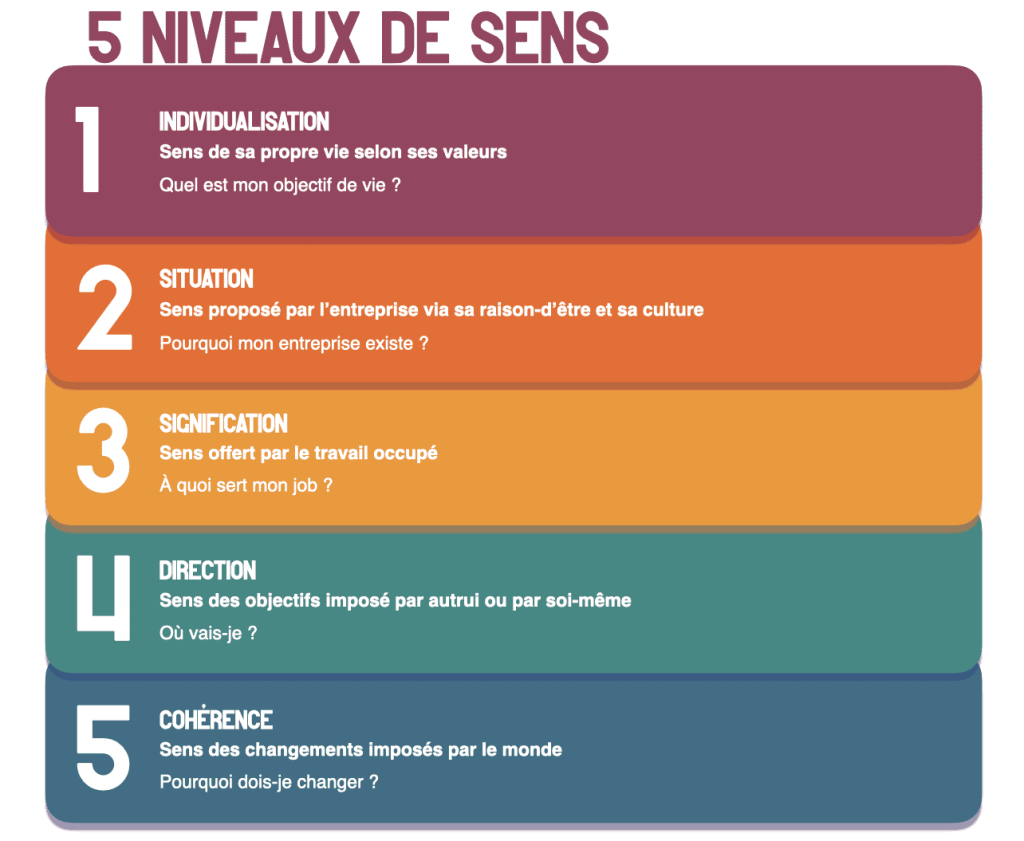
Meaning at work is not a single switch, it runs on several levels at once, and a manager who treats it as one thing will keep missing. Over years of working on this question I have come to describe five levels of meaning: the task itself, the team, the organisation, the contribution to something larger, and the meaning of a life. They are not equal, and they are not all yours to touch.
This is the core of my frame. A manager has real influence over the first four levels and almost none over the fifth. Trying to give someone the meaning of their life is both futile and slightly presumptuous, while aligning the meaning of the task, the team and the contribution is ordinary, doable management. The image below sets out the five levels so the ones you can act on are obvious.
Each level answers a different question. The task asks whether this specific work has a point, the team asks whether it helps the people beside me, the organisation asks whether the place I work for stands for something I can respect, and the contribution asks whether any of it matters beyond the balance sheet. The fifth level, the meaning of a life, is the person’s own and sits outside the office.
How the meaning crisis actually shows up now
The meaning crisis used to announce itself through the exit interview. In 2026 it mostly does not, because the exit door has narrowed and people stay put. The crisis now shows up as disengagement in place, as a recognition deficit, and as a slow change in how much of a life work is expected to fill. Each is easy to misread.
The reason each hides is that it looks like an individual’s private mood, when it is usually a signal about the work itself. A manager who takes disengagement personally, or files it under attitude, misses the design fault underneath. Read as data about the job, the same signals point straight at what to fix.
From resignation to disengagement in place
The single most important shift for a manager is that lost meaning no longer walks out, it stays and switches off. When leaving feels risky, the person who has stopped believing in the work does not resign, they quietly withdraw their effort while keeping the job. That is worse for a team than a clean departure, because the disengagement is contagious and invisible.
The engagement data tells the story. Gallup’s most recent global reading puts employee engagement at its lowest level since 2020, at around 20 per cent, with manager engagement sliding further. In Australia and New Zealand the picture is better but slipping, with roughly 23 per cent engaged and around 11 per cent actively disengaged, and regional optimism about finding another job has fallen sharply. People feel the exit narrowing, and the meaning problem settles in rather than leaving.
Spotting it takes a change of eye. The signals are a drop in questions, a retreat to the strict letter of the role, meetings attended in body but not in mind, and initiative that used to be offered and now has to be requested. None of these breaks a rule, which is why they slide past a manager watching only for problems.
The managers themselves are not immune, which compounds the whole thing. Gallup’s latest reading shows manager engagement falling faster than that of their teams, and a disengaged manager cannot rebuild meaning for anyone else. Looking after the meaning of a manager’s own work is part of the job, not a distraction from it.
This also changes the manager’s scorecard. A stable headcount used to signal a healthy team, and now it can hide a team that has checked out but cannot leave. Low turnover is no longer proof of engagement, so a manager who reads retention as success may be running a quietly hollow operation.
The recognition deficit
The fastest way to drain meaning from good work is to leave it unseen. Recognition is not a reward scheme, it is the signal that the effort mattered to someone, and its absence corrodes meaning quicker than almost anything else. When people cannot see that their work registers, they stop investing the part of themselves that made it good.
This is well within a manager’s control, which is what makes the deficit frustrating. Recognising effort and contribution to the team, not only measured output, costs nothing and takes attention. A manager who names the specific thing a person did well, and why it mattered, refills a tank that a company-wide values statement never reaches.
There is a trap worth naming. Recognition that only ever flows to the top performers tells everyone else that their steady, reliable work is invisible, and that is most of the team most of the time. The meaning-building version notices the quiet contribution that keeps things running, not only the occasional heroics.
The changing place of work in a life
Underneath the workplace signals sits a slower cultural change in how central work is to a life. Work has not stopped mattering, it has stopped being the automatic centre, and managers who still assume it comes first are managing a workforce that no longer exists.
The long-run data is striking. According to the World Values Survey, the share of Australians who say work is very important in their life has fallen from 51 per cent in the mid-1990s to about 33 per cent by 2017 to 2022, one of the sharper declines among comparable countries. Pew Research, surveying advanced economies including Australia, found that people name family well ahead of work as a source of meaning in their lives. Work is now one input into a meaningful life rather than the whole account of one.
It would be a mistake to read this as a young-worker quirk. The shift runs across generations, and older workers have often travelled the same distance more quietly. A manager who dismisses the meaning question as something the graduates will grow out of is misreading a broad cultural change as a passing phase.
For a manager this is liberating rather than threatening. If work is one source of meaning among several, the job is not to win someone’s whole identity, it is to make the hours they do give you coherent and worth their while. That is a smaller and far more achievable target.

Why you cannot give meaning, and what you can do instead
Here is the uncomfortable truth for anyone hoping for a purpose campaign to fix this. You cannot give another person meaning, because meaning is made by the person, not received from a slide. What a manager can do is remove the things that block it and align the levels of meaning that are actually theirs to shape.
Meaning is made, not handed over
The psychiatrist Viktor Frankl, who founded the school of therapy built on the search for meaning, argued that meaning is discovered through what a person does and the stance they take, never issued to them by someone else. Applied to work, that ends the fantasy of installing purpose from above. The manager’s job moves from supplying meaning to clearing its obstacles.
It also explains why imported purpose campaigns so often curdle. A mission written at head office and rolled out in a town hall asks people to adopt someone else’s meaning, which is the very thing that cannot be transferred. What does travel is the honest work of removing obstacles, and each manager can do that in their own patch.
Those obstacles are usually mundane. Pointless process, work whose result nobody ever sees, a stated mission that daily decisions contradict, and effort that goes unacknowledged all block meaning far more than any missing inspirational poster. Remove those, and meaning tends to return on its own.
This reframe is oddly freeing for a manager. You are no longer on the hook to be permanently inspiring, which almost nobody can sustain, and you are on the hook for something concrete instead: clearing the rubbish that gets between people and the point of their work. That is a job description you can actually meet.
Align the levels of meaning you control
The practical version of my five-levels frame is a short sequence a manager can actually run. It works the levels you influence and stays out of the one you do not, which keeps the effort honest and doable.
- The task: make the point of each task visible, and cut the work that has no point.
- The team: show how one person’s work helps the people beside them, so effort has a witness.
- The organisation: close the gap between the stated mission and the decisions people actually see.
- The contribution: connect the work to the difference it makes beyond the company, where that link is real.
- The life: leave it alone, and simply make room for people to find it their own way.
The sequence matters less than the discipline of staying in your lane. A manager who tries to answer the meaning of someone’s life oversteps and usually embarrasses everyone, while a manager who quietly fixes the first four levels earns the trust to be let near the harder questions if they ever arise. Work the levels you actually hold.
The danger of weaponising purpose
Purpose has a dark side a manager must avoid. When meaning is used to justify low pay, long hours or poor conditions, people notice, and the mission turns into a tool of extraction rather than a source of pride. Meaning offered in good faith engages people, meaning used as leverage corrodes them.
I see this when an organisation answers every complaint about workload or reward with an appeal to the cause. Do it for the mission is a fair invitation and a poor substitute for fair treatment. The real test is whether the purpose asks something of the organisation too, or only of the staff. Meaning that flows one way, always demanding sacrifice and never returning care, is spent fast and rarely comes back.
Field note
The team that had forgotten who used their work
I once worked with a back-office team that every survey flagged as disengaged, and the leadership had decided the fix was a new purpose statement. I asked to sit with them for a morning instead. The work was competent and joyless, and one line kept coming up: they had no idea who, if anyone, ever used what they produced.
We did something small. We traced one of their routine outputs all the way to the frontline colleague who depended on it, and we brought that colleague in to say what it let her do for a customer. The room changed in twenty minutes. The task had not moved, the meaning of it had simply become visible again.
The lesson I carry from that engagement is that brown-out is rarely cured by a bigger mission. It lifts when a manager reconnects ordinary work to the people it actually serves, which is one of the levels of meaning a manager genuinely controls.
How to rebuild meaning as a regenerative manager
Rebuilding meaning is steady work on the levels you control, not a campaign. As a regenerative manager, you give people enough autonomy to own their work, you close the gap between what the organisation says and does, and you make recognition a habit rather than an event. Each lever is unglamorous and each one holds.
None of this needs a budget or a permission slip. It needs a manager to spend attention where it is easy not to, on the meaning of ordinary work, week after week. That is the whole discipline, and it is why so few do it consistently.
Autonomy and the manager as mentor
Autonomy is one of the strongest sources of meaning, because owning a piece of work makes it yours to care about. That means shifting the manager’s role from supervisor to mentor, and pushing real decisions down to the people doing the work. Control held too tightly is one of the surest ways to hollow a job out.
The most documented example is Semco under Ricardo Semler, the Brazilian firm that let staff shape their own hours, methods and even some strategic decisions, and saw both retention and productivity rise. The point is not to copy Semco wholesale. It is to notice how much meaning is unlocked simply by trusting people with more of the how, and sometimes the what, of their own work.
Autonomy is not the absence of management, it is a different kind of it. It asks a manager to set a clear intent and a firm boundary, then step back from the how, which is harder than it sounds for anyone trained to be the person with the answers. The reward is a team that owns its outcomes rather than waiting to be told.
The catch is that autonomy without clarity breeds anxiety instead of meaning. People need to know the boundary and the intent before freedom feels like trust rather than abandonment. Set those two things well, and the room you give becomes a gift rather than a test.
Coherence between stated mission and daily tasks
Nothing dissolves meaning faster than a mission that the daily work openly contradicts. People do not need a grander purpose so much as an honest one, where what leaders say and what the job rewards point the same way. The gap between the poster and the practice is where brown-out breeds.
Patagonia is the clearest case of coherence, an outdoor-clothing company whose environmental mission shows up in its products, its supply chain and its ownership structure rather than only in its advertising. A manager rarely controls the whole company’s coherence, yet they own it completely inside their team. When your stated priorities and the work you actually praise agree, meaning has somewhere to stand.
The everyday test is simple. Watch what gets praised and promoted in your team, then compare it to what the mission claims to value, because people believe the second signal over the first every time. Closing that gap is often the single highest-leverage move a manager can make for meaning.
Coherence is also what makes the other levers believable. Recognition rings hollow in a team whose stated values are contradicted daily, and autonomy feels like a trap when the mission is a fiction. Get coherence right and the rest of the work compounds.
Recognition beyond results
Recognition rebuilds meaning when it reaches past the scoreboard. Praising only measurable output tells people that nothing else counts, while recognising the effort, the help given to a colleague and the values lived out tells them the whole of their contribution is seen. That fuller recognition is what refills meaning.
Transparency helps it land. The software company Buffer became known for publishing its salary formula and its numbers openly, which made recognition and fairness legible rather than a matter of trust in the dark. A manager does not need radical transparency to borrow the principle, that people find meaning more easily when they can see how contribution and reward actually connect.
Frequency beats grandeur here. A specific, honest acknowledgement in the ordinary run of a week does more than an annual awards night, because it lands close to the work and names something real. Meaning is rebuilt in small repeated signals rather than staged events.
Peer recognition compounds it further, because meaning grows when a contribution is seen by the people whose opinion the person actually values. A quiet word from a respected colleague can outweigh a formal award handed down from someone distant.
Put meaning back into everyday work
Want to move your managers from purpose slogans to the levels of meaning they can actually shape? Discover how I do it in my keynote on regenerative leadership, built for teams that need re-engagement, not another mission poster.
How to choose your approach to the loss of meaning at work
Once a leadership team accepts that meaning is the constraint, the question is where to invest, and the honest answer depends on your maturity. Some organisations need to make their mission true, others need to lift manager habits, and a few need to redesign the work itself. The comparison below is decision support, not a sales pitch.
Mission reset, manager capability or job redesign, for which maturity
Each option answers a different failure. A mission reset fixes an organisation whose words and actions have drifted apart, a capability program changes how managers create meaning day to day, and job redesign rebuilds work that is meaningless by construction. Match the tool to the real problem.
Sequencing matters as much as the choice. A capability program built on top of a mission the company openly betrays will collapse, because managers will not sell a story their own people can see through. Make the mission true first, then build the habits on top of it.
| Approach | Best when | What it changes | Watch-out |
|---|---|---|---|
| Mission and coherence reset | Stated values and daily decisions openly clash | Whether the mission is true in practice | Backfires if the gap is named but never closed |
| Manager capability program | Intent is fine but recognition and clarity are patchy | How managers make everyday work make sense | Needs leaders to model it, or it reads as more training |
| Job and process redesign | The work itself is fragmented and pointless | The structure of the tasks people do | Slower and costlier, and it exposes legacy inefficiency |
| Regenerative leadership shift | Control, not clarity, is the real constraint | How autonomy and ownership are distributed | Exposes any gap between stated values and acts |
The signals that should guide your investment
A few signals point to where the money should go. Read them without flattering yourself, because each maps to a different response.
- If people stay but visibly coast, treat disengagement in place as the priority, not retention.
- If your survey shows a recognition gap, invest in manager capability before any rebrand.
- If people cannot say who uses their work, the problem is job design, and no slogan will fix it.
How I can help you master the loss of meaning at work
I work with leadership teams that want to turn a hollowed-out workforce back into an engaged one. My role is to help managers rebuild meaning through the levels they control, rather than to add another purpose campaign nobody has time to sustain.
Keynotes and workshops on meaning and regenerative leadership
My talk on the meaning of work reframes the crisis away from grand purpose and towards the levels a manager can move, and my keynote on regenerative leadership sets it inside the wider shift. In workshops and masterclasses, we run the five levels of meaning against your own teams until the fixes are concrete.
Manager programs and diagnostics
Because a single session rarely holds, I build manager development journeys that give recognition and coherence time to become habits. When the meaning crisis is tangled with the other pressures on your people, we place it back inside the full picture and work through a systemic response to the seven management crises, so you treat the chain rather than a single link.

Conclusion, the loss of meaning at work is a management responsibility
The easy read of this crisis is that a generation stopped caring about work. The data says something more precise. People still want their work to mean something, they have simply stopped assuming it will, and when it does not they now stay and switch off rather than leave.
There is a quiet upside buried in that. A person who has stayed is a person still within reach, and re-engaging someone who never left is faster than replacing someone who did. The disengagement in place that looks like the whole problem is also the opening, if a manager chooses to work it.
The better response is to stop trying to hand meaning down and start working the levels you control. Make the task’s point visible, give people a witness and real autonomy, close the gap between the mission and the work, and recognise the whole contribution. Do that, and the third link in the chain stops pulling the others down. Handled as a management responsibility rather than a slogan to broadcast, the loss of meaning at work becomes the moment a team decides the work is worth their effort again.
Frequently asked questions about the loss of meaning at work
What is the loss of meaning at work?
The loss of meaning at work is the sense that a job no longer holds usefulness or value, which drains motivation and engagement and can affect mental health. In occupational psychology it is called brown-out, and it is distinct from burn-out, which is exhaustion, and bore-out, which is boredom.
What is the difference between brown-out, burn-out and bore-out?
Burn-out is exhaustion from too much demand, bore-out is numbness from too little, and brown-out is the flatness of work that has lost its point. They need different fixes, so a manager who reduces workload to solve brown-out will see no change, because the problem is meaning, not load.
Can a manager give employees a sense of meaning?
Not directly, because meaning is made by the person rather than handed over. What a manager can do is remove the blockers and align the levels of meaning they control: the task, the team, the organisation and the contribution. Making the point of the work visible does far more than any purpose statement.
Why does the loss of meaning at work now show up as disengagement rather than resignation?
Because the exit door has narrowed. When people feel it is risky to change jobs, those who have lost meaning stay and quietly withdraw their effort instead of leaving. That disengagement in place is harder to see than a resignation and more costly for a team, which is why managers must watch for it directly.