After walking through the seven management crises one at a time, the obvious move is to launch seven fixes, a program for each. I want to argue that this is exactly the wrong response. Responding to management crises well means treating them as one system with one root and one answer, rather than seven problems to be patched in parallel.
This is the closing article in my series on the seven management crises, and it follows the engagement crisis. Each earlier piece diagnosed a single crisis, and this one draws them together into a response. The seven are connected, they share a cause, and they yield to a single change in how you manage.
| The siloed fix | Why it is one system | The shift that transforms |
|---|---|---|
| Seven separate programsResponding to management crises usually means launching a program for each one, a wellbeing app here and an engagement survey there. Run in parallel, they treat symptoms and miss the system. | One interconnected systemThe seven crises feed each other, so a response to one that ignores the rest leaks away. They share a single root in an extractive model of management, and a single lever in the manager. | One regenerative responseBenjamin Chaminade’s answer is regenerative management, which treats the whole person across their work journey and leaves people and teams healthier than it found them. You change how you manage, not how many programs you run. |
What responding to management crises really means
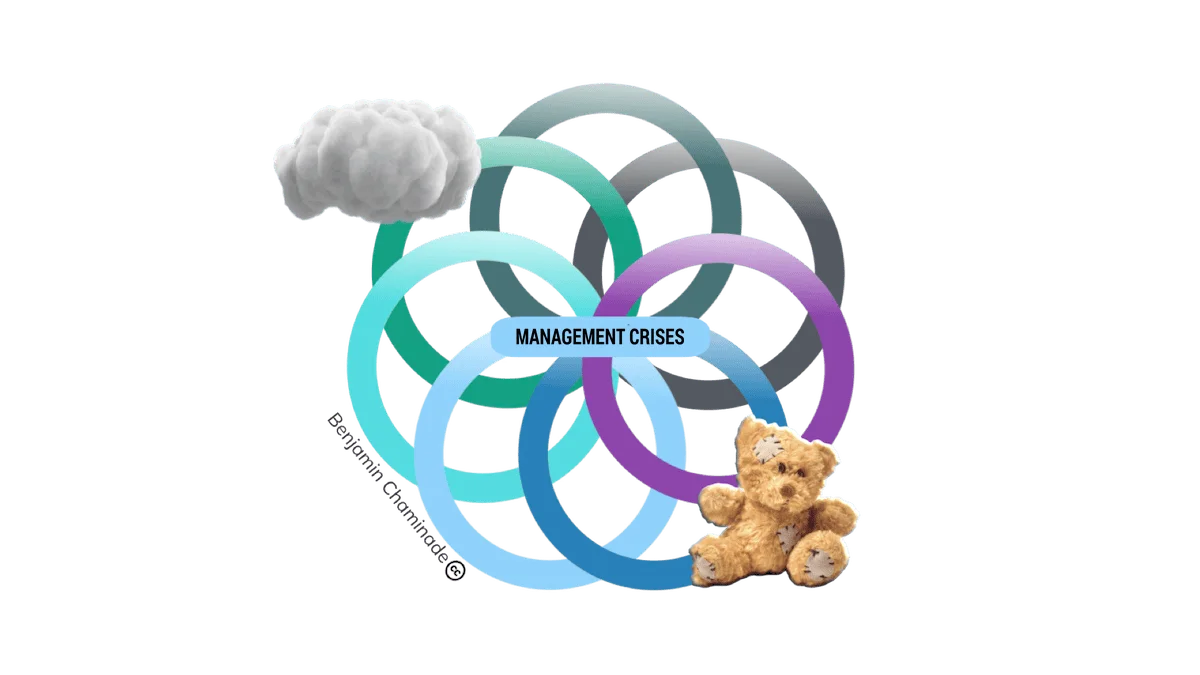
Responding to management crises means treating the seven as a single, connected system rather than a checklist of separate problems. They reinforce each other, they grow from a shared root, and they share one lever in the manager. Seeing that is what turns an impossible to-do list into a single, workable change.
The shift in view is the whole game. Seven crises look like seven budgets, seven owners and seven arguments about priority, and one system looks like a single point of leverage. The first is exhausting and the second is doable, and only the second is true.
Responding to management crises as one system
The crises do not queue politely, they feed each other. Unmet climate anxiety feeds distrust, distrust drains meaning, lost meaning erodes health, and poor health, a widening skills gap and thin connection all converge on the engagement crisis at the end.
Because it is a loop, an isolated fix leaks away. Solve engagement with a perk while trust and meaning stay broken, and the perk drains straight back out through the holes you left. A response that treats one crisis and ignores the six it is joined to is water poured into a sieve.
This interdependence is also why the crises seem to arrive all at once. They trigger each other in sequence, and by the time the last one is loud enough to notice, the earlier ones have been quietly working for months. Reading the chain backwards is how you find the real starting point.
The good news hiding in the loop is that it runs both ways. Just as each crisis worsens the next, each improvement lifts the next, so a genuine gain in trust or health does not stay put, it spreads around the system. Virtuous loops are as real as vicious ones.
Naming the system this way is also practical, because it tells you where to push. In a reinforcing loop, the highest-leverage point is the one that feeds the most others, and in these seven that point is how the manager treats the person.
The shared root in the age of fragility
The seven crises share a single root, which is why they arrived together. They are the symptoms of an extractive style of management colliding with what I call the age of fragility, the era after the old certainties in which shocks are frequent and people and systems are more brittle than before.
Extractive management treats people as resources to be used up, and it was survivable while the world was stable and workers had few options. In a fragile world, with mobile, exhausted and sceptical people, the same style produces climate anxiety, broken trust, lost meaning, poor health, skills that expire, thin connection and, finally, disengagement. Change the root, and you change all seven at once.
Sustainability is the frame, not a bolt-on
The response is really sustainable management in the fullest sense, holding economic performance, environmental responsibility, the wellbeing of people and a positive social impact together rather than trading them off. The seven crises are what happens when an organisation optimises one of these and neglects the rest.
This reframes sustainability from a reporting exercise into a way of running the business day to day. An organisation that treats its people as a resource to burn will show it in disengagement and turnover just as surely as one that treats the climate as an externality shows it in risk. Durable performance comes from refusing the trade-off, from designing work that is good for the business and the people and the world at once. That refusal is a management choice before it is a strategy.
The age of fragility is a structural condition rather than a mood. Supply shocks, climate events, technological upheaval and social strain now arrive faster than organisations can absorb them, and people carry that instability into work. Management built for a stable world quietly breaks under it, which is what the seven crises are.
Naming the root also ends the blame. The problem is a model rather than a set of bad managers, and models can be changed once they are seen.

Why a program for each crisis fails
The instinctive response is to launch a program for each crisis, and it fails for a reason worth understanding. Siloed initiatives treat symptoms in parallel, they compete for the same budget and attention, and they miss the one lever that moves all seven. Understanding why is the difference between spending a lot and changing anything.
The failure is a category error rather than a lack of effort. These organisations are working hard on the wrong unit, treating a systemic problem as a set of independent ones, and no amount of energy applied to the wrong shape produces the right result.
The whack-a-mole of parallel programs
Running one initiative per crisis turns management into a game of whack-a-mole. You fund a wellbeing app, an engagement survey, a diversity initiative and a training catalogue, each owned by a different team, and each treating a symptom while the shared cause carries on unaddressed underneath.
The programs also work against each other. They compete for the same limited budget, attention and goodwill, they multiply the demands on already stretched managers, and they send a confusing signal that the organisation has seven priorities, which is another way of saying none. Effort scatters, and nothing moves far.
There is a hidden cost as well. Every themed program adds a survey to answer, a workshop to attend and a dashboard to feed, so the people the crises are hurting end up more burdened by the response than relieved by it. The cure starts to resemble the disease.
Worse, each program grows its own small bureaucracy that has to be fed and defended, so over time the response calcifies into overhead no one is willing to stop.
The manager is the common lever
There is one factor that sits underneath all seven crises, and it is the manager. The same person shapes whether work feels meaningful, whether the team is psychologically safe, whether skills grow, whether people are connected, and whether they stay engaged, which makes the manager the single highest-leverage point in the system.
The evidence keeps pointing the same way. Gallup finds that around 70 per cent of the variance in team engagement is explained by the manager, and Safe Work Australia locates psychological health in how work is designed and led. Invest in how managers manage, and you move every crisis at once, which no single program can do.
It is worth being clear about why the manager and not the chief executive or the HR team. The manager is the closest point of contact between the organisation and the person, the one who sets the daily weather, so their behaviour reaches people that no policy or program ever touches. Leadership sets the conditions, and the manager is where they land.
This is also why the response is affordable. You do not need seven budgets, you need to change what one person, repeated across the organisation, does with the authority they already have. That is cheaper and harder than any program, because it asks for a change in behaviour rather than a purchase.
The most powerful moves are usually the ones you already have the authority to make, and this is one of them.
Why HR cannot carry this alone
A common mistake is to hand the whole response to human resources and expect a department to solve it. HR can design and support, and it cannot manage the daily relationships where the crises actually live, which belong to every manager in the organisation.
When the response is owned by a single function, it becomes another set of programs pushed at managers who did not ask for them, which is precisely the pattern that fails. The crises are created and resolved in thousands of daily interactions between managers and their people, so the response has to be owned there too. HR’s real job is to equip and back managers to lead differently, rather than to run the response on their behalf.
Regenerative management, the single response
The response that treats the root rather than the symptoms is regenerative management. It is my answer to all seven crises at once, a way of managing that leaves people and teams healthier, more capable and more connected than it found them, instead of using them up. It is the opposite of the extractive model that caused the crises.
The word regenerative is borrowed on purpose from living systems, because they solve the exact problem management faces, how to keep producing without depleting the base you produce from. A regenerative forest leaves the soil richer than it found it, and a regenerative manager leaves people richer in skill, health and trust.
What regenerative management is
Regenerative management starts with the person in front of you rather than with a corporate program. Where regenerative leadership begins with the planet, regenerative management begins with the collaborator, taking their past, their present experience of the work, and the future of their career into account.
The test of it is simple and demanding. At the end of a project, a quarter or a year, are your people more capable, more trusting and in better health than at the start, or less. A manager who can honestly answer more is practising regenerative management, and a manager who answers less is quietly running the extractive model that feeds the seven crises.
The three horizons matter here. Regenerative management reads a person’s past, the loyalty and experience they carry, their present, the work they are doing now, and their future, the career they are trying to build, and it manages for all three at once. Most management only sees the present.
It is worth saying what this is not. Regenerative management does not mean softness or an absence of standards, and it often demands more of people, because growth is uncomfortable. The difference is that it demands with support and toward the person’s own development, rather than extracting for the organisation alone.
Why it answers all seven at once
Because the crises share a root, a single change at that root moves all of them. A manager who designs safe, meaningful work, grows people, connects them and treats them as ends rather than means is answering climate anxiety, trust, meaning, health, skills, connection and engagement in the same motion.
This is what makes it a response rather than a program. It is not one more initiative competing with the others, it is a change in how the everyday work of managing is done, which is why it reaches every crisis that ordinary management created. Fix the how, and the seven what-to-do-abouts largely take care of themselves.
There is a proof of this in the field. When a team gets a genuinely regenerative manager, its scores on wellbeing, retention, learning and engagement tend to rise together rather than one at a time, which is what you would expect if they shared a cause. The manager is that cause, for good or ill.
From a job to a work experience
Part of the shift is to stop thinking of work as a job to be filled and to start treating it as an experience of life to be shaped. People no longer separate work neatly from the rest of their lives, so the quality of the work experience now carries real weight.
This is about making work worth a person’s time and energy rather than merely fun. An enriching work experience gives autonomy, growth, connection and a sense that the effort matters, which are the very things the seven crises strip away. Design the experience deliberately, and engagement, health and loyalty follow as results rather than targets.
It is the difference between somewhere people tolerate and somewhere people choose, and that choice is what every one of the seven crises is really about.
Field note
Seven task forces, no change
An organisation I worked with had responded to the crises with admirable energy, and entirely the wrong shape. It had a wellbeing committee, an engagement task force, a diversity council, a retention project and a learning strategy, each with its own owner, budget and dashboard, all running at once.
Two years in, every dashboard was amber and nothing had really moved, because all five groups were treating symptoms while the shared cause, an exhausted and untrained layer of managers running an extractive model, sat untouched between them. The programs were competing for the attention of the very people who could have fixed the root.
The lesson I carry from that engagement is to change how managers manage before you launch a single themed program. When we merged the effort into one investment in regenerative management and the managers who practise it, the separate crises eased together, because we had finally treated the root they shared.
How to respond as a regenerative manager
Responding to management crises in practice comes down to four moves that change the root rather than the symptoms. As a regenerative manager, you redefine what the job is for, you design the whole employee journey, you replace one-off training with real learning, and you back the managers who carry it all. Done together, these treat the system.
The four moves are one response rather than a menu to pick from. Each supports the others, so doing one well and skipping the rest leaves most of the value on the table, and doing all four turns a set of good intentions into a working system.
Redefine the managerial purpose
Everything starts by redefining what management is for. A manager whose purpose is to control and extract output will keep producing the crises, and one whose purpose is to enable people to do their best work and grow is already answering them.
This is the shift I call enableship, where a manager is measured by how much they enable others rather than how much they command them. Clarify that purpose, make it match the values of both the company and its people, and you have set the compass that every other decision follows.
This sounds abstract and lands very concretely. A manager who has genuinely accepted that their job is to enable makes different choices about meetings, feedback, workload and credit every day, and those choices are what people experience as the culture. Purpose is the sum of a thousand small decisions.
Design the whole employee journey
The next move is to treat the entire experience of work as one designed journey rather than a series of disconnected transactions. From the first interview to the last day, every stage is a chance to build meaning, trust, growth and connection, or to erode them.
This is what I mean by the employee lifecycle, and it is a powerful antidote because it addresses several crises at once. A well-designed journey gives back meaning, rebuilds trust, protects health and grows skills as a single coherent experience, rather than as five competing programs bolted onto a job.
The power of the journey view is that it stops the leaks. Crises often creep in at the seams, a rushed onboarding, a promotion with no support, an exit that burns goodwill, and those seams are invisible to a program aimed at a single crisis. Designing the whole path closes the gaps that isolated fixes never see.
Replace one-off training with real learning
If the crises settled in, the odds are your idea of training helped. One-off courses, disconnected from each other and from the work, cannot prepare people for a fast-changing world, and they let skills expire faster than they are topped up.
The regenerative move is to build learning journeys measured in years rather than days, blending formal training, learning on the job, mentoring, coaching and peer exchange into a continuous habit. The concrete steps below turn that principle into a working response.
There is a real economy here too. A coherent learning journey costs less over time than a stream of one-off courses that never compound, and it holds people better, because a company that visibly invests in your future is worth staying with.
- Set the managerial purpose: agree what management is for, and make enablement the standard every manager is held to.
- Map the employee journey: walk the path from hire to farewell and fix the stages that erode meaning, trust or health.
- Build a learning journey: replace one-off courses with a multi-year path blending formal, on-the-job and peer learning.
- Back the managers: train, support and protect the managers who carry the whole response, since they are the common lever.
- Measure regeneration: judge success by whether people leave each period more capable, healthier and more connected than they arrived.
Notice that not one of these is a themed program. Each changes how managing is done, which is exactly why together they answer the whole system rather than a single crisis.
Start with the managers and the purpose, and let the journey and the learning follow, because a clear purpose in a capable manager is what makes the rest cohere.
Above all, keep it one effort. The moment this splinters into four projects with four owners, it becomes the very thing it was meant to replace.

Treat the root, not the seven symptoms
Want one coherent response instead of seven competing programs? Discover how I help leadership teams install regenerative management in my keynote on regenerative leadership, built to answer all seven crises at once.
How to choose your response to the management crises
Once a leadership team accepts that the crises are one system, the question is how deep to go, and the honest answer depends on your appetite for change. Some will add another program, others will invest in managers, and a few will make the full shift. The comparison below is decision support, not a sales pitch.
Siloed programs, manager capability or a regenerative shift
The three responses work at very different depths. Siloed programs treat symptoms in parallel, manager capability moves the common lever, and a full regenerative shift changes the root the crises grow from. Match the depth to how serious you are.
The common mistake is to keep choosing the shallowest response because it is easiest to approve, then wonder why nothing changes. Depth is the point here, since the crises live at the root, and only a response that reaches the root will move them.
| Response | Best when | What it changes | Watch-out |
|---|---|---|---|
| Siloed programs | One crisis is acute and urgent right now | A single symptom, for a while | Leaks away while the shared root persists |
| Manager capability | You want the highest-leverage single move | The one lever under all seven crises | Needs real backing for managers, not a course |
| Full regenerative shift | Several crises are live and reinforcing | The extractive root the crises grow from | Asks leadership to change how it leads too |
| Employee-journey redesign | The damage is spread across the whole tenure | Every stage from hire to farewell | Slower, and it crosses team and function lines |
The signals that should guide your response
A few signals tell you how deep to go. Read them honestly, because each points to a different response.
- If you already run several themed programs and nothing moves, stop adding them and change how managers manage.
- If more than two of the seven crises are live at once, treat the system rather than any single one.
- If your managers are the bottleneck, invest there first, since they are the lever under everything.
How I can help you respond to the management crises
I work with leadership teams that want one coherent response to the seven crises rather than seven programs that cancel each other out. My role is to help you install regenerative management, redesign the employee journey, and turn your managers into the enablers the whole response depends on.
Keynotes and workshops on regenerative management
My keynote on regenerative leadership reframes the seven crises as one system with one response, so a leadership team leaves with a shared map rather than seven worries.so a leadership team leaves with a shared map rather than seven worries. The result is one shared plan instead of seven, which is far easier to lead and far more likely to work. In workshops and masterclasses, we redefine the managerial purpose and design the employee journey for your real teams.
Manager programs and the full response
Because the whole response runs through managers, I build manager development journeys that grow enablers over time rather than train them once. The approach draws on regenerative management, the frame that ties all seven crises into a single change in how you lead. The aim, as ever, is to leave a team more capable, healthier and more connected than I found it.

Conclusion, responding to management crises as one system
The comfortable response is to launch a program for each crisis and report progress on seven dashboards. The honest one is harder and simpler at the same time. The seven crises are one system with one root, so the response is one change in how you manage, not seven initiatives competing for the same attention.
None of this asks for heroics. It asks for a change of default, from using people up to leaving them better, applied patiently in the ordinary work of managing until it becomes simply how the place runs.
The reward is worth the discipline. A regenerative organisation is a kinder place to work, and it is a more resilient and productive one, because people who are left better bring more of themselves to the work.
Regenerative management is that change. Redefine what management is for, design the whole employee journey, build real learning, and back the managers who carry it, and the seven crises ease together because you have finally treated the root they share. That, in the end, is what responding to management crises actually looks like, and it is the work I would be glad to do alongside you.
Frequently asked questions about responding to management crises
What is the best way of responding to management crises?
Treat the seven crises as one connected system, not seven separate problems. They share a root in extractive management and a common lever in the manager, so responding to management crises means changing how managers manage, through regenerative management, rather than launching a program for each crisis.
Why do separate programs for each crisis not work?
Because they treat symptoms in parallel while the shared cause carries on. Siloed programs compete for budget and attention, overload managers, and leak away when the crises they ignore refill them. A single change at the root moves all seven together, which no individual program can do.
What is regenerative management?
Regenerative management is a way of leading that leaves people and teams healthier, more capable and more connected than it found them, rather than using them up. It starts with the collaborator’s past, present and future, and it answers all seven management crises at once by treating their shared root.
Where should a manager start when responding to management crises?
Start with how you manage, not with a themed program. Redefine the managerial purpose around enabling people, design the whole employee journey, replace one-off training with real learning, and back your managers. These change the root, so the crises ease together rather than one at a time.