I have been writing two books. The second one, submitted to Gereso, who already published my book on managing in a VUCA world, will appear as the Guide du management regeneratif. This article condenses its core, and answers a question almost every leadership team I work with puts to me: how do you leave extractive management behind and move to regenerative leadership without falling into cosmetic wellbeing programs?
Leaving extractive management is not a moral posture. It is a decision about organisational survival, because a model that exhausts its people always ends up exhausting itself. What follows is the whole map: a diagnosis of the extractive model, the six principles of regenerative management, and the three temporalities that structure the passage from one to the other. For a way to picture that balance, I have mapped Kate Raworth’s doughnut economics onto management in the managerial doughnut, a frame of reference for meeting people’s needs within the means available.
This work extends the six principles I present in my keynote and set out in detail in the principles of regenerative management on the Glukoze blog. A note on vocabulary first. I use regenerative leadership for the vision and the principles that guide action, and regenerative management for their concrete application day to day. The two are inseparable.
| The problem | The real cost | The way out |
|---|---|---|
| Extractive managementLeaving extractive management behind starts with naming it. The model treats people as a seam to be worked: recruit, consume, replace, then express surprise at the turnover and the loss of know-how. | A seam that runs outThe bill lands as absence, presenteeism, replacement costs and the slow disappearance of informal knowledge. Most of it sits outside the recruitment dashboard, which is why extractive organisations look efficient on paper. | Three temporalities, six principlesRegenerative leadership creates more value than it consumes. It works across three times, repairing the past, co-building the present and preparing the future, on six cultural principles that turn an organisation into a living ecosystem. |

What is extractive management and why leave it behind?
Picture your business as an open-cut mine, one of those operations that digs deeper and deeper to pull every last gram of value out of the seam. Replace the ore with your people and you have extractive management, the dominant model that exhausts talent the way a mine empties a deposit.
The three-step cycle that exhausts a team
Extractive management follows an industrial logic inherited from the nineteenth century and applied to twenty-first century human beings. It runs in three steps: acquire capability, consume it, replace it. Simple, efficient and fatal over time.
A scale-up I worked with illustrated it perfectly. The founder was proud of his people metrics, with time to hire halved, cost per hire optimised and application conversion at the top of his benchmark set. Impressive on paper.
Dig a little and you found turnover well above his sector average, and hidden costs that in his case represented a considerable share of revenue. A company presented as high performing was leaking value faster than a sieve.
Beyond the standard need to explore new opportunities, the real reasons for leaving came down to a style of management where people’s capabilities counted for more than their development or their health.
The five symptoms of an extractive organisation
Before you can leave extractive management behind, you have to spot it at home. Five symptoms turn up in almost every organisation I diagnose, and none of them appears on a standard dashboard.
- The war for talent. You hunt for the rare bird outside while your own capable people are bored or leaving. I have watched a mid-sized manufacturer search the market for a data science expert on a six-figure package while an administrator with a genuine passion for data could have been developed into the role for the price of a training budget.
- Programmed exhaustion. Pull on the rope until it snaps, a sentence I have heard in a leadership meeting. The more you perform today in extractive mode, the more you mortgage your capacity tomorrow.
- Loss of organisational memory. Every departure takes years of relationships and informal know-how with it, and a new starter commonly needs six to twelve months to reach full productivity, which keeps a permanent share of your payroll in learning mode.
- The hidden costs under the waterline. Recruitment, training, onboarding, lost productivity and the effect on everybody else’s morale. The visible cost of a departure is the smallest part of it.
- Systemic vulnerability. Depending on the external market for your key capabilities leaves you at the mercy of the slightest tightening in the labour market.
What the extractive model costs in Australia
Extractive management rests on a simple equation: take more than you give. Extracted value exceeds invested value, and that imbalance carries a measurable price which lands somewhere other than the line item that created it.
The Productivity Commission’s inquiry into mental health estimated the workplace-related cost of mental ill-health in Australia at between 12.2 and 39.9 billion dollars a year in lost productivity and participation, inside a total cost to the country of around 200 to 220 billion dollars. Those are national numbers, and they are built from the same mechanisms that show up in a single team.
The central link in the chain is the manager. Gallup’s research finds that managers account for at least 70 per cent of the variance in team engagement, and in one of its studies one in two adults reported having left a job to get away from their manager.
That last finding explains why leaving extractive management behind is first a managerial move and only second an HR one. Buying a new engagement platform will not touch the seventy per cent.
The vicious circle that feeds itself
The most perverse property of extractive management is that it is self-sustaining. The more you exhaust your teams, the more they leave, the more you have to recruit, the less time you have to develop anybody, the more pressure you apply, and the more you exhaust your teams.
I watched the research and development function of a creative agency lose most of its expertise inside eighteen months through departures. Management responded by recruiting senior people at premium rates. They left too, with no team around them to lean on. The seam was empty and everybody kept digging in the same spot.
Three questions to diagnose your own level of extraction
To place your organisation, watch your reflexes on three concrete points: what happens to the people who leave, the size of your development effort, and how you greet an internal career change.
- Your leavers. You lose contact with them, a few stay in touch, or they routinely become advocates, clients or partners.
- Your development budget. Under one per cent of payroll, between one and three per cent, or above three per cent with a real capability strategy behind it.
- When somebody raises an internal move. You answer that there is no time, that you will look into it, or that it is an opportunity for the business.
If your answers lean towards the first branch each time, you are running the extractive model. If they lean towards the third, you already treat people as a potential to cultivate. To place your organisation more precisely, I set out the maturity stages in the new concepts of regenerative management.
Extractive management is an agricultural inheritance before it is a managerial one
To understand how to leave extractive management, go back to the origin of the word extraction, which is agricultural and mining instead of managerial. Management transposed a logic proven elsewhere, and the source field matters because agriculture has already walked this road and come back.
What intensive agriculture did to soil
For decades intensive agriculture treated soil as a production surface. Force the yield with synthetic fertiliser, extract the harvest, repeat. In the short term the numbers look excellent, which is exactly why the practice spread.
Over the medium term the soil grows poorer. It loses organic matter, loses its microbial life, loses the ability to hold water, and becomes dependent on ever heavier chemical inputs to produce the same tonnage. The yield curve stays flat for years while the cost of holding it up keeps climbing.
Australia learned this lesson at a scale few countries can match. Clearing, continuous cropping and heavy stocking left large parts of the wheat belt and the rangelands with compacted soils, declining organic carbon and salinity problems that took generations to appear and will take generations to reverse.
The mechanism deserves attention because it is the same one running in your organisation. Nothing fails suddenly. Capacity declines while output holds, and the gap gets filled with inputs, which in a workplace means overtime, contractors, bonuses and restructures.
What the pioneers of regenerative agriculture actually changed
Regenerative agriculture is a set of practices aimed at restoring soil fertility instead of depleting it, and it showed the logic could be inverted. Permanent ground cover, crop rotation, reduced mechanical tillage and the return of organic matter to the soil.
The soil comes back to life, holds water better, resists shocks better and eventually produces with fewer inputs. The critical detail is the sequence. Yields usually dip before they recover, which is why so many operations abandon the transition in year two and conclude that it does not work.
Australia has been one of the proving grounds for this, from holistic grazing management in the rangelands to no-till cropping across the grain belt. Charles Massy’s Call of the Reed Warbler documented a generation of Australian farmers who made the switch, and the pattern in their accounts is consistent: the change was as much about how they read their own land as about any single technique.
The documented failures matter as much as the successes. Transitions collapse when a farm changes practices without changing its measurement, keeps judging itself on tonnage per hectare through the dip, and runs out of patience or cash before the soil responds.
They also collapse when a single practice gets adopted in isolation. Dropping the plough while keeping bare fallow and the same chemistry produces disappointment, and the operator concludes the whole approach is ideology. The practices work as a system or they do not work at all.
The third failure mode is the most instructive. A farm converts the paddocks and leaves the books untouched, so the accountant still tracks input costs and yield while the actual asset being rebuilt, the soil, appears nowhere in the accounts. What gets measured survives the transition, and what stays unmeasured gets sacrificed to the quarter.
Transposing the logic to a team
The parallel is uncomfortably close. Replace the soil with the person, the yield with performance, the synthetic fertiliser with the one-off bonus, and the storm with the reorganisation. You get an accurate portrait of a managerial function that extracts, optimises, penalises and replaces, producing disengagement faster than it creates human value.
The promise of regenerative management is the same as the promise of regenerative farming, transposed to people. A team that becomes stronger, more creative and more autonomous over time, the way a living soil or a forest does. I developed this transposition in detail in my article on regenerative agriculture as a way to reinvent management.
The three failure modes transpose as well. Organisations abandon the shift during the dip, when engagement has not moved yet and the old metrics look worse. They adopt one practice in isolation, usually the pleasant one, and drop it when it fails to carry the whole system on its own.
And they leave the measurement untouched, which is the fatal version. A leadership team that keeps steering on utilisation, time to hire and short-term output has no line anywhere for the capability it is trying to rebuild, so the rebuild loses every arbitration it enters.
The central lesson is that regeneration is not a moral luxury. It is what lets the system last.
What are the six principles of regenerative management?
Leaving extractive management is not a matter of extracting less. It means changing the logic entirely, to create more value than you consume. That shift rests on six cultural principles that form the DNA of regenerative leadership, and each one answers a specific crisis in contemporary work. I explain how these principles hold a team together in my breakdown of the six pillars of holistic management, the load bearing structure that lets an organisation leave extractive habits behind.
Purpose, diversity and experimentation
The first principle cultivates a shared and evolving purpose. Unlike a frozen corporate mission, it is enriched by everybody’s contribution and it answers the crisis of meaning. You reconnect past experience to something larger, align daily action with it, and project that purpose into each person’s professional development.
The second principle values diversity and collective intelligence. It turns differences, often treated as obstacles, into collective wealth. You value unusual career paths, mobilise those differences inside co-construction, and cultivate a rich ecosystem to prepare for what comes next.
The third principle frees experimentation and accepts failure. Against the perfectionism that paralyses innovation, testing becomes the norm and failure becomes data. This is precisely the approach behind a properly run four-day week trial, time-boxed with indicators agreed before it starts, which I analyse alongside other cases in my examples of companies that regenerate their teams.
Resilience, hidden talent and distributed trust
The fourth principle builds systemic resilience, which answers the threat of skills obsolescence. You use past strengths as foundations, build adaptive systems in the present, and prepare your teams for the shifts ahead.
The fifth principle reveals and orchestrates hidden talent. Everybody carries unused potential, and the manager becomes the person who surfaces it. You run a form of archaeology on past career paths, create the conditions for expression, and invest in development.
The sixth principle distributes trust and power. It answers the crisis of confidence and replaces vertical control with horizontal accountability. You repair relational damage, distribute trust inside present decisions, and build a durable systemic trust.
Field note
The team that stopped digging the same hole
In the creative agency whose research function had lost most of its expertise inside eighteen months, the extractive reflex was intact. Leadership wanted to recruit three more senior people, convinced the problem sat in the recruitment market. I proposed the opposite: freeze external hiring for a quarter and put the budget into the two juniors who had stayed, handing them responsibilities they were not yet quite qualified to carry.
The bet on anticipated trust was uncomfortable for the first few weeks. Then one of the two juniors picked up a client file abandoned by a departed senior and finished it, leaning on the informal memory of the remaining team. External recruitment had never managed that, because the senior hires had been arriving into an empty team they were expected to rebuild on their own.
Leaving extractive management did not take more money, it took a reallocation. The same budget, pointed at internal development instead of replacement, regenerated a capability that extraction had been destroying on a loop. The way out usually starts by stopping the digging, not by digging somewhere else.

What are the three temporalities of regenerative leadership?
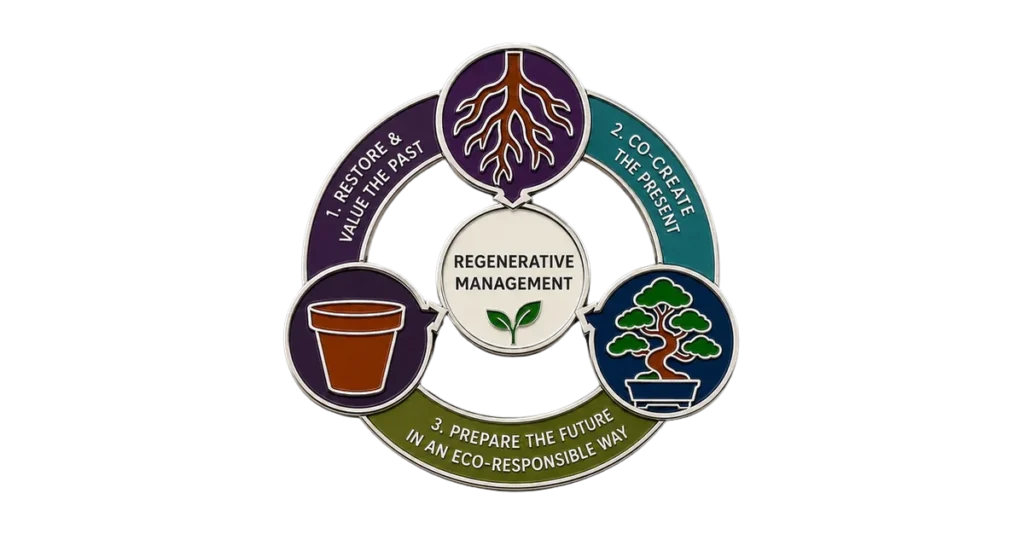
The six principles stay abstract without a time frame for applying them, which is why regenerative leadership is organised around three temporalities. They answer a simple reality. Your people are not blank pages. They arrive with a past worth valuing, live a present worth co-building, and look towards a future worth preparing.
Regenerative leadership starts by repairing and valuing the past
The past of your people is a seam of unused resources, in the good sense of the word this time. Every experience, successful or failed, carries learning. This first temporality calls for a form of managerial archaeology: identifying the talent hiding behind the official job description, recognising the managerial injuries that block potential, and valuing varied career paths.
Beyond valuing, some situations need repair. Extractive management leaves marks, including lost confidence, impostor syndrome and a fear of initiative.
Without playing therapist, the regenerative manager turns those zones of fragility into zones of growth, by validating the way each person naturally works and by reframing destructive self-criticism.
Temporality two, co-building the present
The present becomes a permanent learning laboratory. You move from a logic of prescription to a logic of collective experimentation. Meetings become co-creation workshops, problems become collective challenges, decisions become participatory processes, and the daily experience of work becomes a source of engagement.
Co-building also means redistributing decision power. You delegate decisions to the people closest to the work, create spaces for collective decision, and accept that some directions will escape your direct control.
That apparent loss of power generates more influence and a more authentic engagement, which is the part leadership teams find hardest to believe before they have tried it.
Temporality three, preparing the future responsibly
This temporality upends the logic of retention. You invest in developing your people even if they eventually leave, which paradoxically produces more loyalty. You build transferable capability, encourage personal projects that enrich the professional ones, and accept that some people will leave you better equipped than they arrived.
Your organisation becomes a springboard instead of a gilded cage, and the reputation that follows does more recruiting than any campaign.
The future also gets prepared collectively, by creating a learning ecosystem. Collaborative scanning of what is shifting in your sector, cross-training between functions, and collective preparation for changes such as the arrival of artificial intelligence. I set out markers for tracking this in my ten simple indicators for measuring regenerative management.
Turn your reading into a first move on Monday
Want to know which capability to develop from your own dominant style? Read my article on how to enrich your managerial heritage and leave with one action you can apply this week.
How do the six principles and the three temporalities fit together?
The temporalities tell you when to act across a person’s journey. The principles tell you how to act regeneratively. Crossing the two turns every managerial situation into a chance to leave extractive management, since a past failure becomes learning that feeds present co-building and prepares future resilience.
Three practices at the crossing points
The articulation becomes concrete through precise practices, each sitting at the intersection of one principle and one temporality.
- Resilience applied to the past. Narrative resilience sessions where each person recounts how they got through a significant professional difficulty. Those accounts become the team’s collective resilience record, and they feed an early warning system for weak signals.
- Hidden talent in the present. Leadership rotations where each person runs the meeting that matches their talent. The quiet one who is excellent at synthesis takes the notes and the summary, the creative one facilitates ideation, and the accountant with a design habit redraws the finance dashboards.
- Trust projected into the future. Mandates of anticipated trust, where you hand somebody a responsibility they are not yet quite qualified to carry, betting on their capacity to grow into it. That is exactly the lever that worked in the creative agency described above.
The reinforcing loops between principles and temporalities
The system is not a static grid, it produces virtuous loops. When you repair the injuries of the past by restoring trust, you free the expression of hidden talent, which in turn reinforces trust. A positive spiral of recognition and performance starts turning.
Co-building the present is enriched by experimentation, which values the diversity of approaches. The more you experiment, the more you discover the value of difference, and the richer the co-building becomes.
Preparing the future develops resilience, which reinforces purpose, because people who feel ready for what is coming commit more readily to a mission that outlasts the turbulence.
The regenerative manager’s dashboard
To steer the articulation, here is a reading grid crossing the six principles with the three temporalities. It works as a compass for placing your current practice and spotting the cells you have been ignoring.
| Principle | Past, repair and value | Present, co-build | Future, prepare |
|---|---|---|---|
| Purpose | Reconnect experience to something larger | Align daily action | Project the mission into each career |
| Diversity | Value unusual career paths | Mobilise difference inside decisions | Cultivate new diversity |
| Experimentation | Turn failures into learning | Create safe spaces to test | Develop adaptive agility |
| Resilience | Build on past strengths | Build adaptive systems | Prepare for the shifts ahead |
| Hidden talent | Surface buried potential | Create the conditions for expression | Invest in development |
| Trust | Repair relational damage | Distribute decision power | Build systemic trust |
The signals that prove you are leaving extraction behind
You will know the articulation is working from signals you can observe without building a measurement machine. Six of them are worth watching, and none requires a survey.
- People refer to the past spontaneously to inform present decisions.
- Failures get debriefed as thoroughly as successes, for what they teach.
- Initiatives emerge without you having to start them.
- Talent shows up in unexpected areas.
- Trust shows up as a greater willingness to take risks.
- The team anticipates change instead of absorbing it.
Regenerative, cosmetic or extractive, how to tell which one you are buying
Three approaches compete for the same budget line and they are easy to confuse, since all three arrive with the vocabulary of care. Comparing them against your own criteria before you commit is the difference between a culture shift and an expensive morale campaign.
Comparing the three against the criteria that matter
Read the table from the middle column, since what an approach changes structurally is the only reliable way to tell them apart. Anything that leaves the underlying logic untouched will hand you the same problem back within a year.
| Approach | What it changes structurally | What it costs | Signal it is not working |
|---|---|---|---|
| Extractive, unchanged | Nothing, the logic stays take more than you give | Cheap now, expensive in turnover and lost knowledge | Recruitment metrics improve while capability declines |
| Cosmetic wellbeing | Peripheral benefits added on top of the same logic | Real budget, no structural change | People take the benefits and still leave |
| Regenerative | The logic itself, across three temporalities and six principles | Reallocation instead of extra budget, plus a visible dip | Nothing observable changes after two quarters |
The question to ask any provider, including me
One question separates the three. Ask what the organisation will stop doing as a result of the programme. A cosmetic approach has no answer, because it only adds. A regenerative one names something concrete, usually a meeting cycle, a control or a reporting line.
The second question is about the dip. Any real transition costs something visible before it pays, exactly as a soil transition does, and a provider who promises improvement in every indicator from month one is selling you the cosmetic version.
How I can help you leave extractive management behind
Leaving extractive management does not get decreed at an offsite. It gets built, with a shared vision, an honest diagnosis and first concrete moves that survive contact with a calendar. That is the logic of my work, starting simple and measurable instead of beautiful on a slide.
Align, diagnose, run a first pilot
I start by aligning your decision makers on a shared vision through a keynote, then run a rapid diagnostic to find where your organisation leaks value. Together we launch a first pilot inside thirty days, aimed at removing one real irritant and installing one team ritual that lasts.
To equip your managers I supply ready-made kits, including decision meeting templates, feedback grids and reusable models, along with facilitation tools such as values card decks and decision matrices.
Three entry points depending on your maturity
The engagement differs according to where you are starting from, and choosing the wrong entry point wastes a year.
- If you are starting out, an alignment keynote, a rapid diagnostic and a three-hour pilot workshop, with one simple objective at thirty days.
- If you have already tried things, a short audit of existing practice, a remastering in regenerative mode, and a relaunch through an eight-week programme with communities of practice.
- If you are aiming at a culture change, a six to nine month programme with leadership agreements, a curriculum for frontline managers, cross-mentoring and a shared impact dashboard.
To build the programme that suits your situation, contact me through benjaminchaminade.com.au or explore the training pathways offered by Glukoze.
Conclusion: leaving extractive management is a choice, not a fate
Extractive management is not a fate. It is a choice, often unconscious, inherited and unexamined, and still a choice. In an economy where company value rests overwhelmingly on human capital, continuing to manage as though it were the age of coal is anachronistic and dangerous for the organisation itself.
Leaving extractive management does not require a revolution. It requires a shift of logic resting on three temporalities and six principles, plus a few concrete moves starting tomorrow morning.
A team that has tasted regeneration does not go back, because an organisation that stops exhausting its ecosystem also stops exhausting itself. Regenerative leadership is no longer a question of whether, only a question of where you start.
Frequently asked questions about extractive and regenerative management
What is extractive management?
Extractive management treats people as a seam of capability to be acquired, consumed and replaced. Inherited from a nineteenth century industrial logic, it optimises the short term by depleting human capacity, which feeds turnover, disengagement and the loss of organisational memory.
What does disengagement cost Australian organisations?
The Productivity Commission estimated the workplace-related cost of mental ill-health at between 12.2 and 39.9 billion dollars a year in lost productivity and participation. Most of that cost lands away from the budget line that created it, which is why extractive organisations can look efficient on paper.
Where do you start when leaving extractive management?
Start small and concrete. Run an honest diagnostic to find where the organisation leaks value, then a thirty day pilot that removes one real irritant and installs one team ritual. This is a reallocation of existing resources towards development, not an extra budget.
What is the difference between regenerative management and wellbeing programs?
Wellbeing programs add peripheral benefits without touching the underlying extractive logic. Regenerative management changes the logic itself, working across three temporalities and six principles to create more human value than it consumes. One decorates, the other regenerates.
Does preparing people to leave drive your best talent away?
This is the responsible paradox of regenerative leadership. Investing in durable employability, even with a departure in view, produces more loyalty than a retention strategy does. An organisation experienced as a springboard holds people better than a gilded cage.