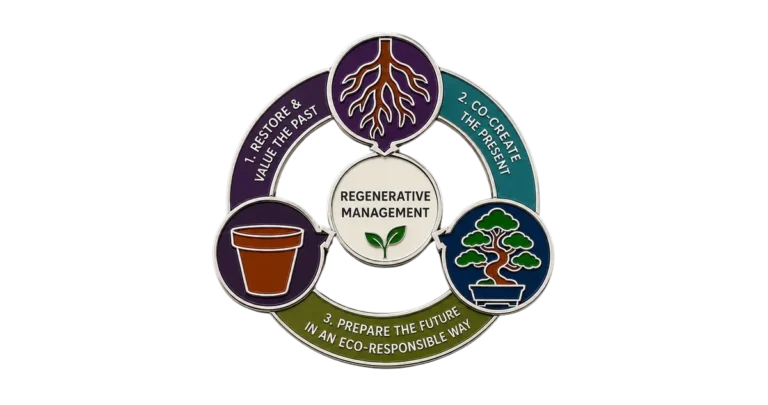
Holistic management promises a calmer working life for managers and their teams. It rests on six foundational pillars, and these are not “best practices” you bolt onto an existing org chart. They are the load-bearing structure that lets an organisation move from extractive management to regenerative management. This model is the subject of my next book, due out in early 2026.

| The iceberg | The six pillars | The energy economy |
|---|---|---|
| Holistic management starts by rejecting the CVHolistic management treats each team member as an iceberg, where qualifications and job title are only the visible tip and the real capability sits below the surface. Traditional management stops at the CV and wastes the rest. | Six pillars, not six slogansHolistic management rests on six pillars: systemic vision, interconnection, a regenerative environment, work-life balance, continuous learning and creative adaptability. Each pillar comes with a weekly protocol rather than a value statement on a poster. | The real unit to measure is energy, not talentThe sharper question a team should ask is not which hidden talents are being wasted, but whether the system currently in place extracts energy from people or regenerates it. Holistic management is the operating answer to that second question. |
What holistic management actually changes about how you see a team
Holistic management changes the unit you measure. Instead of asking which individual talents go unused, it asks whether the team, as a system, is extracting energy from its people or regenerating it. That single shift in the question changes almost everything a manager does next, from who gets recruited to how meetings get run.
The iceberg problem with traditional management
Every team member is an iceberg. The visible part, qualifications, job history and technical skills, is only a fraction of what that person can actually bring. Below the surface sit personal interests, soft skills built in other contexts, life experience and passions that quietly shape how someone works and where they create value.
Traditional management stops at the CV, because the CV is the easy part to read. Holistic management dives for what sits below it. The salesperson who does amateur theatre on weekends may hold exceptional relationship skills your sales process never asks for. The developer obsessed with video games may intuitively understand the gamification mechanics that could transform how customers experience your product.
Teams as an energy economy, not an org chart
An org chart tells you who reports to whom. It tells you nothing about whether the system is draining people or replenishing them. I find it more useful to think of a team as an energy economy: every ritual, every meeting and every rule either spends energy or generates it, and the balance between the two predicts burnout and turnover long before an exit interview does.
The Australian data backs the urgency of this reframe. The Australian HR Institute found that 38% of employers reported a rise in psychosocial claims or complaints in the twelve months to October 2024, with job demands, workplace conflict and isolated work as the leading causes. Energy is not a soft metric. It is the leading indicator of a hard cost.
The six pillars of holistic management
The six pillars are systemic vision, interconnection, a regenerative environment, work-life balance, continuous learning and creative adaptability. Each pillar comes with a protocol you can run inside two weeks, not a value statement to hang on a wall. I have used every one of these with real teams, and I have kept only the versions that produced a visible change in behaviour.
Systemic vision: see the ecosystem, not the parts
Systemic vision treats the team as a living organism with its own personality, where every part influences the others, rather than as a set of positions to optimise one by one. Traditional management scores each role in isolation. Systemic vision looks for coherence across individual, team and organisational goals instead.
This shift changes real decisions. When you recruit, you stop looking only for the sharpest technical skill and start looking for the profile that will enrich the existing ecosystem. When you organise work, you favour synergies over isolated individual output. When you evaluate performance, you weigh contribution to collective intelligence alongside personal results.
How to run it this week, the ecosystem review:
- Pick one single topic: recruitment, quality or deadlines.
- Spend five minutes mapping who depends on whom, on a whiteboard.
- Spot one friction point: a duplication, a wait, a bottleneck.
- Agree on one small change to test for two weeks.
- Log the effect and keep the before-and-after map.
A 35-person industrial manufacturer I worked with discovered that quote approval routed through both sales and finance even for modest amounts. The two-week test gave a single owner authority over quotes under a defined threshold, backed by a weekly random check. The friction disappeared without anyone losing oversight.
Interconnection: build the synapses of collective intelligence
Interconnection favours the free flow of information and the synergy between skills and talents, building links instead of silos. It goes further than communication alone, aiming to create an organisational network where any team member can activate the resources of the whole rather than just their own patch.
A holistic manager becomes an architect of links. They spot natural affinities, organise cross-functional meetings and facilitate informal exchange. Value tends to appear at the intersections between disciplines, in the grey zones where different expertise overlaps, and the manager’s job is to multiply those points of contact.
How to run it this week, the crossed duo:
- Pair two people from different disciplines: support and product, or marketing and finance.
- Give the pair one concrete irritant to fix within an hour, such as tickets landing in the wrong queue.
- The pair produces one simple fix (a script, a rule, a template) and publishes it for the team.
A B2B software publisher paired one support specialist with one product manager to write three triage questions for every incoming ticket. The document sits pinned inside the ticketing tool. After two weeks of use, the pair reviewed it and adjusted two of the three questions based on what had actually changed behaviour.
A regenerative environment: cultivate mutual thriving
A healthy working environment cultivates mutual trust and shared responsibility, creating the conditions for people to thrive and perform. This pillar goes beyond simple kindness, aiming to build an ecosystem that feeds its members instead of exhausting them.
A regenerative environment behaves like a mature forest, where every element both contributes to the whole and draws resources from it. Conflict becomes an occasion for growth, difference becomes complementarity, and one person’s difficulty mobilises the collective’s intelligence rather than their isolation.
How to run it this week, the energy thermometer:
- Every Friday, each person rates their energy from one to five and names one factor behind the number.
- Post the team average somewhere visible.
- If the average sits under three for two consecutive weeks, remove a meeting or simplify a process, then check the effect after a fortnight.
A consulting practice found that Tuesdays carried three long meetings back to back. The two-week test merged two of the meetings and capped every remaining one at 25 minutes. The Friday average climbed within the first fortnight, and the cap has stayed in place since.
Work-life balance: honour the whole human being
Balance between professional and personal life accounts for each person’s needs on both sides, respecting the diversity of situations and aspirations across a team. It recognises that people are not resources to optimise but complex human beings whose lives outside work matter to the work itself.
Holistic management refuses the artificial split between the person at work and the person off the clock. Energy, worries and learning move between both spheres constantly. A person thriving at home brings more creativity to work, and a real achievement at work feeds self-worth in every other part of life.
How to run it this week, the team agreement:
- Collect everyone’s non-negotiables, whether personal constraints or peak-performance windows.
- Agree on three shared rules, for example two meeting-free blocks, one mandatory synchronous window and free choice for the rest.
- Review the agreement every 90 days against results and feedback.
A design studio reserved mornings for deep creative work and shifted every meeting to after 10am. The team reported fewer interruptions and longer stretches of uninterrupted focus on long tasks within the first month.
Continuous learning: turn error into fertile ground
Continuous learning and development install a culture where mistakes become learning opportunities and shared knowledge enriches the whole team. This pillar repairs a common professional wound: the fear of failure that paralyses innovation and holds people back from their full potential.
A regenerative manager builds what I call a pedagogy of error, turning setbacks into raw material for collective intelligence. They create safe debrief spaces, encourage experimentation and celebrate what a failure taught the team. Over time, this posture reshapes a team’s whole relationship to mistakes and frees up creativity that fear had been suppressing.
How to run it this week, the five-question debrief:
- What did we try?
- What worked?
- What got stuck?
- What is the likely root cause?
- What changes from the next cycle? Write a ten-line note and file it in a shared folder.
A sales team sent a proposal with an outdated price. The debrief traced the cause to a missing final check. The fix was a four-item checklist added to the proposal template, applied immediately to every quote sent afterward.
Creative adaptability: surf uncertainty on purpose
Adaptability and flexibility prepare a team for change and treat creativity as the answer to shifting challenges rather than a threat to defend against. This pillar repairs another common wound: change experienced as something imposed rather than chosen, turning adaptation into a desirable collective skill instead.
Adaptive management builds what biologists call antifragility, a term popularised by essayist Nassim Nicholas Taleb to describe systems that do not merely withstand shocks but grow stronger from them. Uncertainty, under this lens, becomes a creative opportunity rather than a threat to survive.
How to run it this week, the portfolio of three small bets:
- For one challenge, define three options: cautious, ambitious and bold.
- Give each option one week and a small budget.
- Set a clear stop rule: a number, a date or a named owner.
- Extend whatever works, archive the rest with a written lesson.
One of my own e-commerce ventures faced a stalled lead pipeline and tested three options in parallel: a 20-minute webinar, a limited free trial and a partnership with a niche media outlet. Each option ran for one week against pre-agreed indicators, and the team decided which to scale based on the actual results rather than gut feel.
How the six pillars compound into a virtuous loop
The six pillars do not work in isolation. Systemic vision surfaces the interdependencies, interconnection turns them into working links, a regenerative environment installs the safety to use those links honestly, balance frees up the energy to sustain it, learning turns setbacks into shared capital, and adaptability converts that capital into sturdier practice, which then reveals new blind spots and feeds systemic vision again.
From systemic vision to a regenerative environment
Mapping real dependencies, rather than the theoretical org chart, reveals where work actually gets stuck and shows a manager exactly which links to build first. A sales team that depended on production for technical sign-off discovered the same question resurfaced every Tuesday, so a fixed 20-minute weekly slot between the two teams replaced the ad hoc back-and-forth.
Once those links exist, the risk shifts from silence to noise. A support and product team opened one shared channel for priority feedback and agreed a rule that every resolved decision gets written down in three lines. Fewer conversations get relitigated once everyone knows exactly where to look.
From balance to learning to adaptability
A calmer environment lets people set their own rhythm without guilt, which is exactly when a 90-day team agreement on synchronous windows and meeting-free blocks tends to stick. Once people are breathing rather than firefighting, they learn better, which is the right moment to install a short debrief after every delivery rather than after every disaster.
Lessons captured this way convert naturally into small, testable bets rather than grand pronouncements. A team facing a stalled pipeline does not need a strategy offsite. It needs three small, time-boxed options and a clear rule for when to stop each one.
Closing the loop: back to systemic vision
Every test reveals a blind spot the original map missed. A partnership that opens a new lead segment, for instance, often demands a fresh qualification step linking marketing, sales and delivery around one shared entry criterion, something the original dependency map never anticipated.
Update the map after every test cycle rather than once a year. A 30-minute session to revise it, one change at a time, keeps the whole loop honest and stops any single pillar from drifting back into the old extractive default.
How to choose a holistic management format against your own criteria
Choosing between a keynote, a workshop and an embedded programme depends on four criteria: how fast you need visible change, how deep the behaviour shift needs to run, what it costs to deliver, and which trigger moment in your organisation you are actually responding to right now.
Comparing the three formats
The table below lines up the three formats against the same criteria, so you can weigh them against your own situation rather than a generic recommendation.
| Criterion | Interactive keynote | Practical workshops | Embedded programme |
|---|---|---|---|
| Time to visible change | Days, a shared vocabulary | Two to six weeks, first rituals | Three to twelve weeks, durable habits |
| Depth of behaviour shift | Awareness and alignment | Three to five installed rituals | All six pillars practised and reviewed |
| Cost profile | Lowest, a single session | Moderate, a handful of sessions | Highest, ongoing coaching |
| Best trigger moment | Restructure, merger, kickoff | A specific recurring friction | Sustained turnover or burnout signals |
Which signals should guide your choice
If you need managers and leaders to align on a shared language fast, a keynote does the job. If a specific friction keeps recurring, such as cross-team handoffs or meeting overload, a workshop installs the ritual that fixes it directly. If your turnover or your psychosocial claims data has been climbing for more than a quarter, a single session will not hold, and an embedded programme is the honest answer.
Field note
The quote that took three weeks to approve
A 35-person industrial manufacturer brought me in convinced their problem was a slow sales team. Twenty minutes into an ecosystem review, mapping who depended on whom for a single process, the real picture appeared on the whiteboard: every quote, no matter how small, needed sign-off from both sales and finance.
Nobody had designed that rule on purpose. It had accumulated, one cautious exception at a time, until a two-hundred-dollar quote took the same approval path as a two-hundred-thousand-dollar one. We tested a single change for two weeks: one named owner for quotes under a defined threshold, with a weekly random audit instead of a universal double sign-off.
The lesson: most bottlenecks blamed on a team’s speed are actually a system nobody has looked at directly. Map the dependency before you touch the people.
How I can help you master holistic management
Based on your priorities and your team’s size, I build a simple path to activate the six pillars of holistic management without adding weight to an already full plate. The goal is visible rituals within 30 days, decisions written down, and a shared language that cuts down on misunderstandings.
Interactive keynote for leadership alignment
I deliver an engaging keynote that aligns leaders and managers around one shared direction, mixing field stories, live tool demonstrations and real-time votes so the room leaves with the six pillars in their own words. The goal is simple: turn intention into a first concrete ritual inside the following week, not a slide deck nobody reopens.
Practical workshops for weekly rituals
We move into workshop mode, short and useful, to install the rituals that change day-to-day team life: the 30-minute ecosystem review, the crossed duo, the energy thermometer, the five-question debrief and the portfolio of small bets. You leave with ready-to-use checklists and templates so the rollout happens without friction.
Ongoing programme: internal school and peer communities
I run a modular programme that professionalises your managers around the fundamentals of regenerative leadership, mixing virtual sessions, real cases from your own context and rituals to install between sessions. I also launch and facilitate internal peer communities, so the learning keeps circulating and turns into shared reflexes long after the programme ends.
Want to see the full model behind these six pillars?
Ready to understand how holistic management fits inside the wider regenerative leadership framework? Discover the complete approach in my guide to regenerative management.

Conclusion: holistic management is an energy system, not a checklist
Holistic management is not another item on an already long to-do list. It is a change of lens that moves a team from a system that extracts energy to one that regenerates it. You do not stack more recipes on top of the old ones. You start simple loops that, week after week, make the organisation clearer, more capable of learning and more adaptable.
Start small if this resonates. One dependency map, one crossed duo, one 15-minute debrief. Three gestures, and holistic management stops being a concept on a page and starts being the way your team actually works.
Frequently asked questions about holistic management
What is holistic management in a workplace context?
Holistic management treats each team member as more than their CV and manages the team as a whole system rather than a set of isolated roles. It rests on six pillars, each paired with a weekly protocol rather than a general value statement.
How is holistic management different from regenerative leadership?
Holistic management is the operational layer, the six pillars and their weekly protocols. Regenerative leadership is the broader framework these pillars sit inside, aimed at the long-term health of the whole organisation rather than one team’s rituals alone. I set out how that longer view unfolds over time in the three temporalities of regenerative leadership.
Can a small team use the six pillars without extra headcount?
Yes. Every protocol in this article, from the ecosystem review to the energy thermometer, runs inside an hour with no new tools or budget. The constraint is consistency over several weeks, not resourcing.
Which pillar should a struggling team start with?
Start with systemic vision if you cannot yet name where the friction sits, since the ecosystem review reveals the real bottleneck before you touch anything else. Start with the regenerative environment pillar if the friction is already obvious and morale is the more urgent problem.
How long before holistic management shows measurable results?
Individual rituals, such as the crossed duo or the five-question debrief, typically show a visible effect within two to six weeks. The full compounding loop across all six pillars usually takes a full quarter to become a genuine habit rather than a novelty.