Why « HR business partner » is giving way to « business contributor »
For thirty years, « HR business partner » was the highest compliment a People function could earn. The title meant a seat at the leadership table and a voice in shaping strategy. It proved that HR had moved from administration to influence.
This article sets out the posture that runs through all my work on HR Design, the human-centred, iterative, collaborative and prototype-driven approach I have been developing since 2020. It explains what changes when HR moves from supporting the business to creating value inside it, and which concrete moves you can start this quarter to get there.
| The inherited title | What caps it | The shift |
|---|---|---|
| HR business partnerAn HR business partner translates a strategy decided elsewhere into people decisions. For a long time, this role marked the People function’s entry to the leadership table. | A role absorbed and outgrownAgentic AI absorbs a large share of execution work, and leaders now expect a reading of organisational capability rather than an engagement tracker. | From partner to contributorA business contributor brings to strategy what would not exist without the People function: capability forecasting, experience architecture and coherence diagnostics. The change is one of posture, with no new headcount and no new budget. |
HR business partner is only the starting point
For a long time, the HR business partner title served as the People function’s finish line. It is becoming its starting line, because five forces are pushing it aside: consumerisation of work, arrival of agentic AI, a shift in how leaders look at the workforce, pay transparency and demographic renewal. Each one asks HR for a contribution that the partner role never planned for.
Consumerisation of work
Candidates and employees now expect the same fluency from their employer that they get from their banking app. They compare your application form to a meal ordered at midnight, and your internal tools to the consumer products they use on weekends. The gap shows up in offer acceptance rates, in departures during the first six months and in the public reviews candidates write about recruitment processes before they even sign a contract.
A partner adapts to these expectations. A contributor designs an experience that lives up to them.
Arrival of agentic AI
Generative and agentic tools have absorbed a large share of what HR business partners used to do: answering questions about internal policies, drafting job ads, pulling analytics and routing manager requests. None of these tasks requires an experienced HR professional any more.
The work AI cannot do still requires one: reading the culture, identifying the organisation’s incoherences and deciding what deserves to be measured. The partner role was built around execution work. The contributor role is built around judgement work.
A shift in how leaders look at the workforce
Boards now treat workforce data with the same seriousness as the P&L. The CHRO Association’s 2026 survey makes the point bluntly: 91% of the CHROs surveyed rank AI and workplace digitisation among their most immediate concerns, far ahead of governance, engagement and talent. This US survey, based on responses from around 150 CHROs of large corporations, describes a context that does not transfer as-is to Australia.
It still signals a change in the question put to HR. The question « how engaged is our workforce? » is giving way to another one: « what can our people actually do, and how fast can they adapt? ». A partner answers the first question. A contributor answers the second.
Pay transparency
Australian law has moved pay out of the HR office and into the open. Since 7 December 2022, the Fair Work Act gives every employee the right to share, or not share, their pay and to ask colleagues about theirs, and pay secrecy terms in contracts made from that date have no effect. Since 27 February 2024, the Workplace Gender Equality Agency has published the median gender pay gap of every private sector employer with 100 or more employees. The first release covered nearly 5,000 employers, and half of them showed a gap above 9.1%.
A partner applies a pay scale. A contributor has to justify it to any employee who compares notes with a colleague and to anyone who reads the organisation’s published gap, which requires a job architecture and objective criteria that many organisations have never formalised.
Demographic renewal
Treasury’s 2023 Intergenerational Report projects that over the forty years to 2062–63, the number of Australians aged 65 and over will more than double and the overall participation rate will slide from 66.6% to 63.8%. Skills that leave with retiring cohorts rarely come back through a simple hire, because part of that knowledge was never written down.
A partner replaces departures role by role. A contributor anticipates the knowledge that is leaving, organises its transfer and decides which parts the organisation should rebuild differently.
What « business contributor » really means
In the original HR Design framework, I wrote that this approach transforms HR from a designer and implementer of processes into an experience architect and innovation promoter. I also wrote that HR becomes an essential component of the business and that, with design in mind, it goes beyond the business partner or business contributor roles to become a business creator.
Six years later, I want to be more precise. Partner, contributor and creator describe three genuinely different roles, and the distinction matters because it decides how you spend your week. Each level reflects a different relationship with the business, far more than a different job title.
Partner, contributor and creator
A business partner translates business strategy into people decisions. Strategy comes from elsewhere and HR helps execute it.
A business contributor brings to strategy something that would not exist without the People function. That something is a clear-eyed reading of three questions: which capabilities the organisation can credibly build, which ones it cannot and which experiences will decide whether the strategy survives contact with reality. Workforce knowledge becomes an input to corporate planning, instead of a slide added at the end.
A business creator generates revenue or margin directly from the People function. Disney Institute, Porsche Consulting and Toyota’s production system academies are the historical references. Jean-Louis Motel’s HR department at Evolution generated €2 million by selling training and methods to clients. These cases remain rare, and they deserve attention because they show what happens when a People function puts an external market value on its expertise.
Why contributor is the realistic target
For most organisations, the move from partner to contributor is the most urgent one. The creator role remains a long-term aspiration, which assumes an offer the external market is willing to pay for, and most People functions are not there yet.
The contributor role, on the other hand, is within reach this year. It requires no new headcount and no new budget, only a change of posture. The HR Design framework was built precisely to make that change possible, and the next section breaks it down into five concrete shifts.
Five shifts that turn a partner into a contributor
Shift 1: from responding to anticipating
A partner reacts to the brief. A contributor questions it.
In HR Design, the inspiration phase exists for exactly this reason. Before launching a survey or sketching a persona, the question itself has to be questioned. I borrowed this discipline from Tim Brown and Jocelyn Wyatt, who warned that an overly prescriptive brief almost always leads to an incremental and mediocre result.
A partner receives a brief that says « reduce turnover by 5% ». A contributor reframes it: « which experience are our employees leaving, and which version of that experience would they actively choose to stay for? ». The first version produces a retention bonus. The second produces a redesigned offer.
Reframing goes well beyond wording. It changes the audience (from leavers to current and future employees), the time horizon (from one quarter to an ongoing process), the budget owner (often shared with operations) and the success metric (from turnover rate to an experience quality indicator the team defines for itself).
Shift 2: from employer branding to experience architecture
Employer branding is a transaction. Experience architecture is an offer.
Most employer branding budgets still fund communication material that promises what the lived experience cannot deliver. My work gives the result a name: the consumerisation gap. Candidates compare their application journey to a meal ordered at midnight, and employees compare their internal tools to the consumer apps they use on weekends. The gap shows up in offer acceptance rates, in departures during the first six months and in candidates’ now common habit of rating recruitment processes publicly on social media before they sign.
A contributor closes this gap by treating the whole Talent Cycle Wheel as a single architecture project. Attraction, recruitment, inclusion, management, recognition, development, separation and the relationship after departure form the stages of one continuous experience, which the organisation either designs deliberately or improvises badly. Sourcing Model Canvas, DNA Check-up and Meaning and Purpose Set-up are the tools I use to make this architecture explicit.
Shift 3: from individual productivity to institutional intelligence
AI forces this shift faster than any other, and most People functions miss it.
The dominant reflex is to give every employee an AI copilot and measure individual productivity gains. Brandon Sammut, Chief People and AI Transformation Officer at Zapier, explains clearly why this reflex stalls. He describes a ceiling on institutional AI: someone builds a useful AI practice and nobody else benefits, so the value stays locked at individual level. Zapier’s response was to ask each of its eleven departments to ship one significant new way of working with AI every quarter of 2026, which adds up to forty-four shared cases in a single year.
A contributor’s job is to design the rituals, spaces and incentives that turn private AI experiments into shared capability. This is collaboration in the strict sense I have always given it in HR Design, well beyond participation and cooperation: real collaboration, where anyone can launch an idea and decisions are made together.
Here is a quick test. In your organisation, can someone in marketing learn from an AI practice built by a colleague in finance without sending them a Slack message? If the answer is no, you run a participation system instead of a collaboration system, and your AI investment is losing value.
Shift 4: from engagement surveys to capability forecasting
Engagement surveys ask people how they feel. Capability forecasting asks what the organisation knows how to do.
Steve Holdridge, President and COO of Dayforce, describes people data rising to the highest levels of enterprise decision-making. In his view, an organisation’s people data will rival its financial data in strategic importance in 2026. The view of the workforce moves from a historical record of headcount and costs to a living map of capability, agility and operational potential.
This shift is a matter of posture far more than software. A contributor stops presenting last quarter’s engagement score and presents next quarter’s capability forecast: skills gaining value, skills losing it, roles where succession is missing and areas where the team’s appetences meet, or fail to meet, emerging business needs.
Some readers will recognise here my long-standing work on the anti-obsolescence grid. This grid makes forecasting concrete at individual level. Aggregated across teams, it becomes a reading of organisational durability that leaders can put on a board agenda.
Shift 5: from process owner to guardian of coherence
My next book on HR Design develops the idea of HR as Chief Coherence Officer. Here is the short version.
A partner owns processes. A contributor answers for coherence between what the organisation says, what it does and what people actually experience.
In a world that has moved from VUCA to BANI, where employees must be autonomous and aligned, remote and present, productive and creative all at once, the scarce resource becomes coherence far more than effort. That coherence plays out between brand promise and recruitment process, between values on the wall and performance review criteria, between innovation rhetoric and tolerance for failed experiments, and between what a manager is rewarded for and what their team actually needs.
A contributor’s role is to make these incoherences visible, name them and propose redesigns that reduce them. No AI agent can hold this role, because coherence rests on judgement anchored in a reading of the culture, far more than on a pattern detected in data.
HR Design ladder: a self-assessment
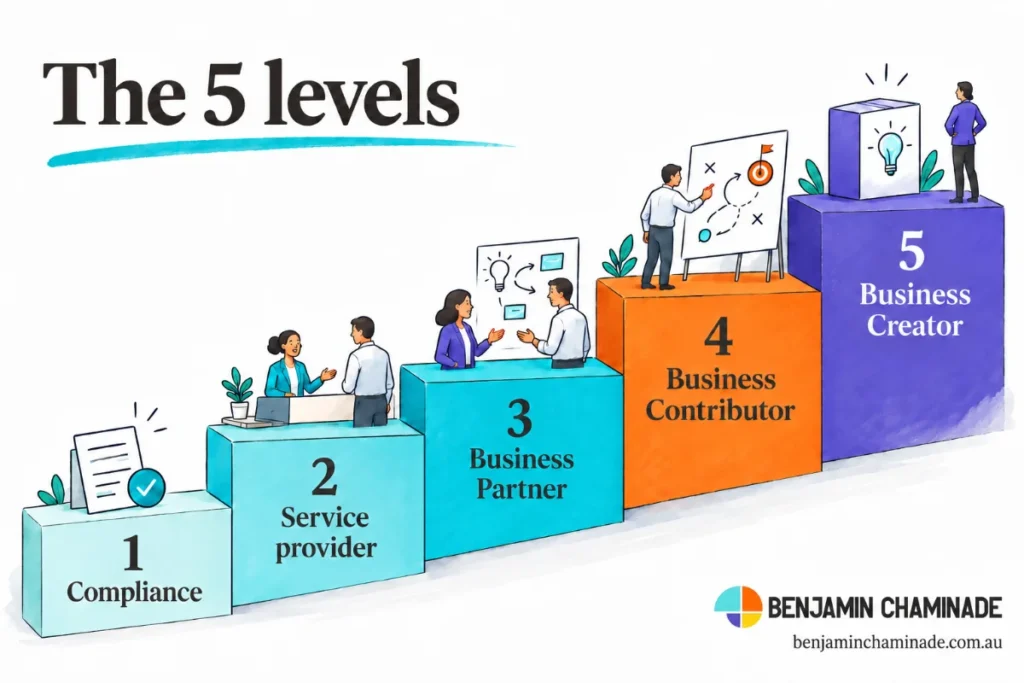
The five shifts do not happen all at once and follow a progression. To make this progression usable, I built a five-rung ladder that helps any People function locate itself today and identify its next realistic step. This ladder is also the basis of my twenty-question self-assessment.
The five levels
Rung 1, compliance
HR exists to protect the organisation legally. Contracts, payroll, dispute handling and reporting dominate the activity.
This rung remains indispensable, and it keeps getting heavier. In Australia, every private sector employer with 100 or more employees must lodge an annual Gender Equality Report with the Workplace Gender Equality Agency. An employer that misses its compliance requirements cannot obtain the certificate of compliance it needs to supply government with goods or services worth $80,000 or more, and may lose access to Commonwealth grants. A function that stops at this rung lodges the report, files the certificate and moves on to the next obligation, without ever using the data to inform a decision.
Rung 2, service provider
HR runs a catalogue of services such as recruitment, training and benefits. Internal clients submit requests and receive deliverables.
Efficiency becomes the master metric: processing times, cost per payslip and requester satisfaction. In the United Kingdom, the government plans to group the HR, payroll and finance functions of its departments into five shared service centres, used by more than 450,000 civil servants. The National Audit Office found that previous strategies had failed to deliver their intended savings, and the programme deadline has slipped from 2025 to 2028.
The example shows the limit of this rung: a better organised service is still a service, and its success is measured first by what it costs.
Rung 3, business partner
HR is embedded in business units, translates strategy into HR plans and is consulted on organisational decisions.
This model, formalised by Dave Ulrich in the late 1990s, remains the norm in large organisations. A GE Vernova listing for a Lead HR Business Partner gives a faithful description: as first point of contact for employees and managers, the role holder executes HR policy and strategy and works with some autonomy, within functional practices, precedents and well-defined policies. The role sits close to the ground and knows its unit’s challenges. Its limit lies in where strategy comes from, which remains outside the People function.
Rung 4, business contributor
HR shapes strategy by bringing capability forecasts, experience architecture and coherence diagnostics that other functions cannot produce. Its work changes what the organisation decides, beyond how it executes those decisions.
Schneider Electric offers an example. In March 2020, the group launched its Open Talent Market, an internal marketplace that uses AI to match employees’ skills and ambitions with full-time roles, part-time projects, mentoring and learning. The People function produces a reading of the skills available across the group that neither finance nor operations can produce.
Rung 5, business creator
HR generates external revenue or margin by turning its expertise into an offer.
Renault Group comes close with ReKnow University, its corporate university, whose courses are open to group employees, industry partners, young people in initial training and jobseekers. The group aimed to train 35,000 people by 2025. Expertise built to transform its own teams thus becomes a resource for its whole ecosystem, even though the group does not publish the revenue it generates.
Where most People functions really sit
Most functions sit between rungs 2 and 3 and aim for rung 4. The aspiration is realistic. The path is rarely linear, and skipping rungs usually produces a function that talks like rung 4 while operating like rung 2.
The pattern I meet most often has a name: « rung 3.5 syndrome ». The People function uses the right vocabulary (experience, capability, contribution and coherence), runs the right initiatives (employee experience programmes, AI pilots and skills frameworks) and still operates like a service provider as soon as an emergency lands on the desk. Vocabulary changes faster than posture. Closing that gap is the real work, and it usually takes twelve to eighteen months.
Field note
The HR director who sold his methods
Among the HR directors I have worked with, Jean-Louis Motel, now retired, took the People function at Evolution all the way to the top rung of this ladder. His HR department sold clients the training and methods it had first built for its own teams, and generated €2 million in the process.
The figure matters less for its size than for what it proves. A method an external client agrees to pay for leaves the category of overhead and joins the organisation’s assets. The People function behind it walks into the leadership meeting with proof from the market, where most People functions walk in with a budget to defend. The case remains rare, and it sheds light on the whole ladder: each rung is climbed when the People function produces what other functions cannot.
The business creator role starts with a simple question, to ask of every HR tool built in-house: would an external client pay for it?
What HR Design adds to other approaches
Several approaches claim to modernise HR: design thinking applied to HR, agile HR, employee experience platforms and the reinvention of total rewards. Each has its merits and none is enough on its own. HR Design presents itself as a synthesis built for the People function, rather than as a competing framework, with two distinctive traits that other approaches regularly miss.
A plural audience
HR Design forces the function to design for three populations instead of one. Candidates, employees and former employees form distinct groups whose needs overlap without merging. Most HR initiatives target only the second group, sometimes only part of it. HR Design treats all three as legitimate audiences, each with its own experience to design.
This includes former employees who will become advocates, boomerang candidates or clients. It also includes non-candidates, whose silence is the strongest signal about your attraction strategy. If your only candidate data comes from people who have already applied, you are working with a survivorship bias that no employer branding campaign will correct.
Discipline of the prototype
A business contributor presents a working prototype instead of a thirty-page transformation plan: a new onboarding ritual, a redesigned career conversation or an AI-assisted internal mobility tool. They then improve it visibly with the people concerned. The prototype is the deliverable and the plan is its residue.
Here HR Design borrows most directly from Lean Startup and growth hacking: build small, test fast and learn in public. A People function that adopts this discipline leaves its place as the slowest department in the organisation and joins the fastest learners.
Five concrete moves to start this quarter
The five shifts and the ladder help you think, without being enough to change anything by Friday. The list below converts the framework into five moves to launch this week, with no new budget, no executive sign-off and no software purchase. They are deliberately modest, because the discipline of the prototype requires starting small.
Quick wins
- Run a coherence audit on one experience: choose a single moment in the talent cycle (a candidate’s first interview, a new employee’s first week or an exit interview). Map what is promised, what is delivered and what is felt. The gap is your starting point.
- Pick one AI experiment and institutionalise it: find an AI practice already in place somewhere in the organisation and turn it into a shared, documented and transferable practice. Measure how far it spreads rather than the individual gain.
- Replace one engagement question with a capability question: instead of asking « how engaged are you on a scale of 1 to 10? », ask « which skill, missing today, will you need in your role in twelve months? ». The answers are immediately usable.
Deeper moves
Write a one-page contribution thesis: what does your People function bring to strategy that would not exist without it? If you cannot write it on one page, you do not have it yet.
Co-design one ritual with the people it concerns: a monthly review, a recognition moment or a meeting format. Apply the logic of collaboration rather than participation. The brief stays open and the decision is shared.
How I can help you become a business contributor
Reading an article is one thing, and shifting the posture of an executive team or an HR team is another. Over the past six years, I have refined two formats that turn the HR Design framework into action: a keynote for leadership teams that need to align on direction, and a workshop for HR teams ready to prototype. Both are designed so that everyone leaves with concrete decisions rather than slides.
Keynote: from partner to contributor
This is a 60 to 90-minute keynote for executive committees, leadership teams and HR conferences. It walks through the five shifts, the ladder and the context that makes the change urgent. It is conversational, illustrated with concrete cases from my consulting practice, and ends with an open exchange with the room.
It works particularly well to open an HR offsite, a leadership retreat or a transformation launch. Its purpose is to give the room a shared vocabulary and diagnosis, so that the work that follows has a chance of being coherent, far more than to convince anyone to adopt a new framework.
Possible formats: in person, remote or hybrid. Languages available: English and French. The keynote also exists as a recorded version for internal HR communities.
Workshop: design your contribution
This is a one or two-day workshop for HR teams of 8 to 20 people, ready to apply the HR Design framework to a specific challenge in their organisation. The workshop runs in three sequences:
- locate the function on the ladder, using the self-assessment and a structured group debrief;
- choose one of the five shifts to work on, by crossing the team’s lowest score with the strongest business priority;
- and prototype the first move in real time, with the relevant HR Design tools (DNA Check-up, Sourcing Model Canvas, Talent Cycle Wheel mapping or Meaning and Purpose Set-up).
At the end of the workshop, each participant leaves with a concrete prototype, a 90-day plan and a shared diagnosis the team can use to align with its executive committee. The workshop works as a co-design sprint, far more than as a training session.
Possible formats: on site, remote over two half-days, or blended with a remote diagnosis and an in-person prototyping day. Languages available: English and French.
How to start the conversation
If one of these formats suits your team or your event, write to me through the contact page or reach out directly on LinkedIn. I will send you a short scoping questionnaire to check that the format fits your context, then propose a session designed for your situation rather than copied from another organisation’s transformation.
What this means for the rest of my work
This article belongs to a wider body of work. Each of the five shifts connects to other articles, tools and frameworks I develop in my consulting and writing. If something here resonates, the related articles go deeper into each facet of the contributor role, and they will appear on this site over the coming months.
Related articles
On the candidate side, my work on consumerisation of recruitment, the non-candidate experience and segmentation between candidates and non-candidates extends the attraction stage of the Talent Cycle Wheel.
On the employee side, the managerial doughnut, the fragility canvas and my work on regenerative leadership cover management, recognition and development.
On the former employee side, my work on bridging and alumni relationship management closes a loop that most organisations still treat as an exit door instead of an open bridge.
The idea of the Chief Coherence Officer ties it all together. Each article sheds light on one facet, and all of them ask the same question: what does the People function need to contribute to the business, beyond simply supporting it?
Continuing the conversation
I will keep updating this article as practice evolves. If something resonates, contradicts your experience or raises a question you would like me to address, write to me. The most useful articles in this series were born from readers’ objections.
Before you close this tab, take five minutes to locate your function on the ladder with the self-assessment. You will know which rung it sits on, which of the five shifts to work on first and what to do from next week.
Posture put to the innovation test
Want to see the contributor at work on a specific field? Discover how the People function decides which novelty enters the organisation and lasts, in the article on the role of HR in innovation, the logical sequel to this one.
Benjamin Chaminade has worked at the crossroads of HR, design and innovation since 2003. He is the author of HR Design and several other books on talent, management and employer branding. The full HR Design framework, including the Talent Cycle Wheel, the DNA Check-up and more than 150 tools, will soon be available on reboot-lab.com.
Frequently asked questions about the HR business partner
What is an HR business partner?
An HR business partner is an HR professional attached to a business unit, responsible for translating the organisation’s strategy into people decisions: recruitment, organisation design, skills and support for managers. The role gave HR access to strategy, while remaining a role that executes a strategy decided elsewhere.
What is the difference between an HR business partner and a business contributor?
An HR business partner translates strategy into HR plans. A business contributor brings to strategy something that would not exist without the People function, such as capability forecasting, employee experience architecture or coherence diagnostics. Their work changes what the organisation decides, beyond how it executes its decisions.
Will AI make the HRBP role disappear?
AI absorbs a large share of an HRBP’s execution work: answering policy questions, drafting job ads and pulling analytics. Judgement stays human, whether it means reading the culture, identifying incoherences or deciding what deserves to be measured. The role is moving towards this judgement work, which belongs to the contributor.
How do you assess the maturity of a People function?
The HR Design ladder places a People function on five rungs: compliance, service provider, business partner, business contributor and business creator. Most functions sit between the second and third rungs. A twenty-question self-assessment lets you locate yours and identify the shift to work on first.