


The 4 innovation strategies
The main aim of an innovation strategy is to secure the growth and the long term survival of the organisation in the face of competition and market change. To be effective, that strategy has to be aligned with the overall vision of the organisation, with its strategic objectives and with the resources available to it.
But there is more to it... Something is missing!
You also have to take into account the risk taking and the boldness that your organisational culture allows. The task is to find the right balance between iterative improvement that answers customer expectations and the pursuit of a revolution that offers them something they never asked for.
In a world where change is the only constant, innovation has gone from being a luxury to being a vital necessity. Yet innovation follows many paths, ranging from subtle evolution through to radical revolution. That is why I have designed an approach built on four innovation strategies, each one striking its own balance between listening to the customer and entrepreneurial boldness.
From continuous innovation, which refines what already exists, through to radical innovation, which challenges orthodoxies and opens up new horizons, these strategies are your compass for finding your way through the complex world of innovation.
So get ready to set off on a journey that could redefine not only your organisation, but perhaps even your industry.
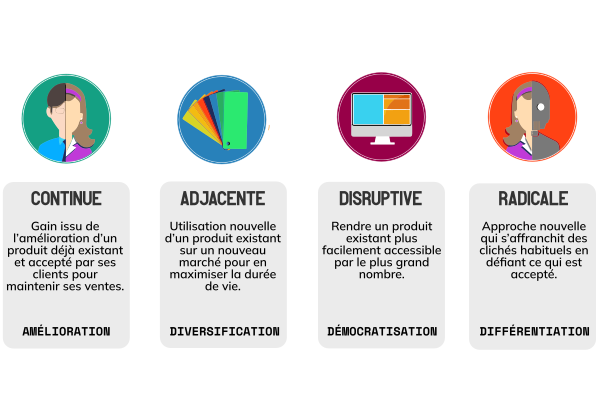
Getting to know the 4 innovation strategies
I built these four innovation strategies out of my professional experience in Australia and in France. In each setting I put new rules of the game in place to shake up the sectors I was working in.
Starting with the human resources consulting sector in Sydney, I took my inspiration from dating apps to revolutionise the recruitment process, a form of adjacent innovation. I then introduced pricing aligned with the engagement practices of my clients, which belongs to radical innovation. In France, in the car industry, I gave my clients the option of updating their car free of charge for two years, another radical innovation, before pivoting to a new business model to widen my client base, which counts as disruptive innovation, all without falling into « the usual hype talk ».
These four innovation strategies adapt to a range of company cultures and management styles, which gives you a versatile framework for stimulating creativity and growth.
Continuous innovation,
Continuous innovation is the most accessible and the most immediate form of innovation. It rests on listening closely to the needs and the expectations of customers in order to make incremental improvements to existing products and processes. Whether in terms of price, manufacturing, use or aesthetics, this strategy aims to optimise and refine what already works well. This innovation happens step by step, and over the long term it accumulates into significant competitive advantages.
Continuous innovation rests on listening to the customer and on the incremental improvement of products and processes from the angles of price, manufacturing, use, aesthetics and so on
Adjacent innovation
Adjacent innovation is a more ambitious strategy that goes beyond listening to the customer and draws on emerging trends and on inspiration from other sectors of the economy. This is what people call capillarity or cross-pollination. The approach lets a company step outside its comfort zone and explore new avenues that it can apply to its own field, which gives it a unique competitive advantage.
Adjacent innovation rests on listening to trends and drawing inspiration from sectors of the economy other than its own. People call this capillarity or cross-pollination.
Disruptive innovation
Disruptive innovation is the answer to the great upheavals under way, whether artificial intelligence, the move of work towards freelancing, or the socio-economic Great Reset. This form of innovation calls for fresh thinking and for the creation of entirely new business models. It carries risk, and the potential reward is enormous. Companies that succeed at disruptive innovation can redefine the rules of the game in their sector.
Disruptive innovation answers the disruptions under way (AI, freelancing, Great Reset and so on) and calls for new business models.
Radical innovation
Radical innovation is the boldest and riskiest approach, and it offers the largest rewards. It takes the opposite view of the orthodoxies most widely accepted in a given sector in order to create something completely new and unexpected. This form of innovation can be unsettling and even controversial, and it has the potential to transform a company, a whole market or even a society.
Radical innovation takes the opposite view of the most widely accepted orthodoxies. It is the boldest approach and its rewards can be the largest.
Each of these innovation strategies offers a different and complementary way to navigate the complex, constantly shifting landscape of business today.
Using the 4 innovation strategies
To share a common vocabulary
The word innovation carries several meanings, and the same family of innovation can go by several names. Continuous innovation, for example, is also called aggregative, iterative or incremental innovation. Then there is the mix of English and French, where radical innovation is also called breakthrough innovation.
To make innovation personal
Knowing the different innovation strategies is only the starting point! By inviting your employees to identify their level of creativity, their curiosity and their appetites, they can position themselves on the innovation style that suits them best.
To question the capacity of your company culture to innovate
Understanding that other types of innovation exist alongside continuous innovation and disruptive innovation shows you that your company culture can stand in the way of your ideas! Identifying the degree of boldness and risk-taking that your company culture can accept, or cannot accept, is the first step towards building a genuine culture of innovation.
Finding the right balance between the 4 innovation strategies
The long-term survival of a company can no longer rest on listening to customers alone. That makes it predictable, dull and unable to secure the loyalty of its customers. It also cannot stop serving its current customers to go chasing unicorns.