


The 6 Ds of disruption
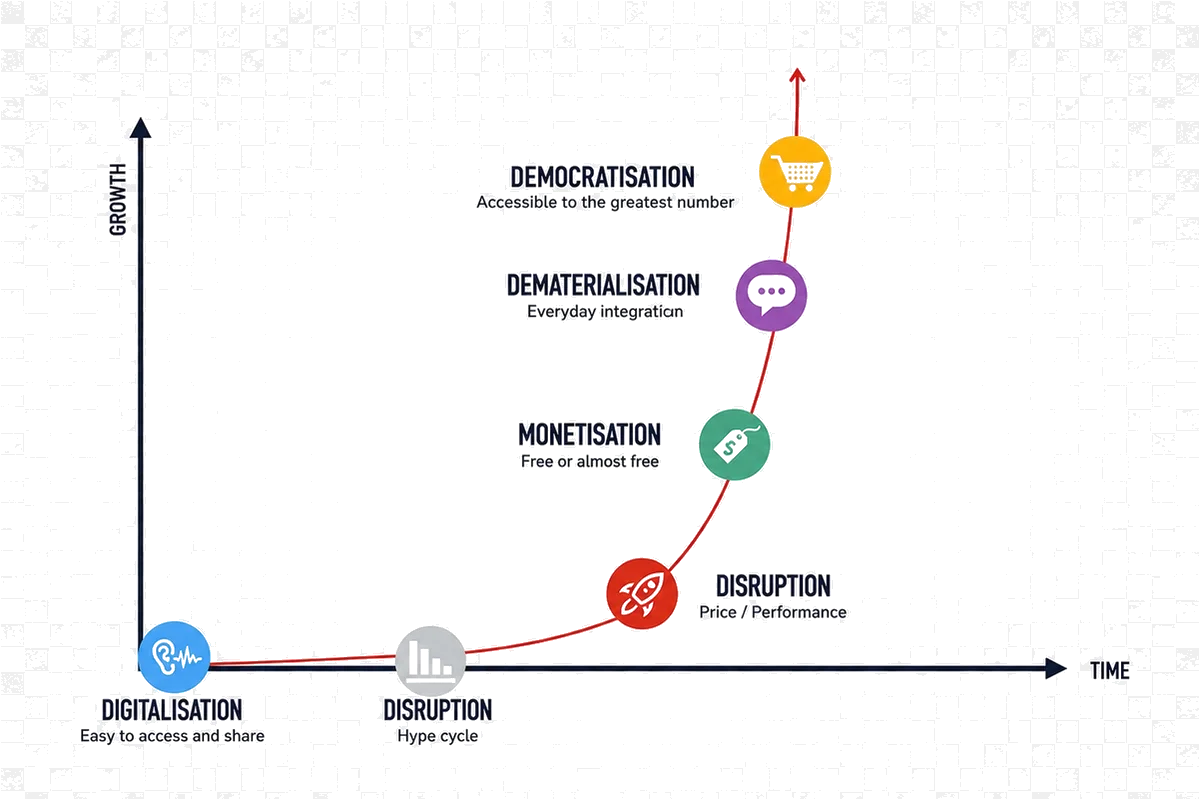
The Six Ds are a chain reaction of technological progress, a road map of rapid development that always leads to enormous upheaval and enormous opportunity. This exponential approach rests on the theory of disruption and on the hype cycle, which show the gap between the moment a topic becomes fashionable and the moment it actually produces effects.
We live in a time when news travels around the world in an instant. Music, films, games, communication and knowledge are permanently available on connected devices, twenty four hours a day. From biotechnology to artificial intelligence, technologies once reachable only by large corporations and governments are becoming available to almost everyone. Twelve year old YouTubers have access to tools that only professionals could use a few years ago.
The risk that an entrepreneur disrupts their industry, to use the current jargon, and that hundred year old companies vanish without warning has never been greater. Look at the current no code movement.
Fifty years ago, or even twenty, disrupting meant offering a product or a service people needed but did not yet have, then finding a way to produce it at higher quality and lower cost than your competitors. That meant hiring staff, having physical space to put them in, and waiting, sometimes for years, for the hard work to pay off and the products to materialise.
With digital technologies developing at an exponential rate, and the word is now well and truly out, the corporate landscape of the 21st century has taken on a radically different look and a radically different speed in a world we now describe as VUCA.
The structure of companies is changing from the inside. In place of hundreds of employees and large factories, companies are dematerialising what used to be physical and creating new products and new revenue streams within a few months, and sometimes within a few weeks. There is little need to remind you of YouTube or Instagram, both sold for more than a billion dollars before their third birthday. In short, you no longer need to be a large company to have an enormous impact and to line your pockets along the way. It is no accident that the 6Ds are often tied to the hype cycle.
The 6D let you track the effects of a disruptive technology in more detail than the sources of disruption.
The 6 Ds in question
Before you work through the list below, note that the version I use draws on the 6Ds of Diamandis, and I believe the order and the content of the 6Ds have moved on since this concept was published in 2016.
Digitisation
Digitisation is the first crucial stage of technological transformation. It converts analogue information into digital data, which makes that data easy to store, share and analyse. Once information is available in digital form, you can handle it and use it far more effectively. This stage opens the way to innovation and to exponential growth.
One of the major advantages of digitisation is that whatever is digitised can be replicated and sold at a cost close to zero. Automation lets the product being sold keep pace with growing demand without any extra development or investment, while it keeps its features and its performance. This ability to replicate and sell at low cost is a key driver of exponential growth.
On top of that, once information can be represented by ones and zeros, whether it is music or biotechnology, it becomes an information based technology and follows the same exponential growth as computing. Digitised information is easy to access, share and distribute, so it travels at the speed of the internet. That accessibility and that ease of distribution also feed exponential growth and innovation in many fields.
Deception
When digital technologies first appear, they can often look disappointing, because their initial impact is generally small. This perception grows stronger because the press and speakers often seize on a fashionable technology topic and create high expectations. It helps to understand that when something starts to be digitised, its initial period of growth always lasts longer than people think. Exponential trends grow very slowly at the start. Doubling 0.01, for example, gives you only 0.02, then 0.04, and so on. Exponential growth really takes off once the barrier of whole numbers is crossed. Only then does 2 quickly become 16, which becomes 64,000.
It is therefore crucial to see through this initial stage of disillusion, which is in reality temporary. Once exponential growth begins, progress can be fast and surprising. Technologies that once looked unimportant can quickly become major forces of change and upheaval. Keep in mind that the adoption of new technologies in the real economy can be slower than expected, as the Hype Curve shows. Once exponential growth kicks in, though, the impact of these technologies can be considerable.
Disruption
This is the moment when the adoption of a product becomes so volatile that its growth turns genuinely exponential. The existing market for a product or a service is then “disrupted” by the new market that the exponential technology creates. Digital technologies perform better on both efficiency and cost. Once you can stream music on your phone, for example, buying CDs becomes obsolete. In the same way, once you can take, store and share photos with your phone, buying a camera becomes pointless.
As digital technologies develop and mature, they start to disrupt established markets and industries. Companies that fail to adapt quickly to these changes risk losing their relevance and their competitiveness. This stage of upheaval brings major shifts in traditional business models and in the way customers buy and use products and services. Companies therefore need to be ready to adapt and innovate so that they stay competitive in the face of these disruptive changes.
Demonetisation
Demonetisation describes the process by which the costs of producing and distributing products and services are reduced or removed through the use of digital technologies. In other words, demonetisation means that products and services become cheaper, and sometimes free, because of automation, digitisation and the greater efficiency of technology.
This phenomenon of demonetisation can show up in several ways. Software, for example, costs less to produce than physical hardware, and it can be copied and distributed at a cost of virtually nothing. New business models, such as freemium or flat rate pricing, also let users access products or services free of charge or at a fixed and affordable cost. As a result, money gradually leaves the equation as technology becomes cheaper, often to the point of being free.
Demonetisation has significant implications for companies and for consumers. For companies, it can cut costs and so allow products and services to be offered at more affordable prices. For consumers, demonetisation means easier and cheaper access to high quality products and services. This can improve the quality of life of millions of people by making technologies and services that were once reserved for an elite available to the general public. Users can download an unlimited number of apps on their phone to reach terabytes of information and enjoy a multitude of services at costs close to zero, as they do with GPS, weather, share prices and the rest.
Dematerialisation
Dematerialisation is the process by which physical products and services are gradually replaced by digital solutions. This stage is marked by the disappearance of physical objects in favour of digital versions that are more practical and more accessible. Dematerialisation becomes possible thanks to the arrival of digital technologies that convert analogue information into digital data.
This movement of dematerialisation combines the integration and the simplification of what existed before. The combination of the radio, the camera and the telephone, for example, gave birth to the smartphone. Separate physical products are removed from the equation, and technologies that were once bulky or expensive are replaced by smaller devices that are simpler to use.
Dematerialisation has important implications for companies and for consumers. It reduces the costs of production and distribution, improves the efficiency and convenience of products and services, and widens access to technologies once reserved for an elite. CDs and DVDs, for example, have been replaced by music and video streaming services, and paper road maps have been replaced by GPS navigation apps. These changes have made products and services more accessible and more practical for consumers, and they have opened new opportunities for growth and innovation for companies.
Democratisation
Democratisation refers to the stage where products and services become available to far more people at more affordable prices. This stage is marked by greater accessibility and greater equality of access to products and services. It helps reduce inequality and improve the quality of life of millions of people by making technologies and services once reserved for an elite available to the general public.
Democratisation becomes possible thanks to the digitisation and the dematerialisation of products and services. Once information or a service is digitised, it can be shared and distributed easily at a cost close to zero. More and more people can therefore reach it, whatever their socio-economic status. Powerful technologies are no longer the preserve of governments, large organisations or the wealthy. 4G and Wi-Fi, for example, have become available to a wide public, which lets a great many people connect to the internet and reach information and services online.
Democratisation has important implications for companies and for consumers. It opens new opportunities for growth and innovation for companies, and it improves the quality of life of consumers. It is worth noting, though, that the phases of technological transformation are neither automatic nor easy. The 6Ds are a road map that shows what can happen when an exponential technology is created. Small teams can now change the world faster and more effectively than large companies could, and it is equally common for those large companies to buy the small innovative teams.
There is also a 7th D that could sit before Democratisation: Disintermediation
It refers to the stage where digital technologies reduce or remove the costs tied to producing and distributing products and services by cutting out the traditional middlemen. This stage is marked by the removal of intermediary players in the value chain, which reduces costs and improves efficiency. Disintermediation becomes possible thanks to the digitisation and the dematerialisation of products and services. Digital technologies connect producers and consumers directly, with no need for intermediaries such as distributors, retailers or agents. This reduces transaction costs, speeds up processes and improves the customer experience.
Disintermediation has important implications for companies and for consumers. It opens new opportunities for growth and innovation for companies, and it lets consumers reach better quality products and services at more affordable prices. It can also cause upheaval in established markets and call traditional business models into question.
Using the 6Ds
Beyond the handy device of words starting with D, the 6 Ds are useful to me for several reasons, and I use them regularly in my workshops on reinventing business models as you will read in this case study from a workshop I ran for Suez.
Anticipating trends and opportunities with the 6Ds
The 6Ds of Peter Diamandis offer a structured framework for understanding how exponential technologies progress. By mastering this model, companies can forecast future shifts and anticipate the major trends before they become dominant. This proactive anticipation lets companies prepare, adjust their strategies and seize opportunities ahead of their competitors, which secures an advantageous position in the market.
Innovating and standing out thanks to the 6Ds
The 6Ds work as trend indicators and as catalysts for innovation. Used as a guide, they let companies uncover unexplored areas of innovation and set themselves apart. Whether they are developing revolutionary products, introducing services never seen before or reshaping business models, the 6Ds guide companies towards avenues of innovation that answer the evolving needs of the market.
Adapting to market change with the 6Ds
In a world where change is the only constant, the 6Ds of Diamandis provide a compass for navigating market turbulence. They let companies understand the disruptive forces at work, anticipate the strategic turns they need to take and reshape their operations accordingly. By aligning with the 6Ds, companies can pivot with agility and so secure their relevance and their competitiveness.
Reducing costs and improving efficiency thanks to the 6Ds
The principles of dematerialisation and disintermediation, two of the 6Ds, offer significant opportunities to cut costs. By removing unnecessary intermediaries and building on digital technologies, companies can operate more efficiently and more profitably. That translates into an ability to offer high quality products and services at reduced cost, which strengthens the value proposition for customers.
Improving access and quality of life through the 6Ds
Democratisation, another of the 6Ds, puts the emphasis on making products and services available to a wider audience. By adopting this approach, companies can widen their customer base and play a crucial role in reducing inequality. By making technologies and services once reserved for an elite available to everyone, they hold the power to improve the quality of life of millions of people and so contribute to a fairer world.