Choosing a keynote and the person who delivers it is the first real decision of your event. Everything downstream, the venue, the running order and the catering, adjusts around that choice rather than the other way round.

I have no idea whether there is a TED effect. What I can see is that organisations book more speakers than they used to, for teams at lunchtime and for clients in the evening. The number of speakers has risen to meet that demand, along with the number of people describing themselves as speakers, which is a different figure. I have set out separately whether giving a TEDx talk is worth it for the speaker who is offered a slot, since that calculation looks different from the stage than it does from the audience.
That abundance made selection harder rather than easier. Telling a seasoned practitioner apart from someone who films themselves alone in front of a whiteboard now takes actual work.
So this article covers how to choose a keynote speaker properly, from the topic through to the day itself. I should declare the obvious conflict of interest before you read another line. I am a speaker, so I have a direct commercial interest in what you conclude here, and I would rather say that up front than have you work it out in the third paragraph.
Working out how to choose a speaker for your event starts somewhere other than where most guides begin. It starts with what your organisation currently cannot say out loud.
| The usual approach | What it produces | The shift that changes the outcome |
|---|---|---|
| Start with the topicMost guidance on how to choose a keynote speaker begins with a theme, then looks for someone credible to deliver it. Selection criteria centre on expertise, showreels and reputation, which are the easiest attributes to compare and the weakest predictors of impact. | Sessions that are enjoyed and forgottenA well credentialled speaker on a well chosen theme can leave a room entertained and unchanged. The same speaker can transform one audience and lose another in the same month, which suggests the variable sits somewhere other than in the speaker. | A keynote is consumed as permissionBenjamin Chaminade’s reading is that audiences take authorisation from an outside speaker more often than information. The organiser’s first question becomes what the organisation needs permission to say aloud, and the topic and the speaker follow from that answer. |
What you are actually buying when you book a speaker
You pay for content and your audience consumes something else. What people carry out of the room is usually authorisation rather than information: the sense that a difficult thing has now been said publicly by someone credible, and can therefore be said again internally. Understanding that changes every selection criterion that follows.
This is the part of the trade nobody advertises, because it is difficult to put on an invoice. It also explains the single most confusing pattern in the industry.
The content you pay for and the permission you receive
Almost nothing in a keynote is genuinely unknown to the room. The examples may be new, the framing may be sharper and the data may be more current, yet the core proposition is usually something a proportion of the audience already suspected. What the speaker adds is standing, and standing converts a private suspicion into a legitimate topic.
Watch the questions at the end and you can see it happening. The useful ones are rarely requests for information. They are people testing whether the thing that was just said publicly also applies to them.
The commercial consequence is uncomfortable for my own trade. Expertise is a qualifying condition rather than a differentiator, and a room full of specialists will not be impressed by expertise they already hold.
Why excellent speakers fail in some rooms
A speaker who transforms one audience and loses another has not changed between the two bookings. The room changed. Specifically, the distance between what the audience privately believes and what the organisation officially says changed, and that distance determines whether a keynote lands as relief or as noise.
Where that distance is wide, an outside voice is welcome, because it gives people language for something they have been carrying alone. Where it is narrow, the same session sounds like a consultant restating the strategy deck with better slides.
This is why references are a weak signal on their own. A glowing reference tells you the speaker matched that organisation’s gap, and says very little about whether they will match yours.
Where this idea comes from, and what is mine
The observation that outside voices legitimise internally held views is not original to me. Organisational research has long described the way external validation moves an idea from private opinion to acceptable position, and every consultant who has been hired to say what an internal team already recommended knows the mechanism intimately.
What I contribute is narrower. I treat the permission gap as the first measurement of an event brief rather than as an amusing side effect, and I build the selection sequence around it.
I make that distinction explicitly because I ask the same honesty of the speakers I recommend. Anyone presenting this mechanism as a personal discovery should be treated with suspicion, including me.

Why the selection got harder
Selection became difficult because supply grew faster than any way of assessing it. Producing the visible signals of a speaking career now costs almost nothing, so the markers organisers historically relied on, a website, a showreel and a confident biography, no longer separate a practitioner from a presenter. The filters have to move somewhere the cost is still real.
None of this makes newer speakers worse. It makes the old shortcuts useless, which is a different problem and an easier one to fix.
How to choose a keynote speaker when everybody is one
The useful filters are the ones that cost the candidate time rather than money. A body of published work over several years, a trail that predates the speaking career, named engagements that can be checked, and a willingness to be specific about what a session will not cover all take effort to fake. Production values take an afternoon.
Apply the same test to yourself while you are at it. An organiser who cannot describe the audience beyond a job title is asking to be sold a standard set.
The single most efficient filter remains a preparation call with a real question in it. Ask a candidate what they would refuse to say to your audience and listen to how long it takes them to answer.
What credentials stopped telling you
Credentials tell you that someone was once qualified in a field, and they say nothing about whether that knowledge is current or whether it survives contact with a room. A senior title held five years ago and a certification obtained a decade ago both look identical on a biography. Neither predicts whether the material has been tested since.
The gap shows most clearly in examples. A speaker who is still practising uses cases from the last eighteen months, and a speaker who has stopped uses the same three stories they used in their best year.
Ask for two recent examples from your own sector. The hesitation, if there is one, arrives quickly.
What you can still verify
Four things remain genuinely checkable without a bureau. Published work you can read, recorded sessions you can watch in full, past clients you can contact directly, and the specificity of the answers you get on a preparation call. Everything else on a speaker page is a claim rather than evidence.
Contacting a past client is the step organisers skip most often and the one that returns the most. Ask what surprised them rather than whether they were happy.
If a speaker cannot supply a reference from a comparable audience, that is information. It may mean they are early in their career, which is fine, and you should then price and brief accordingly.
Start with the change you want
A keynote topic earns its place when it carries a change the organisation actually wants. Start by naming what should be different in the week after the event, then work backwards to the theme and only then to the person. Reversing that order is the most common and most expensive mistake in event planning.
The test is brutally simple. If you cannot finish the sentence beginning “a week after this session, I want people to”, you are not ready to contact anyone.
Naming what should be different afterwards
Write one sentence describing the observable difference you want, in behaviour rather than in feeling. Inspired is not an outcome. People raising risks earlier, managers running one-to-ones differently, or a team asking to be measured on something new are all outcomes, because you would notice their absence.
Most organisers find this harder than expected, which is itself useful information. A vague answer usually means several stakeholders want different things and nobody has said so.
Settle that disagreement before the brief goes out. A brief written by committee is the most expensive document in event planning, and I have set out how to write a better one in my guide to briefing a keynote speaker in seven steps.
Defining the audience with more precision than a job title
Knowing that your audience is middle managers tells a speaker almost nothing. What matters is what they have been through in the last year, what they are being asked to deliver now, and whether attendance is voluntary. A room that chose to be there and a room that was rostered on behave like different species. When the audience sits in people and culture roles, the brief shifts again, and I cover that in my notes on choosing an HR keynote speaker who can blend evidence with practical tools.
Mixed seniority is the hardest configuration and the most common. When executives and frontline staff sit together, the permission gap runs in two directions at once, and a session pitched at either group alienates the other.
Tell your speaker the composition honestly, including the proportions. A speaker who knows that a quarter of the room reports to the person in the front row will make different choices.
Identifying the messages you want carried
Key messages should be aligned with your strategic objectives and stated in plain language, since anything that requires a slide to explain will not survive the walk to the car park. Two or three messages are the working maximum for a single session. A list of seven guarantees that none of them travels.
Separate the messages you want reinforced from the ones you want introduced. Reinforcement is comfortable and cheap, and introduction is where an external speaker actually earns the fee.
Be explicit about anything that is off limits. Every organisation has topics that cannot be raised from the stage, and a speaker who discovers one of them live will spend the rest of the session recovering.
Measuring the gap between corridor talk and room talk
The distance between what your people say informally and what gets said in official settings is measurable, and it predicts the right speaker profile better than any showreel. A wide gap calls for someone who can name difficult things safely. A narrow gap calls for someone who brings genuinely new material, since permission is not what the room lacks.
This changes what you are assessing. Instead of evaluating candidates, you begin by evaluating your own room.
A protocol you can run before briefing anyone
The exercise takes under an hour and needs no survey tool. You are collecting language rather than opinions, so capture the actual words people use and resist the temptation to summarise them into themes. The wording is the finding.
- Ask six to eight people across different levels what they would say about the current situation if there were no consequences.
- Ask the same people what actually gets said in formal meetings on the same subject.
- Write both sets of answers verbatim, in two columns, without cleaning up the phrasing.
- Underline any statement that appears in the first column and never in the second.
- Choose the single underlined sentence that would do the most good if a credible outsider said it from the stage.
That sentence is the real brief. Everything else in your brief document supports it or gets in its way.
What the size of the gap tells you
A wide gap means your people already know what is wrong and lack a safe way to say it. The speaker profile you need is credible, direct and willing to name things, and their expertise matters less than their nerve. A narrow gap means the diagnosis is shared and the room needs method, tools or an outside perspective on what to do next.
Getting this backwards produces the two classic failures. A provocative speaker in an aligned room is heard as a lecture, and a methodical speaker in a frustrated room is heard as avoidance.
Both failures are usually blamed on the speaker. Both were decided by the organiser weeks earlier.
When the gap is zero
Occasionally the two columns match, which means people say the same things privately and publicly. That is a healthy organisation and a difficult booking, because there is no permission to grant. In that case the honest answer is that you may not need a keynote at all, and a workshop or a working session will serve you better.
I say that knowing exactly what it costs me. A speaker who never tells an organiser that a keynote is the wrong instrument is selling rather than advising.
The same logic applies in reverse. Where the gap is enormous and the subject is genuinely painful, a keynote alone will open something the day has no capacity to hold, and the session needs to be paired with follow-up work.
Choosing the keynote topic
A good keynote topic is specific enough to match your strategic objectives and broad enough to hold a mixed room. It should either resolve an internal problem or feed an initiative already under way. Fashionable themes are not disqualified by being fashionable, and they are disqualified by having no connection to anything you are actually doing.
The practical method is to pick a broad theme, then break it into sub-themes for different sessions and workshops across the event.
Themes that carry a change, and themes that sound good
A theme carries a change when someone in the room will have to do something differently for it to be true. A theme sounds good when everyone can agree with it without cost. Innovation, agility and resilience all sit in the second category until you attach them to a decision your organisation is currently avoiding.
The reliable test is opposition. If nobody in your leadership team could reasonably argue against the theme, it is decoration.
Consult widely before settling it. Participants, sector peers and your event organiser all see things the internal sponsor cannot, and their disagreement is more useful than their approval.
Popular themes and what each actually delivers
The table below groups themes that come up repeatedly in Australian corporate events, with what each one realistically produces in a room. Read the third column before the first, since the outcome should drive the choice rather than the label.
| Family | Example themes | What it realistically delivers |
|---|---|---|
| Leadership and management | Decision making under pressure, engaging teams, and leading change | Shared vocabulary among managers, and permission to lead differently from the previous regime |
| Capability building | Managing time and priorities, interpersonal communication, and creative problem solving | Practical techniques, provided the session is a workshop rather than a talk |
| Specific pressures | Digital transition, environmental transition and reporting, and psychosocial risk at work | Recognition that a pressure is real, which is often the blocked step |
| Future and uncertainty | Fragility, artificial intelligence at work, and the future of skills | A frame for anxiety already present in the room, and lower resistance to change afterwards |
None of these families is better than the others. They answer different gaps, which is the only comparison that matters.
Narrowing a broad theme into one talk
A theme is not a talk. Leadership is a theme, and one decision your managers keep avoiding is a talk. The narrowing step is where most briefs stop too early, which leaves the speaker to guess and produces the generic session everyone remembers vaguely and nobody acts on.
This is why I organise my own sessions into a small number of themes with a limited number of angles inside each, rather than offering an open menu. You can see how that works on my speaking page.
A speaker offering to talk about anything is telling you something. Range is a strength, and unlimited range usually means the material is shallow enough to be reshaped on request.
Building your shortlist
You can reach a shortlist through a speaker bureau or you can build it yourself. Doing it yourself takes a few hours and three tools that most organisers underuse: a search engine for authority, a bookshop for depth, and video for delivery. Each answers a different question, and no single one is sufficient.
Most speakers now have a site, and the more serious ones have recorded material you can assess before you ever pick up the phone.
What a search engine tells you, and what it hides
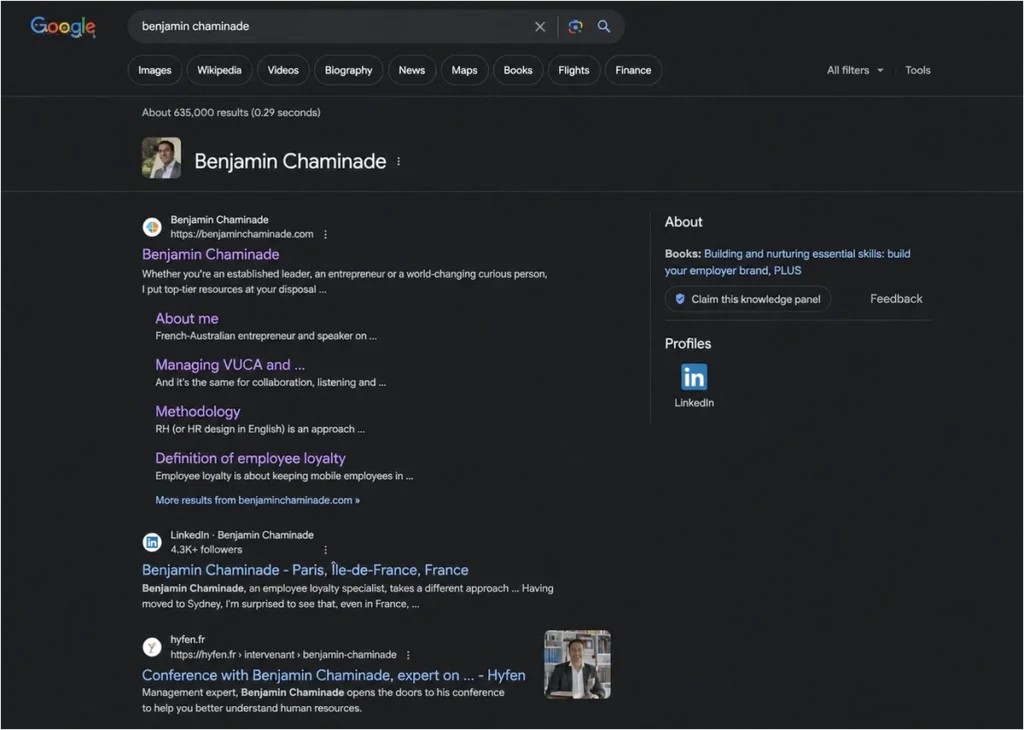
Search tells you whether someone has an established body of work: articles, interviews, contributions and citations that show authority in a field over time. A serious candidate leaves a trail that predates their speaking career. The absence of that trail is a signal worth taking seriously.
What search hides is currency. A well optimised site can present material assembled years ago as though it were current thinking, and nothing on the page will tell you which.
Check whether the examples are recent and whether they are Australian. A speaker recycling overseas case studies from a decade ago will not survive questions from a room that works in the sector.
Using books to find genuine depth
If you want an expert rather than a presenter, start from published books on your subject and work back to their authors. A book is a slow, expensive commitment to a body of thinking, which makes it a reasonable filter. Click through to the author page and you have a shortlist that was assembled by publishers rather than by marketing budgets.
One caution has become necessary. Self-published output has made it trivial to produce thirty titles in a year on subjects the author has never practised.
Look at publication pace and publisher. A book every few years through a recognised publisher tells a different story from a monthly release on the same platform.

What video reveals that a website cannot
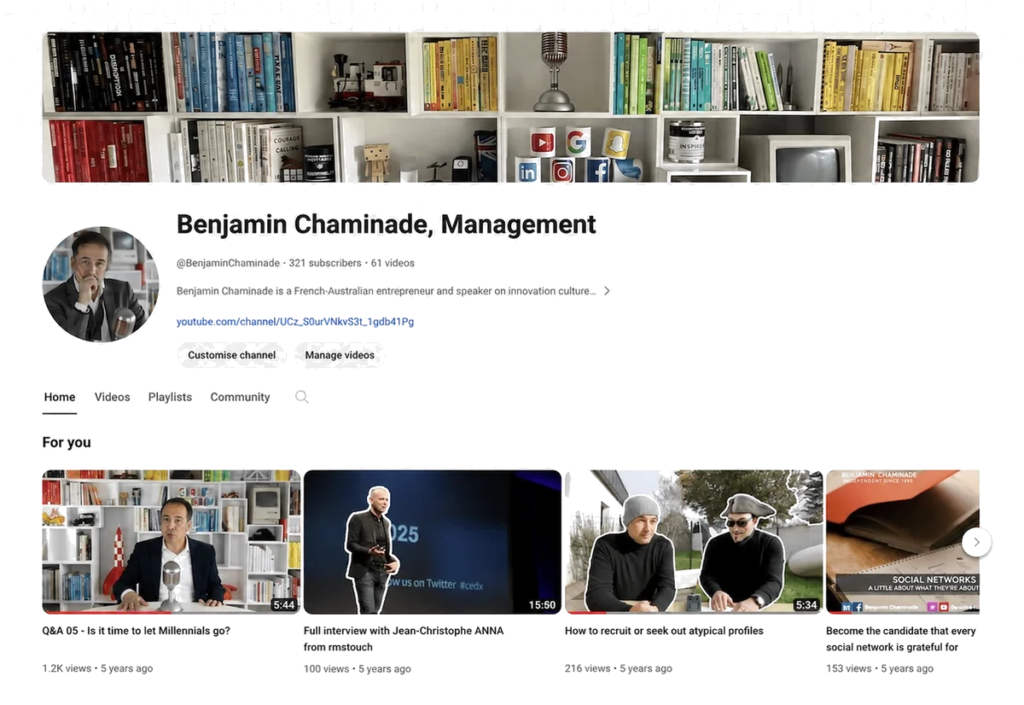
Video is where you judge delivery. Watch a full session rather than a showreel, since a showreel is edited to remove exactly the moments that would tell you something. You are looking for whether the speaker holds a room without raising their voice, and whether the audience is laughing with them or at a joke.
Three things are worth watching for specifically.
- A style that suits your audience: a technical register for engineers, and a different one for a sales conference.
- Evidence of adaptation across recordings, since the best speakers adjust the same material to different rooms rather than replaying it.
- Handling of a question they did not expect, which is the only unedited moment you are likely to see.
Combining the three tools gives you a reasonably complete picture. Text tells you about authority, books tell you about depth, and video tells you about the room.
Field note
Arriving like a hair in the soup
I have been received badly enough times to recognise the pattern before the session starts. Nobody at the door knows a speaker is expected. The room is being reset from a previous item and the technician is unavailable. Somebody eventually appears, apologises for the confusion, and asks how long I need to set up while looking at their phone. None of this is rudeness. It is an event where the keynote was booked by one person and delivered to another, and the handover never happened.
What it costs is not my comfort. It costs the organiser about ten minutes of the session, because a speaker who has not been able to talk to anyone before walking on stage has no read on the room and spends the opening finding it. The same thing happens at the other end, when the session finishes and the speaker is left standing near the coffee urn while the agenda moves on. Those twenty minutes after a talk are where people ask the question they would not ask in front of the room, and they are the highest value minutes of the whole booking.
The operational lesson is to name one person who owns the speaker from arrival to departure and tell the speaker who that is. It costs nothing, it recovers the opening minutes of the session, and it protects the conversations after it, which are the part your audience will actually remember.
Assessing the shortlist against your own criteria
Once you have three or four candidates, compare them against your gap rather than against each other. The relevant criteria are fit with the sentence you identified, clarity of communication, real experience in the field, and the ability to connect with the specific room you have described. Reputation belongs on the list and belongs near the bottom of it.
This section is decision support rather than a pitch. My own interest is obvious, and the criteria below would work against me for plenty of briefs.
Four speaker profiles compared
Rather than rate named individuals, which tells you nothing about your own room, compare the profiles. Each profile succeeds under specific conditions and fails under others, and the failure column is where the useful information sits.
| Profile | Suits | What you get | How it fails |
|---|---|---|---|
| Subject expert | Narrow gap, informed room needing method | Depth, defensible material, and credibility with specialists | Loses a mixed room that wanted meaning rather than method |
| Practitioner from the field | Rooms that distrust theory | Lived examples and hard credibility | Generalises from one context that may not resemble yours |
| Motivational or story-led | Wide gap, low morale, mixed seniority | Energy, emotional permission, and a shared reference | Nothing changes on Monday because no method was offered |
| Public figure or high profile name | Events needing attendance and external visibility | Ticket sales, sponsor interest, and a drawcard | The fee consumes the budget that should have funded follow-up |
Most organisers eventually want a hybrid, and hybrids are rarer than the marketing suggests. Where you cannot get both, decide which failure you can afford.
Bureau or direct, and what each actually changes
A speaker bureau saves you time, gives you access to a large pool of vetted profiles, and brings experience in matching a speaker to an audience and a budget. Going direct gives you a longer preparation conversation and a clearer line to the person who will be on stage. The cost is usually similar, since bureaus negotiate rates that offset their margin.
Bureaus earn their fee most clearly when you need several speakers, when the date is tight, or when you have no shortlist and no time to build one.
The agencies I work with are Pascal Bertholon at A-speakers, Emmanuelle Lory at Simone et Nelson, and Kenneth Grand at We are Minds. If you are reading this in Australia, you can also just contact me directly.
Agreeing scope before you agree a fee
Scope is where budgets expand without anyone deciding, so settle it before the number. A session length, a preparation call, travel, a question and answer segment, any customisation involving interviews with your people, and what happens to recordings afterwards are all separate commitments. Agreeing a fee before agreeing those items guarantees a second conversation neither party enjoys.
Customisation is the item most often assumed and least often specified. Tailoring that means swapping your logo into a template costs nothing, and tailoring that means a speaker interviewing four of your managers before writing the session costs real time.
Say which one you are buying. An organiser expecting the second while paying for the first will be disappointed, and will usually blame the delivery.
Recording rights deserve their own line. Many speakers will allow internal circulation for a defined period and decline public publication, and finding that out after the event is the wrong order.
Signals that you have the wrong candidate
Four signals appear during the preparation call rather than on the day. The speaker asks no questions about your audience, or agrees instantly to every request. They cannot name what will be different afterwards. Or they offer to cover all three of your themes in forty five minutes.
The first is the strongest signal. A speaker who does not interrogate the brief is planning to deliver the set they already have.
For a vertical brief, the qualifying questions get more specific, and I have set out eight of them for one field in my article on how to choose an innovation speaker.
Organising the event so the keynote lands
A well chosen speaker can be undone by the room, the running order or the budget. Venue capacity, technical equipment, accessibility, catering and cost all shape what is possible on stage. Treating logistics as separate from content is how organisations pay for a good session and receive a mediocre one.
The Australian business events sector is substantial, which means these decisions are being made at scale. The industry body reports that business events generate around $36 billion in direct economic benefit and support an estimated 229,000 direct jobs, a figure it publishes itself and which is worth reading as an industry estimate.
Venue and format decisions that change the talk
Room shape affects delivery more than most organisers expect. A wide shallow room supports interaction, a deep narrow one does not, and cabaret seating changes what a speaker can ask of the audience. Confirm the configuration before the preparation call, because it determines what the speaker can plan.
The practical checklist for choosing a venue covers capacity, technical equipment, location and accessibility, catering, and hire cost.
Slot placement matters as much as the room. A keynote after lunch is a different job from a keynote opening the day, and a speaker who is not told which one they have will prepare for the wrong energy level.
Budget, and where the money actually goes
Budget planning fails at the edges rather than at the centre. Speaker fees and venue hire are visible and get planned, while travel, accommodation, technical support and follow-up materials arrive later and unbudgeted. Asking a speaker for an all-inclusive fee removes the most common category of surprise.
The allocation below is my own working rule of thumb from the events I have been part of rather than published sector data. Treat it as a starting shape to argue with.
| Cost line | Indicative share |
|---|---|
| Venue hire | About a quarter |
| Speaker fee | About a quarter |
| Technical and audiovisual | About a sixth |
| Catering and breaks | About a sixth |
| Travel and accommodation | About a tenth |
| Printed materials and other costs | The remainder |
One line is almost always missing. Whatever you spend on the session, budget something for the week afterwards, because a keynote with no follow-up is an expensive way to produce a good mood.
Receiving the speaker
Hosting is the cheapest lever you have and the most frequently dropped. A named contact, a confirmed arrival time, access to the room before the audience, and someone available after the session cost nothing and materially change what you get. This applies at the end as much as at the start.
Send the running order, the dress code and the names of the people the speaker will be introduced to. Small courtesies compound into a speaker who is calibrated to your room rather than guessing.
Expect slide decks to be a negotiation. Many speakers no longer share their slides, because slides that illustrate a talk rather than carry it are close to meaningless without the delivery, so plan your post-event communication around something else.
Choosing a speaker for an online or hybrid event
An online audience is available rather than present, which changes what a speaker has to do to hold it. Reach improves, since geography stops limiting attendance and remote teams can join. Attention gets harder, because every participant is one click from something else, and a speaker who relies on room energy has no room to draw on.
Deciding the format before you shortlist saves you from booking someone brilliant for the wrong medium.
What changes when the room is not a room
Three things change immediately. The speaker loses the feedback loop that tells them how the material is landing, the tolerable session length drops sharply, and interaction has to be designed rather than allowed to happen. A talk that works for fifty minutes in a hall usually needs restructuring into shorter blocks with deliberate participation points.
The permission mechanism still operates online, and it operates differently. People are more willing to type a difficult question into a chat than to raise it standing up in front of their manager.
That makes an online session unusually good at surfacing what your organisation avoids saying. Plan for what you will do with what comes back.
Formats that survive a screen
Shorter sessions with built-in interaction survive a screen. Long narrative keynotes that depend on pacing and audience reaction generally do not, and neither do sessions whose value sits in the conversations afterwards, since online events rarely produce those. Hybrid is the hardest configuration, because a speaker has to serve two audiences with opposite needs at once.
If you run hybrid, decide which audience is primary and tell the speaker. A session pitched at the room with a camera pointed at it is a broadcast, and a session pitched at the screen leaves the people who travelled feeling like extras.
Budget for a second person to run the online side. Expecting the speaker to manage chat, polls and the room simultaneously produces a worse version of all three.
Selection criteria that shift online
Two criteria rise and one falls. Comfort with the technology and the ability to hold attention without audience feedback both become critical, while stage presence in the theatrical sense matters far less. A speaker who is magnetic in a hall can be flat on camera, and the reverse happens just as often.
Ask for a recorded online session rather than a stage recording. The two tell you about different skills, and only one of them is relevant if your event is remote.
Run a technical rehearsal on the actual platform. Discovering on the day that a speaker cannot share sound is an avoidable and very public failure.
Write the brief before you write the shortlist
Ready to turn your one sentence into a working brief? Follow my seven step method for briefing a keynote speaker and give your speaker what they need to land the session rather than survive it.
How I can help you choose the right keynote for your event
I work with event organisers and internal sponsors on the decision that comes before the booking, which is what the room needs to hear said aloud. That work runs as a keynote, a workshop, a longer program, or occasionally as a conversation that ends with me telling you a keynote is the wrong instrument.
The topics I cover sit around innovation, managerial transformation, fragility and the future of work. The method is the same regardless of the theme. If your theme is managerial innovation, I have written a companion guide on how to choose a management innovation speaker, because the label hides a definitional problem worth settling first.
Keynotes
A keynote suits a room that needs a shared frame and a shift in vocabulary, delivered in forty five to sixty minutes with time for questions. I run a preparation call before every booking, and I ask for the sentence described earlier in this article. Organisers who cannot answer it usually discover something useful in the attempt. If you want a sense of the format before you commit, I describe what to expect from a management keynote from both sides of the room.
Sessions run in Australian English with Australian examples and current data, because a room recognises borrowed material immediately.
If you want to see how the trade works from the inside before you book anyone, including me, I have written about what has actually changed in the speaking business.
Workshops and programs
A workshop suits a group that already shares the diagnosis and needs to practise on its own cases, in a room small enough for everyone to be visible. A program suits organisations where the change requires managers to work differently over months rather than to think differently for an afternoon.
Where the theme is innovation, the session usually connects to the wider question of building an innovation culture, since a single talk cannot carry a culture on its own.
Either way, tell me what should be different a week later. That answer shapes the format more than any preference I have.
The gap diagnostic, before you book anyone
Where the stakes are high or the stakeholders disagree, I run the corridor and room exercise described earlier as a short piece of work in its own right, ahead of any booking decision. It takes a day, it involves six to eight conversations across levels, and it produces the sentence your event needs to be built around.
Organisations use the output in two ways. Some brief a speaker with it, and some discover that the sentence belongs to their own leadership team and that no external voice should be saying it for them.
The second outcome happens often enough to be worth naming. It costs me a booking and saves the organisation a session that would have landed as theatre.
Either way you finish with a brief that a good speaker can work from, which raises the quality of every proposal you receive afterwards.
Conclusion
Every guide to how to choose a keynote speaker will tell you to define your objective, know your audience and watch some video. All of that is correct and none of it explains why the same speaker triumphs in one room and dies in the next.
The variable is what your organisation is currently unable to say. Measure that gap first, choose the topic from it, then choose the person who can stand in front of your specific room and say the sentence.
Get that order right and the rest of the process becomes ordinary project management. Get it wrong and you will book somebody excellent and wonder afterwards why nothing moved. That is how to choose a keynote speaker who actually changes something, and it starts a long way before the shortlist.
Frequently asked questions about how to choose a keynote speaker
How do I choose a keynote topic that is actually relevant?
Start from the change you want rather than the theme you like. Name what should be observably different a week after the event, then pick a topic that carries that change. A theme nobody in your leadership team could argue against is decoration.
What criteria matter most when selecting a speaker?
Fit with your specific room comes first, followed by clarity, real field experience and the ability to hold a mixed audience. Reputation belongs on the list and near the bottom of it, since a well known name predicts attendance rather than impact.
Should I use a speaker bureau or approach a speaker directly?
A bureau saves time, brings a vetted pool and handles matching, which is worth most when you need several speakers or have a tight date. Going direct buys you a longer preparation conversation. Costs are usually comparable, since bureaus negotiate rates that offset their margin.
How much of my event budget should the speaker fee be?
In the events I have been part of, the fee tends to sit at around a quarter of the total, similar to venue hire. Ask for an all-inclusive figure covering travel and accommodation, since unbudgeted travel is the most common cost surprise.
What logistics matter most for a keynote to work?
Room configuration, technical setup, slot placement and one named person owning the speaker from arrival to departure. The twenty minutes after a session, when people ask what they would not ask in front of the room, are the most valuable and the most often lost.
Do speakers share their slides after the event?
Many no longer do. Slides that illustrate a talk rather than carry it are close to meaningless without the delivery, and a keynote is neither a training course nor a consulting report. Agree your post-event materials in advance rather than assuming a deck.