A managerial transformation diagnostic measures your management practices circle by circle and gives you a score out of ten for each of the six. It produces a curve, and that curve reads against your natural reflex. The circle where your score collapses rarely shows you where the problem is, it shows you where the problem became visible.
I have put this sixty statement questionnaire to 3,400 managers and 600 executives across large groups, mid-sized companies and small businesses, in every sector. Two findings come back with a regularity that ended up surprising me, and everything below rests on them.
The first concerns the chain of circles. A low score almost always has its cause in the circle immediately before it. The second concerns who answers. Executives score themselves consistently above their own managers, on the same practices and inside the same organisation.
| What the diagnostic measures | What the lowest score hides | The reading that changes the decision |
|---|---|---|
| A chain, not six scoresA managerial transformation diagnostic assesses six management practices that condition each other in a precise order, from trust to creativity. Each circle makes the next one possible, which rules out treating the scores as independent dimensions. | A symptom, not a causeThe score that collapses marks the point where the break becomes visible to the team. The cause usually lives one circle upstream, where the score still looks acceptable and therefore attracts no attention. | Go back one circleFaced with a drop, the useful decision is to open the preceding circle with your team rather than launching a plan on the lowest scoring one. This reverse reading avoids funding the repair of a symptom. |
Why a managerial diagnostic reads backwards
A conventional managerial diagnostic produces six scores and invites you to work on the lowest. That reading looks logical and it fails regularly, because management practices do not form parallel dimensions. They form a chain, and a chain always gives way at the link after the one that let go.
What a management score actually measures
A management score measures the perception of a practice at a given moment, never its solidity. A high score can cover a practice that is sound underneath, or a practice that has never been tested. The difference only appears once the following circle starts to slip.
The Study of Australian Leadership, run by the University of Melbourne’s Centre for Workplace Leadership across almost 8,000 people in more than 2,700 organisations, illustrates that gap at national scale. 84 per cent of frontline managers believe they are effective at gaining employee commitment, while only 50 per cent of their team members agree that their manager involves them in decisions.
Both groups answered sincerely. A diagnostic that stopped at the first figure would conclude that frontline management works. The second figure shows the function degrading exactly where nobody was looking.
The reverse reading rule of the managerial transformation diagnostic
The rule fits in one sentence. When a score falls sharply against the circle before it, resist the impulse to work on the circle that fell and open the one preceding it. The drop measures where the fragility shows, rather than where it was born.
Take an example that recurs in every workshop. A manager scores 7 on creativity and 4 on innovation. The reflex is to build an innovation mechanism, an idea box or an internal hackathon. The cause lives in creativity, where the 7 almost always masks a blind spot the team had already identified.
The test is simple. Put the statements from the upstream circle to your team, replacing my management with my manager. The gap between the two sets of answers gives you the response in ten minutes.
The boundary, when a circle collapses on its own
The reverse rule becomes false if applied mechanically. Some collapses are autonomous and owe nothing to the preceding circle. Confusing them with cascading collapses sends you back up a chain for nothing, while the real constraint stays intact.
A cascading collapse shows three signs. The upstream circle carries an acceptable but fragile score, the team and the manager diverge on that upstream circle, and the drop concerns statements that touch on relationship or posture.
An autonomous collapse looks different. The drop concerns statements that touch on means, time, budget or tools. Low creativity caused by no room, no dedicated time and no experimentation budget says nothing about the curiosity of the previous circle.
The question to ask before going back up the chain fits on one line. Is this circle low because people do not want to, or because they cannot? The first case belongs to the chain, the second belongs to a decision about resources.
What a managerial diagnostic has to measure in Australia
A useful managerial diagnostic accounts for the ground it is applied to. The Australian data describes a particular situation, where the relationship between a manager and their team still scores well while the function itself grows fragile. Three sets of data frame that gap.
Engagement, a floor that weighs on every circle
The engagement circle sits at the centre of the chain, since it conditions collaboration, curiosity and creativity. Its collective starting point is low, which mechanically pulls the whole curve down for the majority of managers.
Gallup’s State of the Global Workplace reports that global employee engagement fell to 20 per cent in 2025, down from a peak of 23 per cent in 2022. Australia and New Zealand sit above that global figure and well above Europe, which makes the Australian starting point better than most and still leaves three quarters of the workforce outside engagement.
Worth looking at squarely. Australian workers report some of the most optimistic job market perceptions in the world, and engagement still sits where it sits. The problem therefore lives in the relationship to work rather than in any national state of mind, which is what makes a managerial diagnostic useful rather than pointless. That relationship is where the loss of meaning shows up first, and I work through it in what a manager can actually fix about meaning at work.
The managerial function itself is losing altitude
A managerial diagnostic measures practices, never the appetite for exercising them. That appetite is falling sharply, and it will decide who occupies your management roles in five years. The data therefore belongs in any reading of results.
Gallup’s most recent measurement puts the decline where it hurts most. Manager engagement fell from 27 per cent in 2024 to 22 per cent in 2025, a nine point drop since 2022, while engagement among individual contributors stayed broadly flat. No other category of worker declined as steeply.
A manager under pressure scores their own practices generously, out of the need to keep going. That is one reason the team version corrects individual scores that good faith alone cannot make accurate.
Room to move, the constraint the scores never show
The questionnaire measures what you do, without measuring what your organisation allows you to do. That limit explains a good share of the autonomous collapses described above, and in Australia the constraint is named in regulation rather than left to interpretation.
Safe Work Australia’s model Code of Practice on managing psychosocial hazards at work lists low job control among the hazards a business must eliminate or minimise so far as is reasonably practicable. Its description covers prescriptive processes that stop workers applying their judgement, along with low skills development opportunity or underused skills.
Those descriptions apply to managers as much as to their teams, which is rarely how the code gets read. A manager with no discretion over their own team’s workload sits inside the same hazard they are being asked to remove for others. This is one reason I argue for management training extended to every employee and not only to managers.
The practical consequence is one question to ask before acting on a low circle. Does this manager have the room to change their practice? Without that check, a management development plan asks supervisors to personally compensate for a constraint built into the organisation.
The six circles, the grid behind the diagnostic
The six circles of managerial transformation form the scoring grid of the diagnostic. They follow an order that is not decorative, since each circle makes the next one possible. Understanding that order decides how the results should be read.

The order of the six circles and its logic
The order runs from trust to creativity, through wellbeing, engagement, collaboration and curiosity. The sequence answers a simple constraint. There can be no wellbeing without prior trust, no engagement without wellbeing, and no collaboration without engagement.
This sequence solved a problem I had carried for years. Management terms arrive year after year as trends that chase each other out. Empowerment in 1998, trust in 2010, freedom in 2013, collaboration in 2016, responsibility in 2017 and curiosity in 2019. Naming the level that comes after management and after leadership is what led me to enableship, the leadership of innovation.
Each concept piles up in a manager’s head and manufactures a complexity that discourages action. Put back in the order where they condition each other, they stop being a collection and become a path. My map of management fads shows which ones left a trace and which ones mostly consumed energy.
What each circle measures in practice
Each circle gathers ten statements that address observable practices rather than intentions. The score therefore measures what you do, not what you think about the subject. Here is what each one assesses.
- Trust: reliance, craft credibility, self-demand, empathy and authenticity. This circle measures whether your team can count on you.
- Wellbeing: working conditions, the pleasure taken in the job, the right to be wrong and mutual help. This circle measures the balance between each person’s appetites and their skills.
- Engagement: enablement, transparency, reciprocity, fairness and responsibility. This circle measures whether your people voluntarily decide to invest themselves over time.
- Collaboration: a shared vision, collective interest, interactivity, complementarity and pooling. This circle measures the group’s capacity to produce together rather than side by side.
- Curiosity: agility, openness to the outside, exposure to new information and the understanding of ambiguous situations. This circle measures your deliberate exposure to what you do not know.
- Creativity: inspiration, inception and ideation. This circle measures your capacity to produce new ideas within a set frame and in a given direction.
The six circles are interconnected beyond their order. Cross-cutting levers run through them, notably empathy, risk taking and the sharing of emotion, in the way a stone sends rings across water.
Understand the model before you score yourself
Want to grasp why these six circles chain in this order rather than another? Discover where the model came from and what each stage involves in the full article on the 6 circles of managerial transformation before you take the questionnaire.
The complete questionnaire, sixty statements
The questionnaire runs to sixty statements in six sets of ten. Give yourself one point if you agree with the statement and no point otherwise. Each set gives you a score out of ten, and together they draw your curve.
How to score yourself in five steps
Taking it alone runs to about twenty minutes, and an hour with a team. The order of the steps matters as much as the questionnaire itself, since the double round is the heart of the method.
- Answer the sixty statements alone, without consulting your team and without hunting for the desirable answer.
- Write down your six scores out of ten and draw the curve in the order of the circles, from trust to creativity.
- Find the first clear drop, meaning the first gap of three points or more between two consecutive circles.
- Put the circle immediately before that drop to your team, replacing my management with my manager in every statement.
- Compare the two scores for the upstream circle and open the discussion on any statement where the gap exceeds two points.
Circle 1, trust
Trust is built on reliance, meaning counting on somebody dependable who keeps their promises, on craft credibility, on self-demand, on empathy and on authenticity. This circle conditions the five that follow, which makes it the first place to open whenever you are in doubt. It is also the circle most exposed to the loss of confidence people now carry in from outside the organisation, which I examine in the trust crisis and the manager’s last reserve.
- My management values honesty.
- My management rests on a personal commitment to keep my promises, or to make none when I cannot be sure of keeping them.
- My management is consistent and does not shift with my emotions or with outside events unrelated to the person or the organisation.
- My management takes other people’s views into account.
- My management could fairly be described as generous.
- My management is consistent with the organisation’s values.
- The organisation’s values state the trust placed in our people.
- Rewards and reprimands are fair and even-handed.
- Trust is explored through questions during recruitment.
- In my team, we say what we think to each other’s faces.
Circle 2, wellbeing
Wellbeing aims at the best available balance between what a team member wants to do, their appetites, and what they are able to do, their skills. It brings in working conditions, the pleasure taken in holding the job, the right to be wrong and the mutual help running through the team.
- My organisation’s values are oriented to its people before performance and clients.
- My management rests on the humility to ask my team for advice on subjects I handle poorly.
- My management promotes conviviality.
- Every team member knows their colleagues’ skills, what they know how to do, and their appetites, what they like doing.
- My management promotes autonomy according to each person’s capacity and wishes.
- The culture rests on the search for a healthy balance between private and working life.
- The culture makes it easy to share our mistakes with no finger pointed.
- We celebrate our wins and debrief our losses.
- During recruitment we ask questions to understand our candidates’ appetites.
- In my team, nobody hesitates to help a colleague in personal or professional difficulty.
Circle 3, engagement
Engagement is the informed and voluntary decision to commit your mind and your effort to an organisation, a project or a job over time. It rests on enablement, on transparency of information, and on reciprocity and fairness of treatment.
This circle deserves particular attention. Gallup reports that global employee engagement stands at 20 per cent, with Australia and New Zealand above that figure and still leaving the large majority of any workforce outside engagement.
- My organisation’s values are understood and shared by everyone.
- My performance management rests on frequent and honest feedback.
- My management offers regular challenges that develop my people’s skills.
- Every team member has the means and the responsibility to reach their objectives.
- I handle information transparently and share what concerns my people with them.
- The culture encourages our people to take responsibility.
- Mistakes are shared and used as a source of learning.
- Team members are involved in evaluating their peers.
- Interviews include questions about what stimulates a candidate professionally.
- In my team, everyone can state clearly what they like and dislike about their experience of work.
Circle 4, collaboration
Collaborating in a group sometimes requires rebuilding the connection first, in order to share a common vision and a set of ideas, to put collective interest first and to let everyone speak. This circle rests on respect for others, on complementarity and on the pooling of what each person brings.
- My organisation’s values make communication and collaboration easier.
- As a manager, I can tell the difference between cooperation and collaboration.
- Team members can decide to build projects together and carry the responsibility for them.
- Every team member has dedicated time for sharing opinions, experience and ideas.
- I have been trained in collective intelligence techniques.
- Our differences are known, respected and valued.
- Our people have plenty of sociable opportunities to meet each other.
- Collaboration is rewarded in my organisation.
- Our values were discussed with our people and our people share them.
- Our workspaces were designed to make collaboration easier.
Circle 5, curiosity
Curiosity is the desire to live new experiences, acquire new knowledge and explore new territory. It connects to agility, which links distant ideas together while keeping the organisation adapting continuously to a changing environment.
- My organisation’s values make curiosity easier for our people.
- As a manager, I let my people follow their ideas by attending conferences or meeting experts.
- Team members can choose their projects and their way of working.
- We have a function or a practice dedicated to anticipating the near future.
- Our organisation is flat or arranged in small responsive units.
- We experiment with new forms of work.
- My management evolves as my organisation transforms.
- During the recruitment interview, questions are asked to identify a candidate’s level of curiosity.
- We have a culture of entrepreneurship or an intrapreneurship programme.
- I let my people learn about subjects they choose, even with no obvious link to the training plan.
Circle 6, creativity
Creativity is the production of new ideas within a set frame and in a given direction. This mental process runs through several phases, notably inspiration which comes from curiosity, inception which comes from collaboration, and ideation.
- My organisation’s values place a value on creativity.
- I have been trained in brainstorming techniques.
- My organisation runs a system for collecting ideas.
- Our organisation holds an event that rewards the ideas actually deployed in the business.
- Our organisation has a creativity room or a space that allows group thinking.
- We experiment with our people’s most interesting ideas and involve them in those experiments.
- I try to be creative in my own management practice.
- I let my teams propose alternatives to my decisions or solutions to the problems they hit.
- Interviews include questions that identify a candidate’s creative capacity.
- My people know their colleagues’ creative profile, and mine.
Reading the results of your diagnostic
Six scores out of ten are not yet a diagnostic. The diagnostic comes from the shape of the curve, from where it breaks, and from the gap between your own round and your team’s on the same practices. Here are the three readings to run, in this order.
Curve shapes and what they tell you
A management curve rarely takes a random shape. Four profiles recur across the rounds, and each one calls for a different decision. Identify yours before building any action plan at all.
- The steady descent: scores fall gently from trust to creativity. The path is working, it simply lacks maturity on the later circles. Carry on in order.
- The cliff: two high circles followed by a sharp fall. This is the most frequent case and the one that calls for the reverse reading rule. Open the circle immediately before the cliff.
- The sawtooth: scores alternate with no logic. It almost always signals a round taken too quickly, or a confusion between personal practice and organisational practice. Take it again.
- The high flat line: six scores between 8 and 10. It calls for a team round before any conclusion, since it reflects solid management as often as it reflects a complete blind spot.
Some curves show two drops rather than one. The rule stays the same and the order of treatment matters. Always work the first drop in the order of the circles rather than the most spectacular one, since an early break contaminates everything after it and distorts the reading of the later circles.
A manager who slips at engagement and again at creativity does not have two problems. They have one, sitting at wellbeing or at trust, whose effects propagate and amplify. Treating the second drop before the first is repairing a leak downstream of an open tap.
The double round, manager and team
A managerial diagnostic with one voice stays an opinion. The team round turns that opinion into a measurement, and the mechanism is a tiny piece of rewriting. Every statement starting with my management becomes my manager.
The gap between the two scores is worth more than the scores themselves. A gap under two points signals a shared perception, and therefore a solid base for action. A gap above three points shows that you and your team are not describing the same reality.
That gap also explains why so many management plans fail. They rest on the manager’s diagnostic and never on the diagnostic of the people managed, so they repair a problem the team does not have.
Field note
Executives always score themselves above their own managers
Across five years I have run more than three hundred workshops, keynotes and training sessions bringing together 600 executives and 3,400 managers. The questionnaire circulated there as a discussion aid rather than as a measurement instrument. It became one when I started comparing the score sheets from a single organisation.
Executives score themselves almost systematically above their own managers, on the same circles and for the same practices. The exceptions are countable on one hand. The gap widens particularly from the engagement and collaboration circles, where results degrade sharply in eight cases out of ten.
The mechanism is always the same. The executive scores the organisation’s intention, the manager scores what they actually manage to do with the resources they hold. Both answer sincerely and measure two different objects.
Before launching any managerial transformation plan, run the diagnostic at both levels and look at the gap. A leadership team deciding on its own scores is building on a reality only it can see.
The two circles that slip most often
Two zones hold the majority of observed drops. The first sits at engagement and collaboration, where results degrade sharply in eight rounds out of ten. The second touches curiosity and creativity, where seven respondents out of ten score themselves below five.
That second slip calls for a careful reading. Everyone agrees creativity matters, and very few organisations actually value it in how they appraise, promote or budget. The low score then measures a constraint on resources rather than a deficit of posture.
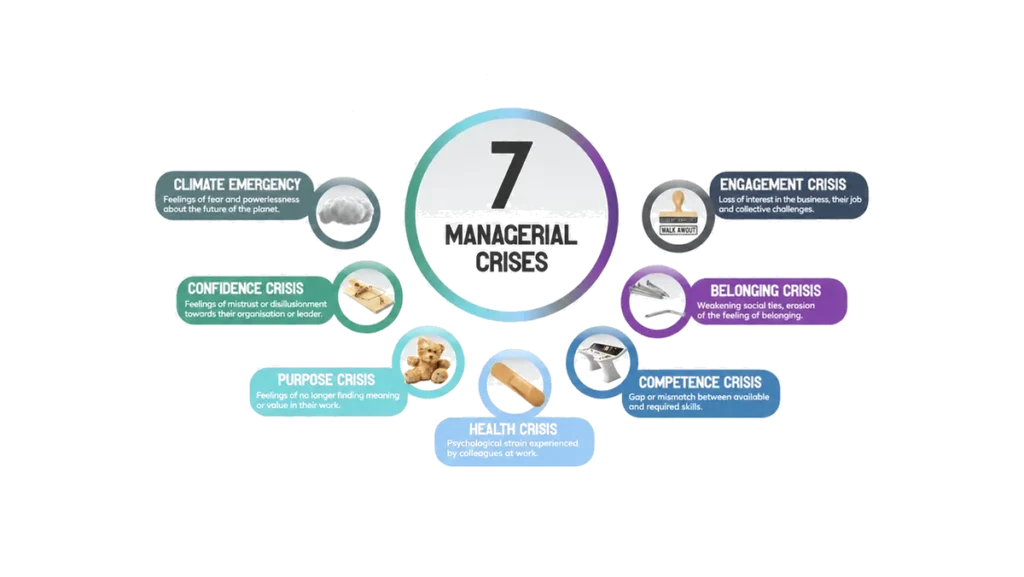
You will find both zones again in the seven crises management now faces, which describe the same breaking points from another angle.
The three most frequent misreadings
Three errors come up every time a team discovers its results. They share one thing, which is that each turns a measurement of a chain into a ranking of dimensions, and that cancels the point of the exercise.
The first is comparing your curve to a colleague’s. Two managers in different functions work with constraints, histories and teams that make the comparison unusable. The only useful comparison sets your curve against your own team’s, and then against your own six months later.
The second is aiming for ten everywhere. A maximum score across all six circles signals a generous round more often than exemplary management. A healthy profile looks like a curve that declines gently, with one or two identified points of vigilance.
The third is treating the diagnostic as an instrument for appraising people. The moment a management score surfaces in an annual review or in a promotion decision, every subsequent round becomes false and the whole thing dies on its own within a season.
Choosing your managerial diagnostic approach against your own criteria
Three families of approach exist for diagnosing management practices, and they answer different needs. The choice depends on your managerial maturity, on the size of the population involved and on the level of conflict you can absorb.
Self-assessment, internal survey or facilitated diagnostic
Each approach produces different data and carries a different cost. The table below compares the three on the criteria that actually decide the outcome, meaning the honesty of the answers obtained and the capacity to act on what the diagnostic reveals.
| Criterion | Self-assessment | Internal survey | Facilitated diagnostic |
|---|---|---|---|
| What it measures | The manager’s perception of their own practices | The average perception across a population | The gap between hierarchical levels |
| Managerial maturity required | Low, no prerequisite | Medium, an existing feedback culture | Low, the third party absorbs the tension |
| Honesty of answers | Good if nobody reads the results | Variable, depends on real anonymity | Good, the third party guarantees confidentiality |
| Suitable scope | One manager, one team | One division, one site | A leadership team, a management population |
| Main risk | The blind spot never confronted | The report that ends up in a drawer | Dependence on the third party if nothing is transferred |
| Time before a decision | Immediate | A few weeks | A few days to a few weeks |
The signals that should guide your choice
Four signals settle the decision without ambiguity. They concern what your organisation already knows how to do, rather than what it would like to measure.
- Your managers already receive upward feedback without it going badly: self-assessment followed by a team round is enough.
- Your last internal surveys produced no visible decision: a facilitated diagnostic will stop you repeating the exercise.
- Your leadership team and your frontline managers describe the same organisation in two incompatible ways: measuring that gap becomes the object of the diagnostic.
- You mainly want to select training priorities: a collective self-assessment, aggregated by circle, will do the job at lower cost.
One last criterion deserves to be stated plainly. A diagnostic is only worth running if somebody commits to acting on what it surfaces. Without that commitment made before the round, the exercise damages the trust of the first circle rather than measuring it.
How I can help you master your managerial diagnostic
I have been working on this diagnostic for more than five years with executives and managers, in keynotes, workshops and longer engagements. My role is to make the gap between hierarchical levels legible, then to transfer the method so you can run it again on your own.
A keynote to set the frame in front of all your managers
The keynote puts your managers and executives in front of the contradictions in practices largely inherited from another model of organisation. It works as an entry point when the management population is large and the work has to start quickly.
The questionnaire is taken live, circle by circle, which produces a collective curve by the end of the session. That curve becomes the material for the discussion rather than a slide deck of good practice. Discover the detail of my work on managerial transformation.
A workshop to work the gap between executives and managers
The workshop takes over once the double round has revealed a significant gap. The work then focuses on the statements where executives and managers diverge most, looking for the origin of the divergence rather than for consensus.
This format suits leadership teams that want to decide on data rather than on impressions. It produces a roadmap ordered by circle, with the reverse reading rule applied to your own results.
A method transfer for your HR teams
Some organisations prefer to bring the practice in house and repeat it every year. I then transfer the grid, the reading rules and the interpretation traps to the HR team or to whoever owns management development.
This option avoids the dependence on a third party noted in the comparison table. In exchange it requires an internal team able to hold the confidentiality of the rounds over time.
Conclusion
The value of a managerial transformation diagnostic does not sit in its six scores. It sits in the shape of the curve, in the precise point where that curve breaks, and in the gap between what you measure and what your team measures on the same practices.
Remember the rule and its boundary. Faced with a drop, go back one circle when the fragility concerns the relationship, and make a resource decision when it concerns time, budget or tools. That distinction will stop you funding the repair of a symptom for months.
The rest comes down to a modest discipline. Take the diagnostic, have your team take it, compare the two curves and start at the first circle where they diverge. A managerial transformation diagnostic is worth nothing while it still has only one voice.
A second diagnostic looks at the same management from another angle and asks what would still hold if you were absent. The invulnerable manager diagnostic scores eight pillars of managerial architecture, from identity and transmission to redundancy and dissent, and it makes a useful companion once you have read your six circles.
Frequently asked questions about the managerial transformation diagnostic
How long does a managerial transformation diagnostic take?
Allow about twenty minutes to answer the sixty statements on your own, and roughly an hour to organise the team round and compare results. The useful time comes afterwards, in the discussion about the gaps, which needs half a day to be done seriously.
Should you start with the circle scoring lowest?
No, unless the low score comes from a lack of resources rather than a lack of posture. When the drop follows a decently scored circle, the cause almost always lives in that upstream circle, and working the lowest score directly means treating a symptom.
How do I put the questionnaire to my team without putting them on the defensive?
Say before the round what you will do with the results and what you will not do. Stick to a single circle rather than all sixty statements, replace my management with my manager, and keep answers anonymous once the team goes past five people.
How does this differ from a standard engagement survey?
An engagement survey measures a level at a given moment across a population. This managerial transformation diagnostic measures a chain of practices and locates the link that gave way, which shows you where to act rather than confirming a problem you already knew about.
Does a high score everywhere mean my management is solid?
Not necessarily. A high flat curve reflects genuinely mature management as often as it reflects a complete blind spot, and only the team round settles which one you have. The gap between the two curves remains the most reliable indicator.