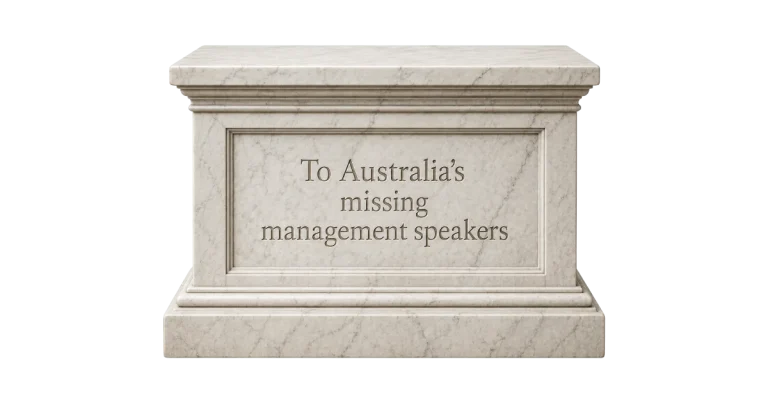
Yes, it is possible to talk about conference trends without embarrassing yourself. For evidence, ask when you last heard anyone mention TEDx, which was the entire conversation not so long ago.
The business events sector is genuinely changing, and most of what gets written about that change is produced by people selling into it:
- Platform vendors publish trends about platforms.
- Venue operators publish trends about venues.
- Hotel groups publish trends showing that people really ought to meet in person.

None of that makes them wrong. It does mean the lists tend to agree with each other for reasons that have little to do with what happens in a room.
I want to write this from the stage instead. I deliver into these formats, so I can tell you which conference trends actually changed the work and which ones only changed the brief. Then I will make a forecast about the future of conferences that does not depend on any technology arriving on schedule.
The forecast rests on one observation. Your audience did not become less attentive. They acquired a skip button everywhere else and cannot use it in your room.
| What the lists say | Why they agree | The change underneath |
|---|---|---|
| The same five headingsPublished conference trends almost always name artificial intelligence, hybrid formats, sustainability, personalisation and return on investment. The list is accurate and interchangeable, appearing in near-identical form across venue operators, platform vendors and event agencies. | Written by interested partiesTrend reports are usually produced by organisations selling the trend they describe. That does not make the observations false, and it does mean the lists describe the supply side of the sector rather than what an audience experiences in a room. | The comparison set movedBenjamin Chaminade’s reading is that audiences now measure a live session against edited, on-demand content they can accelerate or skip. Every surviving trend follows from that single shift, and the future of conferences depends on what a room can do that a skip button cannot. |
The five headings every trend report shares
Published trend reports converge on five headings: artificial intelligence, hybrid formats, sustainability and environmental reporting, personalisation, and measurement of return. The convergence is real rather than lazy, since all five describe genuine pressures on organisers. What the lists rarely explain is why these five and not others.
Before taking them apart, it is worth knowing the scale of the sector doing the changing.
Why conference trends lists all say the same thing
Trend lists converge because their authors share an economic position. A platform vendor writes about technology, a venue operator writes about the value of physical space, and an agency writes about complexity that requires an agency. Each is describing a real pressure, filtered through what they need you to buy.
One example from my own source material is worth naming rather than hiding. A widely circulated set of five trends, covering softer productivity, selling belonging, designing experiences, green gatherings and disruptive technology, was published by the commercial leadership of a large international hotel group.
The observations are sensible and the source is a company that profits when meetings happen in its buildings. Read it as an operator’s view of demand, which is what it is, and it becomes genuinely useful rather than misleading.
The Australian scale, and where the reliable numbers sit
Australia’s business events sector is large enough that these questions carry real money. The industry body reports around $36 billion in direct economic benefit and an estimated 229,000 direct jobs, a figure it publishes itself and which should be read as an industry estimate rather than as independent measurement.
Independent measurement now exists alongside it. Tourism Research Australia publishes official business events data through the national visitor surveys, which is the reference point to use when a vendor quotes you a number.
The two sources measure different things and both are useful. The industry figure includes organisers and exhibitors, and the government figure captures visitor economy spend, so quoting either as the total is a mistake.
What the lists leave out
Three things are missing from almost every published list. Nothing is said about what audiences now compare a session to, nothing is said about how long the effect of a session lasts, and nothing is said about which trends changed delivery rather than paperwork. Those three omissions are the subject of the rest of this article.
The omissions are not conspiratorial. They are simply hard to sell against, since none of the three is solved by buying a product.
They are also the three that decide whether your event was worth running, which makes their absence expensive.
Your audience acquired a skip button
The reference point for a participant is no longer the last event they attended. It is the last piece of content they watched on a screen, edited, available on demand, and accelerable to one and a half times speed with a skip button for anything dull. That comparison set explains the surviving trends better than any technology does.
Nobody in your room became less intelligent or less interested. They developed a habit that your format does not accommodate.
The comparison set moved off the conference circuit
Twenty years ago a keynote competed with other keynotes, and a mediocre one was merely less good than the last one. Today it competes with material that has been scripted, edited, cut for pace and stripped of everything unnecessary. The bar is no longer the average conference session, it is the average edited video.
You can watch the habit arrive in the room. Phones come out at the exact moment a speaker starts a section the audience would have skipped at home.
That moment is measurable if anyone bothers to look for it, and it is far more informative than a satisfaction score collected on the way out.
What a room can do that a screen cannot
A room offers three things a screen structurally cannot. Other people can see how you react, which changes what you allow yourself to think. Nothing can be paused, so attention becomes a shared commitment rather than a private choice. And a question asked aloud has consequences, which makes asking it meaningful.
Notice that none of the three is about content. Content is the thing a screen delivers better, faster and cheaper than any event ever will.
An event that competes on content is competing on the one dimension where it has no advantage, which is the underlying reason so many sessions feel like a video played slowly in an uncomfortable chair.
Why this explains the surviving trends
Run the five headings through this lens and they stop being a list. Shorter sessions and interaction survive because they answer the skip button. Personalisation survives because on-demand content is personalised by default. Hybrid survives because it accepts that some of the audience was always going to watch rather than attend.
Sustainability is the exception and follows a different logic entirely, which I come to below.
The practical consequence for an organiser is a change of question. Instead of asking which trend to adopt, ask what your event offers that a recording of it would not.
Trends that changed the work, and trends that changed the brief
Some trends changed how a session is designed and delivered, and others changed only the documents around it. Hybrid changed the work. Sustainability changed the procurement document far more than it changed the event. Artificial intelligence changed the marketing before it changed anything in the room.
The distinction matters because budget follows the brief, and the brief is often measuring the wrong thing.
Hybrid genuinely changed the delivery
Hybrid changed what a speaker has to do, which is the test of a real trend. Two audiences with opposite needs occupy the same session, one able to leave without anyone noticing and one physically committed. Serving both requires structural decisions about pacing, interaction and camera work that did not exist as questions before.
It also changed the economics for distributed organisations. Bringing senior people to a hub while others join remotely removes flights and accommodation at scale, which is a cost argument rather than an experience argument.
Where hybrid fails, it fails for a predictable reason. The organiser did not decide which audience was primary, and the speaker was left to guess, which I cover in the selection guide for choosing a keynote speaker for your event.
Sustainability changed the procurement document
Environmental requirements now appear in event briefs with real specificity: waste targets, supplier policies, venue certification and travel reduction. The driver is corporate reporting obligation rather than delegate demand, which is why the requirements arrive through procurement rather than through feedback forms. That origin explains their shape.
The consequence is a real gap between briefs and events. A brief can carry four environmental clauses while the event itself changes very little, because the clauses are satisfied by supplier selection rather than by design.
The exception is travel, which is the largest environmental cost of most events and the one decision that actually changes the format. An organisation serious about the number ends up rethinking whether the event needs to gather people at all.
Artificial intelligence changed the marketing first
The visible effect of artificial intelligence on events has been in production and promotion: drafting invitations, generating imagery, summarising feedback and building registration copy. The illustration at the top of this article is an example, and none of the people in it exist. In the room itself, the effect so far is far smaller.
That will shift, and the shift is worth predicting carefully rather than enthusiastically. Real-time translation and live captioning are the two applications that change what a room can do, because both remove a barrier rather than adding a feature.
There is a second effect nobody markets. Generated slides and generated scripts have raised production quality and lowered distinctiveness at the same time, so a well made deck now proves nothing about the person presenting it.
Personalisation and measurement changed the language
The two remaining headings on every list, personalisation and return on investment, changed how events are described far more than how they are run. Both arrived from marketing, where they have precise operational meanings, and both lost most of that precision on the way across.
Personalisation in an event usually means a choice of breakout streams and a name badge. That is segmentation with a friendly label, and it is a long way from the individualised content path the word implies elsewhere.
Genuine personalisation would mean a different session for a different attendee, which almost nobody does because it costs what it sounds like it costs. The version that works is narrower and cheaper: let people choose their depth rather than their topic.
Return on investment suffers the same compression. It gets reported as attendance, satisfaction and social media reach, which are activity measures wearing a financial name, and the gap between that and a defensible return calculation is where most event budgets lose their argument.
Field note
One session, two audiences, two entirely different events
I delivered a hybrid session for an organisation with a head office group in the room and teams joining from three states. The brief treated it as one session with a camera on it. The technical setup was competent, the platform worked, and by any operational measure the event succeeded.
What actually happened was two events running in parallel with almost nothing in common. The room got a live speaker, side conversations, laughter that fed on itself and the chance to catch me afterwards. The remote audience got a fixed wide shot, a chat window nobody was reading, and the experience of watching other people have an experience. The questions told the story. The room asked comfortable questions out loud, and the chat filled with the difficult ones, which is the opposite of what everyone expects. Nobody was monitoring the chat, so the sharpest material in the whole session went unanswered and unrecorded, and the organisers left believing the event had gone well because the people they could see had enjoyed it.
The operational lesson is to decide which audience is primary and to staff the other one properly. A hybrid event with nobody assigned to the remote audience is an in-person event being broadcast, and the chat window is where your most honest feedback goes to die.
Measuring the half-life of a session
The useful unit of measurement is how much of a session survives at thirty and ninety days rather than how it scored on the day. Satisfaction measures the experience, and half-life measures the effect. Two sessions can score identically on the way out and differ completely six weeks later, which is the only difference that justifies the budget.
I should be clear about provenance. The half-life idea applied to content is not mine, and neither is the broader push towards measuring experience rather than attendance.
Why satisfaction scores measure the wrong thing
A satisfaction score collected as people leave measures mood, catering and whether the session finished on time. It correlates with enjoyment and barely at all with behaviour change. An audience can rate a session highly because it was comfortable, and rate a difficult session poorly precisely because it worked.
The measurement industry knows this, which is why return on experience has become a discussed alternative. The concept is sound and the practice is usually still a satisfaction survey with a new label on it.
Anything worth measuring has to be observable by someone who was not asked to rate it.
A protocol at thirty and ninety days
The protocol takes about two hours in total, spread across two touchpoints after the event. You are looking for traces rather than opinions, so the questions ask what people did rather than what they thought. Anything that requires a scale is the wrong question.
- Before the event, write the one behaviour you expect to see afterwards, in observable terms, and tell nobody outside the organising group.
- At thirty days, ask six attendees what they have said or done differently, without prompting them with the session content.
- At thirty days, also check whether any of the session’s vocabulary has appeared in meetings, documents or messages that had nothing to do with the event.
- At ninety days, repeat both checks with the same six people and count what survived.
- Compare the surviving behaviour against the sentence you wrote in step one, and record the gap rather than explaining it away.
The vocabulary check in step three is the most reliable signal in the whole exercise. Language travels before behaviour does, and borrowed language is the first evidence that something landed.
What a short half-life tells you
A session that leaves no trace at thirty days usually failed at the brief rather than at the delivery. Either the change was never named, or the room had no authority to act on it, or the content duplicated something the audience could have watched at their own pace. All three are organiser decisions taken weeks earlier.
Repeat the exercise across several events and the pattern becomes diagnostic. Some formats in your organisation will consistently produce traces, and others will consistently produce nothing.
Stop funding the second category. That single decision will do more for your events budget than any trend on any list.
A realistic view of the future of conferences
Projecting from the direction of travel rather than from any single forecast, live events will be paid for what a screen cannot supply: presence, consequence and the fact of being seen. Formats that deliver those three should grow, and formats that mainly deliver information should continue to shrink towards recorded and on-demand versions of themselves.
This is an extrapolation from an observable trend rather than a measured prediction, and I have labelled it as such deliberately.
Presence with consequence
The valuable moments at an event are the ones with stakes. A question asked in front of your leadership team, a commitment made where colleagues can hear it, and a disagreement voiced in a room rather than typed into a chat all carry weight precisely because they cannot be deleted. Design for those moments and the event earns its cost.
This is why the twenty minutes after a session matter more than most of the session. People approach a speaker to say something they would not say in front of the room.
Protect that window in your running order. It is the highest value and most frequently deleted item on any agenda.
Formats likely to grow, and formats likely to shrink
The table below sets out where the pressure is heading, based on the extended trend rather than on any published forecast. Read the reason column, since the direction matters less than the mechanism producing it.
| Format | Likely direction | Reason |
|---|---|---|
| Information-led plenary | Shrinking | The same content is better consumed on demand at the viewer’s own pace |
| Small facilitated working sessions | Growing | Practice and visible commitment cannot be replicated on a screen |
| Hybrid with a staffed remote audience | Growing | Reach plus cost control, provided the remote side is resourced |
| Hybrid as a camera on a room | Shrinking | Delivers a worse video than a recording and a worse event than an event |
| Short keynote plus structured conversation | Growing | Matches shortened attention while keeping the consequence of a live room |
| Long linear keynote with no interaction | Shrinking | Competes directly with edited content on its weakest dimension |
None of this requires a new technology to arrive. It follows from a habit the audience already has.
What will not change
Three things have survived every previous shift and will survive this one. People will keep travelling to be in the same room as other people, organisations will keep needing a moment that marks a before and an after, and someone will always have to stand up and say the difficult thing out loud. No format has ever replaced any of the three.
Immersive technology will keep being announced as the replacement. It will keep being useful for demonstration and simulation, which is a narrower and more honest claim.
Treat any trend that promises to replace presence with suspicion. Presence is the product.
Deciding which trend deserves your budget
Every trend on every list can be bought, and most organisations can afford one or two. Choose by asking which investment changes what happens in the room rather than what appears in the report. The comparison below sets each common investment against what it actually buys and how it typically disappoints.
This is decision support rather than advocacy. One of these lines competes directly with my own trade.
Four investments compared
Compare on outcome rather than on price, since the cheapest line here is frequently the one that changes the most. Read the failure column first.
| Investment | What it buys | Best when | How it disappoints |
|---|---|---|---|
| Event technology platform | Registration, data and remote delivery | You run several events a year with real remote audiences | Bought for one event, producing data nobody reads |
| A more expensive speaker | Attendance, credibility and a drawcard | The event needs to fill and the profile does that | The fee consumes the budget for follow-up work |
| Facilitation and session design | Structure that produces commitments | The audience already agrees and needs to act | Nothing to facilitate, because the diagnosis is not shared |
| Staffing the remote audience | A second event that actually works | Any hybrid format at all | Rarely disappoints, and is the line most often cut first |
The last line is the cheapest item in the table and the one I would protect before anything else, including my own fee.
Signals you are buying a trend rather than an outcome
Three signals appear during planning. The justification for a purchase names the technology rather than the audience. Nobody can say what the investment will change in the room. Or the item was added after a competitor’s event rather than after a conversation with your own people.
The second is the reliable one. An investment that cannot be connected to an observable difference is an investment in the report.
Where the underlying question is cultural rather than logistical, the answer usually sits outside the event entirely, in the work of building an innovation culture that a single day was never going to deliver.
Sequencing your investments across several events
Organisations running several events a year get better results from sequencing investments than from spreading them thinly across every event. Fix one thing properly, measure whether it moved the half-life, then move to the next. Improving four things at once leaves you unable to say which one worked.
A workable order starts with the brief, since it costs nothing and determines everything downstream. Staffing the remote audience comes second, because it is cheap and immediately visible.
Session design follows, then speaker investment, then technology. That order runs almost exactly opposite to the order most organisations buy in, which tends to start with a platform and end with the brief nobody had time to write.
Hold the sequence across a full year rather than a single event. A trend adopted once and abandoned teaches your organisation nothing except that trends do not work.
Start with the speaker, not the platform
Want the decision that changes more than any trend on this page? Read my full method for choosing a keynote speaker and work out what your room actually needs to hear before you buy anything else.
How I can help your next event survive the week after
I work with organisers on the part of an event that has to survive contact with a distracted audience and then with the following Monday. That runs as a keynote built for shortened attention, a facilitated working session, a hybrid format designed for both audiences, or a short review of why your last event left no trace.
The starting question is the same one running through this article. What does your event offer that a recording of it would not?
Sessions designed for a shortened attention economy
A session built for current conditions runs shorter than the slot suggests, breaks at deliberate points, and puts the audience in a position where they have to respond rather than watch. That structure costs preparation time rather than production budget, which makes it the cheapest improvement available to most organisers.
For hybrid bookings I ask which audience is primary before agreeing anything else, and I ask who will be reading the chat.
Sessions run in Australian English with Australian data and examples, because a room recognises borrowed material instantly and stops trusting the rest.
Reviews and half-life diagnostics
Where an organisation runs several events a year and suspects none of them changes anything, I run the thirty and ninety day protocol described above across a past event and a forthcoming one. The output is a short account of what survived, what did not, and which formats in your organisation reliably produce traces.
The finding is frequently uncomfortable and occasionally costs me future bookings, since one common conclusion is that the organisation runs too many events rather than too few.
That conclusion saves more money than any trend adoption I could sell you, which is why I keep offering it.
Speaking to conference and association audiences
Conference and association programs face the sharpest version of the problem in this article, because delegates paid to be there and are comparing every session to the one before it. The sessions that hold those rooms give people something to disagree with rather than something to agree with.
For multi-day programs I ask where my slot sits, since the third afternoon of a conference is a different job from the opening morning and needs a different structure entirely.
I also ask what the previous speaker is covering. A program where three sessions independently arrive at the same conclusion produces a very tired audience by lunchtime.
Where a program is being rebuilt rather than filled, the more useful conversation happens months earlier, at the point where the agenda is still a blank page and the format is still negotiable.
Conclusion
Every list of conference trends you will read this year names the same five things, and every list is written by someone who benefits from you believing it. The observations are usually accurate. The framing serves the supply side of a sector, which is a different thing from serving your event.
Underneath all five sits a single change with no vendor attached to it. Your audience compares your room to edited, on-demand, skippable content, and they cannot skip you, which is both your problem and your only real advantage.
So design for the things a screen cannot supply, staff the audience you cannot see, and measure what survives at ninety days rather than what people said on the way out. That is the honest reading of conference trends, and it will outlast every acronym the sector produces next.
Frequently asked questions about conference trends
What are the main conference trends right now?
Published lists name artificial intelligence, hybrid formats, sustainability, personalisation and measurement of return. All five are real. The change underneath them is that audiences now compare a live session to edited content they can skip or accelerate elsewhere.
Are hybrid events here to stay?
Hybrid has become a structural format rather than a substitute, mainly because it controls travel cost for distributed organisations. It works when the remote audience is properly staffed and fails when it amounts to a camera pointed at a room.
How do I measure whether an event was worth running?
Measure what survives at thirty and ninety days rather than satisfaction on the day. Ask attendees what they have said or done differently, and check whether the session’s vocabulary has turned up in unrelated meetings or documents.
Is artificial intelligence changing what happens in the room?
So far it has changed production and promotion far more than delivery. Real-time translation and live captioning are the two applications likely to change what a room can do, since both remove a barrier rather than adding a feature.
Why do sustainability requirements appear in briefs but not in events?
The requirements arrive through procurement, driven by corporate reporting obligations rather than by delegate demand. They are usually satisfied through supplier selection, which leaves the event design unchanged. Travel is the exception, since reducing it changes the format itself.
What does the future of conferences look like for speakers?
Shorter sessions, structured interaction and formats that put the audience in a position to respond. Long linear talks compete with edited video on its strongest dimension and lose, while sessions built around presence and consequence keep their value.