Executive teams want to know where they stand on skills, and a maturity assessment is the natural place to look. The instrument deserves a closer look before it is used, because most versions were designed to reward the retention of what an organisation already knows, while the task ahead is to renew that knowledge steadily and bring people with it.

A skills maturity model built for that second task looks different. It still values documentation and a shared language, and it adds what matters most once skills change quickly: the ability to renew expertise while keeping experts engaged and growing.
Key takeaway
How to map your skills maturity curve
Skills maturity is the capacity to renew what the organisation knows, with the people who know it. Place yourself on five stages, from undocumented to renewing, using dated evidence rather than opinion, fix the obstacle that holds you at your stage, and invest in what that stage can put to work.
- Recorded stage: name an owner for the skills record and attach one real decision to it.
- Connected stage: recognise the managers who release talent, and share internal moves openly.
- Anticipating stage: date every skill forecast and review last year’s forecasts against the outcome.
- Renewing stage: give your experts the lead role in renewing their own methods.
How to know it is working: report the renewal rate beside your maturity level, meaning the share of critical capabilities deliberately renewed, replaced or updated over the year.
This article traces where the maturity ladder comes from, explains why maturity now behaves like a curve, maps five stages with the obstacle and the next step at each one, and proposes a measure to report alongside a maturity level.
| THE INHERITED LADDER | WHERE IT NEEDS TO EVOLVE | WHAT THE CURVE ADDS |
|---|---|---|
| Five levels of disciplineA skills maturity model usually follows the five-level ladder created for software process improvement, where each level adds documentation, standardisation and measurement of existing practice. | From retention to renewalCodification delivers strong returns while work stays stable, and those returns level off once skills change faster than documentation cycles can refresh them. | Renewal with peopleThe approach set out here maps maturity as a curve and places organisations that renew expertise deliberately, while keeping their experts engaged and growing, at the top of it. |
Where the maturity ladder comes from
The five-level ladder behind most maturity assessments was created to solve a procurement problem in American defence software. Its origin explains both its strengths and the assumptions it carries into skills management today.
A model built to assess defence contractors
Watts Humphrey joined the Software Engineering Institute at Carnegie Mellon University in 1986, after a long career at IBM, and formalised a process maturity framework at the request of the United States Air Force. The Capability Maturity Model that followed set out five levels running from initial to optimising, as an ordinal scale for assessing the capability of software contractors.
The problem it addressed was serious. The Department of Defense was awarding contracts to suppliers it could not evaluate, projects ran late and delivered defective software, and there was no consistent way to compare one supplier’s discipline with another’s.
The model drew on manufacturing quality management. Reduce variation between teams and projects, make results predictable, and the risk of major overruns falls. For that problem, in that decade, the approach worked well and earned its reputation.
The ladder was applied to people twenty five years ago
Workforce maturity models followed. The same institute published the People Capability Maturity Model, which applied the five-level structure to workforce practices and opened on the need for an agile workforce, written by Bill Curtis, William Hefley and Sally Miller.
Many current skills maturity frameworks share that architecture. Level one is ad hoc, level five is optimised, and progress is measured by how completely the organisation has described and standardised its practices.
Knowing the lineage helps executive teams use the ladder with intent. It carries a clear view of what good looks like, and that view fits some stages of the journey better than others.
What the ladder gets right
The first three levels describe something every organisation needs. A business that cannot name its critical skills, say who holds them or repeat a decision consistently will struggle with anything more ambitious.
Documentation also protects people and the business. When essential knowledge sits with a few individuals, writing it down shares the load, reduces the pressure on those experts and makes it easier for others to grow into the work.
The question for executive teams concerns what comes after level three, once the foundations are in place.
Why maturity behaves like a curve
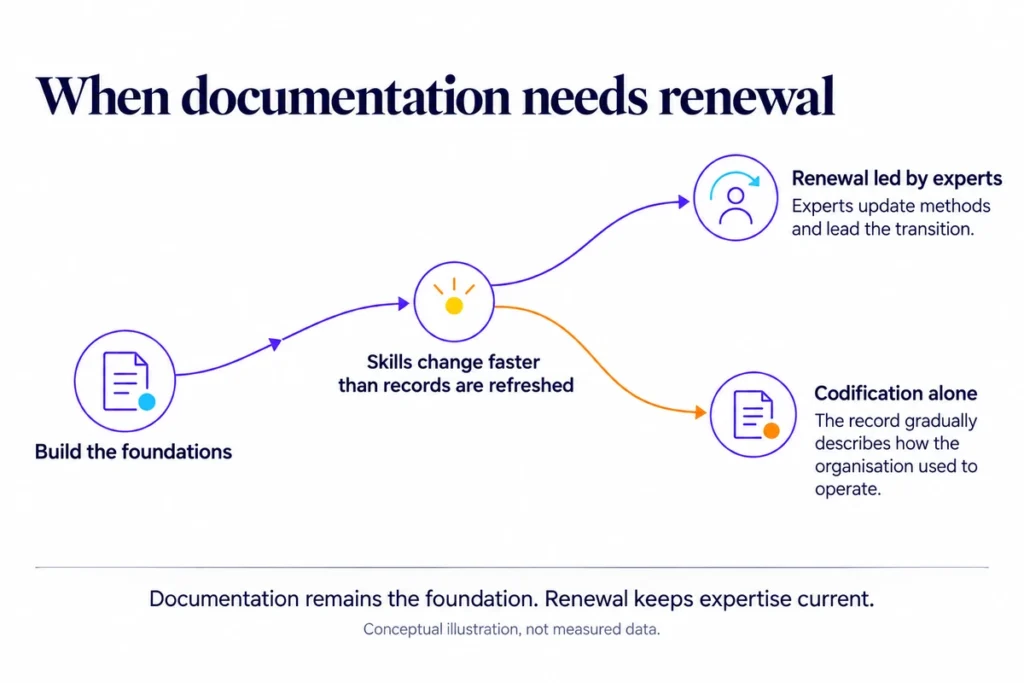
Codification returns value up to a point, then the returns level off and can decline. The turning point comes when an organisation needs to renew what it knows faster than it can document it, which is now the situation in most knowledge-based businesses.
Why the work now changes at that pace is the subject of my pillar article on disruption, its definition and state of play.
The point where documentation needs a renewal rhythm
Every documented practice needs upkeep. Someone has to update it, notice when the work has moved on and help colleagues adopt the new version.
While the work is stable, that upkeep costs little compared with the benefits. Once the work changes every few quarters, documentation needs its own renewal rhythm, or it gradually describes how the organisation used to operate.
Established standards also build loyalty, which is healthy. People take pride in practices they have mastered, and that pride deserves respect when the time comes to evolve them.
How fast skills are moving
The World Economic Forum, surveying more than a thousand employers worldwide, reports that employers expect 39 per cent of workers’ core skills to change by 2030, down from 44 per cent measured two years earlier. Both figures are employer expectations rather than measured outcomes, and the easing trend suggests that organisations are getting better at adapting.
In Australia, Jobs and Skills Australia, the Commonwealth body that analyses the labour market, found in its generative AI capacity study that the technology is accelerating the rate at which occupational skills evolve, calling for faster updates to training packages and curricula.
Together, these findings describe skill content that changes substantially within a planning cycle, in organisations whose documentation is usually refreshed once a year. The curve bends exactly where those two rhythms meet.
The same movement reaches people individually as stable precarity, the fragility of our skills, where a professional position stops being defensible without any visible warning.
At organisation level the same pressure shows up as a gap between the tools on offer and the practices built around them, which I examine in your AI tools are ready and your organisation is not.
Map your position before you decide anything
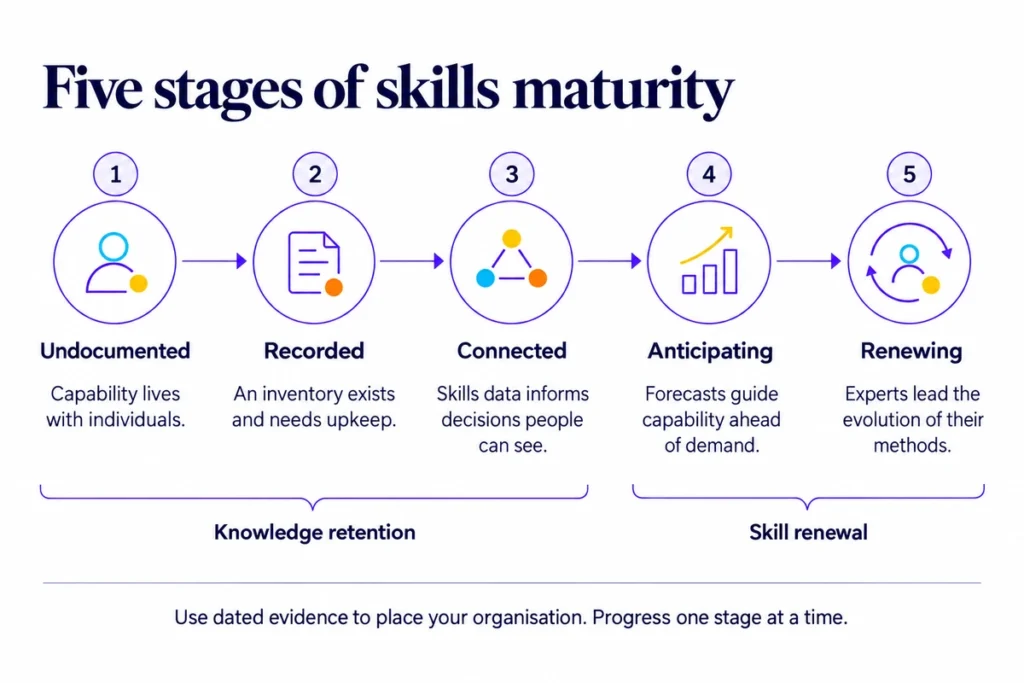
Benchmarking helps when each stage describes behaviour you can observe. Each stage below comes with a visible marker, the obstacle that most often holds organisations there and a next step that fits within a quarter.
Five stages of a skills maturity model, and the next step at each one
| Stage | What it looks like from the inside | The obstacle that holds you here | Next step worth one quarter |
|---|---|---|---|
| 1. Undocumented | Capability lives with individuals and in the memory of long-serving managers | No shared vocabulary, so the same work is described in different ways | Describe the ten most common assignments of one team in skills terms |
| 2. Recorded | An inventory exists, built with care and refreshed around appraisal season | No named owner for upkeep, so the record gradually drifts from reality | Name an owner and attach one real decision to the record |
| 3. Connected | Skills data informs mobility, development and staffing decisions people can see | Managers need support and recognition to release strong performers | Recognise managers who release talent and share internal moves openly |
| 4. Anticipating | The business forecasts skill needs and builds adjacent capability ahead of demand | Forecasts are rarely compared with what actually happened | Date every skill forecast and review last year’s against the outcome |
| 5. Renewing | Expertise is renewed deliberately, and experts lead the transition to new methods | Reward systems rarely recognise the people who retire a method they built | Agree a renewal plan with your experts and report the renewal rate |
Most Australian organisations I work with sit between stage two and stage three, and many describe themselves as stage four. That gap is useful: it shows the organisation where the next quarter of effort will pay off most.
The stages also describe a transition. Stages one to three build knowledge retention, which remains the right objective while work is stable. Stages four and five build skill renewal, which depends on forecasts that get checked and on experts who are supported to lead change.
Organisations progress most reliably one stage at a time. Renewal built on a solid stage three record keeps knowledge in the business while it evolves.
How to place yourself honestly in a single meeting
Self-assessment works best when it asks for evidence with a date. A stage the team can evidence together is a stage it has reached, and that shared evidence builds confidence in the next step.
Four questions and a whiteboard are enough:
- Which three recent decisions did skills data inform, and when were they made?
- When was the record last updated, and by whom?
- Which capability did the organisation deliberately renew or replace this year?
- Which skill forecast from twelve months ago proved accurate, and which did not?
Teams that can answer the third question are usually further along than they think, and it is worth telling them so.
The fourth question deserves the same honesty, and my article on why the future of work has no future explains why most predictions about work answer the wrong question.
Where adaptation breaks down
A stage tells you how far the organisation has come. A bottleneck tells you what to fix next. Six of them account for most of the delay between a strategy that moves and a workforce that follows.
| Bottleneck | The question to ask | The sign it is yours |
|---|---|---|
| Skills visibility | Do we know which capabilities we hold and which are becoming critical? | Staffing decisions are made from memory and personal networks |
| Building capability | Can we develop capability as fast as the work changes? | Development plans are written once a year and reviewed once a year |
| Internal movement | Can people actually move towards the work that matters? | An internal application takes longer than an external hire |
| Manager incentives | Do managers gain or lose by letting people move and experiment? | Your strongest managers hold your strongest people |
| Systems and data | Do our systems give one view we can act on? | Every question needs a different export and a week of work |
| Trust and governance | Is it clear who decides what, and on which data? | Teams wait for a permission nobody feels able to give |
Most executive teams recognise three of the six and then argue about the order. The useful discipline is to pick the one that blocks the others, because improving skills visibility inside an organisation whose managers hold their people changes very little.
Field note
The engineers who taught the next method
An engineering business asked me to help it reach the next level of a capability framework it had adopted three years earlier. The executive team was rightly proud of the progress: procedures written, competencies mapped and assessors trained.
In the opening session I asked what the organisation had renewed or retired since adopting the framework. The answer was nothing, and every improvement had been an addition. Some of its most experienced engineers were still teaching a method the market was moving away from. We asked those engineers to lead the review of their own method. Within two months they had designed the transition to the newer approach themselves, and they became its first trainers.
Renewal works best when the people who built the current expertise lead its evolution. Give experts the mandate to renew their own methods, and the organisation keeps their knowledge, their commitment and their authority through the change.
Where to invest at your stage
Investment pays off best when it matches the stage an organisation has reached. Three families of investment exist, and each one delivers most from a particular stage onwards.
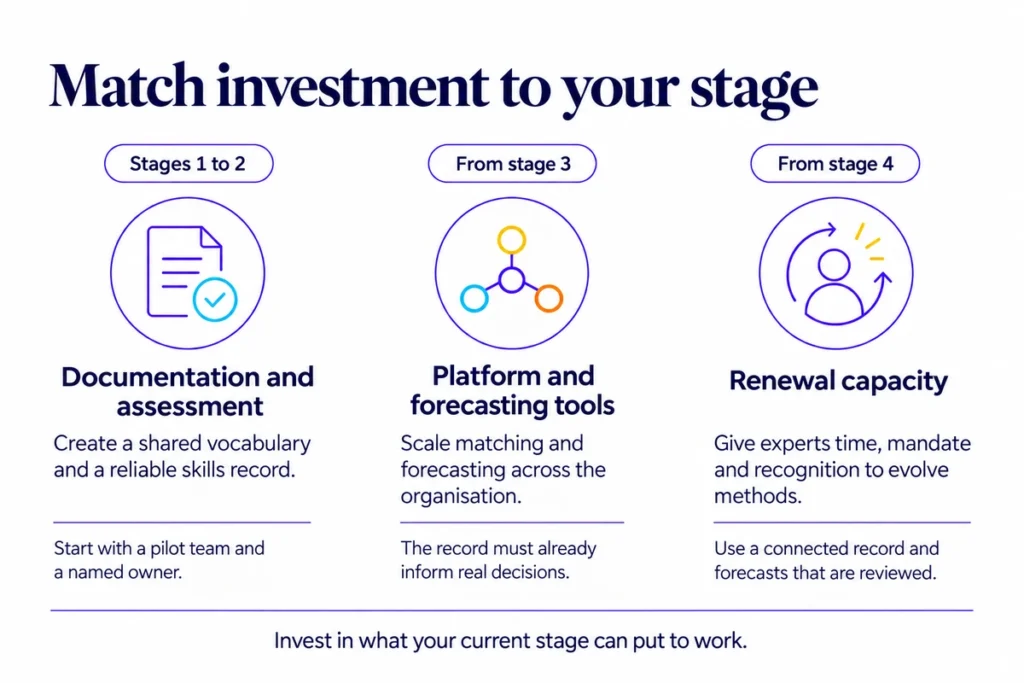
Three investments, and the stage where each one delivers most
| Investment | What it provides | Delivers most from | What to have in place first |
|---|---|---|---|
| Documentation and assessment | A shared vocabulary and a reliable record of who can do what | Stage 1 to 2 | A small pilot team and a named owner for the record |
| Platform and forecasting tools | Inference, matching and forecasting across a large population | Stage 3 | A record that already informs real decisions |
| Renewal capacity | Time, mandate and recognition for experts who evolve their own methods | Stage 4 | A connected record and forecasts that are reviewed |
The logic of the table is sequential. Documentation creates the language, tools scale decisions that already happen, and renewal capacity keeps expertise current while the people who hold it continue to grow.
A worked example shows the value of sequence. A business at stage two that buys a forecasting platform first will populate it from an inventory that rarely informs decisions, and adoption will be slow. The same platform bought at stage three, once the record is in daily use, scales something people already rely on.
Four signals that an investment fits your stage
These four signals help an executive team check that a proposal matches its current position:
- The business case names the decisions it will change, as well as adoption targets.
- The pilot includes the managers who decide on internal moves.
- Record upkeep has an owner before any forecasting begins.
- The plan says what will be renewed or retired to make room for the new capability.
Responsiveness comes from structure more than from speed of deployment. I have developed that idea in my article on why an organisation’s responsiveness is built into its structure, and skills programs follow the same principle.
The measure to report alongside a maturity level
A maturity level describes the current position. A renewal rate describes the direction of travel. Reported together, they give an executive team a coherent picture of both where the organisation stands and how it is moving.
A stage three business with a steady renewal rate is often in stronger shape than a stage four business that has renewed nothing in two years, because it is building the habits the next stage depends on.
The renewal rate also gives people a reassuring signal. When staff see that the organisation plans the evolution of methods openly and involves the people who hold them, change stops feeling like something that happens to them and becomes something they help shape.
The renewal rate, and how to calculate it
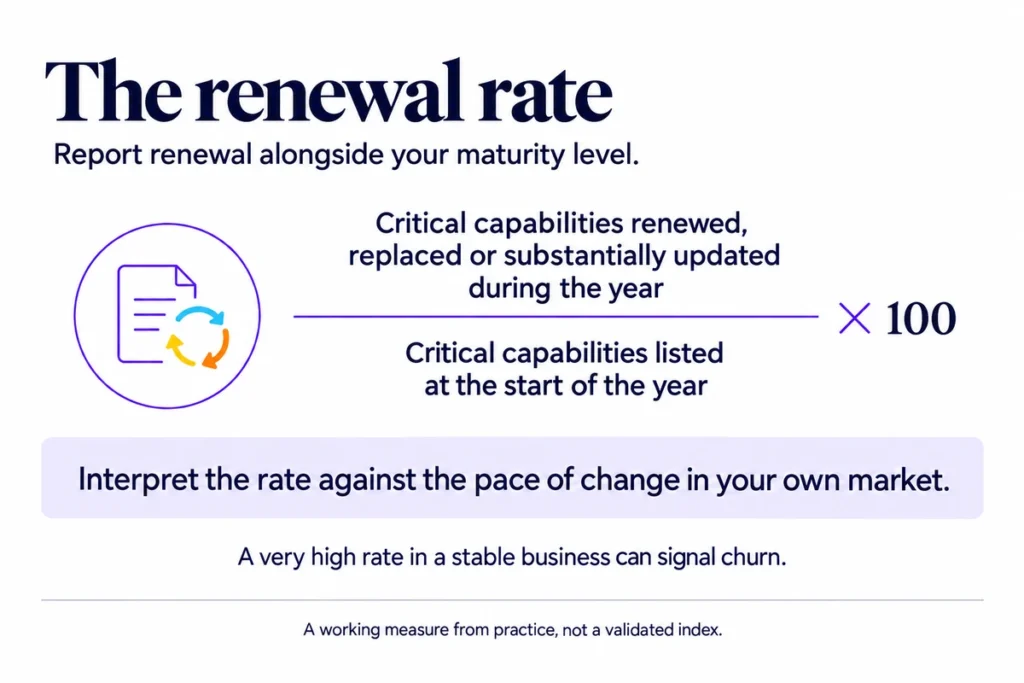
List your critical capabilities at the start of the year. At the end of the year, count how many were deliberately renewed, replaced or substantially updated, and divide by the total. That share is your renewal rate, a working measure I use in practice rather than a validated index.
Targets deserve care. A very high renewal rate in a stable business can signal churn, so the useful comparison is with the pace of change in your own market rather than with another organisation’s figure.
Renewing expertise while keeping experts growing
Renewal concerns methods, and people should feel that difference clearly. The experts who built the current practice hold the knowledge the next practice needs, so the strongest renewal plans give them the lead role in designing and teaching it.
This is what regenerative leadership means in skills terms: leaving people, methods and knowledge in better condition than they were found. The cultural side of that capability is covered in my article on building a culture that can renew a winning practice deliberately.
Anticipation supports the same goal. Teams that notice weak signals early can renew a practice on their own schedule, which is the theme of my piece on the curiosity that helps a team notice weak signals.
Ready to plan your first renewal?
Start with one method your experts are ready to evolve. Read my full approach to building a culture that renews its practices on purpose, then agree the first renewal with the people who know the work best.
How I can help you map your curve
I run this mapping with executive teams as a working session, because the value lies in the shared understanding the team builds about its own position. Two formats cover most needs.
Executive benchmarking sessions
Half a day with the leadership team, the five stages on the wall and the evidence questions applied to each claim. The team leaves with a shared position, one obstacle named and one next step owned by someone with a date.
The session is particularly useful before a budget round, when a platform proposal is on the table and the team wants to confirm which stage it serves.
Keynotes and diagnostics on organisational renewal
My keynotes on the age of fragility and regenerative leadership give a leadership population a shared vocabulary for renewal. The age of fragility is the frame I use in place of VUCA and BANI, for a period of continuous change where recovery and renewal matter more than prediction.
For businesses that want a baseline, my invulnerability diagnostics measure reserves, dependencies and recovery capacity, including the dependencies a maturity ladder does not show.
Conclusion: maturity is the capacity to renew
Benchmarking your skills position is worth the time it takes, provided the instrument measures what matters next. Documentation, a shared language and connected decisions remain the foundations, and renewal led by your own experts is what carries them forward.
Map your stage honestly, address the obstacle that holds you there and report the renewal rate beside the level. A skills maturity model built this way tells you where you stand and shows your people that their expertise has a future inside the organisation.
Frequently asked questions about the skills maturity curve
What is a skills maturity model and where does it come from?
It grades how systematically an organisation identifies, develops and deploys capability, usually across five levels. The structure descends from the Capability Maturity Model built at Carnegie Mellon in the late 1980s to assess software contractors, which explains its focus on documentation and standardisation.
How do we find out which maturity stage we are at?
Ask for dated evidence rather than opinions. Name the recent decisions skills data informed, check when the record was last updated and by whom, and identify one capability renewed this year. A stage the team can evidence together is a stage it has reached.
Is reaching level five always the goal?
It depends on what level five means. Maximum standardisation suits stable work. When skills change faster than documentation cycles, the most valuable top of the curve belongs to organisations that renew expertise deliberately and let their experts lead that renewal.
How do we renew skills without losing experienced people?
Give experts the lead role in evolving their own methods. They hold the knowledge the next practice needs, and leading the transition keeps their authority and commitment intact. Recognise that contribution explicitly in reward and promotion decisions.