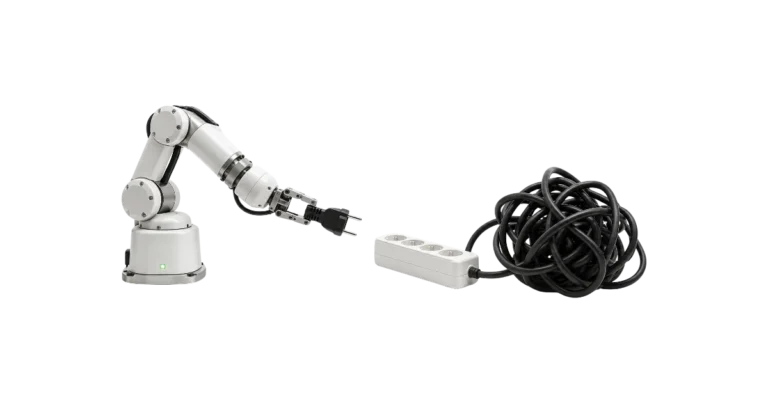
Stable precarity is the state where nothing appears to be changing while your professional position quietly stops being defensible. No warning stage, no visible decline, no month where anybody could have pointed at a chart. The word stable belongs in the name because that is exactly how it feels from the inside, right up until it does not.
It is the first of the four characteristics I use to describe the age of fragility, and it is the one that reaches you personally through your skills.
Now here is the part that makes Australia a different case from almost everything you will read on this subject, and it took me a while to accept it.
The entire global conversation about careers assumes constant movement. Everyone changes jobs now, everyone reinvents, the Great Resignation proved it. Australian data says the opposite. The Australian Bureau of Statistics records that just under 8 per cent of employed people changed employer in the year to February 2025, the second consecutive annual fall.
Read that against the story you have been told. Australians are moving less than they were two years ago, and the ABS notes that job mobility here has generally been trending down for decades.
That is what makes the name accurate. A workforce that has stopped moving inside an environment that has not stopped changing is the textbook definition of a precarious position that looks completely stable.
So this article does something the international material cannot do for an Australian reader. It sets out what stable precarity is, it shows why the Australian position differs from the one described in most commentary, and it gives you the way out that I call a permacareer.
| The condition | Why Australia sits apart | The way out |
|---|---|---|
| Stable precarity, definedStable precarity describes a professional position that appears unchanged while quietly ceasing to be defensible, with no visible warning stage before it fails. Anyone wanting to future proof your career has to work on a condition that produces no symptoms until the moment it produces all of them. | A workforce that has stopped movingInternational commentary assumes constant career movement, built largely on American measurements of a labour market that behaved differently. Australian job mobility has fallen for two consecutive years and has trended downwards for decades, and most people who do change jobs stay inside the same occupation. | The permacareerA career built like a monoculture maximises short-term yield and collapses to a single pest, while a career built on diversity survives a break it did not see coming. The permacareer replaces depth in one place with a portfolio of transferable capability, held deliberately rather than accumulated by accident. |
What stable precarity actually means
Stable precarity means that stability itself has become an unreliable signal. Many parts of working life looked settled and predictable for a long time, in areas as fundamental as peace, economics and personal relationships. What we have discovered since is that precarity can remain invisible until it presents itself, unexpectedly and sometimes devastatingly.
Solidity is an illusory strength
The mistake we all make is treating the absence of visible movement as evidence of soundness. A system that has not failed is a system that has not failed yet, and those are different statements about the future. As anyone who has watched a business go under will tell you, precarious systems are solid right up until they are not.
You can see this clearly in a career because the timeline is long enough to observe. Nobody wakes up to find their expertise has depreciated by half overnight.
What happens instead is that the depreciation runs invisibly for years while every external signal stays reassuring. The pay is fine, the role is secure, the annual review is positive, and the market value of the underlying skill has been sliding the entire time.
The signal only arrives at the point of failure, which is the worst possible moment to receive information. That timing is the whole problem, and it is why this needs to be worked on before there is anything to react to.
The institutions showed it first
Even the institutions we treat as permanent have started to wobble, and watching them is instructive because they fail in the same pattern an individual career does. The state, the company and the school all rest on something that can be withdrawn quietly, which makes each of them precarious in a way that shows no outward sign.
A state rests on the trust of its citizens. Lose that trust and it loses legitimacy and the capacity to govern, and the trust can erode for years without a single visible event.
A company rests on remaining competitive. Technological change, shifting customer preference or a new entrant can each remove that, sometimes all at once, and the accounts look healthy until the quarter they do not.
A school rests on the engagement of its teachers and its students. Working conditions, motivation and public regard can each erode that engagement gradually, and by the time it registers as a recruitment crisis it has been building for a decade.
If the state, the company and the school are fragile in that way, take a moment to consider what that implies about your job, your career, your skills and your social position. None of them sits on firmer ground than the institutions carrying them.
Why this breaks the way we plan careers
Career planning as most people practise it assumes that the ground stays put while you move across it. You choose a direction, you build depth, and you expect the value of that depth to compound. Stable precarity says the ground is moving underneath at a rate you cannot observe from where you are standing.
That does not make planning pointless, and it does change what a plan should contain. A plan built on a forecast of your industry is a bet on the ground, and a plan built on your own transferability is a bet on you.
Only one of those two is inside your control, which settles the question of where to put the effort.
This realisation breaks the illusion of stability and calls on each of us to take charge of our own path, without leaning on the deceptive certainty of being safe. That is uncomfortable, and it is considerably less uncomfortable than discovering it later.
Why Australia is not living the story it keeps reading
Almost everything written about modern careers assumes a workforce in constant motion, and that assumption rests on measurements taken somewhere else. Australian data describes a labour market moving less each year, where most people who do change jobs stay inside the same occupation. The advice and the evidence point in opposite directions here.
The Great Resignation was an American measurement
The phrase entered global vocabulary from a specific and genuine American event. The United States Bureau of Labor Statistics recorded a record quit rate of 3.0 per cent in November 2021, the highest in that series, and published its own analysis putting the phenomenon in perspective.
That number is monthly, and it sat against a long American series where it was a genuine record. Something real happened in that labour market and the reporting of it was accurate.
What travelled internationally was the conclusion rather than the measurement. Australian readers received a narrative about workers walking out en masse, generated by a dataset that describes a different country with different employment structures.
I want to be careful here rather than clever. American monthly quit rates and Australian annual job mobility are built differently and cannot be laid side by side as numbers, so what follows compares each country against its own history rather than against the other.
Australian job mobility is going the other way
Measured against its own record, Australia had a modest rise and has since given it back. Job mobility reached 9.6 per cent in the year to February 2023, which the ABS described as high by recent standards while noting it remained low against earlier decades. It has fallen in each of the two years since.
The long-run picture matters more than any single year. The ABS states plainly that job mobility in Australia has generally been trending down for decades, and it hit a record series low of 7.5 per cent during the first pandemic year.
Put those two facts together and the Australian story becomes almost the reverse of the imported one. A mild recovery from a record low, followed by a return towards it.
Age makes it sharper still. The ABS records people aged 15 to 24 as the most mobile group at around 12 per cent, and workers aged 65 and over at around 1 per cent, so the people with the most accumulated expertise are the ones barely moving at all.
And most Australians who move do not really change
Even the movement that does happen is narrower than it looks from the outside. Of the 1.1 million Australians who changed jobs in the year to February 2025, the ABS reports that almost two-thirds stayed within the same occupation, and among professionals the figure rises to more than four in five.
Sit with that professional figure for a moment, because it is the single most important number in this article. The people best placed to retrain, best resourced to do it and most exposed to skill obsolescence are the group least likely to leave their occupation when they move.
Changing employer while staying in the same occupation is lateral motion. It refreshes your environment and it does very little for the concentration risk sitting inside your skill set.
So the honest description of the Australian professional class is a group that appears mobile, reports feeling busy and stretched, and has barely diversified its actual capability in twenty years. That is stable precarity with a national dataset attached.
Why low mobility raises exposure rather than lowering it
The intuitive reading of falling job mobility is reassuring, since people staying put suggests satisfaction and security. The evidence points the other way. Staying put concentrates your professional value in one place, and it removes the main mechanism by which working adults acquire new capability.
The OECD has measured that second effect directly. Its 2025 Employment Outlook finds that only 6 per cent of 45 to 64 year olds change jobs annually compared with 17 per cent of those under 30, and that learning by doing declines as tenure rises.
That is a compounding trap rather than a static disadvantage. Long tenure reduces the learning that would keep your skills current, which reduces your confidence about moving, which extends your tenure further.
Nobody in that loop is making a bad decision at any point. Each year of staying is individually sensible, and the aggregate is a professional position that has quietly stopped being defensible while every annual review said otherwise.
The first effect, skills obsolescence
Skills obsolescence describes capability that becomes less relevant or outdated through changes in technology, in working methods, in business models or in the wider economic environment. It reaches everybody eventually, regardless of qualification level or age, and it moves fastest in sectors undergoing rapid change. It is the mechanism through which stable precarity actually operates.
What makes a skill obsolete
Four forces do most of the work, and they operate at different speeds, which is why the process is so hard to observe from inside a role.
- The pace of technological change, which can retire a technical skill in a few years and occasionally in a few months.
- Shifts in market practice or customer preference, which quietly strand commercial and marketing capability built for the previous behaviour.
- Regulatory and standards change, which can make a body of hard-won procedural knowledge irrelevant on a fixed date.
- Process innovation, including automation and artificial intelligence, which reduces demand for manual or repetitive capability.
Notice that only the first of those four is the one everybody talks about. Regulatory change and shifting market practice retire more careers quietly than technology retires loudly, and neither produces a headline.
The consequence is straightforward and unpopular. Staying competitive means committing to continuous learning and adapting to new methods, technologies and practices without dragging your feet, and organisations have a matching obligation to invest in the capability of their people.
Physical and economic obsolescence
Skill obsolescence arrives in two distinct forms and they need different responses. Physical obsolescence describes a decline in the capacity to learn and adapt to newly required skills. Economic obsolescence describes a skill made useless by a transformation, regardless of how well the person still performs it.
The physical form is partly about age and considerably more about opportunity. Learning capacity does shift over a working life, and the larger factor is that employers reduce training investment in older workers, so the decline is at least as much a funding decision as a biological one.
Which places the burden squarely on the individual. Workers over fifty-five have to work harder to stay current precisely because less is being spent on keeping them current, and knowing that in advance is worth more than complaining about it afterwards.
The economic form is more brutal because performance offers no protection. A skilled typist was still skilled when personal computers arrived on every desk. A capable translator is still capable in the age of machine translation. Excellence in an obsolete skill is still obsolete.
The expertise paradox
Here is the finding that most people resist and that I have never seen contradicted in the field. The deeper your expertise in a single domain, the more fragile your career becomes, because concentration of value is concentration of risk. Depth feels like security and functions as exposure.
The rule that follows is uncomfortable to write down. The more competent you are in one area, the more suspicious you should be of that competence.
Ask a travel agent, a video rental manager or a film developer. Each of them held genuine expertise, and none of them experienced a gentle decline that offered time to react. Wait a while and there is every chance that data analysts, call centre staff and translators join that list.
Which produces the line I keep coming back to with clients. Relevance has replaced competence as the test that matters, and the two are not the same measurement at all.
The second effect, internal insecurity
Internal insecurity is the loss of confidence in your own capacity to face what is coming. It shows up as persistent doubt about your own skills, about the decisions you make and about the role you occupy, and it becomes a constant companion rather than an occasional visitor. It is the second effect of stable precarity and the one people admit to least.
Why the fear is not irrational
Internal insecurity feeds a specific worry about becoming outdated and obsolete, and the evidence in the previous chapter says that worry is well founded. This matters, because the usual response to someone expressing it is reassurance, and reassurance about a real risk is a disservice.
The useful response is different in kind. Take the concern seriously, then convert it into an inventory, because a named exposure can be worked on and a vague dread cannot.
That conversion is most of what I do in career conversations. Somebody arrives with a general sense that they are falling behind, and leaves with three specific capabilities they have decided to stop relying on and two they have decided to build.
Taking the time for that introspection, assessing and reinforcing your strengths, your unique talents, your appetites and your interpersonal skills, is not self-indulgence. It is the only form of due diligence available on your own position.
What internal insecurity does to a career
The damage runs through avoidance. A person who doubts their capacity to adapt becomes less likely to attempt anything that would test it, which means they take fewer stretch roles, avoid unfamiliar projects and stay where their competence is already established. Every one of those choices deepens the concentration that produced the doubt.
This is the same compounding loop the OECD tenure data describes, arriving from the psychological side rather than the structural one. Insecurity reduces movement, reduced movement reduces learning, and reduced learning increases insecurity.
Australian professionals staying inside their occupation at a rate above four in five is what that loop looks like at national scale. Nobody in that statistic is timid, and a great many of them are quietly protecting a competence they suspect would not survive contact with a different context.
Breaking the loop requires a deliberate act rather than a change of attitude. You have to do something that tests the transferability before you feel ready, because feeling ready is the output of the test rather than a precondition for it.
The emotional weight this places on people, and what an organisation owes them, is the subject of the next article in this series.
Field note
Already done it before
Running a recruitment and engagement consultancy in Sydney gave me a front row seat to stable precarity years before I had a name for it. The pattern showed up as a contradiction I could not resolve for a long time. Candidates arrived wanting to change direction, sometimes urgently, often after a decade of doing one thing extremely well. Employers arrived wanting somebody who had already done exactly the job before.
Two markets, one room, pointing in opposite directions. The candidates who suffered most were not the underperformers. They were the specialists, the people with fifteen unbroken years in a single function who had done everything asked of them and who had, without noticing, made themselves impossible to place anywhere except in the role they were trying to leave. Their depth had become a wall. Meanwhile the people who moved easily were the ones with slightly messier histories, the ones an employer would have described as unfocused five years earlier.
The market rewards depth while you are in a role and punishes it the moment you want out, which means the safest looking career is the hardest one to exit. Test your transferability while you still have the choice, because the day you need it is the day you discover the price of never having built it.
The permacareer, a way out of the monoculture
A permacareer is a working life built for diversity and continuity rather than for maximum yield in one place. I took the name from permaculture because the agricultural comparison is exact. A monoculture produces the highest short-term return and collapses to a single pest, and a career built the same way behaves identically.
The monoculture metaphor, and why it holds
The image comes from a simple observation about how systems collapse. Failure usually follows human appetite for extracting the maximum value from an environment, and agriculture makes the mechanism visible.
Growing a single crop does deliver the highest yield, up to a point. That point arrives when an insect as specialised as the crop destroys the whole field, or when the soil stops producing without chemical support.
A career works the same way. Exploiting one capability exhaustively produces the best returns for a decade or two and leaves you defenceless against an unforeseen change, and the specialised pest that finds your particular field will be as specialised as you are.
Permaculture answers the agricultural version by building diversity, redundancy and mutual support into the system deliberately. A permacareer does the same for a working life, cultivating range and curiosity so that a portfolio of capability stays productive over decades in spite of instability.
Taking inventory of what you actually have
Building a permacareer starts with an honest inventory, because almost nobody can list their own capability accurately. The exercise covers four categories, and most people find that they have been describing themselves using only the first one for their entire working life.
- Technical skills, the hard capabilities attached to your trade or profession.
- Behavioural skills, the interpersonal and cognitive capabilities that travel across every role.
- Appetites and talents, meaning the things you are drawn to and unusually good at, which are frequently different from what you are paid for.
- Unexploited potential, the capabilities you have never had cause to use at work.
Update that inventory annually, in writing, and treat the gaps as the interesting part. The exercise takes an hour and it is the only regular measurement most professionals will ever take of their own position.
Pay particular attention to the third category. Appetites predict what you will keep learning without being made to, which makes them a better guide to a durable second capability than any list of in-demand skills.
Own your learning to future proof your career
Lifelong learning is the working answer to skill precarity, and the responsibility for it has shifted. Beyond whatever institutional support exists, each person has to take their own employability in hand through self-directed learning, because an employer trains for its own short term rather than for your long one.
Check three things about your current employer, and be unsentimental about the answers.
- Whether it gives you genuine access to relevant, high quality training rather than a compliance catalogue.
- Whether it encourages and values learning you initiate yourself, including learning with no obvious application to your current role.
- Whether the development path on offer is aligned with your own aspirations as well as with the organisation’s strategy.
The structural shape to aim for is the T-shaped profile, which comes from the design world and pairs deep expertise in one area with the lateral capability to work across others. That combination raises adaptability directly, and I develop it fully in my article on the T-shaped expert generalist.
Behavioural skills carry most of the protective value in that shape, because they resist obsolescence better than technical ones. Curiosity, relational range, cognitive flexibility, autonomy and creativity survive the transitions that retire everything else.
There is a practical test for whether your own learning is actually building range. Look at what you studied in the past two years and ask whether any of it would be useless in your current role.
If everything you have learned recently serves the job you already have, you have been improving your monoculture rather than diversifying it. Genuine range always looks slightly wasteful from the inside, which is exactly why so few people build any.
See where this sits in the bigger picture
Want to understand why your organisation keeps renaming the problem instead of measuring it? Read my full argument on what the four letters are really scoring in the pillar article on BANI leadership, then come back and run your own inventory.
Specialise deeper, retrain or diversify, which move fits your position
Three responses to skill precarity get recommended and they suit different situations, so the right one depends on where your exposure actually sits. Specialising deeper raises your value inside a stable field, retraining moves you to a different one entirely, and diversifying builds range around a core you keep. Choose against your evidence rather than against the mood.
Comparing the three moves on explicit criteria
Read across from the second column and be honest about which line describes your field. The final column is the one that decides the outcome, since every one of these moves has a specific failure mode and choosing well means choosing the one you can survive.
| Move | Fits when | Time to any return | What it costs | How it fails |
|---|---|---|---|---|
| Specialise deeper | Your field is genuinely stable and demand for the specialism is rising | Short, often within a year | Concentration of your entire professional value in one place | The field shifts and depth becomes the thing you cannot exit |
| Retrain into another field | Your occupation is visibly contracting and you have runway | Long, typically two to four years to full value | Income, seniority and identity, all at once | Started too late, when the runway has already gone |
| Diversify around your core | Your field is stable enough today and you cannot see five years ahead | Medium, with partial returns from the first year | Time and comfort, since you work at the edge of your competence | Produces a shallow spread with no genuine depth anywhere |
One caution about the middle row, because it is the option people reach for too late. Retraining works while you still have income, energy and optionality, and it becomes far harder once the decision has been made for you.
The signals that tell you which one you need
Three signals settle it. If people outside your organisation actively approach you for your specialism, specialise deeper. If job advertisements in your field have thinned noticeably over two years, retrain while you still have runway. And if you cannot answer either way with evidence, diversify, because that is the move that stays useful under both outcomes.
A fourth signal cuts across the others and it is the one I ask about first. Count how many times in the past three years you have done work that made you visibly uncomfortable.
If the answer is none, your transferability is untested regardless of how strong your position looks on paper. Untested transferability behaves exactly like stable precarity, because you will find out what you are worth outside your role at the moment you are forced to leave it.
Whichever move you pick, decide it against a written observation rather than a feeling. A career decision made against evidence can be reviewed in twelve months, and one made against anxiety can only be repeated.
How I can help you future proof your career and your teams
I work with executive teams, HR functions and manager communities on skill fragility, in English and in French. The work is built to end with people holding a written inventory and a named next capability, rather than with a room that agrees the world is changing quickly.
Keynotes on skill fragility and the permacareer
I speak on stable precarity at conferences, leadership offsites and industry events, using the Australian mobility data because it reliably surprises a room that has been reading American commentary for five years.
The session lands best when it closes with every person naming one capability they have decided to stop relying on. Booking details sit on my page on BANI leadership and the age of fragility.
Workshops on capability inventories and T-shaped development
Over a half day or two days we run the four-category inventory across a team, map where capability is concentrated, and design the lateral moves that would test transferability before anybody needs it.
The output is a capability map for the team and one experiment per person, which sits naturally alongside my managerial transformation workshop.
Diagnostics for HR and workforce planning
For organisations building workforce plans, I run a short diagnostic on where your own capability is concentrated and how much of it sits with people who have not changed role in five years or more.
Executive teams that want to place themselves before they plan can start with my skills maturity model and how to map the curve, which sets out five stages from an undocumented record to one where experts lead the renewal of their own methods.
Curiosity is the capability that predicts everything else here, which is why the work usually starts with my curiosity test.
Conclusion: to future proof your career, stop trusting stability
Stable precarity sounds like a contradiction and it describes something ordinary. The institutions we treat as permanent are facing pressures without precedent, and the professional positions resting on them inherit every bit of that exposure without inheriting any of the warning.
Australia carries a specific version of this that the imported commentary will never tell you about. Job mobility here has fallen for two straight years, most people who move stay inside the same occupation, and among professionals that figure passes four in five.
So the Australian professional is not living through the era of constant reinvention they keep reading about. They are living through the opposite, and the opposite is what stable precarity actually looks like when you measure it.
Which leaves a simple instruction. Stop reading stability as safety, take the inventory this year rather than next, and build the second capability before anything forces you to.
Cultivate the permacareer instead of the monoculture, because the only reliable way to future proof your career is to stop depending on any single part of it.
My full treatment of managing in a fragile world is available in book form, published in French by GERESO. Click the image to order a copy.
Frequently asked questions about stable precarity
What is stable precarity?
Stable precarity is a professional position that appears unchanged while quietly ceasing to be defensible, with no visible decline before it fails. It is the first of the four characteristics I use to describe the age of fragility, and it reaches individuals through the slow devaluation of their skills.
Are Australians really changing jobs more often?
No. The Australian Bureau of Statistics recorded just under 8 per cent of employed people changing employer in the year to February 2025, the second consecutive fall, and notes that job mobility here has generally been trending down for decades. The global narrative of constant movement does not match Australian measurement.
Why does deep expertise make a career more fragile?
Because concentration of value is concentration of risk. A single deep specialism puts your entire professional worth in one place, and specialisms are retired by technology, regulation or market shift without a warning stage. Depth feels like security and behaves like exposure.
What is a permacareer?
A permacareer is a working life built for diversity and continuity rather than maximum short-term yield, borrowing from permaculture. It pairs a genuine core capability with deliberate range, so that a change in one field does not remove your whole professional position at once.
How do I know if my skills are becoming obsolete?
Watch demand rather than your own performance, since excellence in an obsolete skill is still obsolete. Check whether advertisements in your field have thinned over two years, whether anybody outside your organisation approaches you, and how recently you did work that made you uncomfortable.