BANI leadership gets sold to you as an upgrade. Brittle, anxious, non-linear and incomprehensible, four new words to replace the four old words of VUCA, as if renaming the weather had ever changed the forecast. I have watched that swap happen in rooms from Sydney to Singapore, and the pattern repeats. A consultant retires one acronym, launches another, the room nods, and nothing changes about how anybody manages on a Tuesday morning.

Here is the number I would put in front of that room instead. Safe Work Australia reports that mental health conditions now account for 12 per cent of all serious workers’ compensation claims, a rise of 161 per cent over ten years, with a median time off work almost five times longer than for other injuries.
Look at what that figure measures. It does not measure how turbulent the market became, how fast technology moved or how interconnected supply chains grew. It measures people. That is the whole argument of this page.
BANI reads as a description of the world and functions as a description of the reader. Brittle, anxious, non-linear and incomprehensible are not properties you can measure in an environment. They are four things that happen to a person looking at one. The acronym is a psychometric instrument that the entire market has mistaken for a meteorological one.
That reading makes BANI more useful rather than less, and it explains why swapping acronyms changes nothing. You cannot manage a mood by renaming it.
So this article does three things. It gives BANI its proper origin and its proper limits, it names the condition the acronym is actually reporting on, which I call the age of fragility, and it hands you an instrument that locates where you personally operate under pressure, because that is the thing BANI has been measuring all along without telling anyone.
| The inherited reading | What the acronym is really doing | The frame that replaces the contest |
|---|---|---|
| BANI leadership as the successor to VUCABANI leadership describes managing inside conditions labelled brittle, anxious, non-linear and incomprehensible, and it is usually presented as the framework that supersedes VUCA. Adopting the vocabulary changes how an environment is described without changing what a manager does under pressure. | It measures the observerNone of the four words names a property that can be measured in an environment. Each one names an experience reported by a person looking at that environment, which makes the acronym a reading of the reader. Understood that way, the framework becomes a diagnostic instrument rather than a weather report. | The age of fragilityThe age of fragility names the condition the acronym reports on, a period in which organisational robustness has given way to exposure. Exposure can be measured, reduced and assigned to an owner, and the practical question becomes which register a manager operates from once the pressure arrives. |
What BANI leadership means and where the acronym came from
BANI leadership means leading inside conditions described as brittle, anxious, non-linear and incomprehensible. The acronym was proposed by futurist Jamais Cascio in 2020, in work presented through the Institute for the Future, to name a state of affairs he judged beyond what VUCA could still describe. It sets out a condition and leaves the response open.
The four words, defined
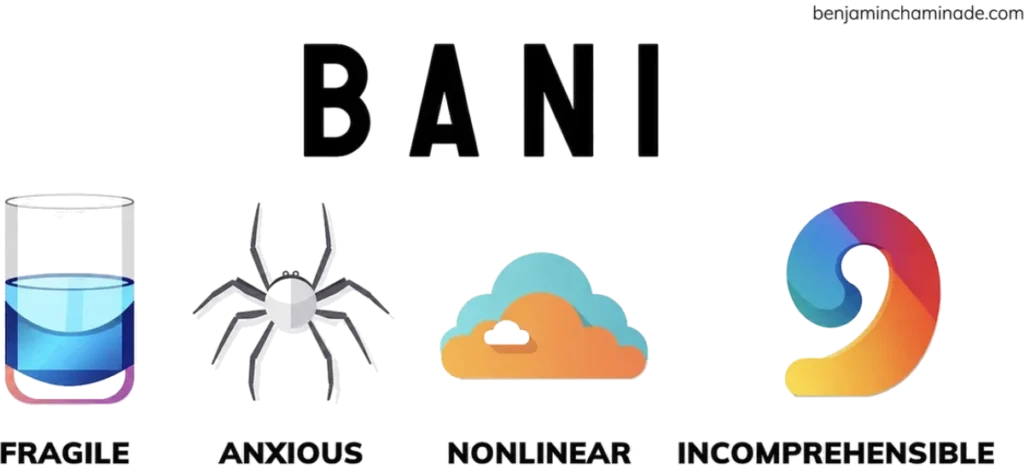
Brittle describes something that holds until it shatters, with no warning stage in between. Anxious describes a standing state of apprehension rather than a spike. Non-linear describes outcomes disconnected in size and timing from their causes. Incomprehensible describes situations that resist explanation even after the fact.
Read those four definitions again and notice something. Three of them describe a system, and one of them describes a nervous system.
Anxious is doing different work from the other three, and nobody in the field seems to find that odd. A bridge can be brittle. A market can behave non-linearly. Neither of them can be anxious.
Hold on to that anomaly, because it is the loose thread. Pull it and the whole framework turns inside out, which is what happens further down this page.
What Cascio actually proposed
Cascio put BANI forward as a way of describing chaos, from the standpoint of a futurist rather than a management theorist. His concern was that existing language had stopped helping people make sense of what they were living through. He offered a vocabulary and explicitly left the operating response to others.
That last point gets lost the moment the framework enters a training catalogue. Cascio wrote about human responses to a BANI world, and the emphasis on human sits in the title of his own piece.
The German consultant Stephan Grabmeier did most of the work of popularising the acronym in management circles from 2020 onwards, which is worth knowing because it explains the shape of the material you find today. A foresight concept was carried into management by people selling management programs.
I set out my own reading of the four letters, including the four illusions each one breaks, in a separate article.
Why the successor framing is wrong
BANI is routinely presented as the framework that replaces VUCA, and the two describe different objects. VUCA describes the external environment and the forces acting on it. BANI describes the experience of standing inside that environment. Treating one as the successor of the other discards information rather than adding any.
The replacement story sells better, which is most of why it circulates. An acronym presented as an update creates an obligation to buy the update.
It also produces a specific and expensive error. An organisation that has replaced its environmental analysis with an emotional vocabulary has stopped studying its exposure and started describing its mood.
I keep both, and I use them for different jobs. The environmental reading belongs in my pillar on VUCA leadership and where decisions are made, and the human reading belongs here.
Why the acronym travelled so fast
BANI spread through management circles faster than almost any framework of the past decade, and the speed is worth explaining, because it says something about what the market was looking for. The acronym arrived precisely when a global disruption had made every existing plan look naive, and it gave people permission to say so.
That is a genuine service and I do not want to be sniffy about it. Naming a shared experience is the first step in doing anything about it, and a leadership team with no words for what it is living through will simply pretend nothing is happening.
Notice what the framework offered that its predecessor did not. VUCA asks a leader to analyse an environment, which is work. BANI asks a leader to recognise a feeling, which is relief.
Relief spreads faster than work, every time. That is not a criticism of the framework and it is a warning about what happens next, because a concept adopted for the relief it provides tends to stop being examined the moment it has provided it.
The tell is easy to spot in your own organisation. If your people can list the four letters and cannot name a single decision that changed as a result, you bought the relief and skipped the work.
What BANI adds that VUCA genuinely missed
Before taking the framework apart, it deserves its due, because BANI corrects two real weaknesses in the older vocabulary. It puts the human cost of disruption inside the analysis rather than beside it, and it replaces a word describing movement with a word describing failure. Both changes are improvements and neither is cosmetic.
The emotional cost was never in the older frame
VUCA has no vocabulary for what disruption does to people. Its four words describe an environment competently and stop there, which left a generation of managers with a rigorous account of their market and no language at all for the state of the humans inside it. BANI puts anxious in the acronym itself.
That single inclusion changes what a leadership team is allowed to discuss. A word in a framework is a permission slip, and executives who would never raise the emotional temperature of the organisation as an agenda item will happily discuss the A in a model.
The Australian data makes the omission look serious in hindsight. Psychological injury claims growing 161 per cent over a decade, with median time off work almost five times longer than for other injuries, describes a cost that no environmental framework was ever going to surface.
So the framework earns its place on that count alone. Whatever else I argue on this page, the letter that pushed the human cost into a management conversation did something useful.
Brittle is a sharper word than volatile
Volatility describes movement, and movement is survivable if you can see it. Brittleness describes something entirely different, a system that gives no signal at all until it fails completely. The second is a far more accurate description of how modern organisational failures actually arrive.
Think about how the failures you have witnessed presented themselves. Very few organisations wobble visibly for two years and then fall over, which is what volatility would predict.
They look fine, they report reasonable numbers, and then a single supplier, a single regulatory decision or a single departure takes out something nobody had listed as load-bearing. That is brittleness, and volatility has no word for it.
The management consequence is direct. A volatile system rewards monitoring, since you can watch the movement, while a brittle system rewards structural survey, since there is nothing to watch until it is over.
That distinction alone justifies keeping the word. It also sets up the reframing that follows, because a system is brittle relative to what somebody expected of it, and that expectation belongs to a person.
BANI describes the reader rather than the world
None of the four BANI words names a measurable property of an environment. Each names a relationship between a situation and an observer. Something is brittle relative to expectations of strength, incomprehensible relative to the capacity trying to comprehend it, and anxious only in the person doing the looking. The framework is a mirror presented as a window.
Four words that need an observer to mean anything
Test each word by trying to measure it without a human present. Brittleness in engineering has a definition, and organisational brittleness has none, because it means that something broke sooner than someone expected. Remove the expectation and the word empties out.
Non-linearity behaves the same way in practice, even though it has a clean mathematical definition. Calling a business outcome non-linear says that the result surprised the person modelling it.
Incomprehensible is the most obvious of the four, since comprehension requires somebody doing the comprehending. A situation is incomprehensible to a reader, in the same way a text is illegible to a reader.
And anxious never even pretended. It was always a description of a person, sitting undisguised in the middle of an acronym everyone reads as a description of the market.
What follows once you accept the reading
If the four letters measure the observer, then a BANI score tells you about the capacity, expectations and mental models of the person reporting it. Two managers in the same organisation, on the same week, will produce different readings. That variance carries information, and the standard interpretation throws it away.
I run this as an exercise and the result is consistent enough to be useful. Ask a leadership team to rate their environment on each letter, privately, then reveal the spread.
The spread is always wide, and it is never random. It maps onto tenure, onto how close each person sits to the operating detail, and above all onto how much authority each person holds to act on what they see.
That last correlation is the one worth chasing. People with the authority to act report a far less incomprehensible world than people with the same information and no authority, which suggests that incomprehensibility is partly a symptom of powerlessness rather than of complexity.
Why this reading makes BANI usable
A framework that measures the environment can only be checked against the environment, which nobody can do reliably. A framework that measures the observer can be checked against the observer, which is straightforward, repeatable and actionable. Reading BANI as a diagnostic of your people turns a slogan into an instrument.
It also changes what you would do about a bad reading. If your people report a highly anxious and incomprehensible world, the environmental interpretation tells you to build resilience and communicate more.
The observer interpretation tells you to look at what those specific people can see, what they are permitted to decide and what they have been trained for. Those three things are inside your control, and the weather is not.
The Australian evidence points the same way. Safe Work Australia’s guidance names high job demands, low job control, poor support and low role clarity among the psychosocial hazards a business must manage, and every one of those is a feature of work design rather than a feature of the market.
How to run the reading with your own team
Running BANI as a diagnostic of your people takes about forty minutes and needs no platform. Each person scores the four letters privately, the scores are revealed together, and the conversation happens about the spread rather than about the average. The average tells you almost nothing and the spread tells you where your organisation actually hurts.
Six steps make it work, and skipping the first two ruins it.
- Define the object being scored. Our market, our division or my own team produce completely different readings, so name one and hold everybody to it.
- Score privately before any discussion, because the first person to speak will otherwise anchor the room.
- Reveal all four scores at once, without names attached, and let the room see the range before anybody explains themselves.
- Start with the widest-spread letter rather than the highest-scoring one, since disagreement carries more information than intensity.
- Ask the two extremes what they can each see that the other cannot, which surfaces the information asymmetry directly.
- Close by asking what each person is permitted to decide about the letter they scored highest, and write the answers down.
Step six is where the exercise stops being interesting and starts being useful. A person reporting a highly incomprehensible world who also holds no authority over it has described a design fault rather than a market condition.
Run it twice a year with the same group and the movement becomes the real measure. A falling incomprehensible score across a team you have given more authority to is the cleanest evidence I know that a structural change actually landed.
The age of fragility, the condition BANI is reporting on
The age of fragility is my frame for a period in which organisational robustness has given way to exposure. BANI reports the sensation and the age of fragility names the condition producing it. The distinction matters operationally, because a sensation can only be described while a condition can be measured, reduced and assigned to somebody accountable.
An environment cannot be brittle, an organisation can
Brittleness is a property of a structure rather than of the weather around it. The same storm meets two buildings and takes one down, and nobody blames the wind for being brittle. Applying the word to the market rather than to the organisation moves the problem somewhere nobody can work on it.
Move it back inside and it becomes tractable immediately. Your exposure is the product of your concentration, your commitment horizons, your approval latency and the number of single points of failure you have accumulated without noticing.
Every one of those four is countable this quarter, without a forecast and without a consultant. I have watched an executive team discover in under an hour that four separate revenue lines rested on the continued goodwill of the same two people.
That is what the age of fragility asks you to look at. Stop grading the storm and survey the building.
The four illusions the fragile world breaks
Each BANI letter corrects a comfortable belief, and reading the acronym as a list of broken illusions is more useful than reading it as a list of conditions. Brittle breaks the illusion of strength, anxious breaks the illusion of control, non-linear breaks the illusion of predictability, and incomprehensible breaks the illusion of knowledge.
Set out that way, the framework stops describing a change in the world and starts describing a change in what we are willing to admit about it.
Systems have always been delicate. Human beings have never been in control. Effects have never been proportionate to causes, and nobody has ever understood the whole picture.
What changed is the availability of evidence that these things are true, delivered continuously and to everybody at once. The world did not become fragile. We ran out of ways to avoid noticing that it always was.
That reading has a consequence people find uncomfortable, and it is the reason I keep the frame. If the fragility was always there, then the organisations now discovering it were exposed for years while reporting good numbers, which means their reporting was measuring the wrong thing.
Robustness measures resist a shock and tell you nothing about the shock you have not imagined. Exposure measures count what you depend on, and they hold regardless of which shock arrives.
What regenerative leadership does with the condition
Regenerative leadership, the practice I develop across this site, is the capacity of an organisation to rebuild capability faster than its environment destroys it. Under fragility, recovery rate matters more than resistance, which reverses where the investment goes. Robustness buys buffers and contingency plans, and regeneration buys speed of rebuilding.
Enableship, my term for the leadership of innovation, sits inside that practice. It concentrates on giving teams the tools and the authority to act without waiting for permission.
Permission-seeking is precisely the behaviour that collapses first under non-linear pressure, because it assumes there will be time to ask. In a genuinely fragile system, the person who has to ask has already missed the window.
You can read more about how I work with executive teams on this in my keynote on regenerative leadership.
Counting your exposure without a forecast
Every measure of fragility that matters is internal, which means none of them requires you to predict anything. That property is what makes the age of fragility workable where the acronym is not, because a forecast can be wrong and a count of your own dependencies cannot. You are measuring the building rather than the storm.
Take concentration first, since it is the fastest to count and the most often wrong. List your revenue lines, your critical processes and your genuinely irreplaceable knowledge, then write a name or a system next to each one.
Count how many times the same name appears. Most executive teams expect a handful of repeats and find a small number of people carrying an alarming share of the organisation, usually people who have never been told.
Commitment horizon comes next, and it is the one finance already knows. How far ahead have you locked spending, contracts and headcount before you could change your mind, and what would it cost to change it anyway.
Approval latency is the elapsed time between somebody seeing something and being allowed to act on it, measured in days rather than in policy. Sample ten real decisions from last quarter instead of reading the delegations schedule, because the schedule describes the intention and the sample describes the organisation.
None of those three exercises needs a consultant, a platform or a scenario. They need somebody senior enough to be told the truthful answer, which is the only genuinely scarce input.
What each BANI letter does to a person
Once you read BANI as a reading of the observer, each letter points at a specific thing happening to a specific person. Brittleness lands on expertise, anxiety lands on the person doing the managing, non-linearity lands on a career, and incomprehensibility lands on judgement. Each has its own article in this series.
Brittle, and what it does to your expertise
Brittleness reaches an individual through their skills. Expertise holds its value and then stops holding it, usually without a visible warning stage, which is exactly the behaviour the word describes. I call the result stable precarity, a state in which nothing appears to be changing while your position quietly stops being defensible.
The cruel part is that depth of expertise increases the exposure rather than reducing it. A person who has specialised narrowly has concentrated their entire professional value in one place, which is a textbook single point of failure.
Travel agents, video rental staff and film developers all held real expertise, and none of them saw a gradual decline. Their skill was fully valuable until the week it was not.
The dedicated article covers the monoculture problem, the difference between physical and economic obsolescence, and what a career portfolio looks like when it is built to survive a break rather than a slope.
Anxious, and what it does to the person managing
Anxiety in a BANI environment concentrates on managers, because a manager absorbs uncertainty on behalf of a team while holding no more information than anyone else. I call the result permanent anxiety, a standing state rather than a response to an event. It is the letter with the clearest measured cost in Australia.
The mechanism is specific and it is rarely named out loud. A manager is asked to convert an unclear situation into clear instructions, every week, using information they know to be incomplete.
Doing that job honestly means carrying the gap privately. Doing it dishonestly means projecting a confidence nobody in the room believes, which costs more.
The dedicated article covers what the Australian work health and safety framework now requires on this, why resilience training arrives in the wrong order, and what a leadership team owes the layer holding the line.
Non-linear, and what it does to a career
Non-linearity reaches an individual through the shape of their working life. Careers used to be described as ladders, which assumes proportionality between effort and progression, and that assumption has quietly stopped holding. I call the result non-linear fragmentation, where a working life becomes a sequence of loosely connected episodes.
The consequence that surprises people is that the linear career has become the unusual one. A continuous upward path through a single field is now the atypical profile rather than the standard against which others are measured.
Recruitment has not caught up, and that gap is where the value sits. Selection processes still reward legible progression, which means capable people with fragmented histories get filtered out by organisations that badly need exactly what those histories produced.
The dedicated article covers what breaks in hiring, how to read a fragmented history properly, and what individuals should be building instead of a ladder.
Incomprehensible, and what it does to judgement
Incomprehensibility reaches a manager through contradictory instructions that are each individually reasonable. I call the result extreme paradoxes, situations where two opposite demands are both legitimate and both binding. The manager is asked to resolve something that has no resolution, then judged on the resolution.
Give autonomy and maintain control. Innovate and keep operations stable. Delegate and stay involved. Be close to your team and keep professional distance. Be transparent and respect confidentiality.
Every one of those pairs is real, and every one of them arrives as an instruction rather than as an acknowledged tension. The damage comes from the pretence that a correct answer exists.
The dedicated article works through ten of these pairs and how to hold each one, which is a different job from the conceptual treatment of contradiction I give in dealing with ambiguity.
The four modes of leadership, and why almost nobody switches
If BANI measures the observer, the useful instrument is one that locates where an observer operates. David Wilkinson’s Modes of Leadership does exactly that, sorting leaders into four modes by how much ambiguity they can hold. Published in The Ambiguity Advantage in 2006 and grounded in research at Cranfield University, it names four registers rather than four personality types.
I use it because it survives contact with a real leadership team, and because a mode is something you can change on a Tuesday. Note that Wilkinson’s framework is about tolerance for ambiguity rather than about seniority, so a mode four operator can sit three levels below a mode one executive.
Modes one and two, where most organisations live
A mode one leader believes they hold the answers and the authority to enforce them, and treats ambiguity as something to shut down. A mode two leader has softened the delivery without raising the ceiling, coordinating rather than commanding while still equating stability with success. Both modes read a BANI environment as a threat to be contained.
Mode one has a signature that is easy to spot from outside. The leader recruits people who agree with them, which produces a room where dissent has no route in.
The Challenger launch decision remains the reference case, because engineers with genuine concerns about the booster joints were pushed into silence by a process that had no way of hearing them. Nobody in that room lacked expertise, and the mode of leadership around them made the expertise unusable.
Mode two is the one to watch in your own organisation, because it looks healthy. A leader who consults everybody, tolerates no real conflict and cannot make an unpopular call will coordinate a team into exhaustion while everyone reports feeling included.
Modes three and four, where ambiguity becomes usable
A mode three leader treats conflict, risk and failure as expected features of the work rather than as faults to eliminate. A mode four leader operates generatively, learning new mental models quickly, discarding outdated ones just as quickly, and stepping back from people who no longer need supervision. Mode four is where BANI leadership stops being vocabulary.
Mode three shows up as deliberately manufactured friction. Running two teams at the same problem, or appointing someone whose explicit job is to argue the opposite case, produces better answers than asking a single group for consensus.
Mode four is rare, and the reason is worth stating plainly. It requires unlearning years of hard-won expertise, and unlearning costs far more psychologically than learning does, because what you are giving up is the thing that got you promoted.
Notice how this connects back to the first letter. A mode four leader is deliberately dismantling the specialisation that stable precarity makes dangerous, which means the two ideas are the same idea seen from different ends.
Switching speed matters more than which mode you prefer
No mode is correct in every situation, and a crisis genuinely can call for mode one. What separates a capable leader from a stuck one is the speed of moving between modes on purpose. Most managers hold a single default that becomes visible precisely when pressure arrives, which is the worst possible moment to discover it.
Three things determine whether switching is available to someone.
- Whether they can name the mode they are currently in, which almost nobody can without being taught.
- Whether the organisation has ever rewarded a mode other than the one it defaults to.
- Whether they have enough capacity left to choose, since a manager at the limit of their load will always fall to their default.
The third condition is the one Australian organisations should read carefully. A leadership population operating at its limit has no switching capacity, whatever the training budget says, which brings the psychosocial data at the top of this page back into the argument as a leadership constraint rather than a wellbeing footnote.
The mode your organisation actually rewards
Every organisation rewards one mode more than the others, usually without deciding to. That preference is visible in who gets promoted, and it overrides any amount of leadership development, because managers read promotions as the real curriculum. A company that trains for mode four and promotes mode one has trained nothing.
Finding your organisation’s preference takes one meeting and a list. Take your last ten promotions into management roles and describe, in a sentence each, what the person was visibly known for at the time.
The words that repeat give you the answer. Decisive, safe pair of hands and delivers under pressure describe mode one. Collaborative, brings people with them and great stakeholder manager describe mode two.
Mode three and mode four have almost no promotion vocabulary in most organisations, which tells you something. When a language has no words for a behaviour, that behaviour does not get selected for.
Fixing this is cheaper than any program and considerably harder politically. Write the mode three and mode four behaviours into your promotion criteria in plain language, then promote somebody on them and say so out loud.
I have watched that single act change a manager population faster than a year of workshops, because it answers the only question managers are really asking, which is what this place actually wants from me.
Field note
The team leader who found her default in twenty minutes
During a management workshop with a mid-sized professional services firm, one team leader arrived certain that her biggest challenge was a difficult direct report. She described the person at length, and she described herself as collaborative and open. Twenty minutes in, running a live scenario built around a missed deadline, she went straight to mode one. Assign the blame, issue the instruction, move on.
I stopped the room and asked what had just happened, and nobody wanted to say it out loud, including her. So I ran the same scenario a second time with one change. Before she responded, she had to name the mode she was choosing. She paused, said mode three out loud, then asked the direct report two questions instead of issuing one instruction. Same person, same problem, same room, four minutes apart, and a completely different conversation.
The gap between a manager’s stated style and their default under pressure only appears when you apply the pressure, so build the pressure into the session rather than asking people to self-assess. Naming the mode out loud before acting is the cheapest switching mechanism I have found, and it costs a sentence.
Find out which mode you fall back on
Want to know where your own default sits before your next hard week? Take my curiosity test and get your five dimensions scored, then use the result to work out which mode your exploring habits actually support.
How to choose a BANI leadership approach against your own criteria
Three investments get proposed once BANI reaches a board agenda, and they solve different problems. Awareness training changes vocabulary, resilience programs change what individuals absorb, and mode work changes what a manager can actually do under pressure. Choose against the symptom you can evidence rather than the one that is easiest to describe upwards.
Comparing the three investments on explicit criteria
Read across from the symptom column and be honest about which line your managers would pick if asked anonymously. The last column is the one that catches people, because each approach fails in a specific and predictable way, and choosing well means choosing the failure you can live with.
| Investment | What it changes | Symptom it fits | Managerial maturity required | How it fails |
|---|---|---|---|---|
| Awareness training on BANI or VUCA | Shared vocabulary for describing the environment | Teams have no common language for what is happening to them | Low, it can be scheduled without structural change | Energy in the room, no change in behaviour six weeks later |
| Resilience and wellbeing programs | Individual capacity to absorb and recover from load | Fatigue and turnover with no end date in sight | Low to medium, mostly investment and consistency | Reads as an instruction to cope better when the load is structural |
| Mode work and decision authority | What a manager can choose to do when pressure arrives | Capable managers default to command or to endless consultation | High, it needs executives willing to reward an unfamiliar mode | Fails outright where managers have no spare capacity to choose |
One warning about the second row, because it matters under Australian work health and safety duties. Training and support cannot be the dominant control where the work design itself is producing the harm, so a resilience offer that arrives before any structural change signals that no structural change is coming.
The signals that tell you which one to fund first
Three signals settle it. If your managers cannot describe what is happening to them, fund awareness. If they can describe it, act on it, and arrive at Friday with nothing left, fund the load before anything else. And if they have capacity and still default to one register under pressure, fund mode work.
A fourth signal cuts across the other three and I watch for it first. Rising voluntary turnover among your strongest mid-level managers points at a maturity and load problem inside the organisation rather than at a hot market.
Repeated escalation of decisions that should sit two levels down points the same way. It looks like diligence and it is usually a mode two default wearing a diligence costume.
Whichever you choose, buy it against a written symptom. An approach purchased against a symptom can be evaluated, and an approach purchased against a mood can only be renewed.
What the first ninety days should actually contain
A BANI leadership program that produces nothing usually failed in its first quarter, by starting with content rather than with a measurement. Ninety days is enough to establish where your managers operate, remove one structural load and prove that a second mode gets rewarded. Content without those three things has nowhere to land.
In the first month, measure. Run the four-letter reading across the manager population, sample your approval latency, and ask one question about capacity that people can answer honestly and anonymously.
In the second month, remove something. Pick the heaviest structural load the measurement surfaced, take it away from the manager layer, and say publicly that this is what you did and why.
In the third month, reward an unfamiliar mode. Find a manager who held a decision open longer than your culture normally tolerates, or who let a team work out an answer rather than supplying one, and make that visible at the level where promotions get discussed.
That third move is the one organisations skip, and it is the one that decides whether any of it survives. Managers read what gets rewarded far more accurately than they read what gets trained, and a single promotion contradicts a year of workshops.
Rewarding the manager who gave a decision away is the same correction I describe in leading through disruption, where the reward system decides whether the shift ever reaches the middle of the organisation.
How I can help you build BANI leadership in your organisation
I work with executive teams, boards and manager communities on leading in the age of fragility, in English and in French. My work is built to put managers back into motion with a clear read on their default mode and a practised route to another one, rather than to reassure them that the environment is difficult.
Keynotes on BANI and the age of fragility
I deliver a keynote on BANI leadership and the age of fragility that gives your managers something usable on Monday morning, without the jargon and without the miracle cure. It works best when it closes with every table naming the mode they fall back on.
Formats run from a short keynote to a half day with facilitated work between segments, in person or remotely.
Workshops on managerial modes and transformation
Over a half day or two days we diagnose where your managers currently operate, run live scenarios under real pressure, and build the naming habit that makes switching possible. My managerial transformation workshop is where that work usually sits.
Teams leave with their own mode map and one structural change identified, since capability without capacity produces nothing.
A diagnostic before you commit budget
I run a short diagnostic built from my own tools to identify the cultural blockers stopping your managers from moving up a mode, including the exercise where a leadership team rates its own environment on the four letters and compares the spread.
It is the fastest way to find out whether you need a keynote, a workshop or a structural conversation, and it usually saves more budget than it costs.
My full treatment of managing through VUCA and BANI is available in book form, published in French by GERESO. Click the image to order a copy.
Conclusion: BANI leadership is a reading of the people you lead
BANI will keep circulating in decks and keynotes for a while yet, and that is fine. Use it to name what people are experiencing. Stop expecting it to tell you anything about the environment that a proper look at your own exposure would not tell you faster.
The four letters have been measuring the observer since the day they were written, and the anxious sitting openly in the middle of the acronym has been telling everyone so. Once you accept that, the framework becomes an instrument you can actually use, because you can survey the person and you cannot survey the weather.
So run the reading on your own leadership team. Collect the four scores privately, reveal the spread, and pay attention to who reports the most incomprehensible world, because it will not be the people with the least information.
Then work the condition rather than the sensation. Survey your concentration, your commitment horizons, your approval latency and your single points of failure, and give your managers enough capacity to choose a mode rather than fall into one.
The organisations that come through this period well will not be the ones with the best slogan about resilience. They will be the ones whose managers can name the mode they are in on a bad Tuesday and choose a different one on purpose, which is the whole of what BANI leadership amounts to once the acronym contest is over.
The four letters, one article each.
Frequently asked questions about BANI leadership
What does BANI stand for?
BANI stands for brittle, anxious, non-linear and incomprehensible. Futurist Jamais Cascio proposed it in 2020 through the Institute for the Future to describe conditions he judged beyond what VUCA could capture. It names a state of affairs and deliberately leaves the response to the reader.
Has BANI replaced VUCA?
The two describe different objects, so neither replaces the other. VUCA describes the external environment and the forces acting on it, while BANI describes the experience of standing inside that environment. Using only one of them means either studying your exposure or describing your mood.
Why is anxious the odd word in BANI?
Brittle, non-linear and incomprehensible sound like properties of systems, while anxious can only describe a person. That anomaly is the clue to what the acronym is really doing, since all four words in fact require an observer and only one of them admits it openly.
How do I know which leadership mode I default to?
Your default appears under pressure rather than in a calm self-assessment. Watch your own first response the next time a deadline slips or a plan changes without warning, since that reaction reveals the register you actually operate from, whatever your stated style.
Is BANI leadership training worth funding?
Awareness training is worth funding when teams lack a shared language for what they are experiencing, and it changes little on its own. Work on switching between leadership modes changes behaviour, provided managers have enough spare capacity to choose rather than fall back on a default.