Ask a senior talent leader what has to change in the next three years and the list arrives quickly: artificial intelligence, skills shortages, restructures and a workforce that expects more from work than it used to. Each item on that list is real. None of them tells you what the leader should do differently on Monday.
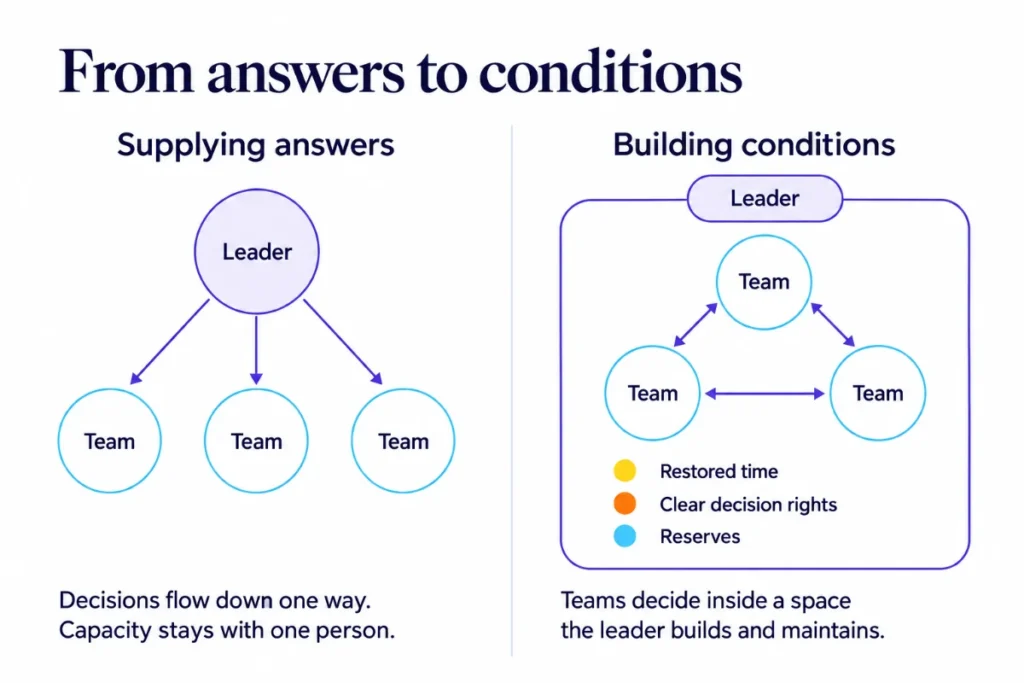
My answer is simple to state and demanding to practise. The biggest shift is a change in what leaders contribute: from supplying answers to building the conditions in which other people find them. Leading through disruption becomes the work of making the future concrete enough to act on, and of making sure people have the room to act.
Key takeaway
The biggest leadership shift of the next three years
The biggest shift is a change of contribution. Talent executives move from supplying answers to building the conditions in which teams find them: a direction made concrete through dated commitments, capacity restored before more change is asked for, and decisions moved closer to the people doing the work.
- Translate the vision into three dated commitments, each with an owner and a place where staff can check progress.
- Stop one activity before starting the next initiative, and say publicly what the freed time is for.
- Move one recurring decision down a level every quarter, then review the team’s decisions.
- Recruit and promote leaders on the autonomy their teams gained under them.
How to know it is working: track time to first initiative, meaning the days between a significant change and the first new idea a team proposes on its own.
This article sets out why that shift matters now, what it looks like in practice, where to invest your leadership effort and how to begin within a single quarter.
| THE PRESSURE | THE SHIFT | WHAT IT UNLOCKS |
|---|---|---|
| More change than answersLeading through disruption now means guiding people through technology, skills and structural change at the same time, often faster than any leader can supply certainty about the outcome. | From answers to conditionsThe leader’s main contribution moves from knowing the answer to creating the conditions in which teams can find and apply it: a concrete direction, dated commitments and restored capacity to act. | Purpose people can checkThe approach set out here treats purpose as credible once it can be verified against visible progress, and treats enableship, the leadership of innovation, as the practice that turns disruption into momentum. |
The shift: from supplying answers to building conditions
For most of the last century, a senior leader earned authority by knowing more than the people around them. That advantage shrinks when knowledge is abundant and changes quickly. The contribution that remains scarce is the ability to create an environment where capable people can move with confidence.
Why answers stopped being the leader’s main contribution
The technology shaping the next three years is more likely to extend people than to replace them. Jobs and Skills Australia, the Commonwealth body that analyses the national labour market, found in its generative AI capacity study that the technology is more likely to augment jobs than to replace them, with no clear evidence yet of entry level roles declining because of it.
Movement between occupations is also a normal feature of the Australian workforce. The same study puts it at about 15 per cent of workers changing occupation from one year to the next, well before generative tools arrived. People have been adapting at scale for a long time, and they are better at it than most transformation plans assume.
Employers are drawing the practical conclusion. Australian organisations now rate adaptability and learning agility as exactly as critical as technical and AI skills for the next two to three years, according to the Australian HR Institute, the professional body for Australian HR, in its March 2026 survey of 612 senior decision makers.
Adaptability is a property of teams in an environment, and leaders design that environment. Their authority now comes from the quality of the conditions they build.
I have made a related case about why the management of tomorrow is better built than forecast. I have also separated the three traditions the word disruption comes from in disruption, definition and state of play.
Enableship, the name for the work that replaces them
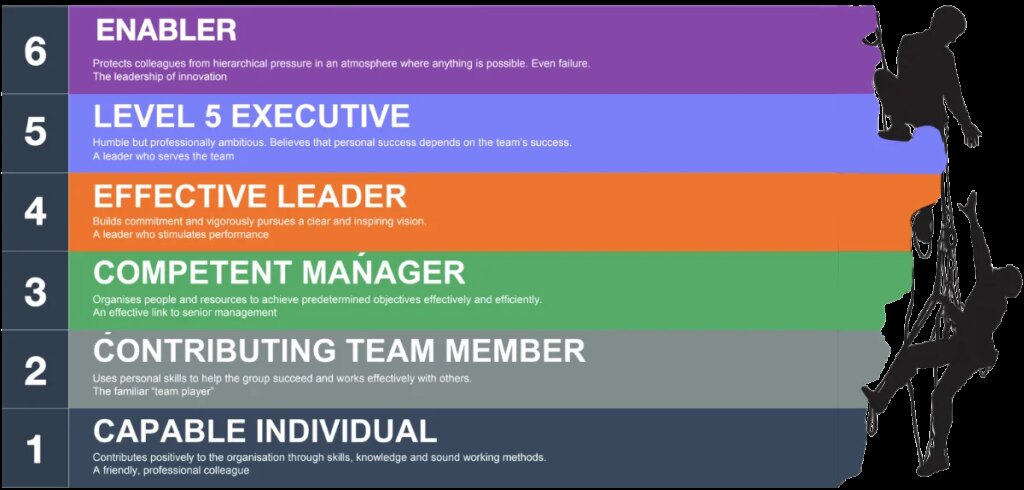
Enableship is the leadership of innovation, a frame I developed to describe leaders whose contribution is measured by the autonomy other people gain. It sits inside regenerative leadership, the practice of leaving the people, relationships and resources used by the work in better condition than they were found.
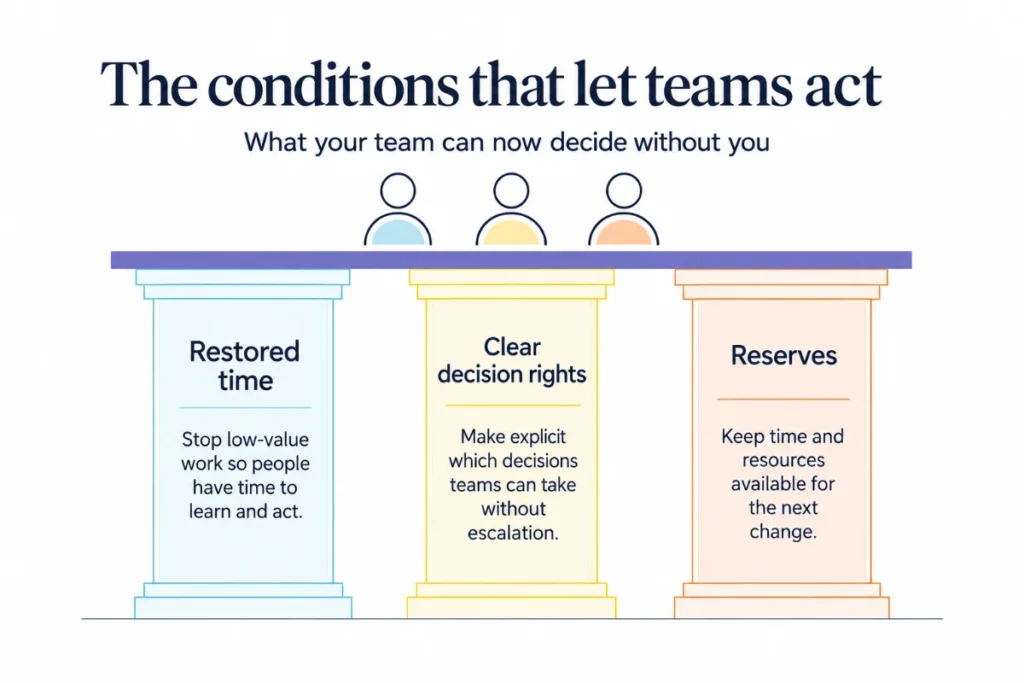
The practical test is a single question. Instead of asking what your team delivered this quarter, you ask what your team can now decide without you. That question changes promotion criteria, the design of leadership programs and the way executive teams spend their own time.
Leaders who adopt it report the same experience: less time spent reassuring, more time spent removing obstacles. The team’s confidence grows because its own capability becomes visible to it.
What changes in the talent executive’s own role
Talent executives hold the levers that make this shift stick, because they shape who becomes a leader and what leaders are rewarded for. Three of those levers deserve attention first: recruitment, promotion and leadership development.
Recruitment can assess leaders on the autonomy they created in their previous team, asking candidates which decisions their people took without them and how that changed over time. Promotion can reward managers whose teams grew more capable, which sends a clear signal about what the organisation values.
Leadership development has the most room to grow. Australian employers rate team development as critical for 39 per cent of their leaders, while 35 per cent report that their leaders are not yet fully proficient in it, according to the same Australian HR Institute survey. That gap is the opportunity: programs built around enabling teams address the capability employers themselves say matters most.
How purpose becomes something people can act on
Purpose moves people when it connects a direction to a next step they can see. A statement about the future earns belief once people can check it against progress, and that check is what converts uncertainty into energy.
What leading through disruption looks like when the future is made concrete
Leading through disruption starts with translating the direction into dated commitments. “We invest in our people” gives nobody anything to hold. “Every team member completes five days of paid development before 30 June, and we publish the completion rate” gives everyone a promise they can watch being kept.
A purpose statement becomes credible at the point where it could be shown wrong in public. That exposure is what makes it believable, because it signals that the leader is prepared to be held to it.
Three commitments of that kind, each with a date and an owner, do more for a workforce’s sense of direction than any vision statement. They give people a rhythm of evidence, and evidence is what lets a team trust the next announcement.
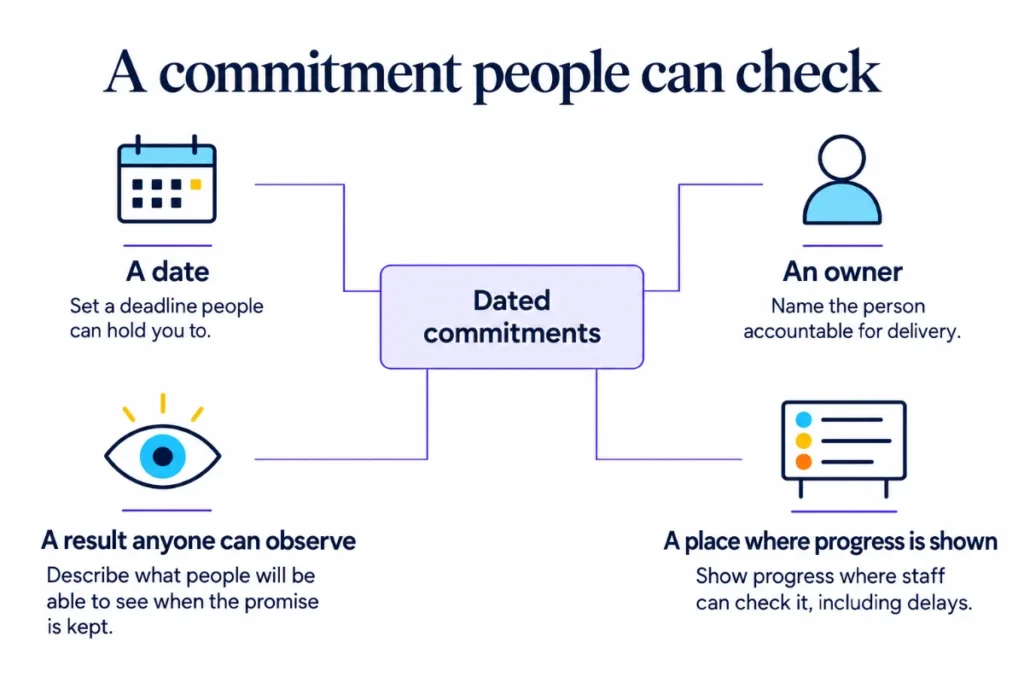
A good commitment has four features: a date, an owner, a result anyone can observe and a place where progress is shown. Commitments without all four slide back into intentions, and people recognise intentions immediately.
Why people commit to a direction they can check
Change becomes manageable when people can locate themselves in it. They want to know what is happening next, who is deciding and when they will hear, and those answers matter more to them than the grand narrative.
Leaders who answer those questions early, including with “we do not know yet, and we will tell you by this date”, build a surprising amount of goodwill. An honest date beats a confident promise every time, because the date can be kept.
Restoring capacity before asking for more change
Every transformation draws on the same reserve of time, attention and goodwill. When Australian employers are asked what blocks upskilling, the leading answer is a lack of time and workload pressure, named by four employers in ten, ahead of budget.
That finding points to an encouraging lever. Capacity can be restored deliberately, by stopping something before starting something new, and teams respond to that gesture with renewed energy. An organisation absorbs as much change as it has restored capacity to absorb, a working rule I apply in every engagement.
The items that leadership teams most often stop, once they look, tend to be familiar:
- reports that are produced every month and read by nobody who acts on them
- approval steps that duplicate a decision already taken one level down
- recurring meetings whose purpose ended with the project that created them
- pilot programs that were never closed, and still consume attention
Stopping any one of them frees hours that people can see, and that visibility matters as much as the hours themselves.
The same logic sits behind my argument that real robustness is measured by the reserves an organisation holds. Reserves give people the confidence to try.
Field note
Three dates on a whiteboard
A services group asked me to help its leadership team prepare the workforce for an automation program. The team had a polished vision presentation and a communication plan, and engagement was sliding anyway. People had heard the vision several times and still had no idea what would change for them, or when.
We set the presentation aside and asked the executives to write three commitments on a whiteboard, each with a date, an owner and a way for staff to check progress. One committed to publishing which roles the program would touch within six weeks. Another committed to protected development time for every affected team. The third committed to a monthly open session where progress against the first two would be shown, including delays.
People commit to a direction when they can see it being delivered. Replace part of the vision with a few dated, checkable commitments, show progress against them in public, and the organisation’s energy returns before the transformation itself has moved very far.
How to choose where to put your leadership effort
Leaders facing disruption can invest in three kinds of response: communication, capability and conditions. All three have value, and they pay off at different speeds. Choosing the balance deliberately is one of the most useful decisions an executive team can make this year.
Communication, capability or conditions, and what each one delivers
| Response | What it delivers | Where it needs support | Signal it is working |
|---|---|---|---|
| Communication: roadshows, purpose statements and town halls | A shared story and a visible executive presence | It holds when each message is backed by a dated commitment people can check | Staff can repeat the next milestone and its date |
| Capability: skills academies, AI training and leadership programs | New options for people and a measurable lift in proficiency | It lands when calendars leave room to apply what was learned | New skills show up in real assignments within a quarter |
| Conditions: restored time, clear decision rights and reserves | The ability to absorb the next change with energy intact | It needs an executive team willing to name what stops | Teams take decisions they used to escalate |
A practical way to use the table is to score your last three leadership investments against it. Executive teams often discover that their spend sits almost entirely in the first two rows, which explains why well-designed programs deliver less than expected: the skills arrive, and the room to use them does not.
Most organisations I work with have invested well in the first two and have room to grow in the third. That makes conditions the fastest source of improvement, and usually the least expensive.
Artificial intelligence tests that third row directly, because the licences arrive whether or not anybody has protected the time to rework the process around them. I set out the conditions that decide the result in your AI tools are ready and your organisation is not.
Capability investment also pays off best when it matches the stage an organisation has reached, which is the argument I set out in my skills maturity model and how to map the curve.
Four criteria to test any leadership investment
Before committing budget, run each proposal through four questions. Each can be answered in one meeting:
- Does it widen what a manager can decide on Monday morning?
- Does it produce a dated result that somebody outside the program can check?
- Does it give time back, or at least avoid adding to the workload that already limits learning?
- Will it continue if the executive who sponsored it moves on?
A proposal that passes all four is rare and worth backing generously. A proposal that fails the third one deserves a second look at its timing rather than outright rejection.
Where to begin in the next ninety days
The shift does not require a new program. It starts with a handful of visible moves in a single quarter, chosen so that people can see the difference quickly.
Three moves for the first quarter
- Write three dated commitments about the change ahead, each with an owner and a way for staff to check progress, and publish them.
- Name one activity the leadership team will stop this quarter to create room, and say publicly what the time will be used for.
- Move one recurring decision down a level, then review after ninety days what the team decided and what it learned.
Each move is small enough to start this week. Together they signal a different kind of leadership, and teams notice within weeks.
The order matters. Commitments come first because they give people something to watch, the stop list second because it creates the room, and the decision moved down a level third because it shows the organisation trusts its teams with the space it has just made.
That third move is also where most leadership programs stop short, because the diagnosis travels through the organisation while the decision rights stay where they were. I set out that gap and the six steps that close it in VUCA leadership, what the doctrine really said.
The obstacle worth naming before you start
One obstacle blocks this shift more often than any other, and it sits with the managers in the middle. A manager who releases a decision, a person or a piece of scope loses capacity straight away, and gains recognition much later, if at all. That arithmetic pushes them to hold on, whatever the leadership message says.
Correcting it costs a line in the reward system rather than a program. Name the managers who gave a decision away or developed somebody into a bigger role, do it publicly at the moment you announce the shift, and the arithmetic changes. Executive teams that skip this step usually watch their three moves stall at the same level of the organisation.
Questions that show whether the shift is happening
These questions work well at the start of an executive meeting, and the answers improve visibly as the shift takes hold:
- How many days pass between a significant change and the first new idea proposed by a team?
- Which decisions moved down a level in the past twelve months?
- Which of our current commitments about the future of work can staff check today?
- What did we stop doing this year to make room for what we started?
- Who in the executive team can say “I do not know yet” and give a date for the answer?
The first question is the one I would bring to a board. Time to first initiative after a change measures the confidence of an organisation more directly than any annual survey.
Want to lead across more than one time horizon?
Give your leadership team a frame for the short, medium and long term at once. Explore my method on the three temporalities of regenerative leadership and choose the horizon each decision really belongs to.
How I can help you make this shift
I work with executive teams and leadership communities on the conditions that let change land well, through keynotes, workshops and diagnostics. The sequence stays the same in every format: make the direction concrete, restore capacity and then build capability.
Keynotes that give a leadership team one vocabulary
My keynotes on the age of fragility, regenerative leadership and enableship give a leadership population a shared language in ninety minutes. The age of fragility is the frame I use in place of VUCA and BANI, for a period where change is continuous and the decisive variable is how quickly an organisation recovers its energy. I compare those two older frames side by side in my comparison of VUCA and BANI.
I deliver these sessions for conferences, leadership summits and manager communities across Australia, with the Australian evidence base built in.
Workshops that turn direction into dated commitments
The workshop format takes a leadership team from its current vision to three dated commitments, a stop list and a first decision moved down a level. The output is something your people can check within ninety days.
For organisations that want a baseline first, my invulnerability diagnostics measure reserves, dependencies and recovery capacity across the business.
Conclusion: the shift is a change of contribution
The next three years will bring more change than any leader can predict, and that is good news for leaders willing to change what they contribute. Build the conditions, make the future concrete with dated commitments and restore the capacity your people need to act.
Teams led this way do more than cope. They find their own answers, faster than any executive could supply them, and that is what leading through disruption with purpose looks like in practice.
Frequently asked questions about leading through disruption
What is the biggest leadership shift needed in the next three years?
The move from supplying answers to building the conditions in which teams find them. In practice that means making the direction concrete with dated commitments, restoring capacity before asking for more change and widening the decisions teams can take without escalating.
How do you keep a team motivated through constant change?
Give people a next step they can see and a date they can hold you to. Pair every new demand with something the team stops doing, and show progress against commitments in public, including delays. Visible delivery sustains energy better than repeated reassurance.
How can purpose help people through uncertainty?
Purpose helps when it connects a direction to checkable progress. Leading through disruption with purpose means translating the vision into a few dated commitments with owners, so people can watch the future being built and place themselves in it.
What should a talent executive measure beyond engagement?
Time to first initiative after a change, meaning the days between a significant event and the first unprompted new proposal from a team. It can be collected without a survey and it shows how quickly an organisation regains its confidence.